Field Brief Summary (G-12): Under the NFIP Standard Flood Insurance Policy (SFIP Dwelling Form Sections VII.G.3-G.5), personal property is settled at Actual Cash Value up to policy sublimits and forfeited if discarded unrecorded: every item must be photographed in place with waterline proof and logged with quantity, description, ACV, and loss amount inside the strict 60-day Proof of Loss window before disposal.
.md twin for G-12.
The dumpster is the deadline nobody puts on the job board.
On a flood loss, mitigation wants the wet contents out — fast, for good reasons: floodwater is contaminated, materials keep deteriorating, and the policy obligates the policyholder to prevent further damage. But on an NFIP claim, everything that leaves the building undocumented leaves the claim undocumented with it. The Standard Flood Insurance Policy does not ask the carrier to reconstruct what was in the house. It asks the policyholder to prove it — in writing, with photographs, inside a 60-day clock.
What the policy actually requires
Two clauses in the SFIP Dwelling Form do the work:
- Section VII.G.3 requires an inventory of the damaged property showing the quantity, description, actual cash value, and the amount of loss — with bills and receipts attached.
- Section VII.G.4 requires a signed and sworn Proof of Loss within 60 days after the loss, and the inventory rides inside it: quantity, description, ACV, amount of loss for the damaged personal property.
Two details operators get wrong. First, the clock runs from the date of loss — not from the day the claim was reported, and not from the adjuster’s visit. Second, Section VII.G.5 makes the number the policyholder’s own: in completing the Proof of Loss, the insured must use their own judgment on the amount of loss and justify it. The adjuster’s estimate is not the Proof of Loss, and waiting for it does not stop the clock. FEMA can extend the deadline by written bulletin after a declared disaster — it happens — but an extension is never something to assume; it has to be confirmed for the specific event. Federal courts enforce the SFIP’s terms strictly, because the policy is a federal contract. A late Proof of Loss can forfeit amounts that were otherwise fully documented.
A supplemental Proof of Loss can be filed later for damage discovered after the first one. The clock does not reset for it.
Why “before disposal” is the whole ballgame
The disputes on flood contents claims are predictable, because adjusters and public adjusters name the same list: depreciation applied to contents, the height of the waterline, pre-existing condition — and items not specifically listed in a contents inventory. That fourth one is the only dispute that is entirely self-inflicted, and it is decided at the curb, on disposal day, weeks before the Proof of Loss is drafted.
An item that was photographed in place, written down with its fields, and then removed can still be argued about — its value, its age, its depreciation. An item that was hauled out unrecorded cannot be argued about at all. There is nothing to argue from.
The sequence that protects the claim:
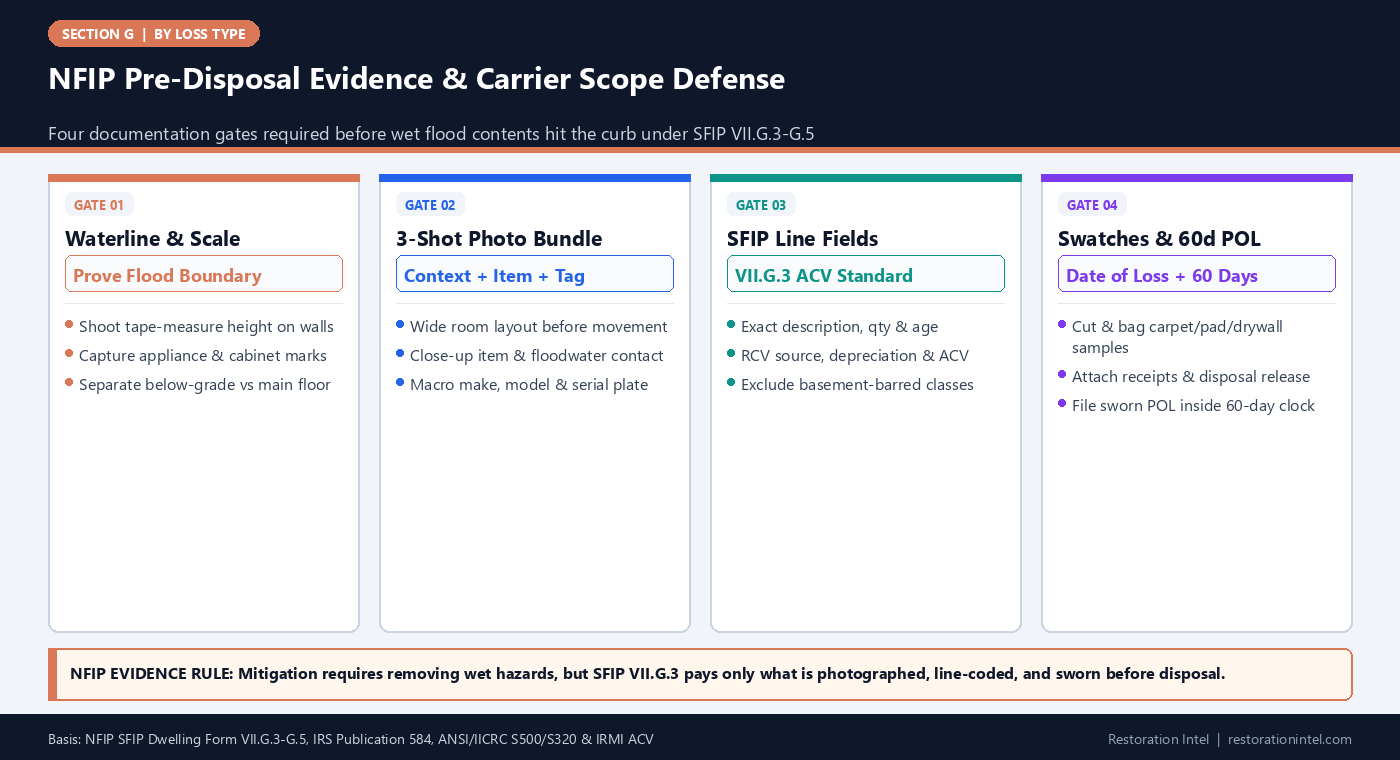
- Photograph the waterline first — on walls, doors, cabinets, and appliances, inside and out, with something in frame for scale, before anything is moved. The waterline is the boundary of the loss.
- Work room by room. Photograph each item in place, then write its line before it moves: description, quantity, approximate age, purchase price if known, and make, model, and serial number for appliances and equipment — the fields FEMA’s claims guidance asks for.
- Then dispose. Mitigation is a policy duty too; the inventory is what lets both duties be true at once. Document the mitigation itself as you go.
- Hold samples. Cut-outs of carpet, pad, flooring, and drywall, labeled by room, give the adjuster something physical to verify after the material is gone. Anything that isn’t a health hazard ideally stays until the adjuster has seen it; samples and photographs are the bridge when it can’t.
The fields are the deliverable
A photograph of a ruined sofa proves a sofa existed. The claim pays on the line: what it was, how many, what it was worth in actual cash value, and what the loss amount is. NFIP contents are paid at actual cash value — depreciated, with no recoverable-depreciation holdback to win back later — and contents coverage is a separate limit the policyholder had to buy ($100,000 maximum on a residential policy; building-only policies have no contents coverage at all). Every vague line is valued at the floor of its range, and every missing line is valued at zero.
That is also where this connects to the standing argument on this site about pack-outs: a pack-out record is not a priced inventory. The NFIP version of the same failure is an inventory written after disposal, from memory, in week seven. The standard is identical — a line has to carry enough for someone who never saw the item to price it and defend the price.
The operator’s version
- Day one: waterline photos, room-by-room inventory started, disposal log opened. Nothing leaves without a line and a photo.
- The calendar: Proof of Loss due date — date of loss plus 60 days — goes on the job file the day the loss is reported, next to the other clocks on a flood claim.
- Below grade, flag it early: NFIP sharply limits basement and below-grade contents coverage. Inventory those rooms anyway, but set the customer’s expectation before the number disappoints them.
- Supplements are a process, not a rescue: damage found during repair gets its own documentation and a supplemental Proof of Loss — filed promptly, inside the same discipline.
The claim is won or lost on what the paper says was in the room. Build the paper while the room still exists.
Sources: NFIP Standard Flood Insurance Policy, Dwelling Form §§VII.G.3–G.5; FEMA claims guidance on contents documentation; DCS PIA, “Flood Damage Insurance Claims” (updated November 9, 2026) — “Create a written and photographic inventory of every damaged item before disposal. NFIP requires documentation of damaged contents to pay the claim.” Related on this site: After Isaias: The Claims Clock, the Wind/Flood Split, and the Paperwork That Decides Both and A Pack-Out Record Is Not a Priced Inventory.
NFIP Pre-Disposal Evidence & Carrier Scope Defense
NFIP Flood Contents Scope Justification & Total-Loss Evidence Matrix
How common flood contents disputes arise during carrier and NFIP Write-Your-Own (WYO) review—and the exact pre-disposal evidence packet required to defend ACV recovery and total-loss determinations.
| Common NFIP Dispute Point | Why Carriers Cut or Deny the Line | SFIP / Technical Standard Hook | Pre-Disposal Field Evidence Required | Carrier-Ready File Deliverable |
|---|---|---|---|---|
| Items hauled to curb unrecorded | No proof item existed, was damaged, or sat below the flood waterline | SFIP VII.G.3 burden of proof on policyholder | Wide room shot + close-up flood contact photo + disposal log before haul-out | Room-indexed photo bundle paired 1:1 to inventory line numbers |
| Generic 'sofa' or 'misc electronics' lines | Examiner prices at lowest entry-level comp and maximum depreciation | SFIP VII.G.3 specific description & ACV basis; IRS Pub 584 fields | Macro brand/model/serial plate photo, material specs, and purchase age notes | LKQ replacement comp URL + stated ACV calculation per line |
| Porous furniture cleaning vs total loss | Disagreement over whether floodwater contamination bars restoration | ANSI/IICRC S500 Category 3 floodwater + S320 porous rules | Waterline scale photo above cushion/frame seam + bio-contamination contact note | S500 Cat 3 total-loss justification + non-salvageable owner sign-off |
| Basement / below-grade contents exclusions | Policyholder expects full payout on unscheduled or barred basement items | SFIP Coverage B basement personal-property restrictions | Separate main-floor vs below-grade room tags and mechanical-item serial photos | Segregated basement sub-schedule flagging eligible appliances vs excluded goods |
| Late or unsupported Proof of Loss | Waiting past 60 days for adjuster estimate forfeits undocumented claims | SFIP VII.G.4-G.5 60-day sworn POL from date of loss | Day-1 calendar lock (DOL + 60d), receipts, physical carpet/drywall swatches | Signed sworn Proof of Loss with itemized ACV schedule + supplemental log |
Building the NFIP Pre-Disposal Photo Bundle and Form/Line Evidence Packet
When floodwater recedes and municipal bulk pickup trucks are rolling down the block, crews face intense pressure to clear wet debris to the curb in a single afternoon. Yet an NFIP examiner reviewing the file six weeks later never sees the curb pile—only the evidence bundle attached to the Proof of Loss. Under ANSI/IICRC S500 and ANSI/IICRC S320, overland floodwater is classified as Category 3 grossly contaminated water, which justifies rapid disposal of porous goods for health and safety—provided the documentation bundle captures every proof point before the item leaves the room.
A carrier-defensible pre-disposal packet pairs a standardized three-shot photo sequence with structured worksheet fields aligned to SFIP Section VII.G.3 and IRS Publication 584 loss-workbook conventions. Every damaged item or counted lot carries a room code, sequential line ID, exact item description (brand, model, dimensions, material), quantity, approximate age, pre-loss condition, current retail replacement reference, applied depreciation basis, and Actual Cash Value (ACV). Because NFIP residential policies settle contents strictly at ACV with no recoverable-depreciation holdback, omitting brand tier or age evidence permanently depresses the policyholder’s payout.
- Three-shot photo sequence per line: (1) wide room frame showing waterline on walls/trim and item placement; (2) mid-range shot showing flood silt/waterline on the item itself; (3) tight macro shot of brand/model/serial labels or fabric/construction grade.
- Physical sample vault bag: Cut labeled 6-by-6-inch swatches of wet carpet, pad, vinyl, and drywall, seal in clear zip bags by room, and retain in a dry garage tote until the adjuster inspects.
- Below-grade schedule split: Tag basement and enclosed lower-level rooms separately so covered mechanical/utility appliances (washer, dryer, freezer) are never mixed with SFIP-restricted basement personal property.
- Signed curb-disposal log: Have the policyholder countersign the daily non-salvageable haul-out sheet matching line IDs to photos before dumpsters or municipal haulers remove anything.
Practitioner Verification Checklist (G-12)
- Log the strict NFIP 60-day Proof of Loss deadline from the date of loss on day one (plus track any confirmed FEMA written extension bulletins).
- Photograph flood waterlines on walls, doors, cabinets, and appliances with a tape measure or ruler in frame before moving contents.
- Complete the three-shot pre-disposal photo bundle (room context, item flood contact, brand/model/serial macro) for every damaged item or counted lot.
- Populate SFIP VII.G.3 / IRS Pub 584 line fields (room, quantity, specific description, age, pre-loss condition, replacement price basis, depreciation, ACV) before curb haul-out.
- Segregate basement/below-grade contents onto a separate sub-schedule and flag eligible covered appliances versus policy-restricted personal property.
- Bag and label physical material swatches (carpet, pad, flooring, drywall) by room and obtain signed homeowner disposal release prior to dumpster loading.
Standards & Related Reading
- ANSI/IICRC S500 Water Damage Standard
- ANSI/IICRC S320 Standard for Professional Contents Restoration
- IRMI Insurance Glossary: Actual Cash Value (ACV)
- IRS Publication 584: Casualty, Disaster, and Theft Loss Workbook
- Related Guide: Category 3 Sewage & Floodwater Losses: First-24-Hour Contents Triage & Stabilization
- Related Guide: Category 3 Sewage & Floodwater Losses: Non-Salvageable vs Restorable Criteria
- Related Guide: IICRC Cat 3 Contents Pack-Out Protocol
- Related Guide: Category 3 Sewage & Floodwater Losses: Cleaning Methodology & Processing Documentation
- Related Guide: A Pack-Out Record Is Not a Priced Inventory
- Related Guide: A Price Tag on a Lost Item Is Worth Nothing
.md twin for carrier-facing claim review.Frequently Asked Questions
Why must NFIP flood contents be inventoried and photographed before mitigation disposal?
SFIP Section VII.G.3 places the burden on the policyholder to prove damaged personal property with written descriptions, quantities, ACV, and photos. Once wet items are hauled to the curb unrecorded, there is no verifiable evidence left for the claim.
When does the 60-day NFIP Proof of Loss clock start?
It runs from the date of loss—not from the date the claim was reported or the adjuster visited. Unless FEMA issues an official written extension bulletin for the specific disaster, a signed and sworn Proof of Loss must be submitted within 60 days.
Does NFIP pay Replacement Cost Value (RCV) holdbacks on personal property contents?
No. Standard NFIP policies settle contents losses at Actual Cash Value (ACV)—replacement cost minus depreciation—with no recoverable depreciation holdback, making accurate brand, tier, and age documentation critical at intake.
What physical samples should crews keep after disposing of flooded porous materials?
Cut and bag labeled swatches of wet carpet, carpet pad, flooring, and flood-cut drywall by room so the field adjuster can physically verify material quality and thickness even after contaminated bulk debris is gone.