Direct Answer: Never haul, crush, or landfill non-salvageable contents without written disposal authorization signed by the property owner (and carrier/adjuster clearance where required), paired with pre-disposal identity photos, rating plates, and a two-person witness dump log—except under documented emergency biohazard rules.
.md twin for estimator QA and carrier file documentation.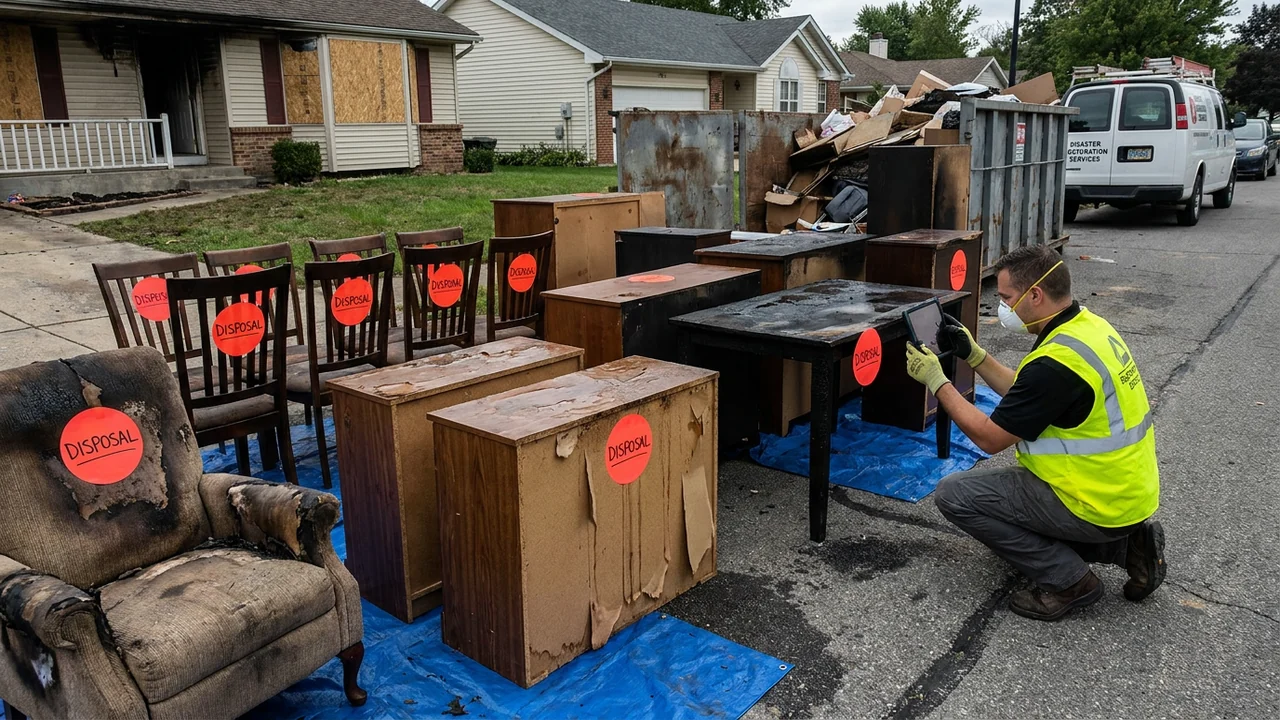
Throwing away ruined contents too quickly is one of the fastest ways for a restoration contractor to absorb a non-reimbursed write-off. Once soggy mattresses, melted electronics, or swollen cabinets hit the transfer station, the carrier desk examiner can dispute the unit count, demand proof of brand and model, or deny line-item pricing because the physical evidence no longer exists.
Equally dangerous, insureds experiencing loss shock often authorize disposal verbally on Day 1 only to ask three weeks later why a sentimental side table or high-end appliance was discarded. Grounded in ANSI/IICRC S320 disposal hygiene, IRMI salvage concepts, and US EPA hazardous waste rules, this Field Guide provides the authorization gates and witness-log template required before any roll-off pulls away.
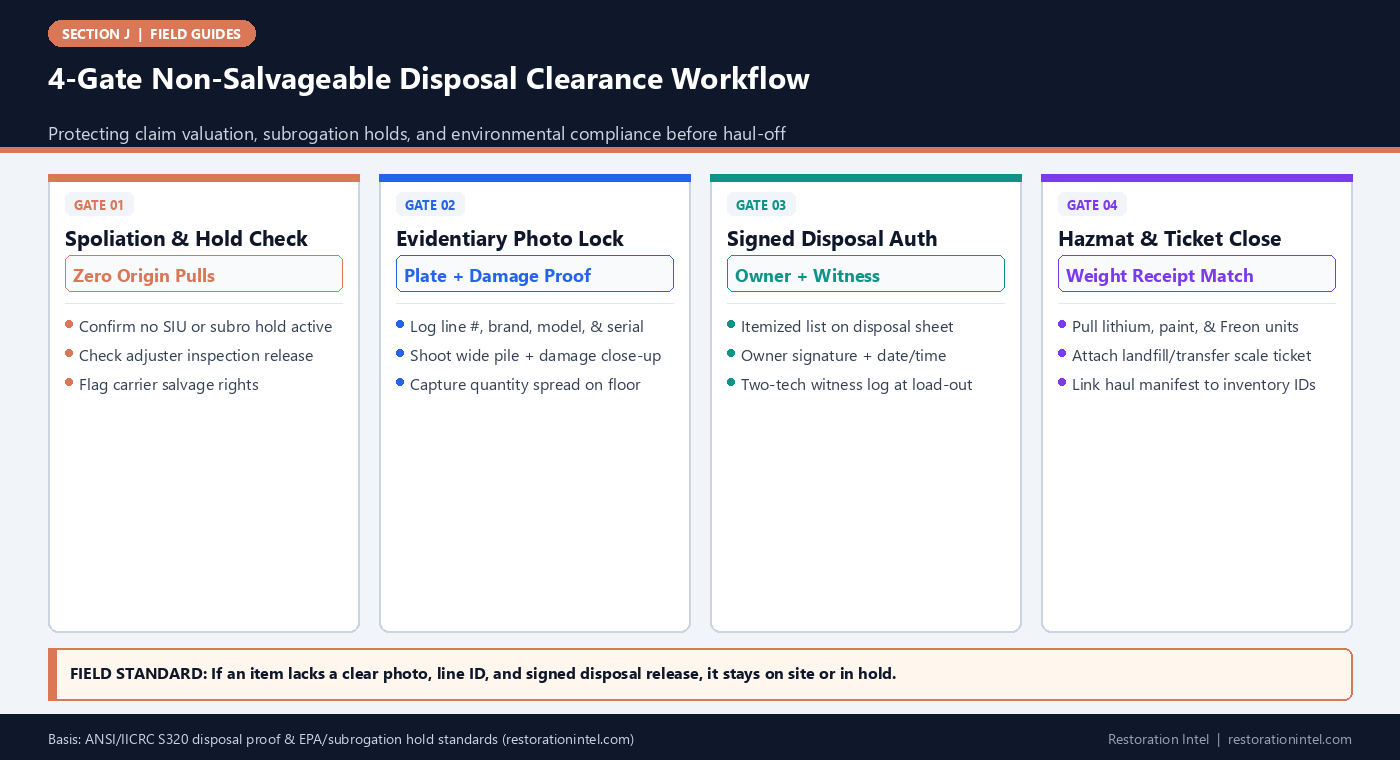
4-Gate Non-Salvageable Disposal Clearance Workflow
Non-Salvageable Disposal Authorization & Hold Matrix
Match the authorization, hold period, and witness requirements to the item class before loading debris dumpsters or haul-off trailers.
| Total-Loss Item Class | Minimum Pre-Disposal Proof | Required Sign-Off Authority | Hold / Waiting Rule | Manifest & Disposal Record |
|---|---|---|---|---|
| 1. Cat 3 / Biohazard / Spoiled Perishables | Wide zone photo + bagged/bin count + itemized spoilage log where feasible | Property Owner + Crew Lead health-hazard notation | Immediate removal permitted for active sewage/putrefaction safety | Double-bag log, photo of loaded bags, disposal date/time |
| 2. Low-Value Household Goods (< $100/unit) | Spread-out table/floor photo showing count & visible damage | Property Owner signature on attached line list | Hold until adjuster walkthrough or written carrier waiver | Box/bin tally + witness initials + transfer station receipt |
| 3. Mid-Tier Furniture & Decor ($100–$500) | 4-angle photo + material/brand tag + close-up of swelling/char/odor proof | Property Owner + Adjuster / Carrier Desk Approval | Minimum 72-hour post-submission hold unless written waiver given | Line-ID list + two-tech witness sign-off + weight ticket |
| 4. High-Value Appliances & Electronics (> $500) | Wide room shot + clear rating plate macro + damage detail | Property Owner + Written Adjuster Total-Loss Confirmation | Hold physical unit on site or vault hold rack until written release | Serial # log + adjuster email PDF + salvage/haul ticket |
| 5. Subrogation / Origin-Zone Assemblies | As-found in-situ sequence ONLY (do not disassemble) | Carrier Subrogation Counsel / SIU / Origin Investigator | Indefinite spoliation freeze until formal written release | Tamper-evident tag # + chain-of-custody vault receipt |
| 6. Regulated Hazmat (Lithium, Paint, Refrigerants) | Model/chemistry photo + exterior condition check | Owner auth + Certified Hazmat / EPA Disposal Manifest | Segregate outdoors immediately (never crush in compactor) | EPA/state manifest, recycler ticket, Freon recovery cert |
Why Premature Disposal Triggers Carrier Denials and Owner Disputes
Field crews naturally want to clear ruined debris fast so mitigation drying can begin. Yet tossing damaged goods without a documented evidentiary record removes the exact physical proof needed to settle Replacement Cost Value and Actual Cash Value. As emphasized in A Price Tag on a Lost Item Is Worth Nothing, even an undeniable total loss fails desk review when the contractor cannot show what brand, size, or quantity sat in that room.
Policy conditions also grant the insurer a right to inspect damaged property before disposal and, in higher-value cases, to exercise salvage rights. A contractor who landfills $12,000 of smoky electronics on Day 2 without adjuster release exposes both the homeowner and the restoration firm to scope disallowance.
- Never assume verbal consent: Verbal ‘just throw it all out’ comments during Day-1 stress carry zero audit protection.
- Inspect-first gate: Confirm with the desk or field adjuster whether an in-person re-inspection is pending before hauling non-biohazard total losses.
- Salvage-value check: High-end watches, commercial kitchen stainless, or intact metal tools may carry carrier salvage offsets.
Required Fields for a Disposal Authorization & Witness-Log Template
A field-ready Disposal Authorization & Witness Log connects three distinct records on one sheet: (1) the Claim & Location Block (`Job ID`, `Claim #`, `Loss Address`, `Adjuster Release Reference`), (2) the Itemized Disposal Schedule (`Schedule Line #`, `Item Description / Qty`, `Brand/Model`, `Reason Non-Salvageable`, `Photo Folder ID`), and (3) the Dual Authorization & Load-Out Witness Block (`Owner Signature + Date/Time`, `Crew Lead Witness`, `Second Crew Witness`, `Haul Vehicle / Roll-Off ID`, `Disposal Facility Name`).
Every line on the schedule must list an explicit technical basis—such as ‘Cat 3 sewage saturation,’ ‘swollen MDF delamination,’ or ‘melted ABS chassis’—rather than vague labels like ‘junk’ or ‘ruined.’ Attach or archive the corresponding pre-disposal photo sequence directly against those line numbers before the roll-off tarp closes.
- Two-witness rule: Require two crew signatures on the load-out witness log verifying every listed item entered the disposal container.
- Emergency biohazard checkbox: Include a dedicated check box for Category 3 sewage or spoiled perishables removed early for occupant health safety.
- Line-number parity: Map every disposal line directly to its master inventory schedule ID so estimators never double-bill or omit haul-off.
Managing Immediate Health-Hazard Pulls vs Held Total-Loss Staging
Active Category 3 sewage saturation, decaying freezer food, and wet animal waste cannot sit in a living room for ten days awaiting an adjuster inspection. When immediate removal is medically or sanitarily necessary, crews still execute the full evidentiary capture first: lay items out cleanly or photograph inside open containers with scale, document counts and brands, obtain the owner’s signed emergency biohazard disposal line, and capture video or wide photos of the loaded bags.
For stable non-salvageable items—dry smoke-damaged sofas, non-biohazard particleboard bookcases, or pitted appliances—stage a clean ‘Hold for Inspection’ corner on site or inside a low-cost vault pallet bay until written adjuster release arrives.
- Staged-spread photo: On emergency pulls, fan small items out on poly sheeting before bagging so quantity and identity are indisputable.
- Vault hold-rack tagging: Use high-visibility red ‘HOLD — PENDING ADJUSTER RELEASE’ tags on any non-salvageable pallet brought back to the warehouse.
- Hold-timeout escalation: Send written 48-hour disposal notice emails to the adjuster before hauling approved total-loss holds.
Segregating Hazmat and Attaching Scale Tickets to the Claim Packet
General construction dumpsters and municipal transfer stations prohibit crushed lithium-ion batteries, oil-based paints, solvents, propane cylinders, pesticides, and unrecovered refrigerant appliances. Loading these into a mixed roll-off risks dumpster fires, landfill rejection fines, and regulatory violations under EPA hazardous waste rules.
Always pull regulated items into a separate hazmat manifest before disposal loading, route appliances containing refrigerants through certified recovery technicians, and scan the final landfill weight ticket or transfer station receipt into the job file alongside the signed witness log.
- Zero-crush battery rule: Pull all e-bike, power-tool, and laptop lithium cells out of general debris before compacting.
- Freon cert match: Retain certified refrigerant recovery receipts for every disposed refrigerator, freezer, or portable AC unit.
- Weight-ticket audit: Match the haul-off date, truck ID, and net tonnage on the landfill ticket to the signed witness-log date.
Practitioner Verification Checklist (J-05)
- Confirm zero active subrogation, arson, or SIU spoliation holds before touching any suspected total-loss item.
- Capture wide contextual photos, damage close-ups, and readable rating plates for every non-salvageable line prior to loading.
- Obtain the property owner’s dated signature on an itemized Disposal Authorization listing specific technical failure reasons.
- Secure written carrier/adjuster release (or document emergency Category 3 health justification) before landfilling stable total-loss goods.
- Log two crew witness signatures at load-out, segregate regulated hazmat, and archive the landfill weight ticket in the job packet.
Standards, Authority References & Related Reading
Primary standards, insurance definitions, and sibling Restoration Intel guides referenced in this brief:
- ANSI/IICRC S320 Standard for Professional Contents Restoration
- US EPA Hazardous Waste Framework
- IRMI Insurance Glossary: Salvage
- Restoration Industry Association (RIA)
- Related Guide: Field Guide: Chain-of-Custody Form Elements & Pack-Out Sign-Off Template
- Related Guide: Field Guide: Evidence Preservation & Spoliation-Hold Rules on Subrogation and Arson Investigations
- Related Guide: Debris Removal, Haul-Off, and Landfill Fees for Total-Loss Contents: Where Valuation Ends and Mitigation Begins
- Related Guide: Salvage Credits and Buy-Back Rules When Insureds Keep Partially Damaged Contents
- Related Guide: A Price Tag on a Lost Item Is Worth Nothing
.md twin for desk QA and team training.Frequently Asked Questions
Can a crew throw away sewage-soaked rugs and spoiled refrigerator food before the adjuster inspects?
Yes, when active biohazard or putrefaction poses an immediate health risk—provided you photograph the spread-out items and brands first, get the owner’s signed emergency disposal authorization, and keep the itemized log.
What happens if an insured verbally tells the crew to dump everything on Day 1?
Never rely on verbal authorization alone. Always document the exact itemized list and obtain a written signature; without signed proof and pre-disposal photos, both owner disputes and carrier denials land on the contractor.
Why do we need two witness signatures on the disposal log?
A two-person crew witness log corroborates that the exact quantities authorized for disposal were physically loaded onto the haul vehicle on a specific date, eliminating discrepancies with landfill tickets.
Which non-salvageable items cannot go into standard restoration roll-off dumpsters?
Damaged lithium-ion batteries, propane tanks, pressurized aerosols, oil paints/solvents, pesticides, fluorescent bulbs, and refrigerators/freezers with unrecovered refrigerants must be segregated for compliant disposal.