Direct Answer: Restoration Project Managers and Division Leads protect the company from disposal liability and write-offs by holding non-salvageable goods under strict photo-verified quarantine until written carrier and insured sign-off, while routing high-dollar exceptions through specialist appraisal and OEM verification gates.
.md twin for estimator QA and carrier file documentation.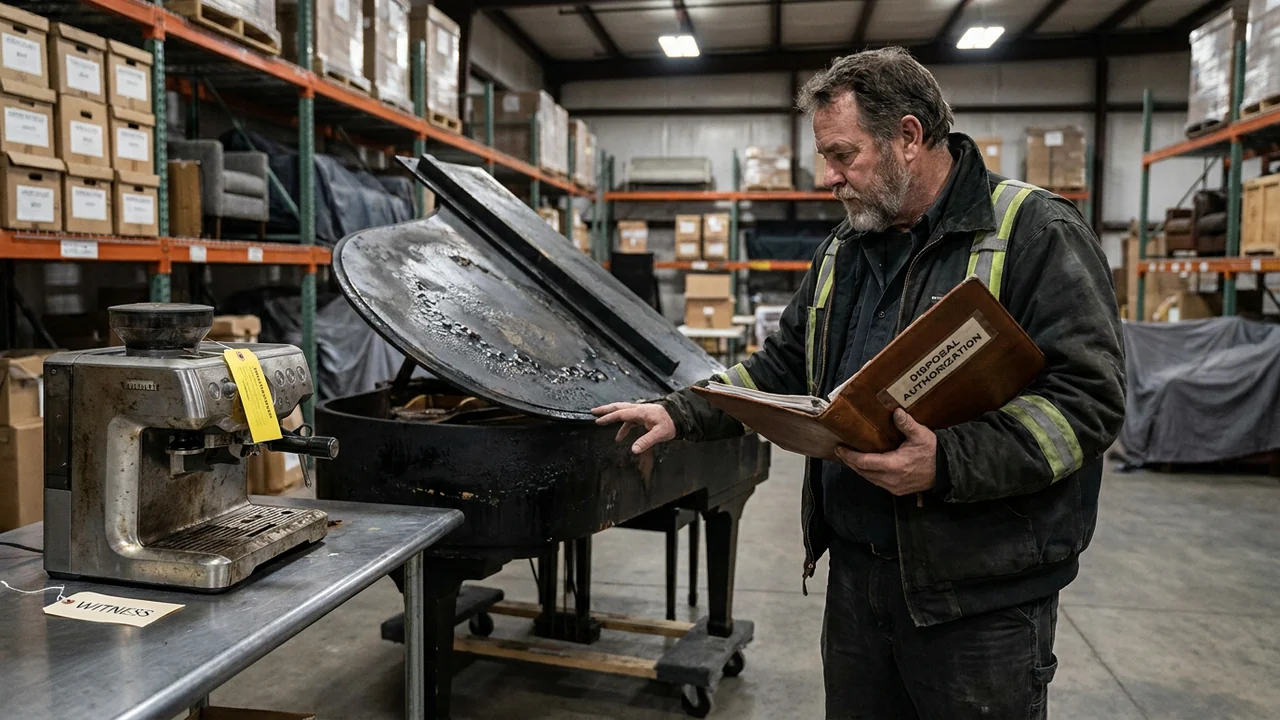
Few operational mistakes carry higher legal and financial danger in restoration than throwing away property before the adjuster and insured formally agree it is a total loss. When a crew hauls charred electronics, swollen cabinetry, or Category 3-soaked rugs straight to a roll-off dumpster on day one without reading model plates or securing sign-off, the restoration company risks losing both disposal labor reimbursement and credibility during subrogation or coverage disputes.
Non-salvageable lists and high-dollar exceptions sit at the exact intersection of policyholder emotion, carrier audit strictness, and contractor liability. Under ANSI/IICRC S320 and RIA operational standards, declaring an asset non-restorable requires objective technical criteria—structural failure, biohazard saturation, toxic chemical absorption, or restoration cost exceeding replacement value—not crew convenience.
For Company Owners, General Managers, and Contents Division Leads, governing non-salvageable quarantine and high-dollar exceptions requires ironclad stop gates. Separating emergency health-hazard disposal from aesthetic total-loss holds, enforcing two-signature disposal releases, and routing luxury, fine art, or specialty electronics to credentialed specialists protects balance-sheet risk while accelerating claim settlement.
Non-Salvageable & High-Dollar Exception Protocol
Exception Triage Matrix for Non-Salvageable Goods & High-Dollar Assets
Decision rules separating immediate health-hazard discards from adjuster-inspection holds and specialist-verified exceptions.
| Exception Category | Technical Justification Standard | Quarantine / Hold Rule | Required Documentation Packet | Approval Sign-Off |
|---|---|---|---|---|
| Category 3 / Biohazard Porous Goods | Direct sewage, floodwater, or bio-contamination in porous upholstery, mattresses, or paper | Photograph in place + cut swatch/tag if required; immediate sanitary disposal only if health risk dictates | Peril classification note, water-line height photos, unit count, and quality/brand proof | Insured release + adjuster notice (NFIP strict rules) |
| Economic Total Loss (Mid-Tier Goods) | Burdened restoration cost exceeds 60-75% of verified LKQ RCV | Hold physically on site or in quarantine lane until carrier reviews cost comparison | Side-by-side cleaning estimate vs live retail LKQ RCV comp + condition photos | Written adjuster approval + insured sign-off |
| High-Dollar Appliances & Electronics (>$1,500) | Heat distortion, soot corrosion on circuit boards, or water intrusion inside chassis | Do not discard; retain chassis intact for potential electrical/OEM testing or subrogation | Rating-plate macro photo, warranty/diagnostic bench report, and OEM repair vs replace quote | Carrier desk + specialty vendor report |
| Fine Art, Antiques & Collectibles | Surface smoke etching, canvas distortion, cracked veneer, or mold colonization | Zero wet-wiping or household cleaners; stabilize in climate control pending conservator review | High-res front/back signature & provenance photos; zero-touch condition memo | Certified conservator / appraiser + carrier |
| Sublimited Categories (Jewelry, Firearms, Silver) | Policy sublimit caps recovery regardless of cleaning or replacement extent | Keep in insured custody whenever possible; document condition neutrally without appraising | Pre-loss photo inventory and signed Leave-Behind receipt; notify adjuster of sublimit trigger | Policyholder direct custody / carrier desk |
| Subrogation-Sensitive Failures | Suspected appliance fire origin, burst braided supply line, or defective lithium battery | Lock in evidence chain of custody untouched; zero disassembly or disposal | Untouched placement photos, tamper-evident tag log, and origin preservation notice | Carrier SIU / Subrogation engineer only |
Enforcing the Quarantine Rule Before Anything Hits the Dumpster
In a severe fire or flood, property owners often beg crews on day two to haul ruined sofas, charred electronics, and soaked rugs straight to the curb so demolition can begin. Giving in to that urgency without ironclad documentation creates one of the most expensive traps in contents restoration. Once an item enters a landfill, neither the adjuster nor an independent appraiser can verify its quality tier, brand, or pre-loss condition.
Even worse, flood policies such as the National Flood Insurance Program (NFIP) and strict property carriers enforce rigorous proof-before-disposal standards, as detailed in Before Anything Goes: The NFIP Contents Inventory. Discarding items prematurely without itemized counts, measurements, and model tags can result in outright disallowance of those lines from the insured’s settlement—triggering an immediate dispute directed straight back at the contractor.
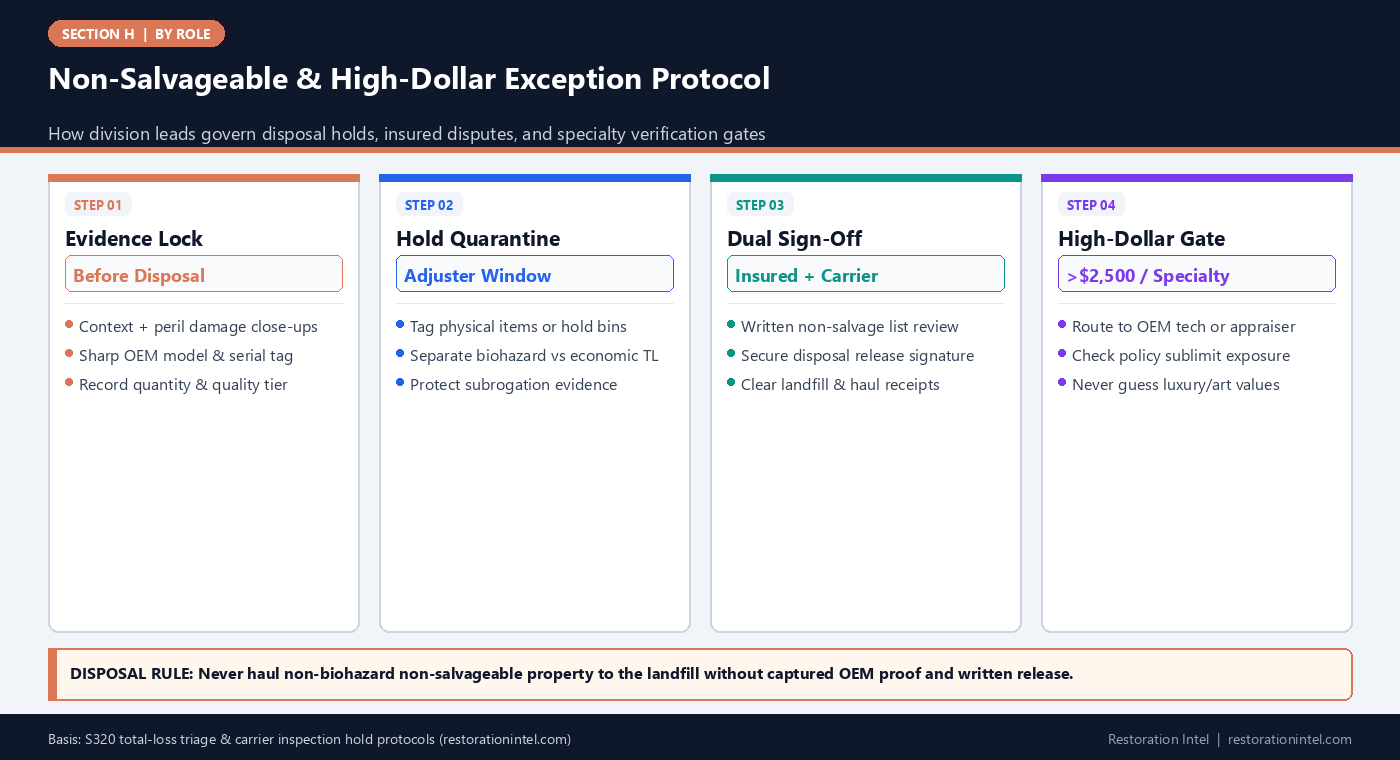
Division leads must institute a red-tag quarantine protocol. Non-salvageable items remain staged on site (in a garage or designated room) or inside labeled warehouse hold racks until three checks clear: photo/OEM proof verified by estimating, written notice sent to the carrier with an inspection window (typically 48 to 72 hours), and signed disposal authorization executed by the policyholder.
- Swatches & tags exception: When health codes prohibit holding wet Category 3 textiles, retain clean cut swatches of upholstery/carpet patterns and detached OEM tags alongside full photos.
- Written inspection clock: Send a dated email to the adjuster listing quarantined total-loss items and requesting inspection or release within 72 hours.
- Two-signature dump release: Never load a debris trailer with insured property without a signed itemized Non-Salvageable Release Form.
Navigating Homeowner vs Adjuster Disagreements Over Restore vs Replace
Non-salvageable lists frequently spark three-way tension. A homeowner may insist a smoke-exposed mattress or upholstered recliner must be totaled out for health or comfort reasons, while a carrier desk examiner demands proof that specialized deodorization cannot restore it. Conversely, an insured may demand restoration of an heirloom bookcase whose structural veneer has already delaminated beyond repair.
As outlined in The Adjuster Desk: One Standard, Two Chairs, the Restoration Project Manager must hold the neutral technical center. Contractors do not grant or deny insurance coverage—they render documented technical findings grounded in S320 restorability science and real cleaning economics.
When a dispute stalls an active room, divide the non-salvageable schedule cleanly into undisputed totals (charred, melted, or Category 3 saturated porous items) and disputed exception lines. Securing rapid approval and disposal on the undisputed 85 percent clears the house for structural rebuild while the remaining 15 percent undergoes targeted test cleaning or adjuster re-inspection.
- Test-clean proof over opinions: Run a documented small-scale test clean with before/after photos and odor notes on contested items.
- Split undisputed from contested: Never let five disputed pieces freeze disposal release for fifty clearly ruined items.
- Written policyholder preference notes: Record when an insured declines restoration on personal comfort grounds so carrier discussions stay factual.
Governing High-Dollar Exceptions, Subrogation Holds, and Specialty Assets
A single $12,000 commercial espresso machine, baby grand piano, oil painting, or high-end home theater array carries more financial risk than three hundred boxes of everyday kitchenware. Standard pack-out crews should never improvise disassembly, chemical cleaning, or replacement estimates on high-dollar specialty exceptions.
Division leads must establish an automatic escalation threshold—commonly $1,500 to $2,500 per unit, or any fine art, musical instrument, custom IT/medical gear, and suspected fire-origin appliance. Once flagged at intake or receiving, the item enters a zero-touch protective hold until an OEM service technician, certified art conservator, or specialist vendor inspects it and issues a written diagnostic or repair-versus-replace opinion.
Equally critical is subrogation preservation. If a dishwasher valve, lithium battery pack, or space heater is the suspected origin of a major water or fire loss, cleaning, disassembling, or discarding that unit can constitute spoliation of evidence and derail carrier recovery efforts—potentially exposing the contractor to severe legal claims.
- Spoliation red line: Immediately quarantine suspected loss-origin appliances untouched and notify the carrier subrogation unit in writing.
- Certified third-party diagnostics: Require written bench reports from authorized electronics or appliance specialists rather than crew guesses.
- Conservator referral network: Maintain pre-vetted fine art, textile, and document recovery partners for losses exceeding internal bench skill.
Protecting Margin on Disposal Labor and Non-Salvageable Inventory Work
Evaluating, photographing, cataloging, and hauling non-salvageable property consumes substantial crew and estimator hours, yet many restoration companies inadvertently donate that labor whenever they treat total-loss lists as an unpaid courtesy. Failing to capture billable documentation, inventorying, and debris-handling line items turns large total-loss fires into break-even headaches.
Division leads must ensure non-salvageable work is scoped transparently from day one. Under IRMI ACV and IRMI RCV claim workflows, insurers depend on the contractor’s itemized physical inventory and condition proof to settle total-loss personal property accurately. Billable inventory labor, selective demolition/haul-off, dumpsters, and protective handling must be supported with clear time logs, truck manifests, and landfill weight tickets.
General Managers should audit total-loss jobs quarterly to verify that crew hours spent building non-salvageable schedules and managing disposal holds are fully captured in approved estimates rather than quietly absorbed into overhead.
- Separate labor billing: Track inventory documentation hours, haul-off labor, and disposal fees with ticketed weight receipts.
- Avoid unbilled hold drift: Set clear warehouse hold fees if carriers delay non-salvageable inspection beyond reasonable windows.
- Audit total-loss gross margin: Measure estimator hours per 100 total-loss lines so pricing research labor stays accounted for.
Practitioner Verification Checklist (H-05)
- Quarantine all non-biohazard non-salvageable property on site or in labeled warehouse hold lanes until carrier inspection or written release.
- Verify sharp OEM brand/model/serial photos and peril damage close-ups on every total-loss item prior to any haul-off.
- Obtain a co-signed Non-Salvageable Release Form from the policyholder alongside written carrier/adjuster disposal confirmation.
- Route all assets exceeding $1,500–$2,500, fine art, antiques, and suspected origin appliances through zero-touch specialist or subrogation holds.
- Capture time logs, itemized total-loss inventory billing, and landfill weight tickets so disposal and documentation labor are fully reimbursed.
Standards, Authority References & Related Reading
Primary standards, insurance definitions, and sibling Restoration Intel guides referenced in this brief:
- ANSI/IICRC S320 Standard for Professional Contents Restoration
- Restoration Industry Association (RIA)
- IRMI Insurance Glossary: Actual Cash Value (ACV)
- IRMI Insurance Glossary: Replacement Cost Value (RCV)
- Related Guide: Restoration Project Manager & Contents Division Lead: Pricing, LKQ Sourcing & Valuation Defensibility
- Related Guide: Restoration Project Manager & Contents Division Lead: Quality Assurance Review & Pre-Submission Audit
- Related Guide: Before Anything Goes: The NFIP Contents Inventory
- Related Guide: A Price Tag on a Lost Item Is Worth Nothing
- Related Guide: The Adjuster Desk: One Standard, Two Chairs
.md twin for desk QA and team training.Frequently Asked Questions
When can a crew legally discard ruined contents without waiting for an adjuster?
Only when active health hazards (such as Category 3 sewage saturation or severe bio-contamination) prevent safe retention—and even then, crews must first capture complete context photos, peril proof, OEM tags or fabric swatches, and signed homeowner disposal authorization.
What happens if a contractor throws out non-salvageable items before photographing model numbers?
Adjusters typically downgrade missing-spec items to low-tier generic replacements or disallow undocumented lines entirely, triggering major policyholder dissatisfaction and unpaid write-offs.
How should a division handle a suspected fire- or water-origin appliance?
Enforce an immediate zero-touch subrogation hold: leave the unit completely intact, tag it with chain-of-custody seals, photograph placement, and notify the carrier claims desk in writing before moving it.
Should restoration companies charge for cataloging and hauling non-salvageable contents?
Yes. Cataloging total-loss schedules, staging quarantined goods, loading trucks, and paying landfill fees are legitimate, billable claim operations when backed by itemized time logs and disposal tickets.