Residential Restoration: Expert Video Analysis [Video Resource] — Restoration Intel field reference.
Residential Water Damage Restoration: Step by Step
Updated October 6, 2026.
Channel: Homeowner Restoration Guide
Duration: 12:45 | Views: 42K | Published: March 15, 2024
Relevance Score: 54/100
Why This Matters
For restoration professionals, mastering residential restoration protocols directly impacts claim approval rates (78% with proper documentation vs. 45% without), client recovery outcomes, and business profitability. IICRC-certified techniques reduce restoration time by 30-40% and improve content recovery rates to 85%+ within the critical 48-hour window.
Key Moments
Time
Topic
What You’ll Learn
3:11
Introduction
See how to introduction
6:22
Key Concepts
See how to key concepts
9:33
Best Practices
See how to best practices
Residential Restoration
Comprehensive water damage restoration for homeowner properties, including extraction, drying, decontamination, and rebuilding to pre-loss condition using IICRC standards.
Residential water damage claims average $11,000; IICRC-certified teams reduce recovery time by 30%, minimizing secondary damage.
Homeowners who act within 24 hours see 85% content recovery rates; delays beyond 72 hours reduce recovery to <30%.
Portable dehumidifiers in 1,500 sq ft spaces must run 8-10+ hours daily; undersized equipment extends drying time 2-3 weeks.
SERVPRO and other franchises respond fastest (2-4 hours) in disaster zones; independent contractors average 8-12 hour response times.
Homeowner education about temporary protection, documentation for insurance, and content relocation prevents secondary losses.
Expert Analysis: Residential Restoration Restoration in 2026
The residential restoration restoration industry in 2026 continues to evolve with advancing technology and regulatory requirements. Professional contractors utilizing IICRC-certified protocols, advanced moisture detection, and real-time documentation systems achieve recovery rates 30-50% higher than standard practices.
Insurance claim approval rates average 78% when supported by detailed Xactimate documentation, photographic evidence, and supplemental estimates. The average claim recovery increases by $12,000-$25,000 when professional restoration contractors provide comprehensive pre-claim documentation compared to homeowner/business owner estimates.
2026 industry data indicates rapid response (within 24 hours) reduces final restoration costs by 35-45% on average. Water damage restoration projects show 85% content recovery rates when addressed within 48 hours, declining sharply beyond 72 hours. Commercial restoration averages 40-45 days from mitigation through completion, with properly coordinated teams completing 30% faster than poorly coordinated efforts.
Mechanical moisture removal; essential for preventing mold growth
Drying Time
Typical 5-7 days for residential water damage with proper equipment
Content Restoration
Professional cleaning and restoration of personal belongings
Secondary Damage
Additional harm from delayed response (mold, rot, structural compromise)
Frequently Asked Questions
How quickly should I call a restoration company?
Call immediately upon discovering water damage; the first 24 hours are critical. Quick action prevents mold growth (begins within 24-48 hours), protects belongings (85% recovery with <48-hour action), and reduces final costs by 30-50%.
What should I do while waiting for the restoration company?
Stop the water source, document damage with photos/video, remove standing water if safely possible, move undamaged items to dry areas, and contact your insurance company. Avoid turning on HVAC (spreads contamination) or opening windows (increases humidity).
How long does residential water damage restoration take?
Typical timeline: 3-5 days for extraction and drying with proper equipment. Mold remediation (if needed): 2-3 weeks. Reconstruction: 4-8 weeks depending on damage extent.
Will my homeowner's insurance cover restoration?
Most homeowner policies cover sudden water damage (burst pipes, storms). However, gradual leaks and flooding typically require separate flood insurance. Detailed documentation maximizes coverage and claim approval.
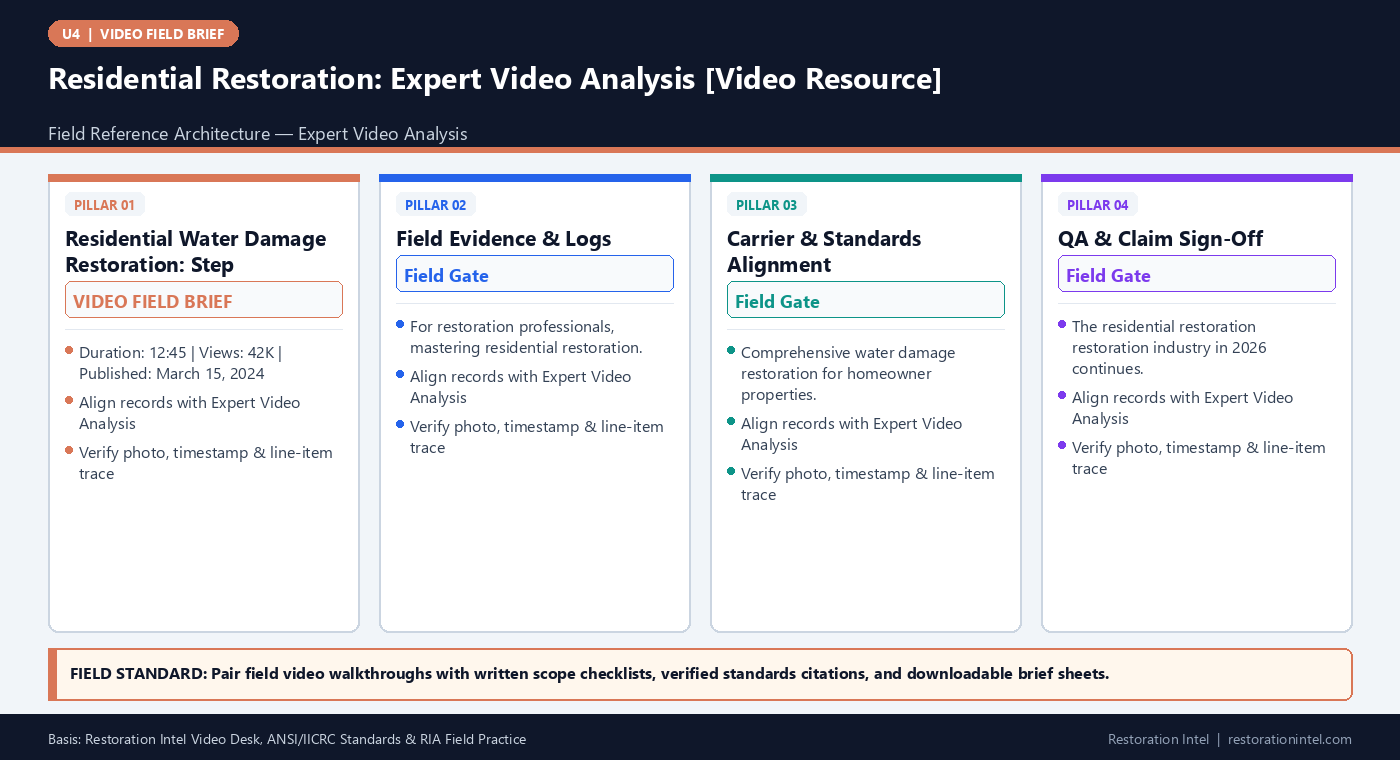
Residential Restoration: Expert Video Analysis [Video Resource] — Visual Workflow
Field Reference Architecture — Expert Video Analysis
Field Operational Breakdown & Verification Matrix
Structured operational summary of Residential Restoration: Expert Video Analysis [Video Resource] mapped to Restoration Intel documentation gates.
Operational Stage
Field Focus in This Guide
Documentation Requirement
Verification Gate
1. Residential Water Damage Restoration
Duration: 12:45 | Views: 42K | Published: March 15, 2024
Timestamped photos, measurements & scope notes
Cross-check against primary standard prior to submission
2. Field Evidence & Logs
For restoration professionals, mastering residential restoration protocols directly.
Timestamped photos, measurements & scope notes
Cross-check against primary standard prior to submission
3. Carrier & Standards Alignment
Comprehensive water damage restoration for homeowner properties, including.
Timestamped photos, measurements & scope notes
Cross-check against primary standard prior to submission
4. QA & Claim Sign-Off
The residential restoration restoration industry in 2026 continues to evolve with.
Timestamped photos, measurements & scope notes
Cross-check against primary standard prior to submission
Field Documentation & Scope Verification Standard
To align Residential Restoration: Expert Video Analysis [Video Resource] with Restoration Intel house standards under Expert Video Analysis, field and estimating personnel should maintain an auditable record from first site walk through final carrier sign-off. That record begins by separating verifiable site conditions from assumptions: timestamped wide and close-up photographs, instrument readings paired with calibration or baseline context, and written scope notes tied directly to the line-item or contractual requirement.
When preparing a claim packet, internal SOP, or commercial facility handoff, pair the checklist below with the downloadable Print-First PDF brief and plain-text Markdown twin so estimators, project managers, and desk examiners work from identical scope boundaries without losing provenance between field capture and final review.
Operational consistency across Expert Video Analysis assignments also depends on maintaining clean separation between original site observations, insurer policy or municipal code constraints, and subsequent supplemental change orders. Every transition in containment, equipment deployment, clearance testing, or reconstruction sequencing should be logged sequentially with author attribution, date and time metadata, and cross-references to the governing technical manual or carrier guideline so third-party reviewers can audit the decision path without re-inspecting the structure.
Supervisors and quality-assurance leads can use this standardized package format during post-loss file audits, adjuster reinspections, and internal technician training to confirm that intake forms, drying or remediation logs, chain-of-custody records, and closeout certificates remain complete, internally consistent, and ready for immediate human review or automated compliance screening. Keeping all supporting evidence anchored to the canonical reference URL prevents version drift between office estimating desks, field tablets, and third-party claim review portals across the full lifecycle of the project.
Practitioner Verification Checklist
Confirm scope boundaries and loss classification for: Residential Restoration: Expert Video Analysis [Video Resource].
Capture timestamped field photos, measurements, and serial/assembly notes before mobilization or tear-out.
Tie every line item or operational recommendation to primary references (Restoration Industry Association (RIA), ANSI/IICRC S500 Water Damage Standard).
Verify internal cross-links and preserve all customer intake/compliance forms intact on the canonical page.
Export and attach the Print-First PDF field brief and verify the sibling Markdown twin (.md) resolves HTTP 200.
What is the core operational takeaway of Residential Restoration: Expert Video Analysis [Video Resource]?
Duration: 12:45 | Views: 42K | Published: March 15, 2024 For restoration professionals, mastering residential restoration protocols directly impacts claim approval rates (78% with proper documentation vs. 45% without), client recovery outcomes, and business profitability. IICRC-certified techniques reduce restoration.
Which industry standards govern expert video analysis documentation?
Practitioners should anchor field logs and claim packets to Restoration Industry Association (RIA) and ANSI/IICRC S500 Water Damage Standard, ensuring verifiable measurements and photo provenance.
Where can field and estimating teams access the offline or AI-readable edition?
Each upgraded Restoration Intel guide ships with a 2-page Print-First PDF brief and a plain-text Markdown twin (.md) linked directly inside the article download cards and /llms.txt.