Updated November 24, 2026 — refreshed with verified 2-page PDF field brief, bespoke workflow diagram, and primary standards references.
Direct Answer: Restoration business owners operate in structural isolation—handling employee turnover, TPA pressure, and working-capital crunches without peers inside their building who can challenge them candidly. Structured non-competing mastermind groups of 10 to 12 owners transform intuition into measurable P&L accountability, compression-tested operating playbooks, and sustained execution.
.md twin for Regulated Materials & Hazmat.
Updated October 6, 2026.
Restoration business owners are, by definition, isolated problem-solvers. They deal with employee issues, carrier friction, cash flow pressure, and strategic decisions largely alone — because the people around them are either employees with a stake in the outcome or friends and family without the context to help.
The MRM Leadership Circle Model
The Floodlight Consulting Group’s MRM Leadership Circle is a mastermind model built specifically for restoration. Limited to 10-12 participants, geographically exclusive (no direct competitors in the same group), meeting twice a month with a rigorous accountability check-in focused on financials and P&Ls. The structure is intentional: safety requires geographic exclusivity, accountability requires regularity, and depth requires a small group.
What Peer Accountability Actually Does
The primary value of a mastermind is not information — most restoration owners have access to information. The value is accountability and pattern recognition. When 10 owners share their P&Ls monthly, patterns emerge that no individual could see alone. When one owner describes a problem they think is unique to their market, seven others recognize it immediately and have already solved it. The compounding of shared experience across non-competing businesses is the mechanism that drives improvement.
Building Your Own Circle
If a formal program isn’t available, the principles apply to self-organized groups: keep it small (8-12), geographic exclusivity, consistent meeting cadence, financial transparency as the norm, and a facilitated agenda that prevents the meetings from becoming social gatherings. The discipline of the format is what creates the safety and the accountability that make the groups valuable.
Frequently Asked Questions
How do you find other restoration owners willing to share financials?
Through industry associations (RIA, IICRC), events like CORE Collective, or referrals from consultants and vendors who work across multiple markets. The key is geographic exclusivity — people are much more willing to be transparent when they know the information won’t be used by a direct competitor.
How is a mastermind different from a trade association?
Trade associations provide information, advocacy, and networking. Masterminds provide accountability, peer coaching, and financial transparency. Both are valuable; they serve different functions. The mastermind is where you talk about what’s actually happening in your business — not what you’d put in a press release.
What topics are most valuable to cover in restoration mastermind meetings?
Financials (P&L, cash position, receivables), hiring and retention challenges, carrier relationship management, equipment and scaling decisions, and leadership development. The recurring financial check-in is the most powerful element — it creates accountability that most owners lack.
Is a mastermind worth the time investment for a small restoration company?
Especially for smaller companies. The owner of a $1-3M company has fewer advisors, less margin for expensive mistakes, and more to learn from operators who have already solved the problems they’re facing. The time investment (typically 2-4 hours/month) is among the highest-ROI activities available to a growth-stage restoration owner.
Related: Leadership pipeline · Extreme ownership and accountability · Company culture guide.
Mastermind Groups for Restoration Leaders: Why Peer Accountability Changes Everything — Visual Workflow
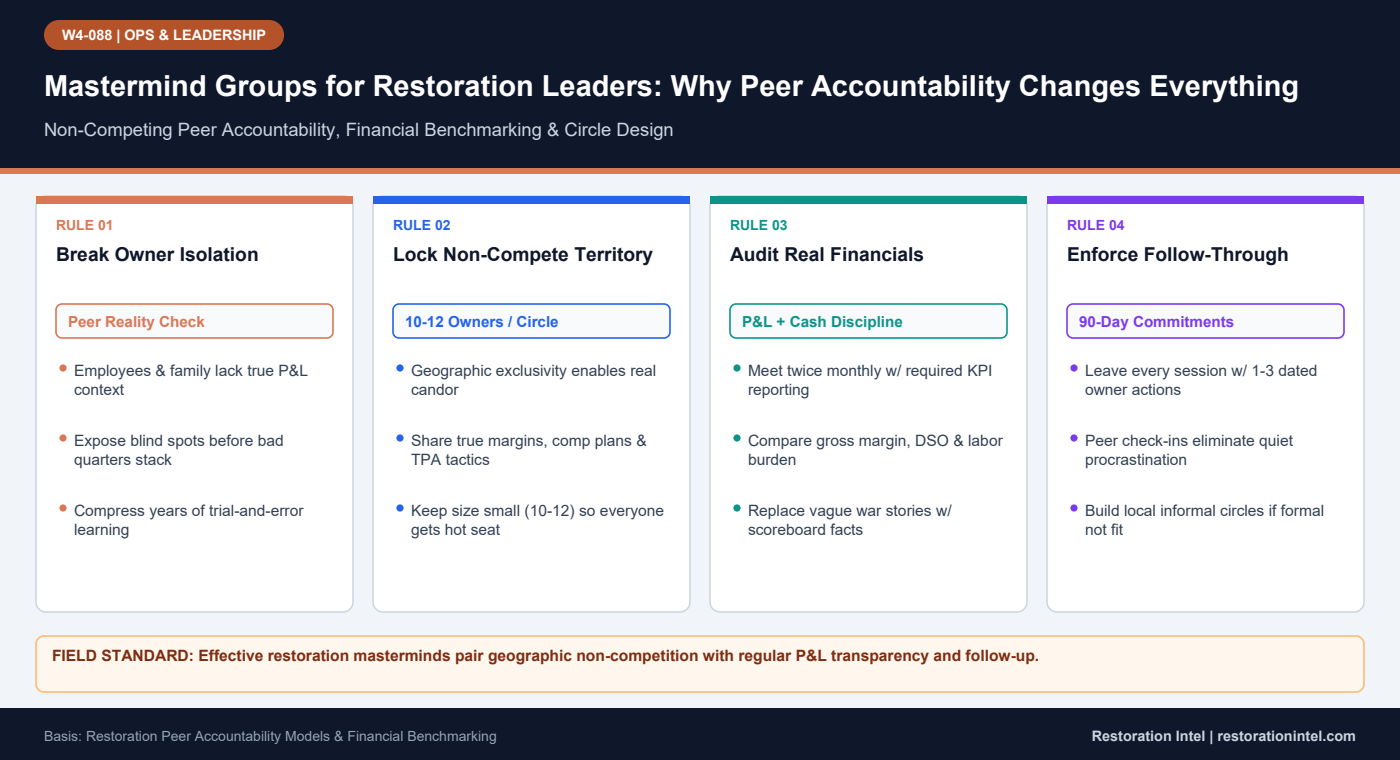
Field Benchmark & Decision Matrix
| Circle Pillar | Structural Requirement | Why It Matters | Weak Group Failure Mode |
|---|---|---|---|
| Geographic Exclusivity | Zero direct overlapping service-territory rivals | Unlocks full candor on pricing, hiring & TPAs | Guarded vanity talk when competitors share room |
| Group Size Control | 10 to 12 vetted restoration operators max | Deep hot-seat time for every owner quarterly | Large 40-person webinars w/ zero accountability |
| Financial Transparency | Standardized P&L, margin & A/R benchmark shares | Surfaces hidden job-costing & overhead leaks | Complaining about carriers w/o margin numbers |
| Cadence & Homework | Twice-monthly check-ins + committed 90-day rocks | Forces action between quarter-end crises | Networking coffee club w/ zero behavior change |
| Peer Stage Match | Comparable revenue tier & operational complexity | Keeps advice relevant to crew & cash realities | $300K startup advising $8M multi-branch shop |
Practitioner Operational Takeaways
- Join or form a peer accountability circle restricted strictly to non-competing markets so owners can share real P&Ls, comp structures, and carrier results safely.
- Keep group size tight (10–12 active operators) with consistent twice-monthly or monthly cadence rather than drifting into casual trade-show dinners.
- Measure every mastermind meeting by concrete, dated commitments reviewed at the start of the very next session.
- Bring standardized financials—mitigation gross margin, rebuild net, DSO days, and technician turnover—so advice addresses root math rather than anecdotes.
Standards & Primary References
- Markdown Twin (.md)
- Leadership Pipeline: Developing Internal Leaders
- Company Culture in Restoration: Retaining Top Teams
- Restoration Industry Association (RIA)
.md twin for carrier and field review.