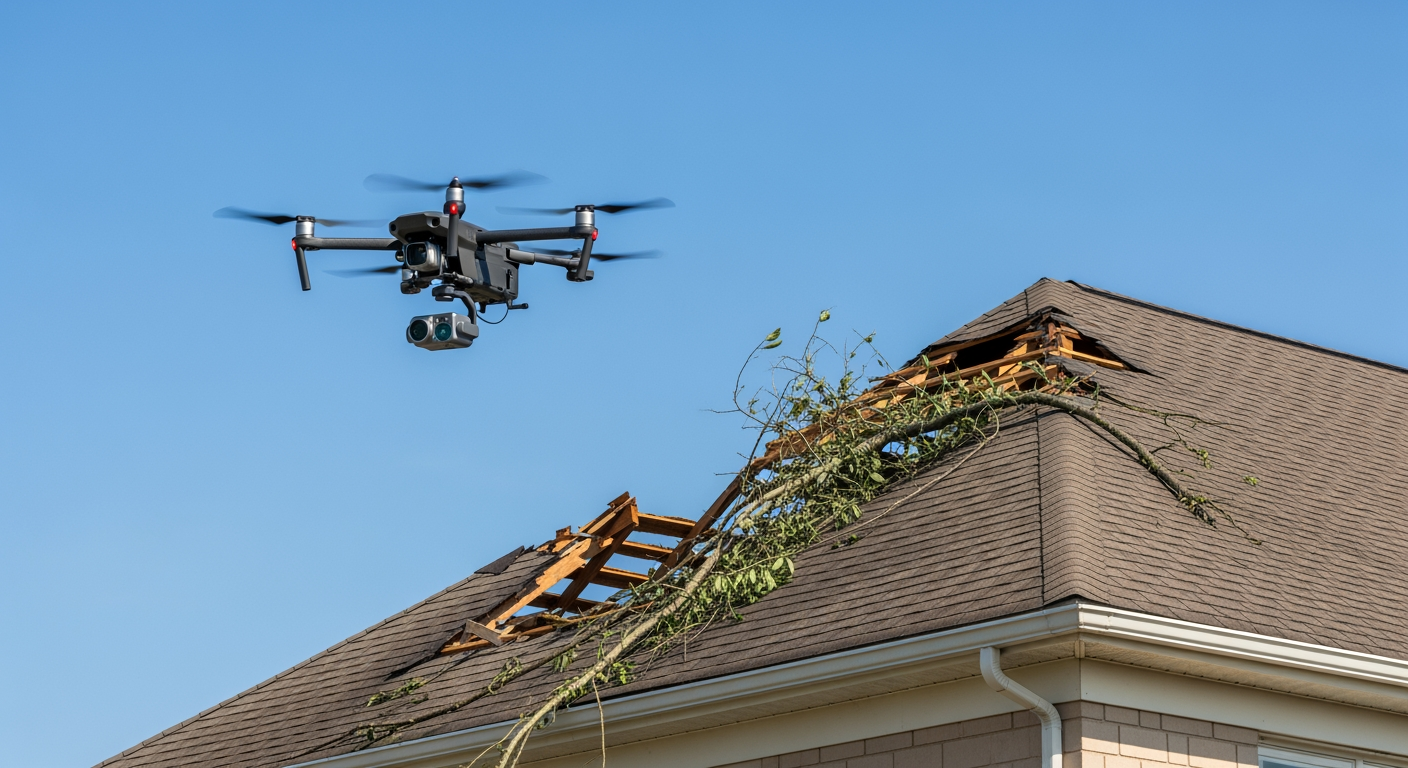
The restoration industry crossed a technology threshold in 2025 that is reshaping how contractors assess damage, develop scopes, and manage projects in 2026. According to Restoration & Remediation Magazine, 88 percent of businesses now use AI in at least one regular function, and the adoption curve in property restoration is steeper than in almost any other construction trade. The convergence of drone-mounted sensors, AI-powered analytics, and cloud-based project management platforms is creating a unified data ecosystem that connects the field crew to the insurance adjuster to the property owner in real time.
Drone-Based Damage Assessment: From Visual Inspection to Multispectral Analysis
The evolution from consumer-grade camera drones to professional restoration assessment platforms represents one of the most significant workflow changes since the adoption of Xactimate. Modern restoration drones carry multiple sensor payloads simultaneously, including high-resolution RGB cameras, radiometric thermal sensors, LiDAR systems, and in advanced configurations, hyperspectral imaging arrays.
Radiometric thermal sensors have replaced simple thermal cameras as the standard for envelope assessment. These sensors capture calibrated temperature data at every pixel, enabling the identification of moisture intrusion, air leakage, and roofing delamination within building envelopes that would be invisible to visual inspection. When a Category 2 water loss affects a commercial building, a drone-mounted radiometric thermal survey can map moisture migration patterns across the entire roof assembly in under 60 minutes, a task that would take a crew with handheld meters an entire day and still miss concealed areas.
Multispectral photogrammetric point clouds take fire damage assessment further than any traditional method. By combining RGB imagery with near-infrared and thermal data, AI algorithms can differentiate between char depths, identify structural members with compromised load-bearing capacity, and detect hidden fire extension behind walls and above ceilings. This capability directly affects fire damage scope development by providing three-dimensional documentation that adjusters and engineers can review remotely.
AI-Powered Scope Development and Cost Estimation
The most transformative application of AI in restoration is automated scope development. Field technicians photograph the loss on a jobsite while an AI-integrated platform assesses the damage extent and produces preliminary scope documents with cost estimates. This is not a replacement for trained estimators but rather a first-pass tool that reduces the time from site visit to scope submission from days to hours.
AI scope tools cross-reference damage imagery against the Xactimate pricing database, local labor rates, and material costs to generate line-item estimates. The accuracy rate on straightforward water losses already approaches 85 to 90 percent when compared to experienced estimator output, according to early adopter data from large multi-location restoration firms. For complex losses involving multiple damage types, the AI produces a framework scope that the estimator refines rather than builds from scratch.
The insurance implications are significant. Carriers are beginning to accept AI-generated preliminary scopes as supporting documentation alongside traditional Xactimate estimates, particularly for first notice of loss documentation and emergency mitigation authorization. This accelerates the claim cycle and reduces supplement disputes when the initial scope is data-rich and defensible.
IoT-Enabled Monitoring and Equipment Management
The Internet of Things has moved from novelty to necessity in restoration project management. IoT-enabled sensors placed throughout a drying project continuously capture temperature, relative humidity, grain depression, and air movement data. This information streams to cloud dashboards accessible to the project manager, the insurance adjuster, and the property owner simultaneously.
The data capture eliminates the most common point of friction in structural drying projects: documentation disputes over drying time and equipment placement. When every data point is timestamped and geolocated, the restoration contractor has an irrefutable record that supports the scope and timeline they submitted. Adjusters reviewing IoT drying logs can approve invoices faster because the data tells the story without requiring back-and-forth communication.
Equipment fleet management has also gone IoT. Dehumidifiers, air movers, and air scrubbers with embedded sensors report their operational status, runtime hours, and maintenance needs to a central platform. Restoration companies running 500 or more pieces of equipment can now track utilization rates, predict maintenance windows, and optimize deployment across multiple active jobs from a single dashboard.
Integration with Insurance Claim Platforms
The emerging standard in 2026 is direct integration between restoration technology platforms and carrier claim management systems. When a drone survey generates a photogrammetric model, the data package flows directly into the carrier’s claim file alongside the AI-generated scope estimate and IoT drying logs. This creates a single source of truth that both parties reference throughout the claim lifecycle.
This integration addresses the chronic problem of scope disputes and supplement delays that have plagued the restoration-insurance relationship. When the data is objective, timestamped, and captured by calibrated instruments rather than subjective field notes, the basis for disagreement shrinks dramatically.
For contractors navigating property claim filing and documentation, technology-enabled loss documentation provides a competitive advantage. Carriers increasingly favor restorers who submit comprehensive digital documentation because it reduces their internal adjustment costs and accelerates cycle time.
Safety and Workforce Implications
Drone deployment eliminates the need for technicians to access compromised roofs, fire-damaged structures, and confined spaces during initial assessment. With more than 20 percent of construction workers over age 55 according to the Bureau of Labor Statistics, reducing physical risk exposure while maintaining assessment quality is both a safety imperative and a workforce retention strategy.
The technology also addresses the industry’s chronic labor shortage differently than simple headcount. A two-person drone team can assess more structures per day than a five-person manual inspection crew, effectively multiplying the output per worker without requiring additional hires. This is particularly valuable during catastrophic event response when demand for assessment capacity spikes far beyond available workforce.
For restoration business owners evaluating technology investments, the ROI calculation has shifted. The question is no longer whether to adopt these tools but how quickly a company can integrate them into existing workflows without disrupting current production. Companies that have already built their scaling strategy around technology adoption are capturing market share from traditional competitors.
Cross-Industry Connections
The technology stack driving restoration innovation connects directly to broader trends in catastrophe modeling where the same satellite and sensor data feeding restoration assessment also feeds insurance pricing models. Healthcare facilities facing water damage remediation challenges benefit from the same IoT monitoring technologies adapted for clinical environments. And organizations building business continuity plans increasingly account for technology-enabled rapid damage assessment as a factor that reduces recovery time objectives.