Direct Answer: Pre-loss boundary mapping in condominiums and townhomes separates original association-maintained fixtures, unit-owner upgrades, and movable personal property before a vertical riser leak or fire forces dual adjusters to freeze pack-out and demolition.
.md twin for estimator QA and carrier file documentation.
Multi-unit condominium losses fail in the first forty-eight hours far more often over authorization and boundary confusion than over drying equipment capacity. When a fifth-floor supply line bursts at 2:00 a.m. and cascades through four stacked units, the mitigation and contents crew arrives to find two completely different stakeholders: the Condominium Owners Association (COA) or HOA property manager operating under a master policy, and individual unit owners carrying HO-6 policies.
Without a pre-loss physical boundary file, crews cannot tell whether custom quartz islands, engineered hardwood floors, plantation shutters, or recessed audio racks belong to the master association restoration scope or the unit owner’s betterments and contents bucket. While two adjusters debate governing declarations, wet cabinetry swells, pack-out stalls in hallways, and restoration schedules slip.
Practical scope boundary: Restoration contractors and contents estimators build pre-loss boundary maps purely to classify physical installation characteristics, attachment methods, and asset specs for operational readiness and estimate routing—never to provide legal advice or interpret insurance contracts. Unit owners, COA boards, and community managers must verify actual master-policy forms and HO-6 endorsements with their licensed insurance broker, carrier, or legal counsel.
Condo & HOA Pre-Loss Asset Boundary Map
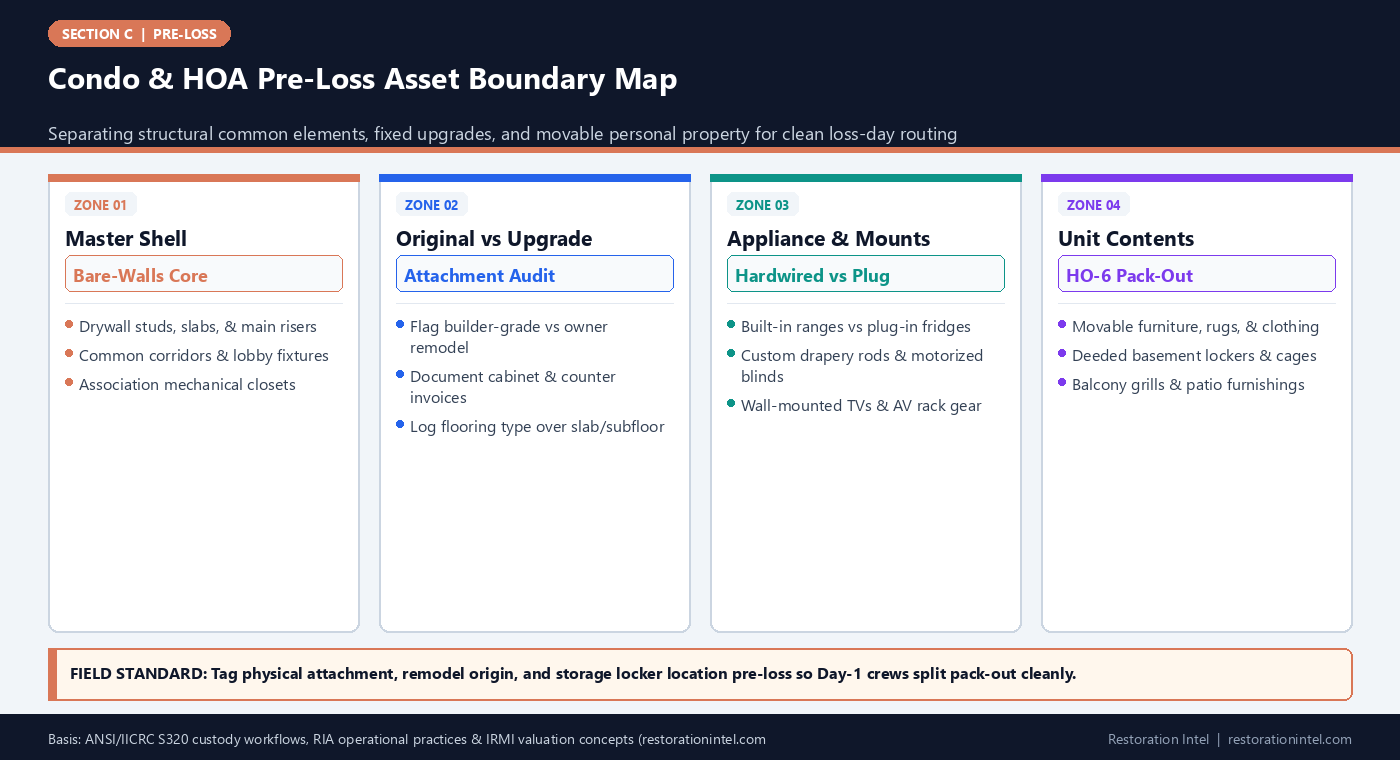
Condo & HOA Physical Boundary Reference for Pre-Loss Documentation
How pre-loss estimators classify common gray-zone items physically inside condos and HOAs before a loss triggers dual-policy routing.
| Asset / Zone Class | Master Policy Operational Cue | Unit-Owner (HO-6) Operational Cue | Pre-Loss Evidence to Capture | Loss-Day Pack-Out & Estimate Routing |
|---|---|---|---|---|
| Original Kitchen Cabinetry & Tops | Builder-spec identical across stacked units | Excluded under bare-walls; check owner upgrade docs | Wide kitchen elevation + drawer box joinery close-up | Hold demo until COA manager confirms master-vs-unit bucket |
| Owner-Installed Remodel Upgrades | Rarely covered if master is original-spec only | Owner betterments & improvements schedule | Contractor remodel invoice + before/after remodel photos | Separate upgrade line items from standard structural dry-out |
| Freestanding & Built-In Appliances | Hardwired exhaust/disposal sometimes in all-in scope | Plug-in refrigerators, washers, & countertop units | OEM serial plate + power/water hookup photo behind unit | Protect plug-in units in pack-out; coordinate hardwired disconnects |
| Hardwood, Tile & Carpet Over Slab | Subfloor slab/acoustic mat typically association side | Floating LVP, custom tile, or owner-laid hardwood | Transition strip photo showing subfloor vs finished layer | Capture moisture readings in both slab and finish floor |
| Custom Blinds, Shutters & Draperies | Exterior-uniform blinds sometimes mandated by HOA | Custom interior shutters, motorized shades, & drapes | Mount bracket close-up + vendor invoice with window count | Tag window treatments by room before wall demo begins |
| Deeded Storage Cages & Garage Lockers | Common-area structure, sprinklers, & security fencing | Personal tools, bikes, luggage, & seasonal bins inside | Locker number placard + interior shelf/bin sweep | Route under unit-owner contents custody with locker ID tag |
Why Multi-Unit Losses Freeze Without Pre-Loss Boundary Files
On a single-family house loss, one policyholder signs one work authorization and one adjuster reviews both structure and contents. On a condominium loss, water travels vertically across unit boundaries in minutes, pulling the COA board, community management company, master insurance carrier, and multiple individual HO-6 carriers into the same drying corridor. When mitigation teams arrive under an association dispatch, unit owners frequently block cabinet removal or contents pack-out because nobody knows which carrier owns the damaged assets.
Estimators routinely see the worst friction around kitchen islands, custom closet organizers, engineered flooring, and built-in wine coolers. Under ANSI/IICRC S500, delaying wet material removal or contents stabilization while parties argue over jurisdiction turns clean Category 1 riser water into Category 2 or microbial amplification within 48 to 72 hours.
Pre-loss documentation breaks that logjam by establishing an agreed physical baseline before water ever hits the floor. When the association and unit owner each maintain a clean visual inventory separating common structural finishes from personal upgrades and movable goods, Day-1 project managers can stage ANSI/IICRC S320 pack-outs immediately without commingling master-policy and unit-owner claim schedules.
- Riser-corridor readiness: Map vertical wet stacks—kitchens, baths, and laundry closets—across stacked floor plans in the pre-loss dossier.
- Dual-authorization awareness: Store both the COA emergency contact and unit-owner contact tree so neither party halts first-24-hour stabilization.
- Clean corridor staging: Identify common elevator pads, loading-dock reservations, and HOA quiet-hour rules before a truck ever rolls.
Physical Cues Separating Association Standards From Unit-Owner Upgrades
Master policies generally fall into bare-walls, single-entity (original specifications), or all-in structures, and individual bylaws vary widely by state and building age. Rather than attempting to interpret legal policy language—which rests strictly with licensed insurance professionals and legal counsel—field documentation teams should record the objective physical facts that any adjuster or examiner needs to apply those policy terms rapidly.
First, document whether finishes match original developer specifications or reflect a post-purchase unit remodel. In a 2008 condo building where every original unit came with maple shaker cabinets and laminate counters, a unit featuring inset custom walnut millwork, marble slab backsplashes, and acoustic ceiling baffles needs clear upgrade invoices and close-up joinery photos vaulted pre-loss. Without proof of the upgrade, desk reviewers often default to standard building comps.
Second, record mechanical attachment methods. Hardwired lighting sconces, plumbed steam ovens, and permanently glued acoustic flooring underlayments behave differently in restoration scope routing than plug-in refrigerators, freestanding wardrobes, or unattached area rugs. Linking these physical facts directly into XactContents or structural estimating files keeps unit-owner schedules cleanly separated from association scope.
- Original-spec photo benchmark: Keep one reference sheet noting builder-grade finishes vs unit-specific upgrades with paid remodel invoices.
- Attachment photo rule: Photograph utility connections (hardwired junction boxes vs standard 120V plugs) behind major appliances.
- Non-UPL boundary note: Label folders by physical attachment and purchase source—never tag a folder as legally covered by Master or HO-6.
Deeded Storage Lockers, Garages, and Common-Area Overflow
Condominium contents losses rarely stay inside the four walls of the residential unit. Most urban mid-rises and coastal condo properties assign deeded basement storage cages, bicycle rooms, subterranean garage storage cabinets, or detached carport lockers located directly beneath overhead fire sprinklers, sanitary drain mains, and garage ramp drains. Ironically, those lowest-elevation zones are the first spaces flooded during heavy rain or main-line backups.
Because storage cages sit inside common association corridors, unit owners often omit them from residential walkthroughs, and restoration crews arriving after a basement pipe break encounter dozens of unmarked wire cages filled with unlabeled plastic totes, golf clubs, skis, and holiday decor. Proving which items belonged to Unit 4B versus Unit 4C becomes an uphill battle once wet cardboard disintegrates.
Pre-loss capture for condos must explicitly walk every deeded off-unit storage locker and garage cabinet. Photograph the unit number placard on the cage door alongside wide shelf views and itemized bin scans, matching the same custody rigor described in A Pack-Out Record Is Not a Priced Inventory.
- Placard-in-frame rule: Always start storage-cage documentation with a wide shot showing the painted unit number or locker tag on the door.
- Elevation check: Note whether items sit directly on bare concrete slabs or elevated steel racking susceptible to overhead sprinkler spray.
- Subrogation readiness: In multi-unit backups, clean pre-loss locker baselines support downstream subrogation review.
Coordinating Association ESAs and Split-Bucket Loss Routing
Restoration companies serving commercial HOAs and condo associations gain massive operational speed by pairing pre-loss asset mapping with a clear Emergency Services Agreement (ESA) framework, as detailed in Emergency Readiness Plans and Agreement Is the Product. When a COA carries a pre-loss readiness dossier covering common mechanical spaces, clubhouse contents, fitness rooms, and management offices alongside a standardized template for unit owners, emergency dispatch avoids hours of contract negotiation.
During loss execution, project managers should maintain strict folder separation between association-owned common contents (lobby seating, leasing-office workstations, pool furniture, maintenance shop tools) and individual unit-owner pack-outs. Never vault common-area lobby chairs on the same barcode pallet as Unit 302’s bedroom linens.
By aligning physical tagging standards with Restoration Industry Association (RIA) best practices and IRMI replacement-cost documentation norms, contractors deliver clean, non-overlapping files that both the master carrier and HO-6 desk adjusters can settle smoothly.
- Common vs unit barcode prefixes: Use distinct lot prefixes (e.g., COA-LOBBY vs U302) when tagging multi-unit pack-outs.
- Clubhouse & amenity capture: Include HOA fitness machines, mailroom kiosks, and maintenance shop equipment in the association pre-loss dossier.
- Broker review handoff: Encourage boards and owners to hand the completed physical schedule to their licensed insurance advisors annually.
Practitioner Verification Checklist (C-07)
- Separate pre-loss condo folders physically by association common areas, unit structural upgrades/betterments, and movable personal contents.
- Collect paid invoices and before/after photos for any unit-owner remodel upgrades (cabinets, counters, custom flooring, built-ins) differing from builder spec.
- Photograph utility hookups and rating plates on all kitchen and laundry appliances to distinguish hardwired fixtures from freestanding plug-in units.
- Walk and document every deeded basement storage cage, garage cabinet, and balcony zone with the unit locker placard visible in the opening frame.
- Pair association common-element readiness files with HOA access rules, elevator dimensions, and dual emergency contact authorizations (without giving policy coverage advice).
Standards, Authority References & Related Reading
Primary standards, insurance definitions, and sibling Restoration Intel guides referenced in this brief:
- ANSI/IICRC S320 Standard for Professional Contents Restoration
- ANSI/IICRC S500 Water Damage Standard
- Restoration Industry Association (RIA)
- IRMI Insurance Glossary: Replacement Cost Value (RCV)
- IRMI Insurance Glossary: Subrogation
- Verisk XactContents Platform Overview
- Related Guide: Tenant Improvements and Betterments vs Contents: Pre-Loss Lease Boundary Mapping for Commercial Tenants
- Related Guide: Pre-Loss Serial Plate and Invoice Vaulting: Organizing Digital Proof So Fire or Flood Doesn't Destroy It
- Related Guide: Documenting Custom Millwork, Built-In Audio, and Smart-Home Integrations Pre-Loss
- Related Guide: Emergency Readiness Plans: The Sales Tool That Converts Commercial Clients
- Related Guide: Agreement Is the Product: Emergency Services Agreement
- Related Guide: A Pack-Out Record Is Not a Priced Inventory
.md twin for desk QA and team training.Frequently Asked Questions
Can a restoration contractor tell a condo owner whether the HOA master policy or HO-6 covers damaged kitchen cabinets?
No. Interpreting policy forms, bare-walls versus all-in master declarations, and HO-6 coverage boundaries is restricted to licensed insurance professionals, carriers, and attorneys. Contractors document physical attachment, original-spec versus remodel origin, and item specs so both adjusters can route claims accurately.
Why do basement storage cages create so many disputes after a condo pipe burst?
Because storage cages sit in common association areas often exposed to overhead drains and sprinklers, yet hold personal unit-owner belongings. Without pre-loss photos showing the locker placard and contents inside, proving ownership and pre-loss condition after cardboard boxes collapse is extremely difficult.
What pre-loss proof helps most when a unit owner upgraded builder-grade flooring or cabinetry?
Paid contractor remodel invoices, material spec sheets (species, plank thickness, stone grade, cabinet construction), and wide plus close-up photos taken after the remodel establish Like-Kind-and-Quality replacement value over builder-basic comps.
How should multi-unit restoration crews prevent cross-mingling COA and unit-owner contents?
Assign separate job prefixes, distinct barcode/color tag series, and isolated vault pallets for common-area association furniture versus each individual unit’s pack-out, keeping chain-of-custody records strictly separated from Day 1.