Direct Answer: A 15-minute 'evidence freeze' protocol trains first-on-scene mitigation technicians to photograph standing puddles, waterlines, wet cartons, and failed plumbing parts before extraction and air movers erase perishable proof.
.md twin for estimator QA and carrier file documentation.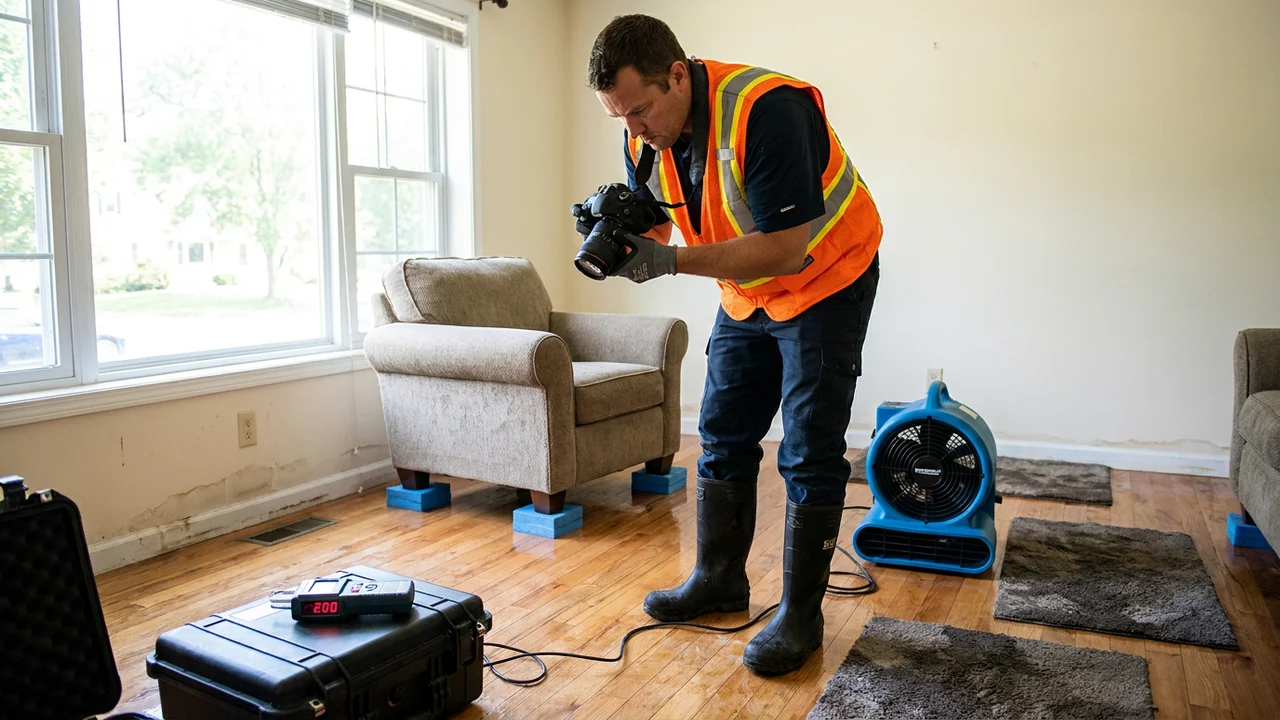
On almost every emergency pipe-burst or sprinkler discharge, the water mitigation crew arrives hours—sometimes a full day—before a dedicated contents team walks through the door. Their emergency mandate under ANSI/IICRC S500 is speed: shut off the valve, extract standing water, block furniture on foam pads, haul out saturated carpet pad, and fire up dehumidifiers before secondary mold takes hold.
That speed saves the structure, yet it routinely destroys the contents claim’s best visual evidence. Once standing puddles are extracted, soaked cardboard cartons are dumped onto the driveway, and furniture legs sit neatly on polystyrene blocks under roaring air movers, the desk adjuster reviewing photos a week later sees dry surfaces and asks why ruined items could not simply be wiped down.
As reinforced in Pipe-Burst Forensic Photography Rules, cross-training mitigation technicians in a compact 15-minute contents evidence freeze protects both ANSI/IICRC S320 documentation and carrier subrogation without slowing emergency stabilization.
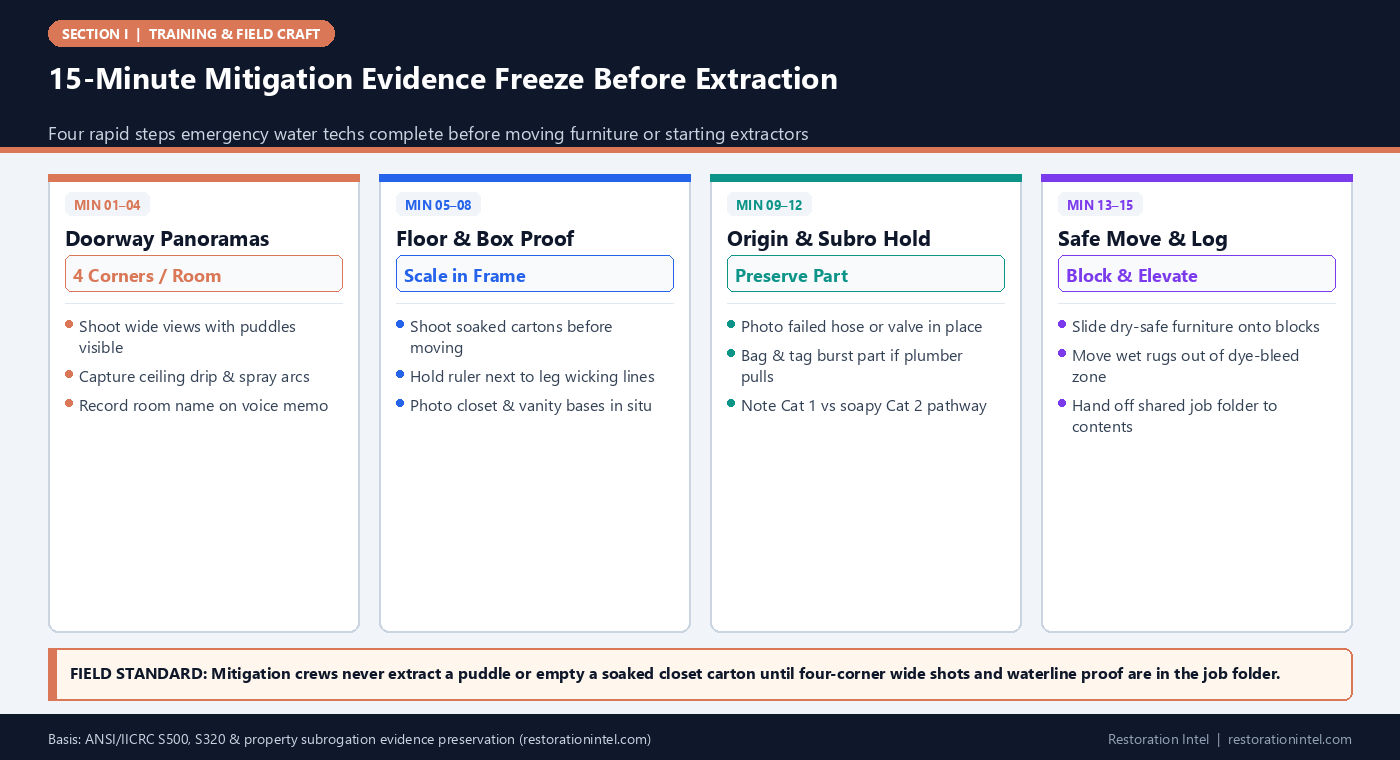
15-Minute Mitigation Evidence Freeze Before Extraction
Mitigation-to-Contents Handoff Matrix During Emergency Stabilization
Exact pre-extraction capture tasks mitigation technicians perform in under 15 minutes versus tasks reserved for the contents team.
| Emergency Scene Zone | What Mitigation Normally Moves Fast | Perishable Evidence Lost If Unshot | 15-Minute Mitigation Capture Rule | Hand-Off Note for Contents Crew |
|---|---|---|---|---|
| Carpeted Living & Bedrooms | Slides sofas and dressers onto foam blocks for extraction | Standing puddle height and wet base rail contact | Wide doorway shot + close-up of leg/skirt touching wet carpet before lifting | Flag MDF dressers with visible base swell |
| Closets & Under-Bed Storage | Pulls damp cardboard boxes into hallway to dry floor | Collapsed wet box bottoms and soaked items inside | Shoot closet floor in situ, open box lids, photo wet contents before dumping | Hold bagged/toted items for contents triage |
| Kitchen & Vanity Sink Bases | Clears cabinet doors to cut wet toe-kicks and run air | Origin spray pattern, chemical puddle, and failed supply line | Photo cabinet interior, label failed hose/valve, bag part for subrogation | Note Cat 2 soap/drain contact vs clean supply |
| Basement Utility & Storage | Sumps standing water and drags out wet shelving contents | Tide line on boxes, shelving legs, and appliance motors | Snap ruler beside waterline on boxes and water heater/washer bases | Tag submerged power tools & appliances unpowered |
| Electronics & Home Office | Unplugs power strips and shifts desk towers out of path | Whether water dripped onto live towers, routers, or cords | Photo wet floor/desk around powered strips before unplugging and elevating | Isolate unpowered; note ceiling drip location |
| Saturated Throw Rugs & Draperies | Rolls wet rugs out onto driveway before pad removal | Dye bleed onto hardwood and curtain-hem water wicking | Shoot rug in place showing bleed/wetness before rolling onto clean poly | Mark breathable roll zone to prevent mildew |
Why Mitigation Speed and Contents Proof Collide in Hour One
Mitigation technicians are trained to act decisively when water is pouring through a kitchen ceiling. Every extra minute of delay lets water wick higher up drywall, seep deeper under floating engineered flooring, and bleed wood stain from chair legs into wet carpet. Telling a mitigation lead to stand idle for three hours waiting for a contents estimator is operationally unrealistic.
Yet moving a soaked particleboard nightstand off wet carpet onto plastic tabs and running three LGR dehumidifiers overnight dramatically changes how that nightstand looks by morning. The standing water is gone, surface sheen dries flat, and only a faint swollen seam underneath hints that the dresser sat in half an inch of water for six hours.
Bridging those competing priorities does not turn water techs into full contents inventory specialists. It simply teaches them to spend ten to fifteen minutes executing a repeatable pre-touch camera sweep—mirroring the clockwise discipline in Room-Sweep Discipline—before the first extractor hose hits the floor.
- No full inventory burden: Mitigation techs do not price, box, or tag individual items—they preserve perishable physical proof of wetness and position.
- Camera before blocks: Make ‘shoot the room before blocking furniture’ as automatic as checking ambient temperature and relative humidity.
- Short voice clips: A 20-second narrated walk per room captures water source, travel path, and odor notes faster than typing.
The Four-Shot Emergency Freeze Drill for Water and Fire Techs
Keep the drill simple enough that a first-year helper executes it reliably at 2:00 a.m. during a frozen-pipe burst. Upon entering any wet or smoke-impacted room, the mitigation technician shoots four mandatory frames in order before touching furniture or clearing walkways.
First is a four-corner wide panorama from the doorway showing ceiling drips, wall streaks, and active floor puddles against furniture bases. Second is a low-angle shot inside open closets, pantries, and vanity cabinets showing stored cardboard cartons sitting in water. Third is a quick scale or moisture-meter frame—holding a pocket ruler or meter pad against a wet sofa skirt or swollen dresser rail. Fourth is the plumbing or appliance failure point itself.
On soot or fire emergencies where emergency board-up and roof tarping occur immediately, the same habit applies: photograph ash fallout on kitchen counters, melted blinds, and open soot pathways before sweeping broken glass or laying protective Ram Board for stabilization crews.
- Box-bottom rule: Never throw away a soggy cardboard box or trash bag of soaked goods until one photo shows the wet bottom and its contents inside.
- Dye-transfer warning: Photograph mahogany furniture stains or rug dye bleeding into wet carpet before slipping foam blocks underneath.
- Shared cloud album: Upload emergency freeze photos straight into the unified claim folder rather than leaving them trapped on one tech’s personal phone.
Preserving Subrogation Artifacts and Category Evidence
Emergency plumbers and mitigation crews routinely clear failed braided toilet supply lines, cracked plastic filter housings, or leaking washing machine hoses while shutting down the leak—and toss the failed fitting straight into a contractor trash bag. When the carrier’s subrogation unit opens a $60,000 contents and structure file two weeks later, the physical component needed to pursue manufacturer recovery is sitting in a municipal landfill.
Cross-training mitigation leads to photograph failed fittings in place, seal any removed component in a labeled clear evidence bag, and record whether water was sanitary Category 1 or contaminated Category 2/3 at discovery protects massive downstream claim value. Equally important, noting detergent suds, toilet overflow debris, or sewage backup odor in the initial room audio log prevents later disputes over why mattresses and rugs were condemned.
When mitigation techs flag non-salvageable perishable food, spoiled refrigerator contents, or swollen cardboard lots cleanly in a labeled witness pile—consistent with Witness-Bin Craft—the contents crew arrives to an organized, defensible site.
- Evidence bag on every truck: Stock heavy zip bags and chain-of-custody tags in mitigation rigs specifically for burst hoses and fittings.
- Category-at-discovery audio: Speak water clarity, soap suds, drain location, and approximate standing time on the initial room clip.
- Do-not-dump hold: Require PM sign-off before hauling any ruined contents to the curb so nothing disappears unphotographed.
Joint Drills and Handoff Accountability Between Divisions
In many restoration companies, mitigation and contents operate as separate silos with separate managers—meaning mitigation sees contents photography as ‘someone else’s problem.’ Changing that culture takes joint tabletop walkthroughs and shared file audits.
Run a 30-minute quarterly ride-along where a contents lead walks a water loss with mitigation crew chiefs, showing real examples of claims paid cleanly versus claims cut because pre-extraction photos were missing—echoing the audit discipline in A Price Tag on a Lost Item Is Worth Nothing. When mitigation techs see that fifteen minutes of camera discipline prevents angry homeowner callbacks and carrier holds on the shared job file, cooperation sticks.
Add a single binary checkbox to the mitigation emergency intake form: ‘Contents Pre-Extraction Freeze Uploaded (Yes/No).’ When the night-dispatch manager checks that box during morning file review, emergency evidence stops slipping through the cracks.
- Cross-division shadowing: Rotate new mitigation leads onto one contents pack-out and vice versa during their first 90 days.
- Shared morning job-folder check: Verify emergency freeze photos hit the job folder before morning dehumidifier monitoring begins.
- Credit good catches: Recognize mitigation techs in morning huddles when their pre-extraction photos save a disputed subrogation or contents item.
Practitioner Verification Checklist (I-23)
- Complete four-corner wide room shots showing puddles, ceiling drips, and furniture contact before starting extraction or placing foam blocks.
- Photograph open closet floors, vanity bases, and saturated cardboard cartons in situ prior to clearing walkways or bagging wet items.
- Capture a scale or moisture-meter reading beside transient waterlines on furniture legs, upholstery skirts, and stored boxes.
- Photograph failed plumbing hoses or valves in place, record water category notes via brief audio, and seal removed parts in labeled evidence bags.
- Upload all emergency freeze media into the shared job folder and brief the incoming contents lead on moved or isolated items.
Standards, Authority References & Related Reading
Primary standards, insurance definitions, and sibling Restoration Intel guides referenced in this brief:
- ANSI/IICRC S500 Water Damage Standard
- ANSI/IICRC S320 Standard for Professional Contents Restoration
- IRMI Insurance Glossary: Subrogation
- Restoration Industry Association (RIA)
- Related Guide: Room-Sweep Discipline: Teaching Technicians a Repeatable Clockwise & Top-to-Bottom Capture Pattern
- Related Guide: Audio Narration Training: Coaching Field Crews to Speak Specs Clearly Without Slowing Pack-Out Speed
- Related Guide: Staging and Photographing the Non-Salvageable Pile: Witness-Bin Craft That Adjusters Can Verify in 60 Seconds
- Related Guide: Two Standards, One Truck: Documentation When the Brand and the Scorecard Disagree
- Related Guide: A Price Tag on a Lost Item Is Worth Nothing
.md twin for desk QA and team training.Frequently Asked Questions
Will cross-training mitigation techs to shoot contents evidence slow down emergency water extraction?
No, when limited to a structured 15-minute pre-extraction freeze. Shooting wide room views, closet floors, and waterlines before moving furniture prevents rework without requiring techs to write full line-item inventories.
What is the single most common piece of evidence lost during emergency mitigation?
Proof of standing water contact on furniture bases and saturated cardboard cartons. Once puddles are extracted, boxes dumped, and furniture placed on foam blocks, dry photos fail to prove severity.
Should mitigation crews ever throw away ruined personal belongings during emergency tear-out?
Only perishable safety hazards if unavoidable—and never without photographing the items in situ first, logging a clear group photo, and getting PM or homeowner authorization.
Why should water techs bag burst supply hoses or fittings?
Failed plumbing parts are critical subrogation evidence. Preserving them with in-situ photos allows the insurer to pursue recovery against defective product manufacturers or negligent installers.