Direct Answer: During active pack-out execution, field technicians follow a clockwise room-boundary sweep, capture a five-step photo sequence from room context down to rating plates and open box interiors, apply dual-face barcode labels to every carton, and enforce strict peril containment so physical items remain traceable from shelf to warehouse rack.
.md twin for estimator QA and carrier file documentation.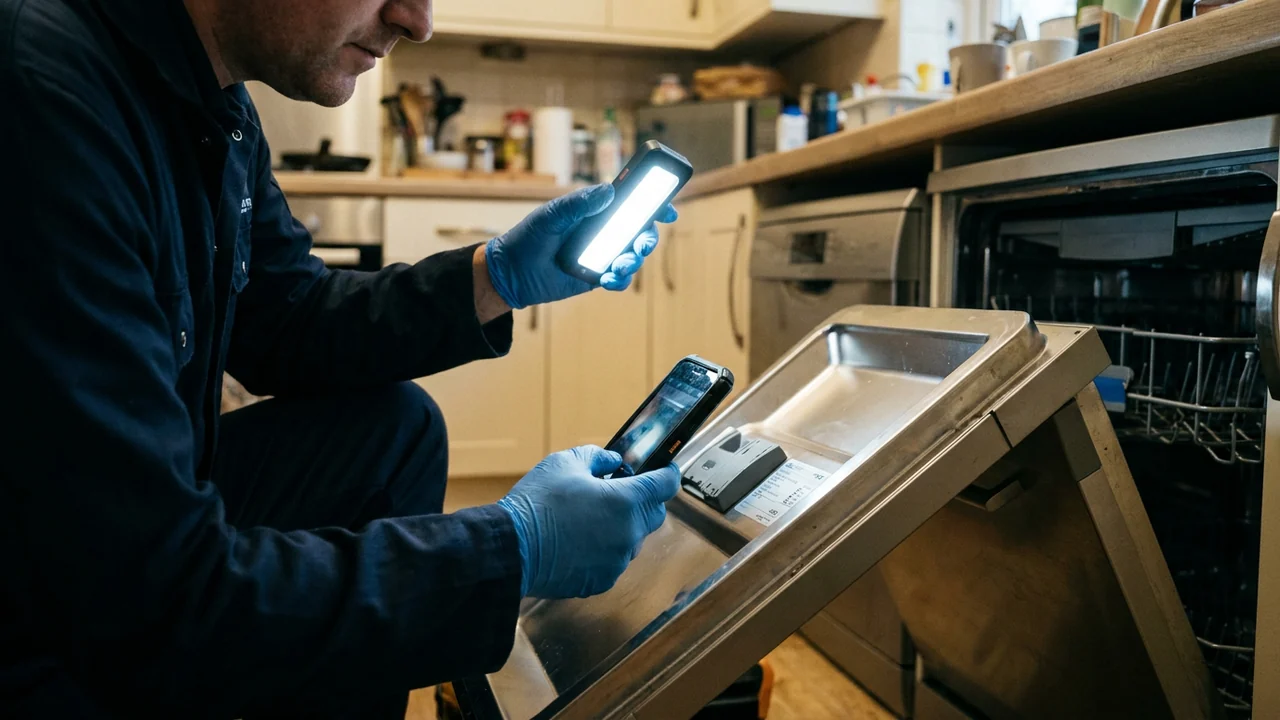
Once packing starts, speed without capture discipline turns a restoration crew into a standard moving company—and moving companies do not survive insurance desk audits. A field technician who wraps twelve stoneware plates in sixty seconds without recording pre-existing chips, maker marks, or which carton received them creates two liabilities at once: the estimator cannot justify specialty cleaning labor, and the company cannot prove whether a hairline crack happened during the fire or inside the truck.
Consistent field capture relies on muscle memory rather than improvisation. Regardless of whether the crew logs lines on a mobile tablet, barcode scanner, or structured sheet, every technician on the truck needs to execute the same sweep direction, the same photo framing order, and the same carton-labeling rules. Under ANSI/IICRC S320, chain of custody is only intact when every container and standalone furniture piece carries a unique identifier tied to documented room origin and pre-pack condition.
In high-volume losses—especially multi-tech fire and smoke jobs governed by ANSI/IICRC S700—documentation breakdowns usually occur at the seams: inside dark lower cabinets, across shift changes, or when helpers drop stray hallway items into half-full kitchen boxes. Tight capture choreography eliminates those silent gaps before tape seals the carton.
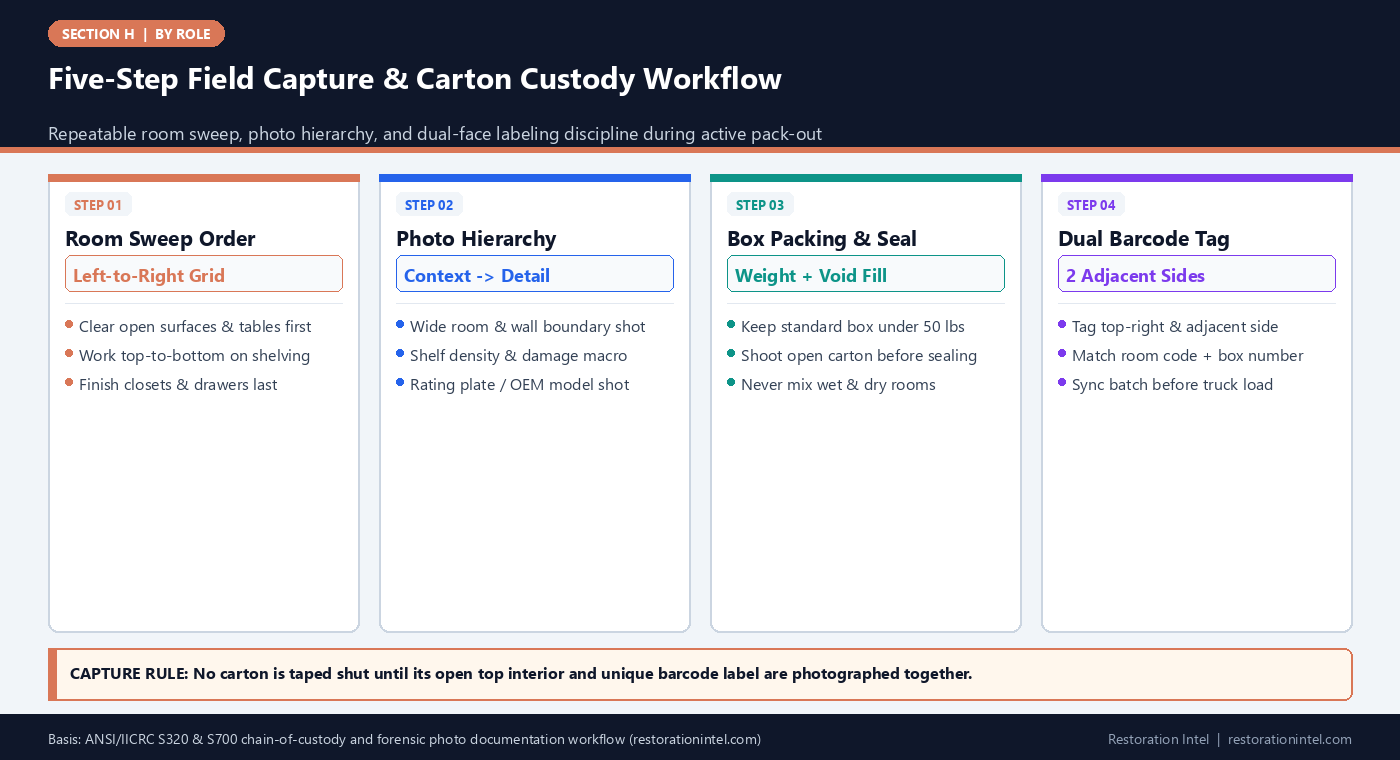
Five-Step Field Capture & Carton Custody Workflow
Field Capture Photo & Labeling Standards by Asset Category
Technicians adjust photographic detail and container tagging based on item fragility, value sensitivity, and carrier review expectations.
| Content Category | Minimum Photo Sequence | Container & Label Rule | Field Condition Note Required | Common Capture Mistake |
|---|---|---|---|---|
| Major Appliances & Electronics | Full front view, rear port layout, sharp macro of rating/serial plate, any soot/water line | Pad-wrapped standalone tag on front top corner + separate bagged cord/remote tag | Power/moisture status, denting, rust, soot accumulation on intake vents | Blurry flash glare washing out model suffix on metallic rating plates |
| Case Goods & Upholstered Furniture | Four-corner walkaround, underside/frame joint if damaged, maker stamp, fabric tear/stain close-up | Blanket-wrapped with stretch film and custody tag on visible outer side | Veneer lifting, pet scratches, water wick height, odor saturation level | Taping adhesive barcode labels directly onto bare wood or leather finishes |
| China, Crystal & Fine Kitchenware | Open cabinet overview, specialty piece maker mark, pre-existing chips, open dish-pack layer shot | Heavy dish pack with cell dividers; FRAGILE + THIS SIDE UP on two faces | Crazing, pre-loss chips, hand-wash gold rim notes, set count | Packing heavy cast iron on top of stemmed glassware or omitting layer padding |
| Closet Wardrobe & Soft Goods | Hanging rack overview, leather/fur/dry-clean tags, visible soot or mildew spotting | Wardrobe box with bar lock or sealed poly garment bag inside carton | Fabric type (wool/silk/leather), wet vs dry state, odor severity | Overstuffing hanging bars until metal brackets tear through carton walls |
| Pantry, Books & Dense Smalls | Shelf-front density shot before clearing, sealed vs opened container check, open box top shot | Small/book carton under 35 lbs for books; medium box for dry pantry/linens | Approximate unit count or shelf count, expiration/open-package status | Pouring loose desk drawers from two different rooms into one unlabeled tote |
| Garage Tools & Hardware Bins | Pegboard/bench context, power tool brand/battery macro, serial tag on high-value tools | Heavy-duty tote or small carton; sharp edges capped in cardboard sleeves | Rust vs fresh water spotting, battery voltage, cord damage | Mixing leaking chemical bottles or fuel-smelling parts with household gear |
Clockwise Room-Boundary Discipline and Zero-Skip Sweeps
Unstructured crews pack whatever catches their eye—a coffee table here, half a bookcase there—leaving behind isolated drawer bottoms, top-shelf luggage, and behind-the-door hooks that surface weeks later when reconstruction demolition begins. Assigning one lead technician per room with a strict clockwise, top-to-bottom sweep removes guesswork. Starting immediately to the left of the main doorway, the crew clears wall art and window treatments, works across upper shelving down to baseboards, and clears closets, nightstands, and under-bed storage in sequence.
Dark spaces create the highest miss rates in contents documentation. Technicians must carry high-CRI headlamps or magnetic rechargeable work lights into walk-in closets, under-sink vanities, laundry alcoves, and attic eaves. Flash-only smartphone shots cast harsh foreground shadows that hide dark appliances, black electronics cables, or soot staining along rear cabinet panels.
When a room cannot be cleared in a single day, the Crew Lead places a brightly colored painter-tape boundary strip across the unfinished cabinet row or shelf and notes the pause point in the shift log. Picking up cleanly at that exact marker the next morning prevents both skipped drawers and double-counted shelves.
- Drawer-last rule: Clear tabletops and open shelving before opening dresser or desk drawers so small loose items are never buried under lamp bases.
- Empty-cavity confirmation: Take one quick confirmation photo showing cleared closets, empty vanities, and bare kitchen cabinets before releasing a room.
- Single-room carton purity: Never top off a dining room box with hallway coat-closet shoes; start a fresh room-coded carton instead.
Executing the Five-Step Forensic Photo Sequence Without Slowing the Line
Good field photography is fast when technicians stop improvising camera angles. Rather than taking twenty aimless pictures of one cabinet, follow a predictable five-shot ladder: (1) an orientation shot from the room doorway showing wall and floor context, (2) a shelf or drawer overview before items are lifted, (3) close-ups of visible loss damage or pre-existing wear, (4) crisp macro shots of brand logos, fabric care tags, and OEM rating plates, and (5) an overhead shot of the packed open carton with its assigned barcode visible beside the top layer.
Rating plates on refrigerators, washers, audio receivers, and commercial tools account for a disproportionate share of capture failures. Direct camera flash bounces off brushed aluminum and glossy stickers, turning model numbers into unreadable white blobs. Technicians should toggle flash off, angle a secondary side work light across the plate, tap to lock focus, and verify sharpness on screen before moving the appliance.
On losses with subtle residue—such as light smoke haze from a protein fire documented under fire pack-out protocols—a white chemical dry-sponge swipe test photographed beside the untouched surface provides undeniable visual evidence that invisible film exists, even when wide room photos look clean.
- Angled side-lighting: Hold a pocket inspection light at 45 degrees rather than using direct flash when shooting metallic serial plates and glass screens.
- Pre-existing damage markers: Point or place a small arrow card beside old scratches, cracked veneer, or missing knobs so wear is distinct from peril damage.
- Cable & hardware bagging: Tape mounting screws, TV stands, and power cords into labeled zip bags anchored directly to the parent piece and photograph the pairing.
Carton Architecture, Dual-Face Labeling, and Multi-Tech Sync Hygiene
A carton label placed only on the top lid vanishes the moment another box is stacked on top of it inside the truck or warehouse vault. Standard crew discipline places the primary barcode or QR label on the upper corner of two adjacent vertical faces—typically the front and right side—so scanners and warehouse leads can read any container without unstacking a pallet. Every label must display the claim identifier, room code, sequential box number, handling tier, and technician initials.
Weight discipline protects both workers and fragile contents. Books, files, vinyl records, and canned pantry goods belong exclusively in small book cartons capped around thirty-five pounds; dishware and glass collectibles ride vertically on edge inside cell-divided dish packs capped under fifty pounds; and lightweight bedding, lampshades, and pillows fill large cartons without creating crush hazards. Overfilled cartons bulge at the seams, causing vault stacks to lean and collapse.
When three or four technicians capture photos across separate tablets on a large loss, duplicate box numbers and orphaned photo batches become a silent failure mode. The Crew Lead should assign fixed box-number blocks per technician or room at the morning huddle (for example, Tech A owns Kitchen 101-199; Tech B owns Primary Bedroom 201-299) and verify local photo sync before lunch and prior to truck departure.
- Two-face label placement: Never place barcodes solely on top flaps or over seam tape where box cutters slice during warehouse receiving.
- Non-adhesive furniture tags: Loop hang-tags through handles or secure labels onto outer stretch film—never stick tape onto lacquered wood, leather, or brass.
- Block-allocated numbering: Pre-assign numeric ranges by room or technician to eliminate duplicate box IDs during simultaneous multi-room pack-outs.
Peril-Specific Containment and Cleaning-Path Tagging in the Field
Pack-out is not just transport; it is the first sorting gate for the warehouse cleaning floor. As highlighted in The Specialty Codes, cleaners lose hours when field crews toss dry-clean wool coats, ultrasonic-safe porcelain, and hand-wipe oiled woodwork into undifferentiated mixed cartons. Using color-coded handling stickers—such as soft-goods laundry/ozone, delicate ultrasonic, hand-clean wood, and electronics—allows warehouse receiving teams to route pallets straight to the proper cleaning bay.
Cross-contamination containment stays active throughout packing. Damp or microbial items must never share a carton with dry paperbacks or clean linens, even within the same room. On fire losses, soot-heavy exterior zones stay outside clean-textile sealing stations, and technicians swap soiled outer gloves whenever transitioning from charred kitchen cabinetry to an adjacent hallway closet.
Whenever a technician uses a field software capture mode alongside XactContents or RIA-aligned field logs, recording accurate handling disposition in the moment eliminates guesswork back at the shop.
- Dry/wet firewall: Bag and tag damp or odor-heavy textiles separately so moisture never wicks into adjacent dry cartons inside the truck.
- Processing route color tags: Mark cartons at sealing time for laundry, ultrasonic, ozone/hydroxyl, electronics, or clean-and-vault.
- Pad-wrap breathability: Never wrap damp solid wood furniture tightly in non-breathable plastic film for multi-day transit; trap moisture causes blush and mold.
Practitioner Verification Checklist (H-10)
- Sweep every room left-to-right and top-to-bottom, finishing drawers and closets last with an empty-cavity sign-off photo.
- Capture the five-shot ladder (room context, shelf overview, damage detail, OEM rating plate, open box interior) for every packed zone.
- Apply readable barcode/room labels to two adjacent vertical box faces and secure hang-tags only onto stretch film or handles on furniture.
- Enforce carton weight limits (under 35 lbs for books/dense smalls, under 50 lbs for dish packs) and keep single-room carton purity.
- Verify unique box-number ranges across all crew devices and sync field photo batches before loading the box truck.
Standards, Authority References & Related Reading
Primary standards, insurance definitions, and sibling Restoration Intel guides referenced in this brief:
- ANSI/IICRC S320 Standard for Professional Contents Restoration
- ANSI/IICRC S700 Fire & Smoke Restoration Standard
- Restoration Industry Association (RIA)
- Verisk XactContents Platform Overview
- Related Guide: Field Contents Technician & Pack-Out Crew Lead: Initial Scope & Loss-Walkthrough Intake
- Related Guide: Field Contents Technician & Pack-Out Crew Lead: Team Handoff Between Field Capture and Desk Estimating
- Related Guide: Restoration Project Manager & Contents Division Lead: Capture & Documentation Execution Workflow
- Related Guide: Contents Restoration After Fire: Pack-Out Protocols, Cleaning Methods, and Insurance Inventory
- Related Guide: The Specialty Codes
.md twin for desk QA and team training.Frequently Asked Questions
Why photograph the open top of every packed box before taping it shut?
An open-box photo with the carton label visible proves both the packing protection used (paper cells, bubble, dividers) and the exact item group inside that box if a dispute arises during warehouse receiving or pack-back.
How do field techs avoid glare on appliance and electronics serial plates?
Turn off the camera flash, illuminate the sticker from a 45-degree side angle with a small inspection flashlight, tap the plate on screen to lock macro focus, and verify legibility before moving the unit.
Can two rooms share the same carton if the last box is only half full?
No. Mixing items from two rooms into one box breaks room-origin tracking, complicates pack-back delivery, and confuses estimators mapping loss locations; fill remaining headroom with crumpled packing paper instead.
What prevents duplicate box numbers when multiple technicians pack simultaneously?
The Crew Lead assigns non-overlapping numeric blocks by room or technician at the start of the job (for example, 100s for Kitchen, 200s for Living Room) and reconciles the scan count prior to loading.