Direct Answer: On medical, educational, legal, or proprietary R&D pack-outs, crews must treat patient charts, student files, diagnostic drives, and trade-secret binders as restricted custody assets—never opening folders, never photographing readable records, and requiring written Business Associate or NDA governance before touching regulated storage.
.md twin for estimator QA and carrier file documentation.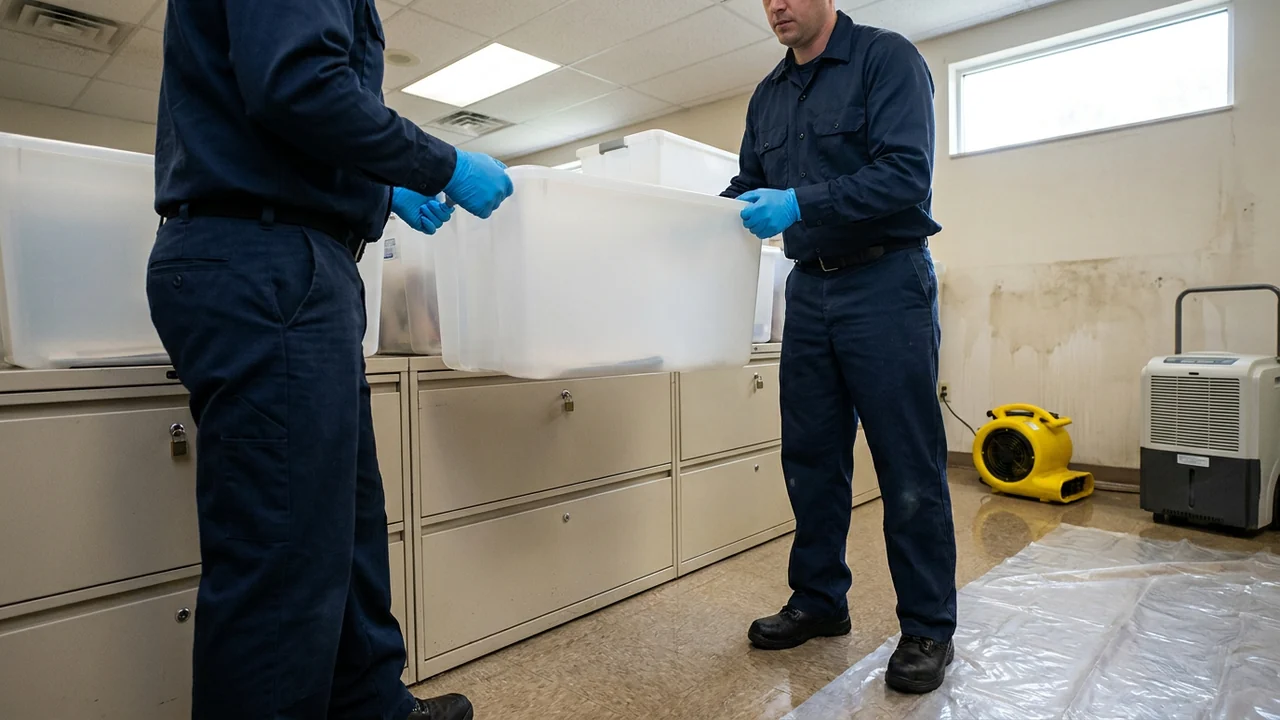
Commercial losses inside dental clinics, outpatient practices, school registrar offices, law firms, and manufacturing labs introduce regulatory privacy liabilities that eclipse the physical value of desks and shelving. A single unblurred close-up photo of a patient intake clipboard, a student disciplinary folder under FERPA, or a proprietary formula binder uploaded to a shared estimating portal can trigger statutory breach notifications and civil penalties.
Guided by the NIST Privacy Framework, ANSI/IICRC S320 custody segregation, and RIA commercial standards, this Field Guide outlines exact containment, zero-read inventory logging, and segregated storage rules for regulated pack-outs.
Regulated Commercial & Clinic Pack-Out Privacy Protocol
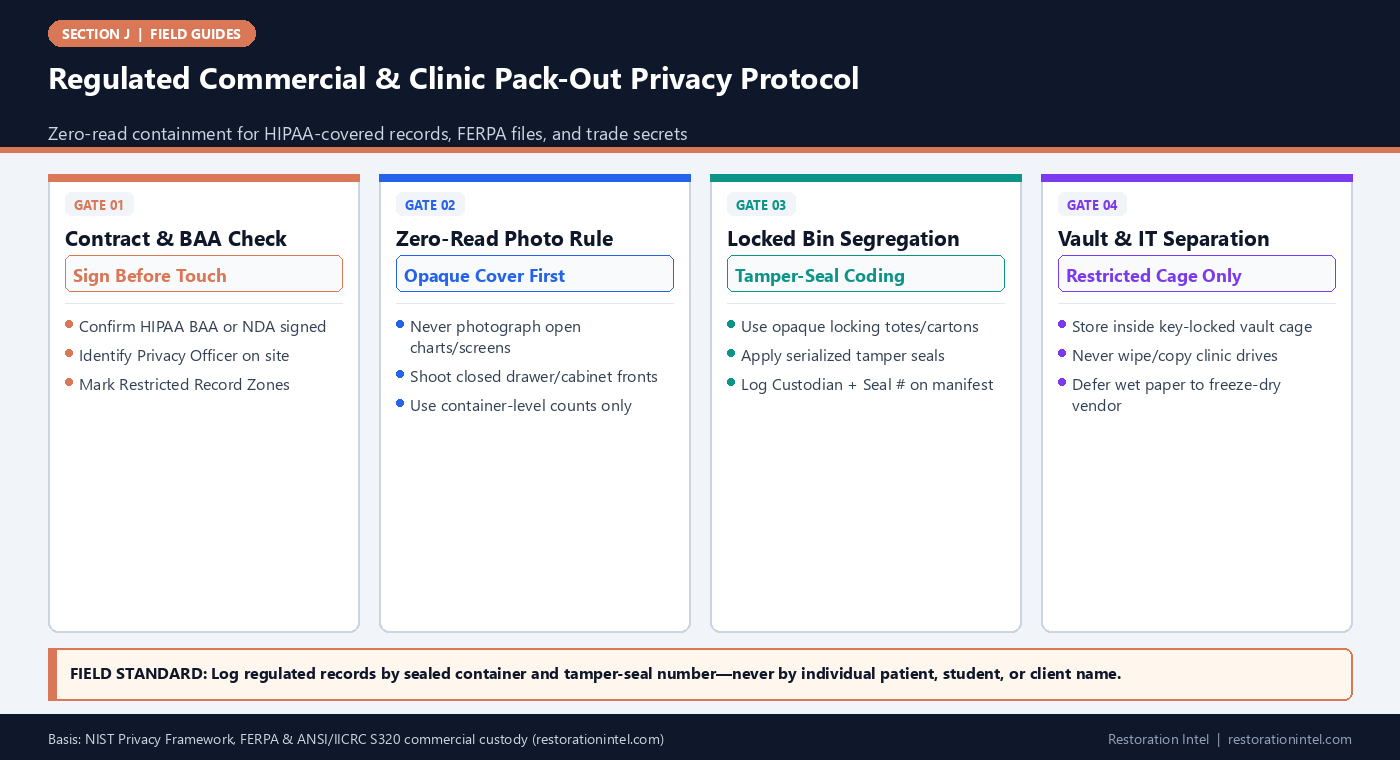
Regulated Record & Trade-Secret Containment Matrix
Apply these site boundaries before moving file cabinets, workstations, or lab binders during commercial mitigation and pack-outs.
| Regulated Asset Class | Typical Loss-Site Locations | Immediate Containment Action | Inventory & Photo Boundary | Custody & Processing Path |
|---|---|---|---|---|
| 1. Clinical & Patient Health Records (HIPAA Practice) | Front-desk sign-in sheets, exam room folders, billing cabinets, film jackets | Close folders immediately; assign site Privacy Officer escort | Log 'Sealed Chart Carton # + Tamper Seal #' ONLY; zero readable text in photos | Sealed opaque bins -> locked vault cage or client-directed HIPAA document recovery vendor |
| 2. Medical Servers, Drives & Imaging Devices | Server closets, X-ray/ultrasound workstations, reception PCs, backup NAS | Disconnect power safely per IT lead; never boot or browse wet drives | Shoot rear asset tag & serial plate only; cover monitor screens | Custody transfer to clinic IT MSP or certified forensic/electronic recovery lab |
| 3. Student & Academic Files (FERPA) | School registrar vaults, counselor drawers, IEP binders, nurse logs | Lock file drawers in place until school official authorizes transfer | Wide cabinet count only; prohibit close-ups of student IDs or transcripts | School-supervised relocation or certified archival freeze-drying vendor |
| 4. Legal, HR & Accounting Case Files | Law firm war rooms, HR personnel cabinets, CPA tax-prep desks | Keep client-matter labels face-down; pack upright inside lidded totes | Count linear feet or sealed box totals; zero document-title captures | NDA-covered restricted vault bay; client privilege sign-off at return |
| 5. R&D Formulas, CAD & Trade Secrets | Lab notebooks, prototype benches, QA testing binders, tooling drawings | Clear cameras from lab bench until owner covers proprietary prototypes | Owner-approved generic description ('R&D Lab Binder Lot — 4 Boxes') | Dedicated locked crate or direct retention by client security team |
| 6. Payment Terminals & POS / PCI Media | Retail counters, clinic check-out desks, merchant batch paper rolls | Isolate damaged POS terminals and paper batch slips in sealed pouch | Log terminal model/serial only; never capture credit card slips or PIN pads | Direct handoff to merchant IT/processor for compliant destruction or swap |
Pre-Pack Governance: Privacy Officers, BAAs, and Non-Disclosure Agreements
On residential losses, a standard work authorization lets crews begin photography immediately. On medical clinics, pharmacies, behavioral health offices, schools, or commercial R&D facilities, crossing the threshold with cameras out before confirming privacy governance can breach federal privacy obligations and commercial contracts. Under HIPAA privacy practice, third-party vendors who pack, transport, store, or dry Protected Health Information (PHI) typically operate under a signed Business Associate Agreement (BAA) or direct on-site clinic supervision.
Similarly, public schools and universities handling student records under FERPA, as well as engineering firms safeguarding trade secrets, require designated client custodians on site before restricted cabinets are unlocked. Establish the written scope, site Privacy Officer contact, and camera restrictions during the initial commercial walkthrough.
- Pre-entry gate: Verify whether a BAA, NDA, or FERPA vendor addendum is required before any crew enters record rooms.
- Site custodian rule: Request that the clinic manager, IT director, or school administrator lock or supervise sensitive areas before general mitigation starts.
- Crew briefing log: Document that every technician assigned to the site signed a brief job-specific confidentiality acknowledgment.
Executing Zero-Read Inventory and Camera-Safe Field Capture
General contents estimators need line counts, box volumes, and damage status—they never need to read a patient’s diagnosis, a student’s Individualized Education Program, or a manufacturer’s chemical formula. Field teams must adopt strict zero-read logging: inventory regulated documents strictly by filing cabinet drawer, linear shelf feet, or sealed opaque container ID.
Every smartphone or tablet camera represents a cloud-syncing exposure vector. Cover open clipboards, X-ray films, and desktop monitors with opaque poly or kraft paper before taking wide room context shots. If wet paper documents require recovery, photograph only the soaked exterior stack edge to substantiate water-height damage without flipping pages open.
- Closed-cover rule: Keep binder covers, folder tabs, and file drawers closed or shielded whenever room cameras are active.
- Linear-foot estimating: Measure soaked paper records by linear shelf feet or bankers-box count for specialist freeze-drying estimates.
- Zero-personal-phone rule: Require company-managed, encrypted capture devices on regulated commercial losses—never personal tech phones.
Handling Wet Paper Records, Servers, and Diagnostic Workstations
When fire sprinklers or burst overhead pipes soak medical charts or legal files, crews have a narrow 24-to-48-hour window before ink bleeds and mold colonizes damp pulp. Do not fan open confidential pages across warehouse drying tables where unauthorized staff can read them. Instead, pack soaked bundles tightly inside lined plastic totes with serialized tamper seals and route them immediately to a certified archival vacuum freeze-drying facility operating under matching privacy agreements.
Electronic workstations, clinic servers, and imaging laptops require equal restraint. Never power on wet computers, never pull hard drives without IT sign-off, and never let non-cleared personnel browse unlocked screens. Log only chassis asset tags, manufacturer plates, and physical moisture lines.
- No-fanning privacy rule: Keep confidential wet charts bundled upright in sealed cold-storage totes rather than open warehouse racks.
- Drive-custody lock: Have the client’s IT vendor pull or image encrypted drives on site when business continuity demands immediate data recovery.
- Document destruction sign-off: If water-ruined PHI or student files are deemed non-salvageable, route exclusively through NAID-certified shredding with a certificate of destruction—never open roll-offs.
Segregated Vault Storage and Tamper-Evident Chain of Custody
Regulated commercial boxes cannot sit beside open residential household pallets on an unlocked warehouse floor. Establish a dedicated, access-controlled cage or locked vault room with key-log sign-in and security cameras aimed at the exterior door—not at open paperwork. Each container receives a serialized numbered zip-tie or adhesive tamper seal recorded on the master custody sheet.
When returning cleared cabinets and sealed boxes, conduct a joint seal-number audit with the site Privacy Officer or office manager. Confirming intact seals from site pickup through reset gives commercial clients and insurers verifiable proof that no unauthorized exposure occurred during restoration.
- Serialized seal log: Record both outgoing and incoming plastic seal numbers on every regulated tote.
- Locked vault access list: Restrict physical key or badge access to the secure cage to the project manager and warehouse lead.
- Certificate of return/shred: Archive signed seal-verification receipts or certified shredding certificates directly in the closed claim file.
Practitioner Verification Checklist (J-07)
- Confirm required BAA, NDA, or FERPA vendor authorizations and designate the client’s on-site Privacy Officer before entering record zones.
- Shield open patient charts, student records, computer monitors, and proprietary lab benches before taking any room context photographs.
- Log regulated documents strictly by sealed container ID, linear feet, and serialized tamper-seal number—never by individual names or text.
- Store packed regulated totes inside a locked, access-logged vault cage or route directly to a BAA-covered freeze-dry or IT vendor.
- Route any approved non-salvageable regulated paper solely through certified cross-cut shredding with a signed certificate of destruction.
Standards, Authority References & Related Reading
Primary standards, insurance definitions, and sibling Restoration Intel guides referenced in this brief:
- NIST Privacy Framework
- US Department of Education FERPA Student Privacy Guidance
- ANSI/IICRC S320 Standard for Professional Contents Restoration
- Restoration Industry Association (RIA)
- Related Guide: Field Guide: Chain-of-Custody Form Elements & Pack-Out Sign-Off Template
- Related Guide: Field Guide: High-Sensitivity Legal Exclusions — Firearms, Medications, Cash, Jewelry, and Passports
- Related Guide: Field Guide: Commercial Tenant vs Landlord Split Quick-Reference Table
- Related Guide: Field Guide: Customer Release & Authorization Language Checklist (Work Auth, Cleaning Risk, and Disposal)
- Related Guide: S320 Public Review Is Open
.md twin for desk QA and team training.Frequently Asked Questions
Do restoration crews need a Business Associate Agreement before packing a medical clinic?
Whenever the contractor will transport, store, dry, or handle containers holding Protected Health Information without continuous clinic staff escort, a signed BAA or equivalent client privacy contract should be executed first.
How should crews photograph water-damaged patient charts or legal files for insurance proof?
Photograph the outside of the wet file cabinet, drawer water line, or packed bankers-box stack with file labels hidden or covered—never shoot close-up frames showing patient names, diagnoses, or client-matter details.
Can wet HIPAA or FERPA records go into a standard non-salvageable dumpster once authorized?
No. Regulated personal or medical records cannot be discarded in open dumpsters or public landfills. Total-loss sensitive documents must go through certified secure shredding with a formal Certificate of Destruction.
What should crews do with clinic servers or desktop computers after a water loss?
Do not power on wet hardware or attempt to copy data. Document the exterior brand, model, asset tag, and water line, then coordinate custody handoff to the clinic’s IT provider or a certified electronics/data recovery specialist.