Direct Answer: A pre-loss contents baseline goes stale as soon as rooms are remodeled, commercial CapEx equipment is installed, or seasonal high-value purchases arrive; property owners keep claim files defensible by pairing a quick annual reconciliation with event-triggered 15-minute delta captures whenever major spend or layout changes occur.
.md twin for estimator QA and carrier file documentation.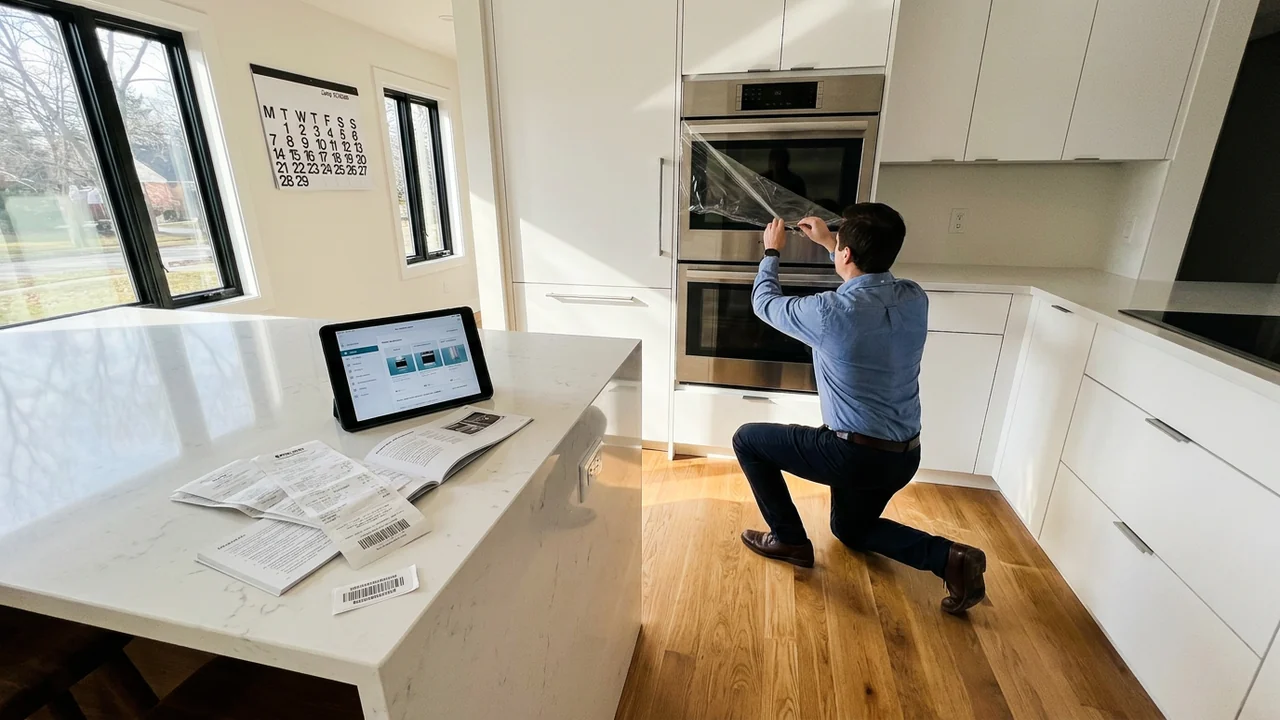
A pre-loss contents baseline is a living asset record, not a permanent trophy. The moment a homeowner finishes a kitchen remodel, a dental clinic commissions new operatory hardware, or a family unpacks holiday electronics and jewelry, an unedited walkthrough from two years earlier stops reflecting reality. When a pipe burst or fire hits after those upgrades, missing delta documentation forces estimators to reconstruct recent acquisitions from bank statements and charred packaging.
Property owners avoid refreshing their inventories because they assume every update means repeating the entire building walkthrough from scratch. In practice, disciplined readiness relies on the same incremental principle used in the minimum viable pre-loss walkthrough: keep the original baseline intact and capture brief, event-triggered delta folders only for rooms or asset classes that changed.
Following structured recordkeeping modeled on IRS Publication 584 and ANSI/IICRC S320 continuity standards keeps every addition verifiable by date while preserving clear audit provenance for adjusters and brokers.
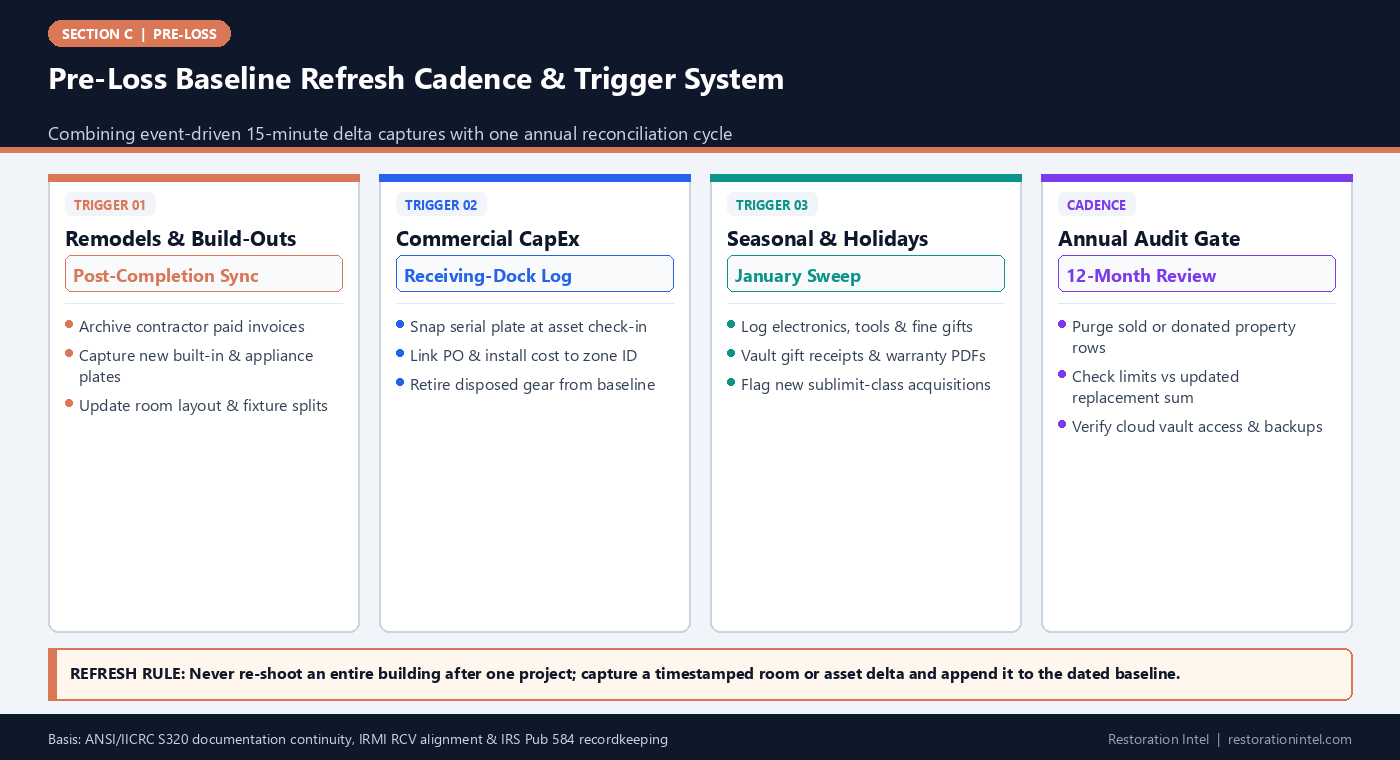
Pre-Loss Baseline Refresh Cadence & Trigger System
Pre-Loss Refresh Triggers, Update Scope & Claim Exposure Matrix
Operational cadence mapping life and business events to targeted baseline updates so pre-loss files never drift years behind physical reality or policy limits.
| Refresh Trigger Event | Target Update Window | Required Delta Evidence | Vault & Register Action | Post-Loss Dispute Prevented |
|---|---|---|---|---|
| 1. Residential Kitchen, Bath, or Room Remodel | Within 14 days of punch-list sign-off | Updated room sweep video, appliance rating plates, custom fixture and window-treatment receipts | Supersede prior room folder with dated revision; split built-in vs portable items | Adjuster relying on older pre-remodel MLS or walkthrough photos showing builder-grade finishes |
| 2. Commercial CapEx & Machinery Installation | At receiving-dock check-in / commissioning | Serial/model plate close-up, vendor PO, rigging/install invoice, and floor-zone placement tag | Append asset row to fixed-asset crossover log; mark retired unit as Disposed/Sold | Unscheduled new equipment missing from prior year-end depreciation ledger at time of fire |
| 3. Holiday, Birthday & Major Retail Acquisitions | First week of January (post-holiday sweep) | Item photo in room, packaging/spec label, digital receipt or gift-provenance note | Add to room inventory; review jewelry, art, electronics, and tool counts for sublimit thresholds | Missing proof for recently gifted high-tier electronics, optics, instruments, or tools |
| 4. Move-In, Relocation, or Tenant Expansion | Within 30 days of occupancy | Full suite/room overview video, updated lease boundary notes, newly assembled furnishings | Re-index room tree to match new floor plan and emergency contact/utility shutoff tree | Stale prior-address baseline rejected because room names and asset locations no longer match |
| 5. Major Divestiture, Estate Gift, or Liquidation | Same month as disposition | Sale receipt, donation acknowledgment, or transfer log for removed high-dollar assets | Move rows to Archived/Removed tab rather than leaving phantom property in active totals | Credibility collapse when a baseline claims items that were visibly sold or moved years earlier |
| 6. Annual Policy Renewal Checkpoint | 30-45 days before renewal date | 15-minute spot check of high-value rooms plus aggregate replacement total check | Export total updated baseline sum for owner/broker review against BPP or Coverage C limits | Silent underinsurance or commercial co-insurance surprises after multi-year inflation |
Why Static Pre-Loss Inventories Fail Within Two Years
Most property owners treat a pre-loss contents inventory like a one-time fire drill: they film a walkthrough when moving into a home or signing a commercial lease, save the video to a folder, and never touch it again. Five years later, when a supply line bursts or an electrical fire damages two floors, that static baseline reflects a building that no longer exists.
Rooms have been upgraded, laptops and televisions have turned over twice, commercial practices have added imaging or lab hardware, and seasonal purchases have accumulated in closets and garages. When an adjuster compares the five-year-old video against the charred or waterlogged loss site, every mismatch invites skepticism rather than speed.
A stale baseline can also create credibility risk in the opposite direction. If a file still lists sold machinery, donated furniture, or prior-generation equipment as active property, submitting that unedited record forces estimators to spend hours defending why the physical debris does not match the pre-loss list—delaying settlement under claim verification workflows.
- Asset churn reality: Electronics, small appliances, tools, and business equipment turn over far faster than structural walls.
- Remodel blind spots: Upgraded cabinetry, appliances, and furnishings remain invisible if the only file on record predates renovation.
- Revision hygiene: Dated delta folders let owners prove when each asset entered the building without fabricating history.
The Four Event Triggers That Mandate a 15-Minute Delta Capture
Asking homeowners or busy facility managers to re-document an entire building every quarter guarantees non-compliance. Instead, durable readiness programs rely on event-driven triggers that require only 10 to 15 minutes of targeted capture immediately after property changes hands or rooms change function.
The first trigger is any physical remodel or tenant improvement. Before contractors pack up after a kitchen renovation, office build-out, or lighting retrofit, the owner walks the updated space for five minutes, reads new finish specs aloud, photographs appliance rating plates, and drops paid contractor invoices into the matching vault folder.
The second and third triggers cover commercial CapEx arrivals and annual seasonal/holiday acquisitions. Recording new machinery, workstations, or point-of-sale gear at the receiving dock takes 60 seconds per asset, while a single early-January sweep captures holiday electronics, hobby gear, and specialty gifts before boxes and receipts are recycled. The fourth trigger is disposition—archiving sold or donated items out of active totals so the register stays honest.
- Post-remodel lock: Capture finished rooms alongside contractor closeout packets and permit sign-offs.
- Receiving-dock habit: Photograph serial tags and vendor invoices before new commercial gear enters production.
- January holiday sweep: Document newly acquired gifts, tools, and electronics before warranty slips disappear.
Running a Lightweight Annual Reconciliation Without Re-Filming Everything
Between event-driven updates, one structured annual checkpoint timed 30 to 45 days before insurance renewal keeps the entire dossier aligned. Rather than starting from scratch, the owner or facility lead opens the existing room tree and runs a rapid visual verification focused on high-dollar zones: mechanical rooms, server closets, kitchens, garages, and primary storage.
During this annual check, the reviewer verifies that cloud storage links still open cleanly, confirms that receipt and serial vault folders follow consistent naming conventions as outlined in pre-loss serial plate and invoice vaulting, and archives any retired equipment rows onto a separate Removed/Sold tab with approximate disposition dates.
Finally, the updated schedule total is compared against current replacement-cost exposure using structured worksheets modeled on IRS Publication 584 and IRMI Replacement Cost Value principles. If cumulative remodels and CapEx additions have pushed contents value well above existing policy limits or sublimits, the property owner brings that factual inventory total to their licensed insurance broker prior to renewal.
- Non-destructive archiving: Move sold or scrapped items to an archive tab instead of deleting historical audit trails.
- Renewal timing: Complete the annual check six weeks ahead of policy renewal so limit reviews are proactive, not rushed.
- Broker handoff boundary: Use the refreshed total as factual asset data for your licensed broker—never self-guess policy endorsements.
Versioning Rules So Estimators Can Reconcile Revisions After a Loss
How updates are saved matters almost as much as capturing them. Overwriting an original walkthrough file with an edited spreadsheet erases provenance and makes it harder for a contents specialist under ANSI/IICRC S320 and RIA practices to show how long an asset was in service before the casualty.
A clean versioned repository keeps the original baseline folder read-only and appends dated delta folders—such as `2026-04_Kitchen_Remodel_Delta` or `2027-01_Holiday_Acquisitions`—each containing its own walkthrough clip, close-up rating plates, and PDF receipts. An index log at the root of the dossier lists every revision date and room affected.
When a loss occurs, the restoration estimator starts with the latest consolidated room register and traces any disputed high-dollar line directly back to its dated delta folder. This audit trail transforms post-loss discovery from guesswork into a straightforward chronological record.
- Immutable base + dated deltas: Keep original capture files intact and store updates in YYYY-MM event folders.
- Single master index: Maintain a one-page revision table noting date, room/zone updated, and file count added.
- Cross-check before submission: After a casualty, reconcile delta additions against surviving physical debris to avoid double counting.
Practitioner Verification Checklist (C-13)
- Keep the original walkthrough baseline intact as a read-only archive and append all future updates in dated YYYY-MM delta folders.
- Trigger a 15-minute delta capture within 14 days of completing any residential remodel, commercial build-out, or major layout change.
- Photograph serial plates and archive purchase invoices at receiving for all commercial CapEx equipment and high-tier portable tools.
- Schedule an annual post-holiday sweep in January to log new electronics, gifts, and potential sublimit-class acquisitions.
- Run a 30-to-45-day pre-renewal reconciliation to archive disposed assets and share updated factual replacement totals with your licensed broker.
Standards, Authority References & Related Reading
Primary standards, insurance definitions, and sibling Restoration Intel guides referenced in this brief:
- ANSI/IICRC S320 Standard for Professional Contents Restoration
- Restoration Industry Association (RIA)
- IRMI Insurance Glossary: Replacement Cost Value (RCV)
- IRS Publication 584: Casualty, Disaster, and Theft Loss Workbook
- Related Guide: The Minimum Viable Pre-Loss Walkthrough: What Any Property Owner Can Capture in 45 Minutes
- Related Guide: Pre-Loss Serial Plate and Invoice Vaulting: Organizing Digital Proof So Fire or Flood Doesn't Destroy It
- Related Guide: Preventing Co-Insurance Penalties Through Accurate Pre-Loss Contents Valuation
- Related Guide: High-Value Personal Property Sublimits: Identifying Jewelry, Firearms, Silver, and Art Before a Loss
- Related Guide: A Pack-Out Record Is Not a Priced Inventory
.md twin for desk QA and team training.Frequently Asked Questions
Do I have to re-film my entire home or business every year to keep a pre-loss baseline valid?
No. Keep your original baseline archived and capture only 10-to-15-minute delta updates for remodeled rooms, new CapEx equipment, or annual seasonal acquisitions, paired with one brief annual reconciliation.
When is the best time to document a remodel or commercial tenant build-out?
Immediately at contractor punch-list sign-off while all finishes, cabinetry, fixtures, and appliance model plates are clean and contractor closeout invoices are easily collected.
How should sold, donated, or scrapped equipment be handled in an existing inventory?
Move retired items to a separate Archived or Removed tab with the approximate disposition date rather than leaving phantom property inside active replacement totals.
Why time the annual baseline check 30 to 45 days before insurance renewal?
Completing the reconciliation ahead of renewal gives owners and facility managers factual asset totals to review with their licensed insurance broker before policy limits and co-insurance schedules lock for another year.