Direct Answer: Restoration Project Managers defuse homeowner and business-owner friction by setting explicit expectations on restoration limits, chain-of-custody milestones, and policy holdbacks in writing on day one—staying strictly inside technical documentation boundaries without crossing into unauthorized policy interpretation.
.md twin for estimator QA and carrier file documentation.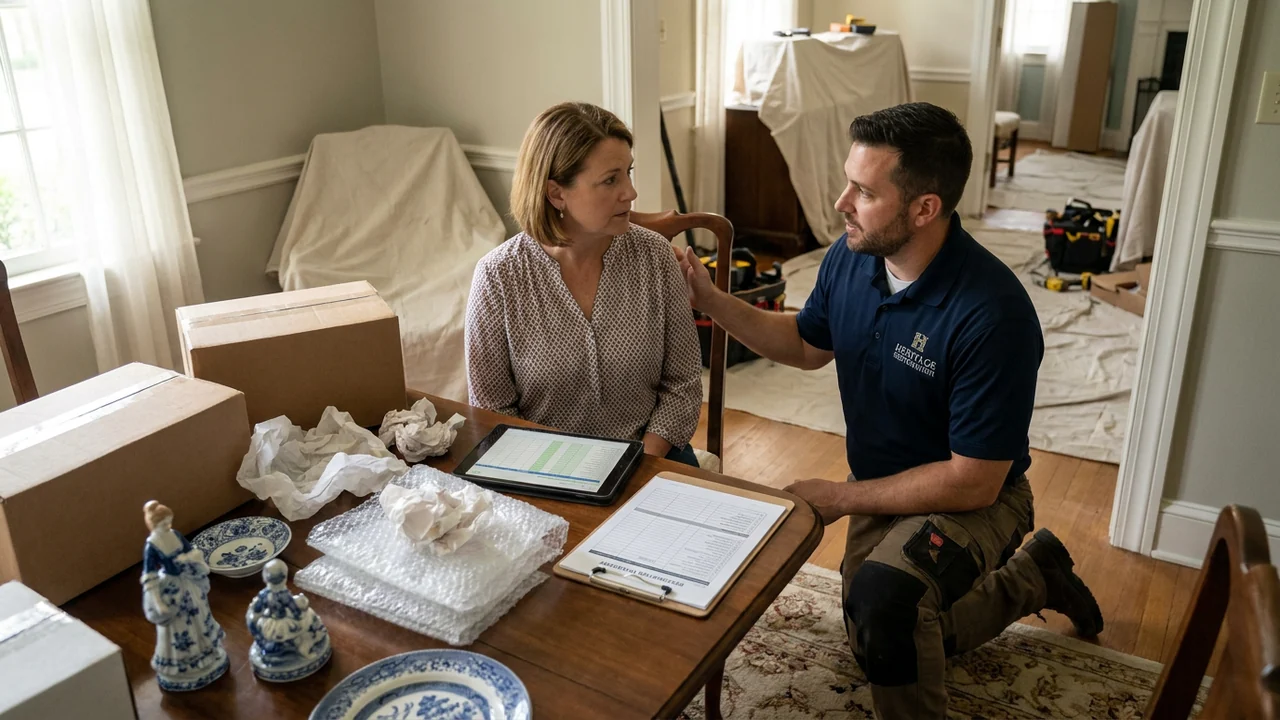
Contents work is deeply personal in a way structural drywall and framing never are. A homeowner staring at smoke-damaged family albums, children’s keepsakes, and wedding china—or a business owner watching revenue halt while commercial equipment sits in wet debris—experiences acute loss-grief and financial panic simultaneously. When communication goes quiet or expectations stay vague, that stress converts straight into anger directed at the nearest Restoration Project Manager.
Yet well-meaning project managers often trigger even bigger crises by overpromising to calm someone down in the hallway. Telling an upset insured ‘Don’t worry, insurance will buy you a brand-new dining set’ or guaranteeing specific cash payouts crosses dangerous legal and regulatory lines regarding the unauthorized practice of public adjusting (UPPA) while setting up bitter conflict when the carrier applies IRMI ACV depreciation or policy sublimits.
For Company Owners, General Managers, and Contents Division Leads, high-stress communication is a core operational discipline. Pairing compassionate transparency on ANSI/IICRC S320 restoration procedures with disciplined written recaps, clear access rules for packed vaults, and respectful stakeholder alignment under RIA professional ethics turns volatile losses into five-star referrals.
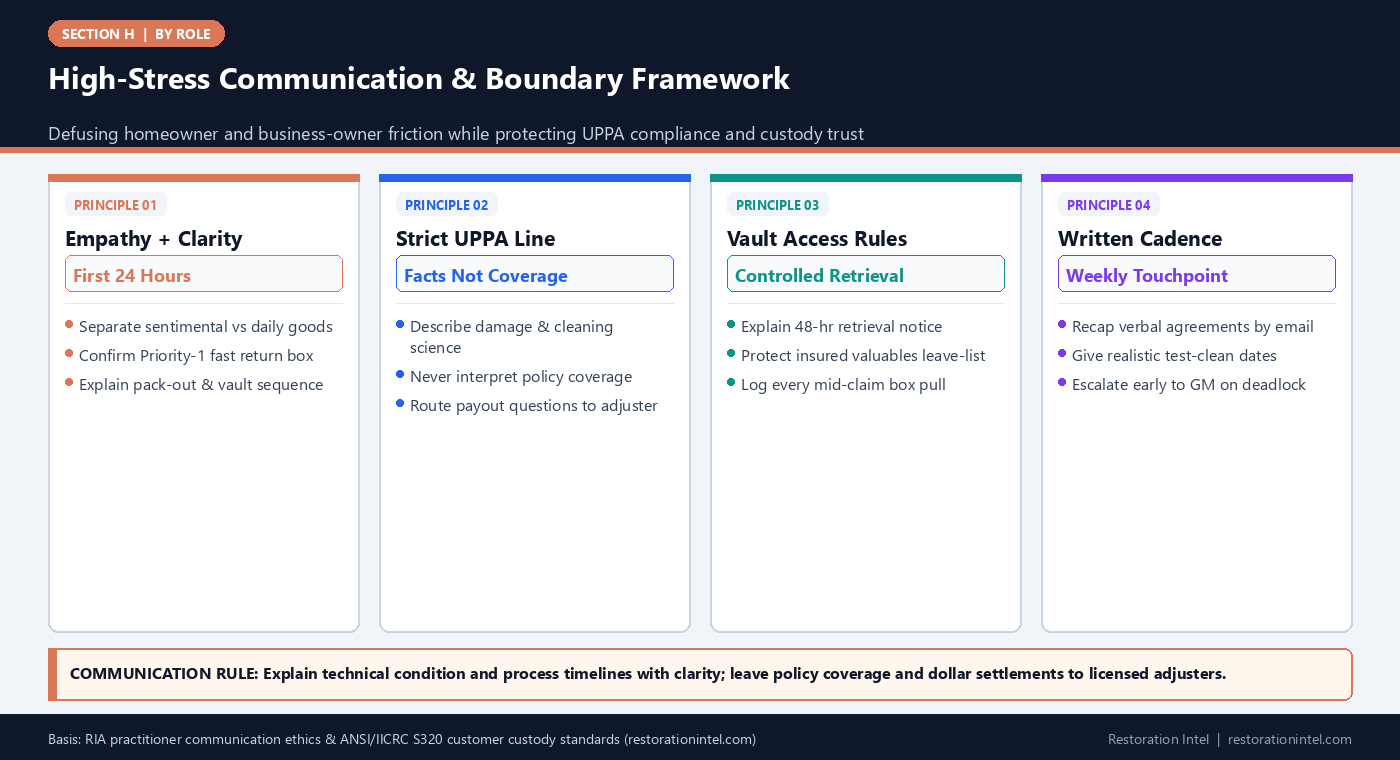
High-Stress Communication & Boundary Framework
High-Stress Stakeholder Friction Scenarios & Compliant PM Responses
Practical communication guardrails for Restoration Project Managers handling tense homeowner, business-owner, and adjuster moments.
| Friction Trigger | Underlying Stakeholder Anxiety | Unsafe / Non-Compliant Reaction | Compliant Operator Script & Action | Documentation Trail |
|---|---|---|---|---|
| Insured Demands Full Replacement Instead of Cleaning | Fear of lingering smoke odor, contamination, or inferior restored feel | 'Sure, we will write everything as totaled so you get new replacements.' | 'We document condition and run verifiable test cleans under S320; your adjuster determines replacement vs restoration under your policy.' | Written test-clean result memo + photos |
| Panic Over Losing Daily Essentials & Kids' Items | Disruption of school, work, and daily household routine during pack-out | Packing entire closets indiscriminately into deep storage vaults | Establish Priority-1 fast-track cartons (work attire, meds, school gear, cookware) for expedited clean/return | Highlighted Priority-1 box list signed at intake |
| Surprise Over Initial ACV Check & Holdbacks | Sticker shock seeing depreciation subtracted from total schedule RCV | Arguing carrier math directly or advising insured on legal settlement tactics | Explain neutrally that carriers typically release initial ACV and hold recoverable depreciation until receipts; refer policy math questions to adjuster | Referral email connecting insured & adjuster |
| Heirloom / Sentimental Item Anxiety | Terror that irreplaceable family items will be lost, broken, or discarded | Treating antique keepsakes with casual assembly-line packing speed | Hand-wrap separately in insured's presence, photograph pre-move state, and assign tamper-evident high-priority box tags | Itemized sentimental custody receipt |
| Commercial Down-Time & Access Demands | Lost daily revenue, payroll pressure, and locked-up client files or inventory | Promising unrealistic 48-hour full-plant return without capacity check | Build phased return schedule prioritizing revenue-critical workstations, servers, and active stock first | Phased commercial continuity schedule |
| Unexpected Vault Retrieval Requests Mid-Claim | Insured suddenly needs seasonal coats, tax records, or specific boxes from warehouse | Allowing unlogged self-service digging inside stacked warehouse aisles | Require 48-hour retrieval notice, pull box to clean viewing bay, document pulled items, and obtain signed release | Signed Vault Access & Item Pull Log |
Drawing the Bright Line Between Technical Guidance and Public Adjusting
In almost every state, negotiating insurance policy coverage, interpreting exclusions, or advising policyholders on how much money a carrier legally owes constitutes public adjusting—an activity strictly restricted to licensed public adjusters and attorneys. Well-meaning Restoration Project Managers slip across that boundary every day when they try to reassure stressed clients with statements about what ‘should be covered’ or promise total-loss buyouts.
Division leads protect both the company and the customer by instituting crystal-clear communication scripts. As illustrated in The Adjuster Desk: One Standard, Two Chairs and Three Adjusters, Three Economies, carriers operate under varied policy forms and valuation philosophies. The contractor’s authority begins and ends with physical facts: what peril touched the asset, what restoration method is technically viable under S320, what that service costs, and what a verifiable LKQ item sells for in the market.
When a policyholder asks whether their RCV endorsement covers a luxury item or why depreciation was withheld, the RPM explains the general industry concept neutrally if appropriate, then immediately puts the specific policy question in a shared email to the assigned adjuster.
- Technical facts only: Speak authoritatively on soot penetration, microbial risk, cleaning test results, and custody timelines—never policy coverage.
- Zero settlement promises: Prohibit field staff from predicting carrier approval outcomes or guaranteed holdback payouts.
- Transparent three-way email: Keep the insured and adjuster aligned via factual written updates rather than off-the-record side promises.
Protecting Sentimental Property and Establishing Priority-1 Essentials
Most homeowner hostility during pack-outs stems from feeling helpless while strangers carry personal life possessions out the front door. Project Managers can defuse up to 80 percent of that emotional friction in the first hour by giving the family structured control over two buckets: Priority-1 daily essentials and sentimental keepsakes.
Before general boxing begins, walk through bedrooms, home offices, and the kitchen with the homeowner to pack or set aside a clearly marked set of Priority-1 cartons—laptops, work uniforms, children’s school supplies, medical equipment, and core cooking utensils. Fast-tracking Priority-1 cleaning and delivery within days rather than months proves immediately that the company cares about the family’s daily life.
For irreplaceable sentimental items—photo albums, military medals, family quilts, and hand-me-down porcelain—slow down visibly in front of the owner. Use clean acid-free tissue or dedicated mirror-packs, log individual item descriptions rather than generic box labels, and capture clear photo receipts on site so the insured watches their memories handled with visible respect.
- Walk-the-keepsakes ritual: Spend fifteen deliberate minutes tagging sentimental items with the owner before production crews accelerate.
- Priority-1 orange/blue tape: Color-code urgent daily cartons so warehouse cleaning bays process them ahead of general storage.
- Controlled vault access policy: Explain warehouse retrieval fees and 48-hour notice rules upfront so mid-claim box requests never spark surprises.
Managing Commercial Business-Owner Urgency and Phased Continuity
Residential clients worry about comfort and memories; commercial owners worry about payroll, lease penalties, customer churn, and regulatory compliance. A dentist whose clinic suffered a sprinkler discharge or a restaurateur hit by a grease-hood fire calculates losses by the hour, not the month.
General Managers and Division Leads must tailor commercial communication around operational continuity rather than generic pack-out schedules. During day-one intake, map which assets generate immediate revenue—IT racks, point-of-sale hardware, specialized exam chairs, active patient/client records, and core production tools—versus archival storage and lobby furnishings.
Presenting a written, phased restoration schedule within 24 hours gives the business owner concrete dates for temporary space setup and critical equipment return. Coordinating directly with the client’s IT vendor, facility manager, and commercial adjuster positions the restoration company as a decisive business-continuity partner.
- Revenue-first triage: Prioritize cleaning and diagnostic testing on core revenue-producing machinery before lobby decor.
- Vendor coordination calls: Include the client’s IT, medical-equipment, or kitchen service reps early so calibration isn’t delayed.
- Executive milestone briefs: Send concise bullet updates every 48 to 72 hours to ownership so commercial leaders never chase status.
Written Recap Discipline and Early GM Escalation Protocols
In high-stress environments, people routinely forget or misremember verbal conversations. A homeowner exhausted after a 2:00 a.m. fire may hear ‘We will inspect the sofa at the shop’ as ‘We are throwing the sofa away and replacing it.’ Without written recaps, those misunderstandings explode weeks later during pack-back.
Every substantive verbal conversation—scope changes, non-salvageable discussions, vault retrieval rules, or timeline adjustments—should be followed within two hours by a brief, polite recap email summarizing what was agreed, what remains pending carrier approval, and the exact next milestone date.
Finally, train RPMs on an unmistakable escalation trigger. When a homeowner refuses access, threatens legal or regulatory action, or becomes verbally abusive toward technicians, the Project Manager pulls crews safely back from conflict and escalates immediately to the Contents Division Lead or General Manager. Early executive intervention resolves stalled claims cleanly before disputes harden into formal complaints.
- Two-hour recap habit: Confirm every material field agreement in writing via email or portal message the same day.
- No silent gaps: Even when waiting on third-party lab results or carrier approval, send a brief weekly ‘holding status’ update.
- Safety & escalation line: Empower field leads to pause work and involve the GM immediately if stakeholder hostility threatens crew safety or custody.
Practitioner Verification Checklist (H-07)
- Deliver clear written expectations on restoration workflow, Priority-1 turnarounds, and vault retrieval notice rules on day one.
- Enforce strict UPPA compliance across all staff: describe technical damage and S320 cleaning science without interpreting policy coverage.
- Complete a dedicated sentimental keepsake and Priority-1 essentials walkthrough with the property owner prior to general pack-out.
- Send written email recaps within two hours of any verbal scope, timeline, or non-salvageable discussion with insureds or facility leads.
- Trigger immediate GM/Division Lead escalation whenever communication deadlocks, access is refused, or hostility threatens crew safety.
Standards, Authority References & Related Reading
Primary standards, insurance definitions, and sibling Restoration Intel guides referenced in this brief:
- Restoration Industry Association (RIA)
- ANSI/IICRC S320 Standard for Professional Contents Restoration
- IRMI Insurance Glossary: Actual Cash Value (ACV)
- IRMI Insurance Glossary: Replacement Cost Value (RCV)
- Related Guide: Restoration Project Manager & Contents Division Lead: Initial Scope & Loss-Walkthrough Intake
- Related Guide: Restoration Project Manager & Contents Division Lead: Handling Non-Salvageable Lists & High-Dollar Exceptions
- Related Guide: Restoration Project Manager & Contents Division Lead: Performance Metrics, Margin Tracking & Cycle-Time KPIs
- Related Guide: The Adjuster Desk: One Standard, Two Chairs
- Related Guide: Three Adjusters, Three Economies
.md twin for desk QA and team training.Frequently Asked Questions
Can a restoration project manager tell a homeowner what their insurance policy will pay for?
No. Interpreting policy coverage, guaranteeing settlement payouts, or negotiating claim entitlements without a license can violate state public-adjusting laws. Contractors must limit statements to physical damage, technical cleaning viability, and restoration service costs.
How do you stop homeowners from feeling overwhelmed during a whole-house pack-out?
Create immediate control by identifying and fast-tracking Priority-1 daily essentials together, hand-logging sentimental keepsakes in the owner’s presence, and issuing a written weekly timeline.
Should homeowners be allowed to walk into warehouse aisles to grab items from packed vaults?
No—unlogged self-service entry creates safety, inventory, and bailee liability risks. Require 48-hour advance notice so staff can pull the box to a clean viewing bay and log any removed items with a signature.
What is the best habit to prevent delivery-day disputes over verbal promises?
Send a concise written recap email within two hours of every material site conversation confirming scope boundaries, items left behind, test-clean plans, and next decision dates.