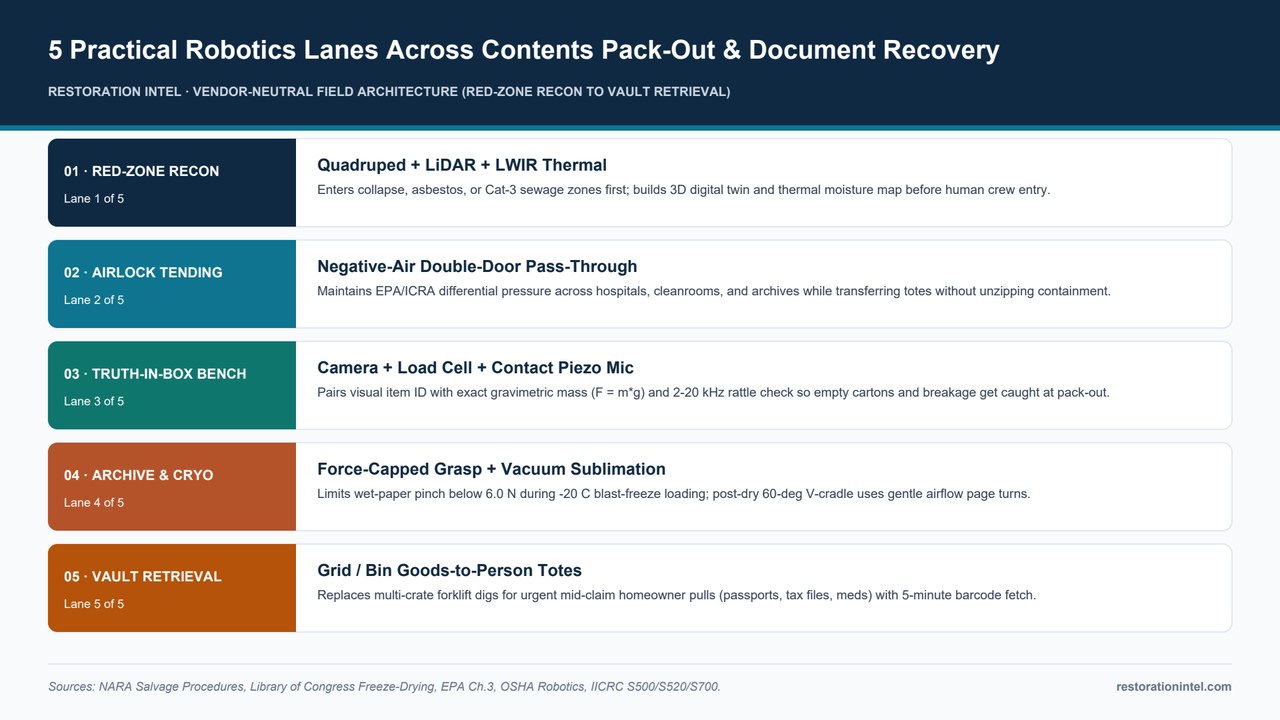
Direct Answer: Contents pack-out and document recovery robotics deliver immediate claim ROI in five non-humanoid lanes: (1) quadruped LiDAR and thermal red-zone recon, (2) interlocked negative-air containment airlocks, (3) gravimetric-plus-piezo truth-in-box intake benches, (4) force-capped cryo freeze-dry handling and airflow page turning, and (5) automated goods-to-person vault retrieval.
Five Practical Robotics Lanes in Contents Pack-Out & Document Recovery
| Robotics Lane | Operator Fit | Physical Bottleneck Solved | Sensor / Hardware Stack | Claim & Margin Payoff |
|---|---|---|---|---|
| 1. Red-Zone Recon | Large-loss pack-out & industrial fire | Weakened floors, friable asbestos, and Cat-3 sewage stall human entry for days. | Quadruped + 3D LiDAR + 8–14 µm LWIR thermal + gas sensors | Pre-entry 3D baseline & room schedule before crew mobilization. |
| 2. Airlock Tending | Healthcare, cleanrooms & archives | Unzipping negative-air poly barriers collapses differential containment pressure. | HEPA/desiccant pods + interlocked double-door pass-through | Maintains continuous EPA/ICRA pressure cascades during tote exit. |
| 3. Truth-in-Box Bench | Franchise intake & contents triage | Video-only capture misses empty cartons, internal moisture, or concealed rattles. | RGB camera + gravimetric load cell (F = mg) + 2–20 kHz piezo mic | Binds photo, exact weight, rattle status & SHA-256 to every carton. |
| 4. Cryo & Sublimation | Wet legal, medical & archival recovery | Wet paper tears under <6 N shear and bleeds ink if thawed past 48 hours. | Force-capped (<6 N) cryo loader + vacuum freeze-dry + airflow page turner | Zero thumb tears on brittle dried pages + automated digital twin. |
| 5. Vault Retrieval | Multi-month climate storage vaults | Urgent homeowner item pulls force unbillable hours of crate unstacking. | Goods-to-person bin grid + 21 CFR Part 11 barcode custody log | 5-minute item-level retrieval with unbroken chain of custody. |
Most public discussions about robotics in property damage jump straight to sci-fi humanoids folding towels. On real disaster losses—where crews face unstable fire-damaged framing, friable asbestos, Category 3 blackwater (sewage backup triage), or waterlogged corporate archives—the highest-margin robotics deployments solve specific physical bottlenecks without waiting for human-level dexterity.
1. Red-Zone Recon & Pre-Packout Digital Twins
When a commercial fire or roof collapse triggers an engineering hold, contents sit exposed to corrosive soot and high humidity for days before adjusters or pack-out crews can safely cross the threshold. Deploying a legged quadruped such as Boston Dynamics Spot outfitted with 3D LiDAR, 8–14 µm LWIR thermal radiometry, and multi-gas monitors alongside Matterport digital-twin workflows lets teams document structural sag, map wet pockets behind drywall, and pre-build room-by-room schedules before entering OSHA 29 CFR 1910.1001 regulated boundaries.
2. Interlocked Negative-Air Containment Airlocks
Protecting sensitive zones—hospital imaging suites, pharmaceutical labs, cleanrooms, and municipal vaults—requires preserving differential pressure (EPA Mold Remediation Chapter 3 and IICRC S520). Every time a technician unzips 6-mil poly containment to swap a desiccant hose or carry out packed bins, negative pressure drops. Autonomous low-GPP monitoring pods (structural drying psychrometrics) paired with mechanically interlocked double-door pass-through totes let packed inventory exit sealed zones without ever opening both doors at once.
3. The Truth-in-Box Intake Bench: Camera + Scale + Contact Mic
Video-walkthrough capture speeds up field scoping in fire contents pack-out and modern pack-out operations, yet unimodal computer vision cannot verify whether a sealed carton is empty, waterlogged, or rattling with broken china. Peer-reviewed manipulation studies—SuccessVQA (33.3% unseen VLM false positives), Calandra et al., ManiWAV, and REFLECT—show why pairing RGB cameras with gravimetric load cells (F = mg) and 2–20 kHz contact piezo microphones stamps an objective mass and rattle receipt onto every barcode under IICRC S500 and IICRC S700 expectations.
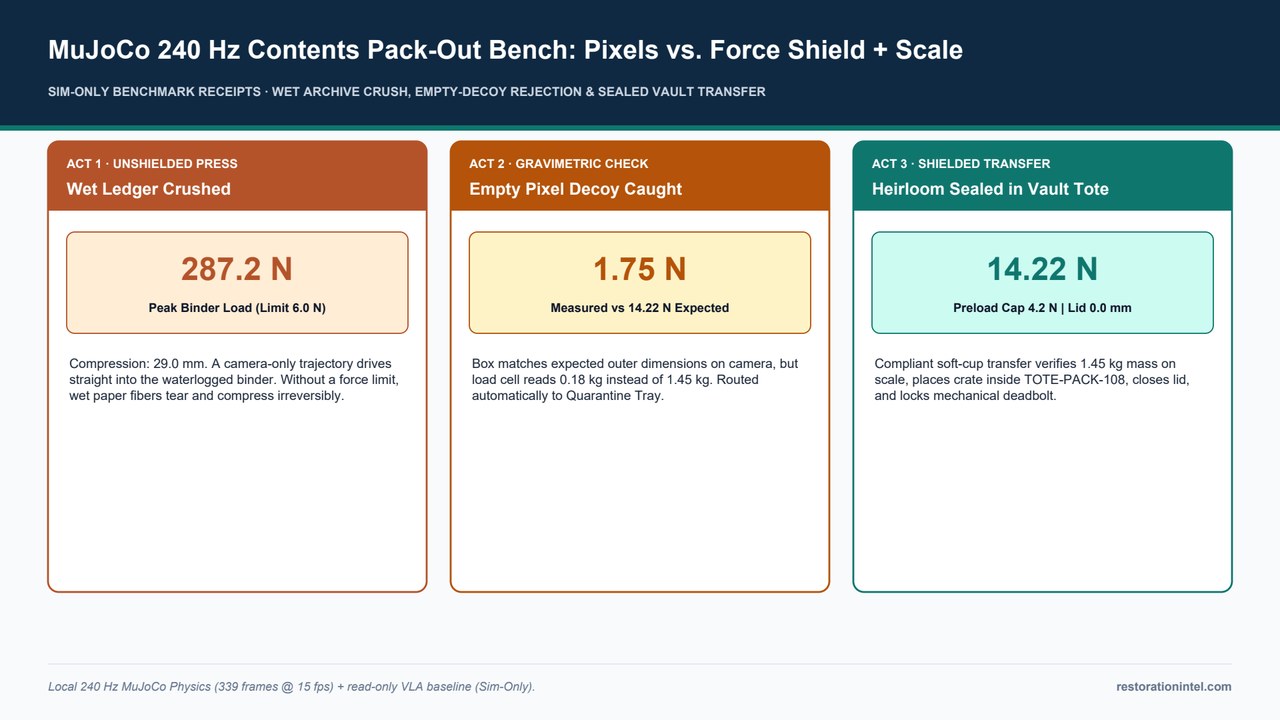
| MuJoCo 240 Hz Act | Physical Test Condition | Measured Force / Mass | Containment & Manifest Outcome |
|---|---|---|---|
| Act 1: Unshielded Wet Press | Vision-only arm drives straight into simulated waterlogged archival ledger | 287.2 N peak (29.0 mm crush) | CRUSH BREACH — exceeded 6.0 N wet-paper limit. |
| Act 2: Empty Pixel Decoy | Visually identical sealed carton placed on tared gravimetric scale | 1.75 N (0.18 kg) vs 14.22 N expected | QUARANTINED — empty decoy rejected to red tray. |
| Act 3: Shielded Vault Seal | Soft-cup preload cap (4.2 N) + scale + deadbolted tote | 14.22 N (1.45 kg), lid 0.0 mm | SEALED — manifest eceba139681d1d… locked. |
Recording mass and acoustic energy at the exact moment a carton closes changes adjuster disputes from subjective photo arguments into verifiable physics. Every barcoded tote leaves the loss site with its net tare weight, ambient relative humidity, and contact-microphone impact log bound to one immutable manifest hash, preventing missing-item claims or unverified empty-box scans from slipping silently into warehouse intake ledgers.
4. Sub-Zero Cryo Handling & Airflow Document Digitization
Wet archival paper swells, bleeds ink, and grows mold rapidly if not stabilized quickly. Both the National Archives salvage procedures and the Library of Congress drying guidelines prioritize freezing wet collections within 48 hours followed by vacuum freeze-drying sublimation—a process deployed at industrial scale by specialist document-recovery providers (document recovery solutions and sublimation process). Inside -20 °C staging bays, force-capped manipulators prevent >6.0 N shear tears on saturated spines; after sublimation, 60-degree V-cradle ScanRobot-style feeders use gentle vacuum and airflow rather than rigid mechanical fingers to turn brittle pages into searchable digital twins.
5. Goods-to-Person Vault Retrieval & Per-Job Neutral Receipt Files
During multi-month rebuilds, restored belongings sit inside high-bay climate vaults (contents storage and digital inventory tracking). Automated bin-grid storage (AutoStore goods-to-person grids) eliminates unbillable forklift digs when an insured urgently needs one tax folder or passport mid-claim, while recording custody events compatible with 21 CFR Part 11 audit logs. Just as important, keep a vendor-neutral per-job folder holding raw photos, scale readings, and tote hashes before syncing into any platform listed in our 2026 Restoration Vendor Census (Matterport, Encircle, and fire restoration guide).
{
  "job_id": "LOSS-2026-1126-PACKOUT",
  "neutral_hub": "./per_job_vault/TOTE-PACK-108/",
  "tote_id": "TOTE-PACK-108",
  "sensor_receipt": {
    "rgb_image_sha256": "<sha256>",
    "gravimetric_mass_n": 14.22,
    "max_handling_force_n": 4.2,
    "piezo_rattle_band_khz": "2-20",
    "rattle_fault_detected": false,
    "deadbolt_lid_gap_mm": 0.0
  },
  "carrier_export_parity": {
    "local_manifest_rows": 142,
    "carrier_csv_rows": 142,
    "parity_verified": true
  }
}
Frequently Asked Questions
Which robotics deployment delivers the fastest ROI in contents restoration and document recovery?
Fixed-station truth-in-box intake benches (global-shutter camera + gravimetric load cell + contact piezo mic + barcode scanner) and quadruped LiDAR/thermal red-zone recon deliver immediate margin impact without requiring fragile humanoid dexterity. Operators eliminate empty-box false positives and pre-scope compromised structures before human crews enter.
How do robotics help protect waterlogged legal, medical, and historical documents during stabilization?
Wet paper tears under low shear and bleeds ink if held above freezing beyond 48 hours. Force-capped manipulators (below 6.0 N preload) load crates into -20 C blast freezers and vacuum freeze-drying sublimation chambers without pinching bindings, while post-dry 60-degree V-cradle scanners turn brittle pages using gentle airflow rather than mechanical thumbs.
How should contractors store robotic intake telemetry so carrier exports never lose line-item evidence?
Keep a vendor-neutral per-job directory containing original photos, gravimetric scale weights (kg and N), acoustic rattle pass/fail tags, and SHA-256 tote manifest hashes before importing into carrier estimating or contents platforms. Files remain the audit source of truth even if a downstream software uploader silently discards an unsupported media format.
Primary Verification Sources
- NARA Salvage Procedures for Water-Damaged Records
- Library of Congress Vacuum Freeze-Drying & Drying Guidance
- EPA Mold Remediation in Commercial Buildings (Chapter 3 Containment)
- OSHA Industrial Robotics Safety Standards
- eCFR 21 CFR Part 11 Electronic Custody Records
- SuccessVQA Unimodal VLM Failure Benchmark (arXiv:2303.07280)
- Companion 2-Page Field Brief PDF · Markdown Twin