Direct Answer: Defensible decommissioning of condemned heavy machinery requires separating gross scrap metal value from fluid-evacuation, rigging, and certified disposal costs, confirming subrogation and lienholder releases in writing, and capturing serial-plate destruction proof before haul-off.
.md twin for estimator QA and carrier file documentation.
When a commercial CNC mill, walk-in refrigeration rack, print press, or packaging line is declared a constructive or physical total loss, the claim does not end the moment Replacement Cost Value (RCV) or Actual Cash Value (ACV) is agreed. Heavy equipment contains tons of steel, copper windings, and stainless alloy—alongside regulated oils, refrigerants, coolants, and lead or lithium batteries. Carriers routinely ask about salvage value, scrap credits, or proof that condemned assets will not re-enter commerce under an active warranty.
Without rigorous decommissioning documentation, one of two costly errors occurs: either an adjuster deducts an inflated gross scrap estimate that ignores the crane, torching, and hazmat evacuation fees required to extract the carcass, or a contractor scraps a machine prematurely before subrogation counsel, a lender, or the carrier’s salvage vendor inspects it.
Compliance disclaimer: environmental evacuation, refrigerant recovery, and disposal of condemned machinery must satisfy applicable US EPA hazardous waste, Clean Air Act refrigerant, and OSHA HazCom regulations using licensed technicians and permitted facilities. This brief documents claim accounting and chain-of-custody workflows only and is not environmental legal counsel.
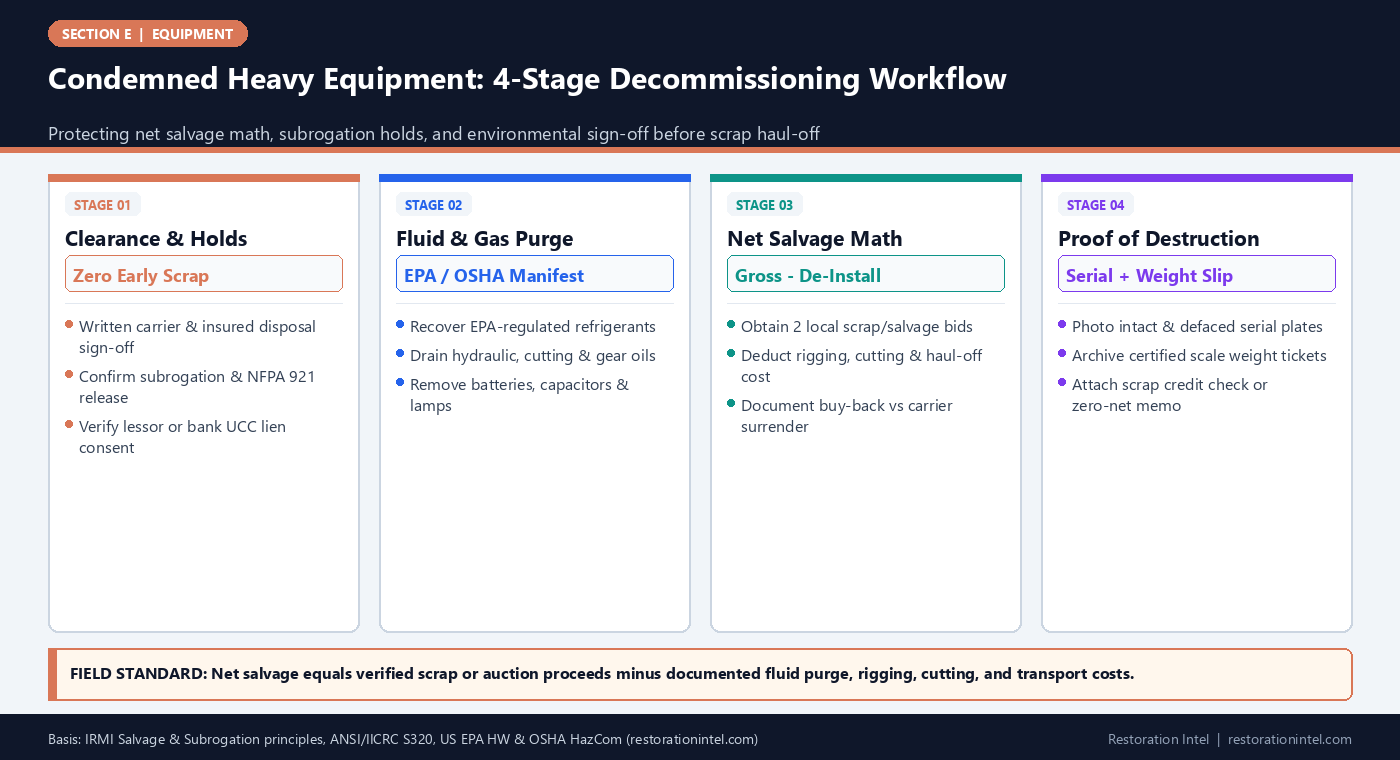
Condemned Heavy Equipment: 4-Stage Decommissioning Workflow
Salvage, Scrap & Decommissioning Documentation Matrix by Scenario
Required authorizations, cost offsets, and proof artifacts when retiring condemned commercial machinery.
| Decommissioning Scenario | Governing Constraint | Financial / Credit Rule | Environmental & Safety Action | Closing File Artifacts |
|---|---|---|---|---|
| Carrier Exercises Salvage Rights | Carrier owns carcass upon total-loss payout | No scrap credit deducted from insured; carrier pays extraction | Hold equipment dry/secure until carrier salvage vendor picks up | Signed carrier salvage release and pickup bill of lading |
| Insured Retains / Scraps Locally | Carrier deducts agreed net salvage value | Credit = Gross Scrap/Parts Bid minus Rigging, Purge & Haul-Off | Complete EPA refrigerant/oil purge before scrapyard delivery | Two salvage bids, rigging/drain invoices, and scale weight ticket |
| Negative Net Salvage (Cost > Scrap) | Demolition & hazmat exceed metal value | Net salvage = $0; excess removal shifts to Debris Removal coverage | Document why specialized crane/hazmat cuts exceed steel weight | Itemized scrap quote showing negative net + debris disposal invoice |
| OEM Brand-Protection / Warranty Condemn | Manufacturer forbids resale of heat/wet unit | Zero parts resale allowed; scrap steel weight only after render-unusable | Follow OEM destruction instructions (cut frame/defeat control box) | Before/after serial plate destruction photos + sworn scrap receipt |
| Subrogation or Lessor Lien Active | Third-party recovery or UCC lender interest | Do NOT scrap or alter unit until written legal/lender release | Stabilize fluids safely without destroying origin components | Written subrogation waiver, lienholder release, and storage log |
Gross Scrap Value vs Net Salvage Recovery Math
One of the most frequent valuation disconnects on heavy equipment claims happens when a desk examiner looks up commodity steel or stainless scrap prices per ton, multiplies by the machine’s shipping weight, and deducts that gross figure from the insured’s settlement. In reality, a five-ton commercial oven or CNC machining center bolted inside a second-floor plant cannot teleport onto a scrapyard scale.
Under IRMI salvage valuation principles and the workflows explained in Salvage Credits and Buy-Back Rules, salvage credit reflects net realizable recovery after deducting the mandatory costs to make the asset safe, detached, and deliverable. Those offsets include utility disconnect, oil and coolant drainage, licensed refrigerant recovery, oxy-fuel or plasma sectioning to clear doorways, rigging/forklift rental, and flatbed haulage.
When extraction and environmental prep cost more than the scrap metal pays—common with insulated walk-in boxes, asbestos-lined ovens, or lightweight aluminum commercial hoods—net salvage value is zero, and the net removal expense belongs under debris removal rather than reducing the insured’s machinery payout. Presenting written quotes from two local industrial scrap or machinery liquidators alongside the rigging bid makes the net math indisputable.
- Two-bid benchmark: Solicit two written salvage/scrap offers (one machinery liquidator, one certified metal recycler) stating gross offer and excluded prep costs.
- De-install isolation: Reference De-Installation and Rigging Labor to separate wreck-out labor from clean-unit installation.
- Buy-back transparency: If the business owner wants to keep stripped parts or undamaged motors for spares, negotiate an explicit salvage credit before teardown.
Subrogation Holds, Lienholders, and Premature Disposal Traps
Before a torch touches a condemned boiler, compressor, or conveyor drive, verify three written clearances: the property adjuster’s total-loss sign-off, any active subrogation preservation hold, and third-party lessor or UCC-1 lender consent. Scrapping a machine that allegedly sparked a plant fire—or disposing of a leased forklift without the finance company’s release—exposes the contractor and insured to spoliation claims and uninsured loan balances.
In fire losses investigated under NFPA 921, even equipment sitting adjacent to the point of origin may be tagged as potential artifact evidence until opposing experts complete a joint destructive lab exam. Never assume verbal permission from a plant supervisor overrides a carrier’s written evidence-hold notice.
Maintain a signed disposal authorization following the Non-Salvageable Disposal Authorization and Witness-Log Template, explicitly listing asset IDs, serial numbers, and the date every hold cleared.
- Evidence vs scrap check: Confirm in writing whether the carrier or forensic engineer requires whole-unit crating instead of local scrap.
- Lender & lease parity: Cross-check UCC filings and equipment leases before releasing heavy assets to third-party liquidators.
- Witness verification: Log date, time, carrier representative name, and disposal contractor on every heavy-equipment release form.
EPA Environmental Evacuation and OSHA HazCom Decommissioning
Scrapyards and municipal landfills will reject—or assess steep environmental penalties against—heavy equipment arriving with free liquids, unrecovered refrigerants, PCB-containing ballasts/capacitors, or mercury switches. Under US EPA hazardous waste rules and OSHA HazCom standards, contaminated hydraulic oils, synthetic cutting fluids, glycols, and fire-charred electrical components require controlled extraction, drum labeling, and manifested transport.
Commercial chillers, blast freezers, and rooftop-adjacent food-processing condensers require EPA-certified Section 608 technicians to evacuate and weigh recovered refrigerant prior to line cutting. Documenting recovered refrigerant pounds and drummed oil gallons serves dual purposes: it proves legal compliance to environmental authorities and substantiates legitimate decommissioning charges on the claim schedule.
When legacy equipment manufactured before modern material bans contains suspected asbestos gaskets, refractory brick, or lead solder in soot residue, pause mechanical torching and engage licensed environmental abatement specialists before sectioning frames.
- Pre-cut fluid manifest: Drain sumps, gearboxes, and reservoirs into DOT-rated drums labeled with contents and asset origin ID.
- Refrigerant recovery log: Attach technician certification number and recovery-cylinder weight log for every condemned cooling unit.
- Legacy material screen: Flag refractory-lined ovens, older transformers, and pre-1980 industrial presses for hazardous-component testing before cutting.
Serial-Plate Destruction Proof, Scale Tickets, and Tax/Audit Trails
Many OEMs, medical-device makers, and food-equipment manufacturers refuse to issue replacement quotes or honor warranty transfers unless the fire- or flood-damaged unit is permanently rendered inoperable. Their concern is straightforward: a soot-stained machine resold at auction could later cause safety failures or fraudulent warranty claims.
When OEM destruction or carrier anti-resale clauses apply, document a strict three-photo sequence: (1) intact machine with legible serial plate, (2) rendered-unusable step (such as severed main power harness, drilled or chiseled data plate, or sectioned frame), and (3) loaded transport leaving the facility. Pair those images with certified public scale tickets showing tare and gross weight, recycling facility receipts, and any salvage credit check issued to the insured or carrier.
Clean decommissioning packets also feed downstream accounting—including casualty loss reporting considerations referenced in IRS Publication 547—and prevent post-claim audit clawbacks over missing disposal verification.
- Legible-before-deface rule: Never chisel, torch, or grind off a rating plate until clear macro photos confirm every model and serial character.
- Scale-ticket matching: Require the scrapyard ticket to reference the claim asset ID or job number, not a generic mixed-iron load.
- Debris vs equipment split: Keep structural demolition debris separate from scheduled BPP equipment weight slips per Debris Removal and Haul-Off guidelines.
Practitioner Verification Checklist (E-17)
- Obtain written total-loss, subrogation-release, and lessor/lienholder clearance before altering or scrapping any condemned machine.
- Solicit two written salvage or scrap quotes alongside itemized rigging, cutting, and haul-off bids to establish true net salvage value.
- Schedule licensed EPA refrigerant recovery and drain hydraulic oils, coolants, and batteries into labeled containers with manifests.
- Capture clear macro photos of intact rating plates before executing any OEM-mandated serial defacement or frame sectioning.
- Archive certified scale weight tickets, disposal manifests, and net salvage credit checks inside the final claim packet.
Standards, Authority References & Related Reading
Primary standards, insurance definitions, and sibling Restoration Intel guides referenced in this brief:
- IRMI Insurance Glossary: Salvage
- IRMI Insurance Glossary: Subrogation
- US EPA Hazardous Waste Framework
- OSHA Hazard Communication Standard (HazCom)
- ANSI/IICRC S320 Standard for Professional Contents Restoration
- IRS Publication 547: Casualties, Disasters, and Thefts
- Related Guide: De-Installation, Rigging, Crane Access, and Re-Installation Labor on Heavy Contents Equipment
- Related Guide: Portable Power Generators, Welders, and Compressors: Fuel, Battery, and Hazmat Prep Before Pack-Out
- Related Guide: Salvage Credits and Buy-Back Rules When Insureds Keep Partially Damaged Contents
- Related Guide: Debris Removal, Haul-Off, and Landfill Fees for Total-Loss Contents: Where Valuation Ends and Mitigation Begins
- Related Guide: Field Guide: Non-Salvageable Disposal Authorization & Witness-Log Template
.md twin for desk QA and team training.Frequently Asked Questions
Does the adjuster deduct gross scrap metal value from our equipment settlement?
No—under standard salvage principles, salvage recovery reflects net realizable value after deducting the necessary costs of fluid evacuation, refrigerant recovery, rigging, sectioning, and haulage. If extraction costs exceed scrap proceeds, net salvage is zero and excess removal falls under debris removal.
When can a contractor legally torch or scrap a fire-damaged CNC machine?
Only after obtaining written total-loss approval from the carrier, confirming there are no active NFPA 921 or subrogation holds, and clearing any third-party lessor or lender lien interests.
Why do OEMs sometimes demand photos of a destroyed serial plate or cut frame?
Manufacturers require proof that compromised fire- or flood-exposed machinery has been permanently disabled so unsafe units cannot be cosmetically cleaned, resold into secondary markets, or submitted for future warranty claims.
Does this decommissioning workflow replace EPA or state hazardous waste rules?
No. Decommissioning documentation supports accurate insurance accounting and custody tracking, while physical refrigerant recovery, oil/coolant evacuation, and regulated waste disposal must be performed in compliance with applicable EPA, OSHA, and state laws.