Direct Answer: In fire, smoke, and protein-residue losses, contents are classified as non-salvageable when they cross any of four ANSI/IICRC S700 and S320 thresholds—structural charring or thermal deformation, health/regulatory condemnation of consumables, irreversible odor or soot penetration into unsealed porous substrates, or restoration-and-deodorization costs exceeding Replacement Cost Value.
.md twin for estimator QA and carrier file documentation.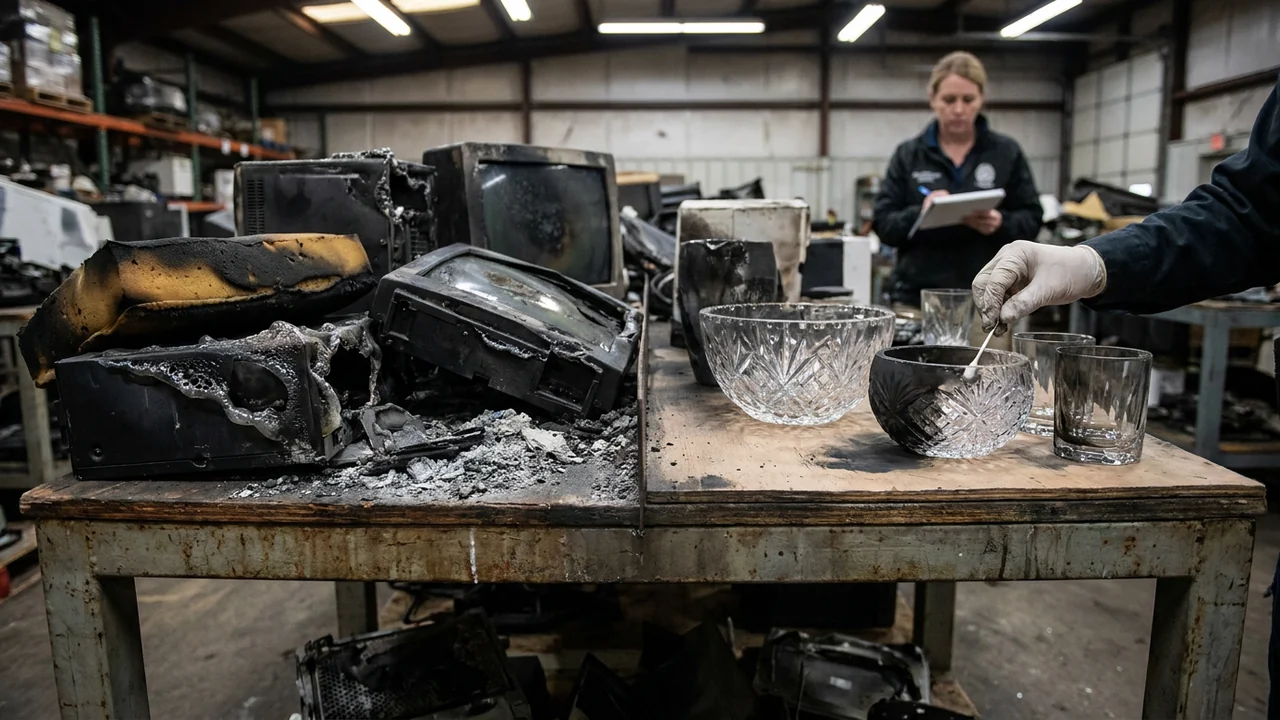
Fire claims rarely present an all-or-nothing contents decision. While rooms directly engulfed in flames contain obvious charred ruins, rooms down the hall or on an upper floor often hold hundreds of intact furnishings, garments, electronics, and dishes coated in varying concentrations of dry soot, wet synthetic tar, or rancid protein film. Declaring an entire home a blanket total loss without technical justification triggers immediate carrier pushback, yet attempting to clean thermally compromised or odor-locked items wastes claim funds and ends in homeowner odor callbacks.
ANSI/IICRC S700 and ANSI/IICRC S320 resolve that ambiguity through objective physical, sensory, safety, and economic tests. Technicians evaluate whether heat altered the material’s geometry or metallurgy, whether smoke or protein oils penetrated unsealed fibers beyond deodorization reach, whether suppression water added swelling or microbial risk, and whether multi-stage plant processing still leaves a comfortable margin below current replacement pricing.
Because protein-residue fires behave differently from heavy carbon fires, salvageability criteria must explicitly account for invisible lipid saturation and odor rebound under seasonal heat and humidity. Coupling disciplined test-cleaning verification with transparent IRMI salvage cost comparisons gives estimators and adjusters a shared evidentiary playbook.
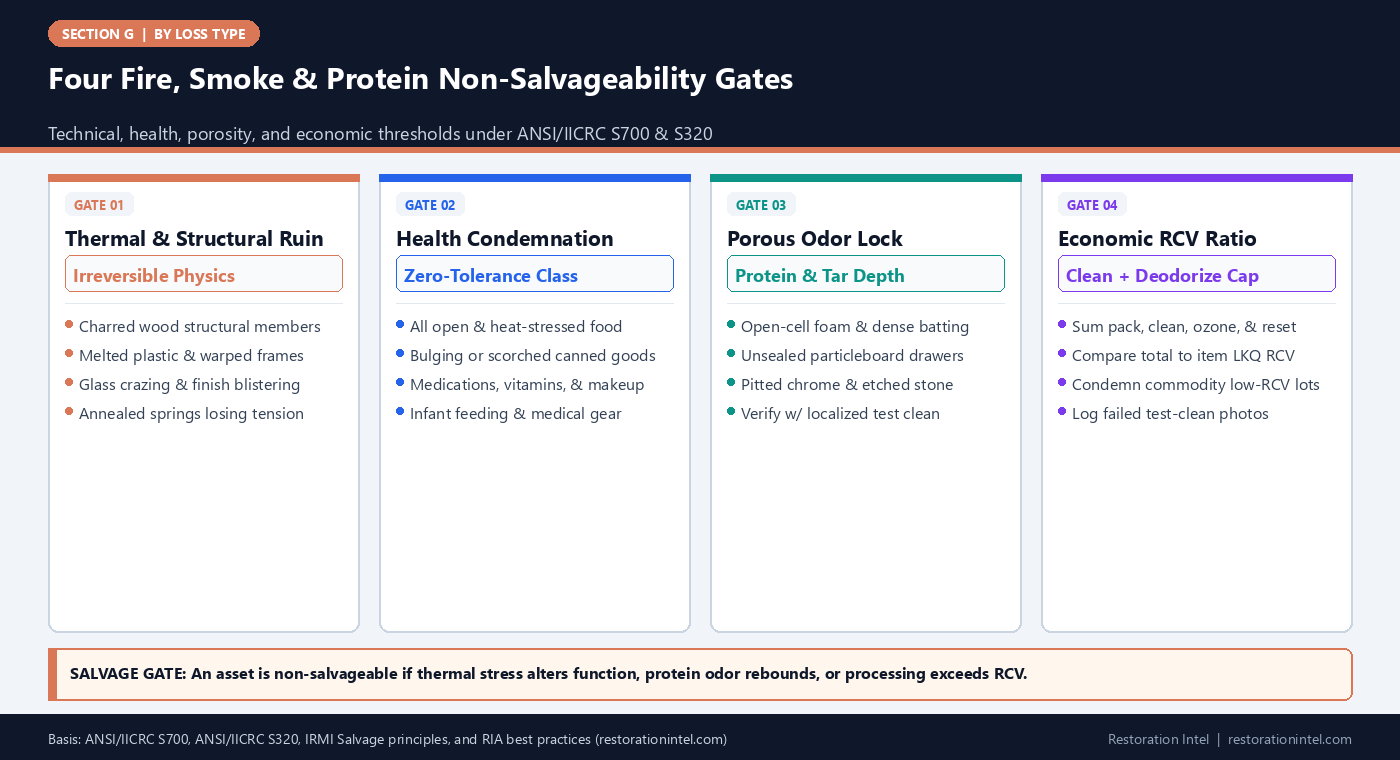
Four Fire, Smoke & Protein Non-Salvageability Gates
Fire, Smoke & Protein-Residue Salvageability Matrix by Asset Class
Standard technical failure points and S700/S320 disposition baselines for heat-, soot-, and protein-exposed personal property.
| Content Class | Thermal / Chemical Failure Point | Protein-Residue Vulnerability | Default S700 / S320 Disposition | Economic / Claims Boundary |
|---|---|---|---|---|
| Solid Hardwood Casegoods & Antiques | Deep charring, blistered finish into raw wood, heat-failed hide glue joints | Moderate; raw underside/drawer interiors absorb polymerized grease vapor | Restorable if structurally sound and uncharred; refinish if finish crazed | Compare full pack-out, chemical strip, deodorize, and refinishing vs LKQ RCV |
| Upholstered Sofas, Mattresses & Cushions | Scorched fabric, melted synthetic fibers, heat-weakened coil springs | Severe; open-cell urethane foam and batting trap deep rancid protein odors | Non-Salvageable in heavy/protein smoke; restorable only in light dry-soot zones | Failed odor-rebound test or heavy multi-pass extraction cost triggers total loss |
| Particleboard, MDF & Laminate Furniture | Peeling thermally softened melamine/edge banding or suppression-water swell | High; exposed raw particle edges wick rancid grease and resist sealing | Usually Non-Salvageable if heat-warped, wet, or protein-saturated | Low replacement cost rarely justifies multi-stage cleaning and encapsulation |
| Consumer Electronics & Major Appliances | Melted cord insulation, warped housings, acid-corroded PCBs, soot inside motors | High; cooling fans draw greasy aerosol onto circuit boards and heatsinks | Conditional; light external smoke restorable, internal soot/heat damage condemned | Safety/warranty voidance and board cleaning cost require certified tech evaluation |
| Apparel, Draperies & Soft Textiles | Scorched/melted synthetic fibers, permanent soot setting in high heat | High; lipid aerosols bond to wool, silk, and synthetics until emulsified | Restorable via specialty dry/wet smoke laundering unless scorched or RCV exceeded | Itemized garment clean rate compared against depreciated/RCV wardrobe tiers |
| Glassware, Cookware, Porcelain & Metals | Thermal shock cracking, melted non-stick coatings, deeply pitted plating | Low; non-porous body allows degreasing unless anodized/unsealed finish etched | Highly Restorable unless heat-warped, cracked, or pitted beyond polish | Low unit cost everyday plastics/glasses may still fail economic batch threshold |
| Pantry Food, Cans, Meds & Cosmetics | Any heat exposure, smoke penetration through seams, or suppression water contact | Total; porous labels/seals admit toxic combustion volatiles and bacteria | Non-Salvageable (Mandatory Health Condemnation) | Log unit counts and shelf context photos before immediate sanitary disposal |
Thermal Thresholds: Charring, Deformation, Crazing, and Metallurgical Pitting
Physical heat damage draws the clearest non-salvageable boundary in a structure fire inventory. Once wood furniture reaches pyrolysis—turning into black charcoal—structural load capacity and joinery integrity are permanently lost. Even without visible flame contact, radiant heat inside upper wall cabinets or hallways melts ABS plastic appliance housings, warps vinyl record collections, crazes tempered glass oven doors into micro-fractured webs, and anneals steel bed springs so they permanently lose elasticity.
Chemical etching from wet synthetic soot represents a closely related irreversible failure. Hydrogen chloride gas released by burning PVC wire insulation and plastics dissolves in moisture to form hydrochloric acid on surfaces. Within hours to days, that acid pits electroplated chrome bath fixtures, clouds aluminum window trim, corrodes copper windings inside power tools, and etches permanent dull ghosts into polished marble and plated silverware.
Where pitting penetrates through decorative chrome or brass plating down to base zinc or steel, ordinary polishing compounds cannot restore pre-loss appearance. Under ANSI/IICRC S700, crews document both the macro thermal or acid defect and any failed localized test-clean area so the adjuster sees immediately why restoration cannot return the item to pre-loss condition.
- Thermal crazing check: Inspect glass tabletops, ceramic figurines, and glazed porcelain under angled light for fine heat-fracture networks.
- Cord & gasket inspection: Check refrigerator door gaskets, microwave seals, and power cords for tackiness, brittleness, or heat flattening.
- Pitting depth rule: If acidic soot etched bare metal or peeled electroplating, reclassify from clean-and-polish to refinish/replate or total loss.
Why Protein Residue and Heavy Smoke Defeat Cleaning on Unsealed Porous Substrates
Homeowners and inexperienced estimators often assume that if a sofa or dresser sits two rooms away from a kitchen grease fire with zero black charring, a quick wipe and deodorizing mist will cure it. Protein-residue chemistry proves otherwise. When animal fats, oils, and proteins combust incompletely, they aerosolize into microscopic sticky droplets that penetrate woven upholstery, open-cell seat cushions, unsealed particleboard drawer bottoms, raw wooden bed slats, and exposed cardboard storage boxes.
Unlike dry wood smoke—where soot particles often sit near the outer surface and respond well to HEPA vacuuming and dry vulcanized sponges—protein lipids coat individual fibers in a water-insoluble film that steadily oxidizes into a sour, rancid odor. When summer heat or home humidity rises months after move-back, trapped lipids volatilize again, causing classic post-restoration odor callbacks on items that smelled temporarily masked in an air-conditioned warehouse.
For high-value solid wood pieces with raw interior panels, controlled degreasing followed by shellac or specialized odor-blocking sealers on unexposed underside surfaces can succeed. For inexpensive particleboard, open-cell mattresses, stuffed pillows, and heavily saturated upholstery, however, non-salvageable condemnation prevents chronic indoor air complaints and duplicate claim rework.
- Unsealed interior sniff test: Pull out dresser drawers and press your nose near raw particleboard backs—protein odor hides sharpest inside enclosed unsealed cavities.
- Mattress & foam caution: Open-cell polyurethane cushions and pillow-top mattresses subjected to heavy protein or synthetic smoke rarely pass long-term odor clearance.
- Paper & books limit: While rare archival documents can undergo specialized freeze-drying or chamber deodorization, everyday paperbacks and damp cartons are typically condemned.
Health-Condemned Categories: Food, Pharmaceuticals, Cosmetics, and Safety Gear
Certain categories carry strict zero-tolerance condemnation rules regardless of how clean their outer packaging appears. All open food, refrigerated goods affected by power loss, boxed pantry staples, spices, pet food, and alcoholic beverages exposed to fire heat or smoke plumes must be declared non-salvageable. Combustion gases carry toxic polycyclic aromatic hydrocarbons, soot particulates, and firefighting chemical aerosols that infiltrate paperboard seals and plastic screw caps.
Sealed metal cans and glass jars are not automatically exempt either. Intense ambient heat expands internal contents, breaking hermetic jar lids or causing metal can seams to micro-vent and draw contaminated air back inside as the room cools—creating spoilage and botulism hazards. Any canned goods showing bulging ends, soot-stained seams, scorched labels, or heat exposure near fire zones belong straight in the condemned health-loss schedule.
The exact same precautionary standard applies to prescription medications, over-the-counter drugs, vitamins, cosmetics, infant formula, baby bottle nipples, and personal safety equipment such as firefighting/motorcycle helmets, climbing harnesses, and car seats whose impact-absorbing foam degrades silently under elevated heat.
- Zero-salvage consumables: Condemn all open food, heat-exposed sealed jars/cans, spices, and pantry items after capturing shelf-context photos.
- Pharma & cosmetic rule: Discard prescription drugs, inhalers, ointments, makeup, and toiletries exposed to smoke or elevated heat without exception.
- Safety-critical gear: Condemn child car seats, bike/motorcycle helmets, and fall-protection harnesses exposed to fire heat or heavy smoke per manufacturer safety guidance.
Applying the Restoration-Cost-to-RCV Ratio and Test-Clean Verification
Whenever an item clears thermal, health, and porosity screens, its final disposition turns on economic feasibility under ANSI/IICRC S320 and IRMI salvage valuation rules. Estimators must compare the complete all-in restoration burden—pack-out wrapping, warehouse transport, multi-step degreasing or ultrasonic processing, chamber deodorization, climate-controlled storage, and reset delivery—against current Like-Kind-and-Quality Replacement Cost Value (RCV).
Carriers frequently set internal cost-to-replace guidelines—often flagging items for replacement once cleaning approaches 60 to 80 percent of RCV, though exact policy rules and insured sentiment vary. Spending $95 of technician labor and deodorization chamber time to rescue a $70 laminate nightstand or $15 plastic blender makes zero economic sense. Conversely, spending $280 to clean and deodorize a $2,400 solid cherry dining table or $1,200 heirloom china set delivers massive claim savings.
When salvageability on a high-value finish, specialty rug, or antique looks borderline, perform a documented 15-minute localized test clean on an inconspicuous corner—and photograph the result. As emphasized in Salvage Is a Window, Not a Service and fire contents pack-out protocols, showing both the failed test-clean patch and the transparent cost-to-RCV worksheet closes carrier disputes before pack-out trucks even roll.
- All-in cost comparison: Include packing materials, transport, cleaning, thermal/hydroxyl deodorization, and reset—never compare bench-wash minutes alone against RCV.
- Test-clean proof card: Tape off a small test square on borderline finishes or stone, photograph before and after, and attach the result to the total-loss line.
- Electronics specialist gate: Route borderline high-dollar electronics and appliances through qualified electronics testing rather than guessing board corrosion in the field.
Practitioner Verification Checklist (G-14)
- Condemn any contents showing structural charring, melted housings, heat-crazed glass, annealed springs, or pitted electroplated finishes.
- Enforce mandatory health condemnation on all fire- and smoke-exposed food, canned goods near heat, pharmaceuticals, cosmetics, and safety helmets/car seats.
- Inspect unsealed drawer interiors, particleboard backs, and open-cell upholstery foam for deep protein-residue odor lock before packing.
- Run documented localized test cleans on borderline high-value finishes and metals to prove cleanability or failure before full pack-out.
- Compare fully loaded pack, clean, deodorize, and reset cost against current LKQ RCV and flag economic total losses transparently.
Standards, Authority References & Related Reading
Primary standards, insurance definitions, and sibling Restoration Intel guides referenced in this brief:
- ANSI/IICRC S700 Fire & Smoke Restoration Standard
- ANSI/IICRC S320 Standard for Professional Contents Restoration
- IRMI Insurance Glossary: Salvage
- Restoration Industry Association (RIA)
- Related Guide: Structure Fire, Smoke & Protein-Residue Losses: First-24-Hour Contents Triage & Stabilization
- Related Guide: Structure Fire, Smoke & Protein-Residue Losses: Damage Evidence & Forensic Photography Rules
- Related Guide: Structure Fire, Smoke & Protein-Residue Losses: Carrier Scope Justification & Total-Loss Defense
- Related Guide: Contents Restoration After Fire: Pack-Out Protocols, Cleaning Methods, and Insurance Inventory
- Related Guide: Salvage Is a Window, Not a Service
.md twin for desk QA and team training.Frequently Asked Questions
Are canned foods still safe to eat after a house fire if the metal cans did not melt?
Usually no. Heat can compromise can seams and cause micro-venting that pulls smoke toxins or bacteria inside as cans cool, while soot and firefighting chemicals contaminate lids. Health guidance recommends discarding heat- or smoke-exposed pantry goods.
Why do solid wood furniture pieces often survive fires better than upholstered sofas in the same room?
Finished solid hardwood has a dense exterior seal that shields internal wood fibers from soot and protein penetration, whereas upholstered sofas contain permeable fabric, cotton batting, and open-cell foam that trap odors internally.
When does a technically cleanable item become an economic total loss?
When the full cost to pack out, transport, clean, deodorize, store, and return the item approaches or exceeds its current Like-Kind-and-Quality Replacement Cost Value (RCV) or carrier-approved salvage cap.
Can electronics that were not melted by flames still be non-salvageable?
Yes. Acidic soot and moisture drawn in by cooling fans corrode circuit boards, connectors, and motor windings silently, creating reliability and fire hazards unless cleared by qualified electronics restoration testing.