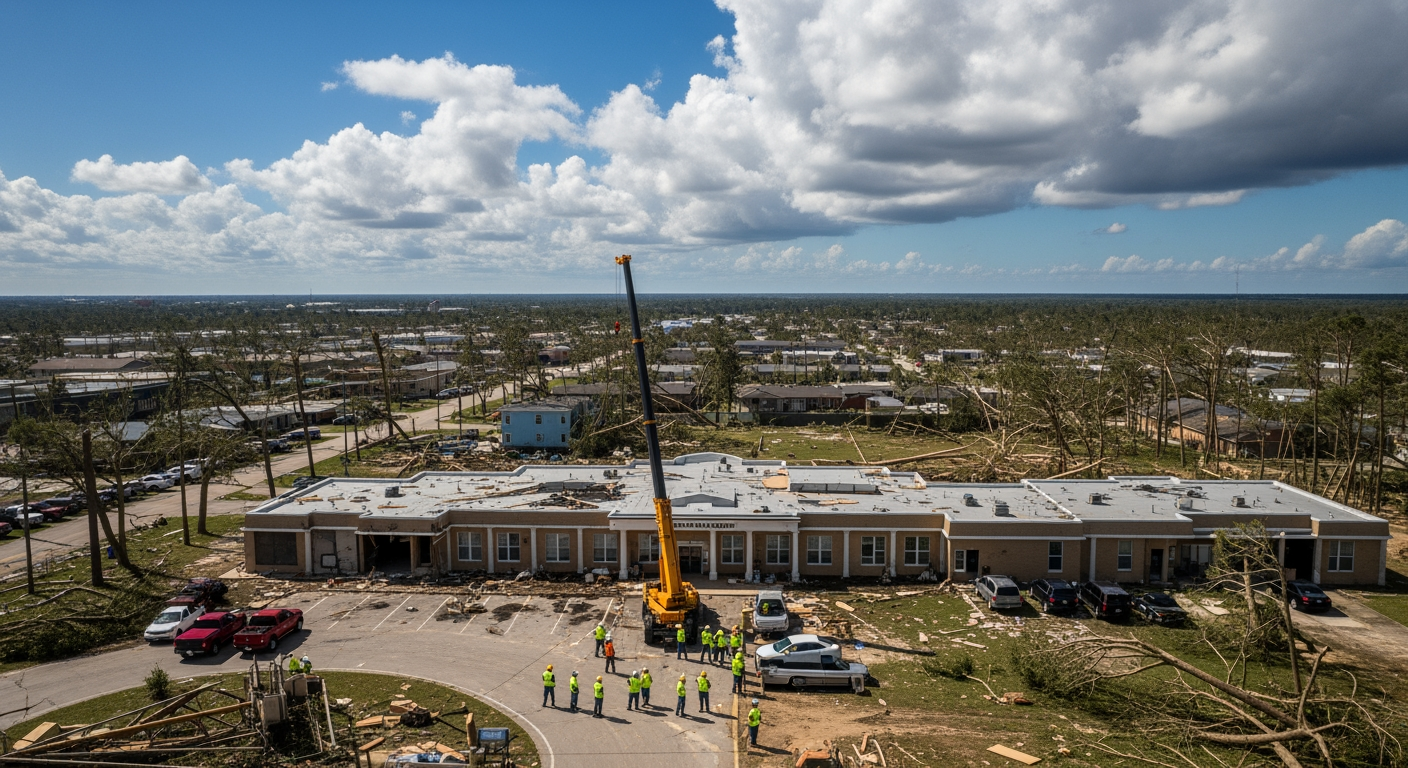
Global natural catastrophes produced over $100 billion in insured losses annually for the fifth consecutive year in 2025, with severe convective storms alone accounting for $50 billion and the California wildfires adding an estimated $40 billion. These figures from Munich Re and Swiss Re represent a structural shift in restoration demand that is permanent, not cyclical. For restoration companies, climate-driven demand changes everything from fleet sizing and geographic coverage to workforce development and insurance carrier relationships.
The New Normal: Catastrophe Frequency and Restoration Capacity
The restoration industry historically operated on a model where catastrophic events were regional, seasonal, and separated by recovery periods. The 2024-2026 pattern has broken that model. Overlapping wildfire seasons in the western states, year-round severe convective storm activity across the central and southern regions, and increasingly powerful hurricane seasons along the Gulf and Atlantic coasts have created near-continuous catastrophe response demand.
This persistent demand creates capacity constraints that ripple through the entire restoration supply chain. Equipment manufacturers report extended lead times on dehumidifiers, generators, and specialty drying equipment. Temporary labor markets in catastrophe zones experience wage inflation that can double or triple normal rates. And restoration companies must choose between maintaining response capacity for their local markets and deploying to catastrophe events where the revenue opportunity is larger but the operational risk is higher.
The companies that navigate this environment successfully are those with scaling strategies that account for surge capacity rather than steady-state operations. This means maintaining equipment reserves, cross-training crews on multiple damage types, and establishing mutual aid agreements with peer companies in other regions.
Wildfire Restoration: The Fastest-Growing Segment
Wildfire restoration has evolved from a niche specialty into the fastest-growing segment of the restoration industry. The California wildfires of 2025 demonstrated that wildfire losses can rival or exceed hurricane losses in total insured value, particularly when the fires affect high-value residential and commercial properties in urban-wildland interface zones.
Wildfire restoration requires specialized capabilities that differ significantly from water or standard fire loss restoration. Smoke and ash contamination from wildfires contains a complex mixture of combustion byproducts including heavy metals, asbestos fibers from older structures, and carcinogenic compounds that require hazmat-level protocols. The chemistry of smoke residue in wildfire events is fundamentally different from structure fire residue because of the diversity of materials burned across an entire landscape.
The scale of wildfire events also changes the emergency response calculus. When thousands of properties are affected simultaneously, traditional one-at-a-time restoration workflows cannot keep pace. Program work models where restoration companies contract with insurance carriers to handle hundreds of claims under standardized protocols have become the dominant approach for catastrophic wildfire events.
Insurance Market Response to Climate-Driven Losses
The insurance market response to escalating climate losses directly affects restoration companies. Carrier retreat from high-risk markets, rising deductibles, and stricter underwriting standards all change the economics of restoration work. When carriers raise wind and hail deductibles from $1,000 to percentage-based deductibles of 2 to 5 percent of insured value, the out-of-pocket cost for policyholders increases dramatically, affecting their willingness and ability to authorize restoration work.
Understanding the coverage exclusions and gaps in evolving property insurance policies is essential for restoration contractors who need to set accurate expectations with property owners about what the insurance will and will not cover. The growth of catastrophe modeling also means that carriers are pricing risk more granularly, which affects which properties carry adequate coverage for full restoration.
Parametric insurance products are emerging as a complement to traditional indemnity coverage. These index-based policies pay out automatically when predefined triggers such as wind speed thresholds or earthquake magnitude are met, providing immediate liquidity for emergency mitigation before traditional claims are adjusted. Restoration companies positioned to respond to parametric trigger events can secure work faster because the funding mechanism eliminates the delay between loss event and payment authorization.
Workforce Development for Climate-Scale Response
The restoration workforce challenge is fundamentally different in a climate-driven demand environment. With more than 20 percent of construction workers over age 55, the industry faces retirement-driven attrition at the same time demand is increasing. Climate-driven restoration requires not just more workers but workers trained in multiple specialties who can deploy across damage types and geographies.
The hiring frameworks and retention strategies that worked in a stable-demand environment need recalibration for an industry where catastrophe deployment is frequent, projects are geographically dispersed, and the physical and emotional demands on workers are intensifying.
Training programs must also evolve. Cross-training water damage technicians in fire restoration protocols and vice versa creates workforce flexibility that matches the multi-hazard nature of climate events. When a hurricane produces both flooding and wind damage, crews that can address both damage types operate more efficiently than specialized teams waiting for their specific scope.
Business Continuity for Restoration Companies
Climate events that drive restoration demand also threaten the restoration companies themselves. A restoration contractor whose own facility is in a flood zone, whose supply chain depends on single-source vendors, or whose workforce lives in the same community affected by the disaster faces an existential challenge: they must recover their own operations while simultaneously responding to the event that damaged them.
Restoration companies need their own business continuity plans that account for scenarios where the business is both responder and victim. This includes disaster recovery planning for operational technology, supply chain diversification for critical materials and equipment, and emergency communication systems that function when local infrastructure is compromised.