Direct Answer: Multi-month storage claims fail in the warehouse, not just at the loss site, when trucks are stacked by arrival order instead of load weight and vaults lack deterministic rack coordinates. Combining E-track load tiers, dock-to-vault barcode handoffs, 40-55 percent relative humidity climate control, and four-part Zone-Aisle-Bay-Level indexing guarantees instant retrieval for partial returns and adjuster inspections.
.md twin for estimator QA and carrier file documentation.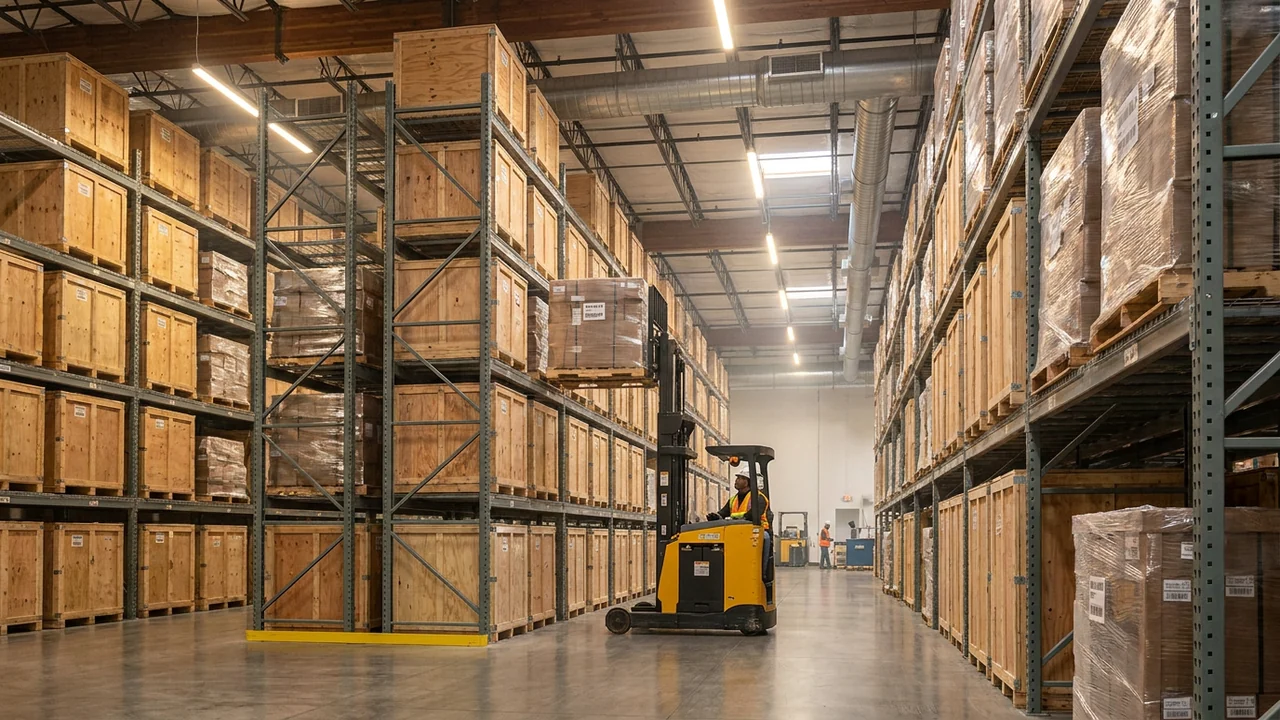
A residential fire or major water rebuild routinely keeps household contents in warehouse custody for four to nine months. During that span, the policyholder asks for winter coats or tax records, a sub-vendor pulls an area rug for cleaning, or a structural delay forces a partial pack-back to a completed guest wing. When containers are loaded onto box trucks without weight hierarchy and stacked into unlabeled warehouse rows, every mid-claim retrieval triggers hours of blind forklift shuffling and preventable transit breakage.
Under ANSI/IICRC S320 custody principles and Restoration Industry Association (RIA) storage standards, physical care does not end when the box truck leaves the driveway. The truck bed, unloading dock, cleaning bay, and long-term storage vault operate as one continuous chain of custody where every container scan updates a physical coordinate.
Training field leads and warehouse technicians on unified loading geometry and climate-controlled rack indexing eliminates two of the most expensive operational leaks in contents restoration: crushed lower cartons discovered months later on pack-back day and missing-container panic when a homeowner requests an urgent item.
Truck-to-Vault Custody & Climate Rack Architecture
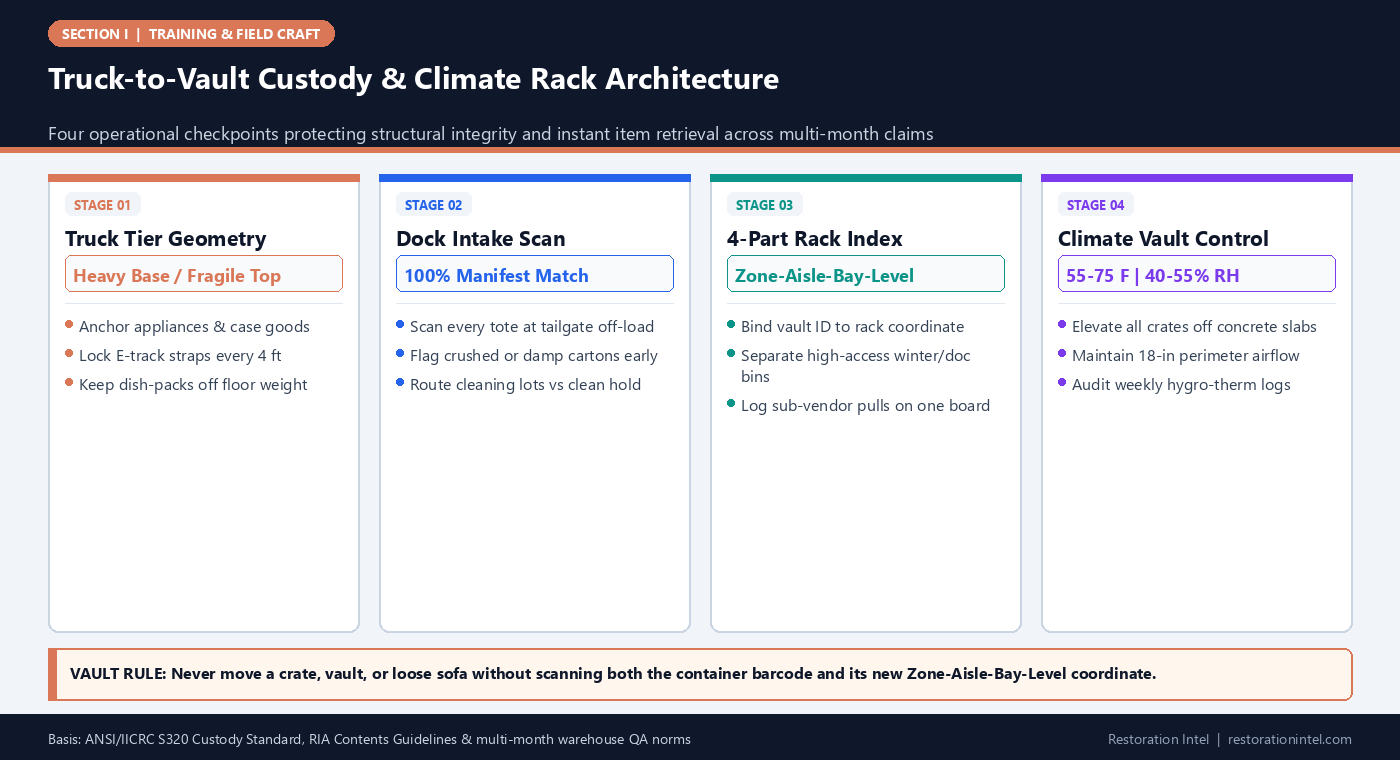
Truck Loading, Vault Mapping & Climate Indexing Standards
Field-to-warehouse execution matrix governing container tiering inside box trucks, dock-intake reconciliation, and long-term rack indexing for extended restoration claims.
| Logistics Phase | Physical Stacking & Restraint Rule | Custody & Barcode Action | Environmental / Access Standard | Prevented Claim Failure |
|---|---|---|---|---|
| Truck Nose & Heavy Base Tier | Load washer/dryers, solid dressers, and book cartons tight to nose wall with furniture pads between faces | Scan item tags prior to strapping; log loose-furniture pad count on truck sheet | Verify zero loose casters or unlatched drawers before departing site | Cabinet racking, drawer blowout, and shifting load impact |
| Mid-Deck & Dish-Pack Tier | Stack uniform medium/dish-pack boxes max 3-4 high; bridge gaps with dunnage sheets and load bars | Keep color-coded fragile tape and room codes facing aisle for dock check | Never stack heavy toolboxes or liquids above glass or stemware packs | Crushed lower flaps and hidden transit stemware breakage |
| Top Deck & Upholstered Goods | Place lightweight linen cartons, lampshades, mirrors, and wrapped mattresses on top or vertical E-track slots | Confirm breathable film vs sealed wrap matches loss moisture state | Protect mattress edges from strap pinch using corrugated corner guards | Film tear, mildew trapping, and bent mirror frames |
| Warehouse Dock Intake | Unload by disposition lane: Clean Hold, Ultrasonic/Hard Clean, Textile Sub, and Urgent Owner Access | Reconcile physical scan count against site manifest before truck clears | Isolate damp or smoky lots away from dry multi-month vaults | Unaccounted totes and smoke-odor transfer to clean vaults |
| Climate Vault & Rack Indexing | Load wooden vaults or palletized racks with 4-in slab clearance and forklift-safe weight distribution | Assign four-part coordinate (e.g., Z2-A04-B12-L2) in custody system | Maintain 55-75 F and 40-55% RH with logged daily/weekly sensor checks | Veneer warping, slab moisture wicking, and multi-hour bin hunts |
Engineering Box-Truck Load Tiers to Prevent Hidden Transit Compression
Transit damage on a contents claim rarely happens from a single dramatic drop; it happens slowly over thirty miles of highway vibration when soft corrugated boxes carry heavy loads they were never engineered to support. Crew leads must coach loaders to build every truck wall from the floor up in locked horizontal tiers rather than tossing cartons into open floor voids as dollies arrive at the ramp.
Dense items—appliances, solid-wood case goods, book cartons, and packed tool chests—form the floor tier against the truck nose and E-track side rails, separated by quilted moving blankets so finished surfaces never rub bare wood or metal. Medium household cartons and engineered dish-packs sit above that stable deck, and lightweight pillows, framed art, and lampshades ride strictly on top or secured vertically inside slotted mirror cartons strapped to the wall.
Before the roll-up door closes, the lead inspects every strap tension point. Ratchet or cam straps must cross rigid box corners or cardboard edge protectors—never tighten directly across upholstered cushions or fragile lamp cartons. A five-minute load walk at the curb prevents months-later disputes over whether a cracked dresser foot happened during the fire or on the interstate.
- Three-tier height discipline: Never stack standard medium boxes more than four high or place heavy kitchen/tool cartons above wardrobe or linen boxes.
- Vertical edge protection: Strap mirrors, TVs, and glass tabletops upright against padded E-track walls rather than laying them flat under shifting loads.
- Pad-and-band furniture drawers: Remove loose shelves, wrap hardware bags to the frame back, and band drawers closed with stretch film over protective pads—never tape directly onto wood varnish.
Executing the Dock-to-Vault Barcode Handoff Without Ghost Boxes
The single highest-risk custody gap in contents logistics occurs at the warehouse receiving dock when a tired afternoon crew unloads three rooms’ worth of vaults before someone records where they went. As detailed in Nobody Could Tell Me Where the Rug Was, an item becomes unanswerable the moment physical movement outpaces system updates.
Every truck arriving at the facility undergoes a gated dock intake before cartons scatter into cleaning bays or storage aisles. One receiving technician scans each container barcode off the tailgate and confirms the physical tally matches the field crew’s signed pack-out manifest—a workflow also grounded in custody-to-inventory parity. Any discrepancy—such as a missing box number, crushed corner, or wet bottom seam—is photographed and flagged on the intake exception log immediately while the field lead is still on site to explain it.
Simultaneously, containers are sorted into four physical dock lanes: Immediate Cleaning (ultrasonic/hand clean), Specialty Sub-Vendor Hold (rugs, textiles, electronics), Clean Long-Term Vault Hold, and High-Access Owner Retrieval. Routing at the dock stops dirty soot-laden cartons from being tucked inside clean long-term vaults ‘just for tonight.’
- Gate the truck release: A box truck is not cleared for next-day dispatch until dock intake scans match 100 percent of the outbound field count.
- Label-out stacking rule: Orient every barcode and color-coded room tape toward the open aisle so warehouse staff can verify container IDs visually without unstacking pallets.
- Immediate damage-exception photo: If a carton arrives dented or moisture-stained at the dock, open and inspect contents under camera immediately rather than storing broken glass until pack-back.
Building Four-Part Rack Indexing and Climate Controls for Multi-Month Claims
Saying an item is ‘in Warehouse B’ is useless when Warehouse B holds ninety wooden vaults and three hundred pallet slots. Every storage location must follow a deterministic four-part coordinate address—Zone-Aisle-Bay-Level (for example, Z2-A03-B08-L2)—stenciled on high-contrast rack placards and mirrored inside the job’s custody record. Loose oversized pieces such as sofas, dining tables, and rolled carpets occupy dedicated cantilevered rack bays with individual bay tags, never leaned randomly against perimeter walls.
Because structural rebuilds stretch across seasons, climate stability inside the storage envelope directly protects restoration quality. Warehouses holding wood furniture, leather, musical instruments, and electronics for multiple months must hold steady conditions—typically 55 to 75 degrees Fahrenheit and 40 to 55 percent relative humidity—logged via calibrated hygrometers rather than guesswork. All wooden vaults and furniture skids remain elevated at least four inches off concrete slabs on pallets or dunnage rails with open aisle clearance so air circulates freely and roof or sprinkler drips never wick into cardboard.
Equally important for multi-month harmony is pre-indexing an ‘Easy-Access Zone’ near the front of the rack map. Seasonal clothing, school supplies, tax folders, and medical equipment flagged during pack-out sit in front-tier Level-1 bays so a homeowner retrieval takes ten minutes instead of pulling down four stacked vaults with a forklift.
- Four-part coordinate discipline: Bind every container and loose-piece barcode to an exact
Zone-Aisle-Bay-Leveladdress at put-away. - Front-tier Easy-Access lane: Reserve accessible lower-bay slots for high-probability homeowner pulls (seasonal apparel, documents, hobby gear).
- Weekly rack and climate audit: Log temperature/RH readings weekly and walk aisles for leaning stacks, broken wrap, or unrecorded vault relocations.
Tracking Sub-Vendor Pulls and Partial Pack-Backs Without Breaking Custody
Long claims rarely sit static inside one vault. Area rugs travel to wash plants, fine electronics move to specialty bench technicians, and cleaned kitchenware returns early once cabinets pass inspection. Whenever a container or single item leaves its indexed rack slot for any reason, the warehouse lead must record a formal custody transfer—logging item ID, destination vendor or room, transfer date, expected return date, and receiving signature.
When a single box is opened in the cleaning bay and split across two processing streams—say, porcelain figurines staying in ultrasonic holding while silver flatware moves to polishing—technicians must either re-link the child items to new container IDs or mark the parent carton as ‘Split/Partially Processed’ with explicit child locations. Leaving the master manifest pointing to an empty original box number creates panic during final load-out.
Finally, prior to scheduling multi-month pack-back delivery, the warehouse lead runs a pre-pull audit 72 hours ahead of truck dispatch: confirming every indexed rack coordinate, verifying sub-vendor returns have cleared post-clean QA, and staging completed vaults in reverse room-return order so pack-back crews unload upstairs bedrooms before ground-floor living rooms.
- Zero unlogged sub-vendor handoffs: Never release a rug, clock, or firearm to a third-party specialist without a signed transfer ticket tied to the job board.
- Parent-child split logging: Update container records whenever items are repacked after cleaning into smaller or clean archival totes.
- 72-hour pre-pull staging check: Verify 100 percent container and sub-vendor availability three days before promising a homeowner return date.
Practitioner Verification Checklist (I-13)
- Load box trucks in locked horizontal tiers (heavy base against nose/E-track, dish-packs mid-deck, light/fragile upright or top) with padded corner protection on all strap points.
- Execute a 100 percent tailgate barcode scan at warehouse dock intake, reconciling physical container counts against the field crew’s signed manifest before releasing the truck.
- Segregate incoming cargo at the dock into Clean Hold, Cleaning Line, Sub-Vendor Hold, and High-Access Owner Retrieval lanes.
- Index every vault, pallet, and cantilevered oversized furniture piece to a four-part Zone-Aisle-Bay-Level coordinate inside the custody system.
- Maintain and log climate-controlled vault conditions (55-75 F, 40-55% RH) with 4-inch off-slab clearance and perimeter airflow spacing.
- Record formal custody transfers for every sub-vendor pull, container split, or mid-claim homeowner retrieval, and complete a 72-hour pre-pull audit before pack-back.
Standards, Authority References & Related Reading
Primary standards, insurance definitions, and sibling Restoration Intel guides referenced in this brief:
- ANSI/IICRC S320 Standard for Professional Contents Restoration
- Restoration Industry Association (RIA)
- Verisk XactContents Platform Overview
- IRMI Insurance Glossary: Salvage
- Related Guide: Box Packing Geometry & Dish-Pack Engineering: Preventing Transit Breakage Claims During Vault Storage
- Related Guide: Barcode, QR, and Color-Coded Tape Vault Labeling Systems That Survive Humidity and Stacking
- Related Guide: Upholstery, Mattress, and Soft-Furniture Wrapping: Breathable vs Sealed Film Rules by Loss State
- Related Guide: Electronics Disconnection & Cable Mapping: Labeling AV Racks, Home Workstations, and Clinic Desks Before Unplugging
- Related Guide: Handling Partial Pack-Backs and Phased Returns When Structure Repairs Finish Early in Select Rooms
- Related Guide: Nobody Could Tell Me Where the Rug Was
.md twin for desk QA and team training.Frequently Asked Questions
Why is four-part rack indexing necessary when all boxes on a job are already barcoded?
A barcode proves an item exists on a manifest, but without a deterministic Zone-Aisle-Bay-Level rack coordinate, warehouse staff still have to open and shift multiple vaults manually whenever an adjuster requests an inspection or a homeowner needs a seasonal coat mid-claim.
What temperature and humidity range should contents warehouses hold for multi-month claims?
Climate-controlled contents vaults typically maintain 55 to 75 degrees Fahrenheit and 40 to 55 percent relative humidity, paired with off-slab pallet clearance and weekly sensor logs to prevent veneer delamination, rust, and microbial growth.
How should crews prevent breakage when strapping furniture and dish-packs inside a box truck?
Anchor heavy appliances and case goods on the floor tier against E-track walls with moving pads between contact faces, keep dish-packs out from under heavy weight, and route straps across corrugated corner protectors rather than bare wood or soft cushions.
What breaks chain of custody fastest during a four-to-nine-month storage claim?
Unlogged mid-claim movements—such as sending a rug to a third-party cleaner, splitting cleaned items into new totes without updating parent box IDs, or handing a seasonal bin to the homeowner without a signed release.