Updated October 6, 2026.
Direct answer. Independent contractors win storm and commercial work by building intake, dispatch, documentation, and first-call agreements themselves — infrastructure that survives the third simultaneous loss, not a franchise royalty line.
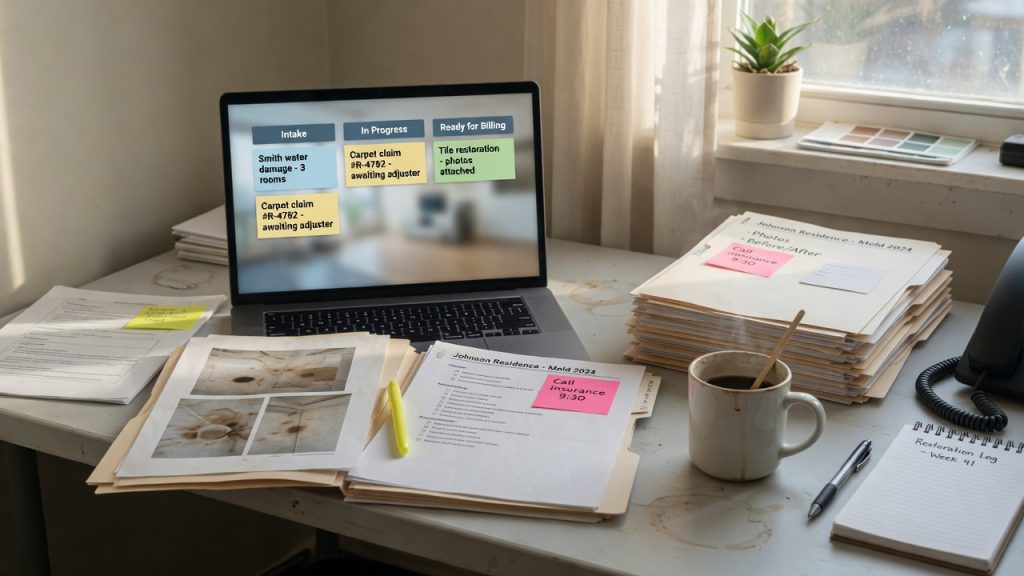
Winning commercial and storm work without a franchise means building the intake, dispatch, documentation, and first-call stack yourself so you can take volume without paying a brand that also competes with you for the same buildings.
Franchises look like they own CAT season because the 800 number and the playbook already exist. Independents already win the first hour on a local commercial building. The gap is what happens after the third call lands while two crews are still extracting. That gap is infrastructure, not heart.
What the franchise fee actually buys
- Brand recognition on a residential search
- A dispatch script and a call center
- Program access some carriers already mapped to the logo
- A playbook you could write yourself and then actually follow
What it does not buy: the night engineer’s cell phone, the riser map, or an Emergency Response Agreement on a specific property. Those are how independents take commercial storm work from under the logo. See the ERA system and how facility managers choose a vendor.
Three tiers of independent infrastructure
Tier 1 — call truth. Shared after-hours number plus a sheet every call hits. If it is not in the sheet, it did not happen. Missed storm calls are not a marketing problem.
Tier 2 — file and money truth. Track every TPA, supplement, and payment in one place so storm work does not die in portal logins. Cap program work using the TPA playbook. Run margin on the Field App before you accept the logo’s terms.
Tier 3 — a desk that survives the season. Named estimator, named PM, after-hours path, and a commercial packet you can hand an FM before the next cell hits. AI dispatch is optional. A second person who can open a file is not.
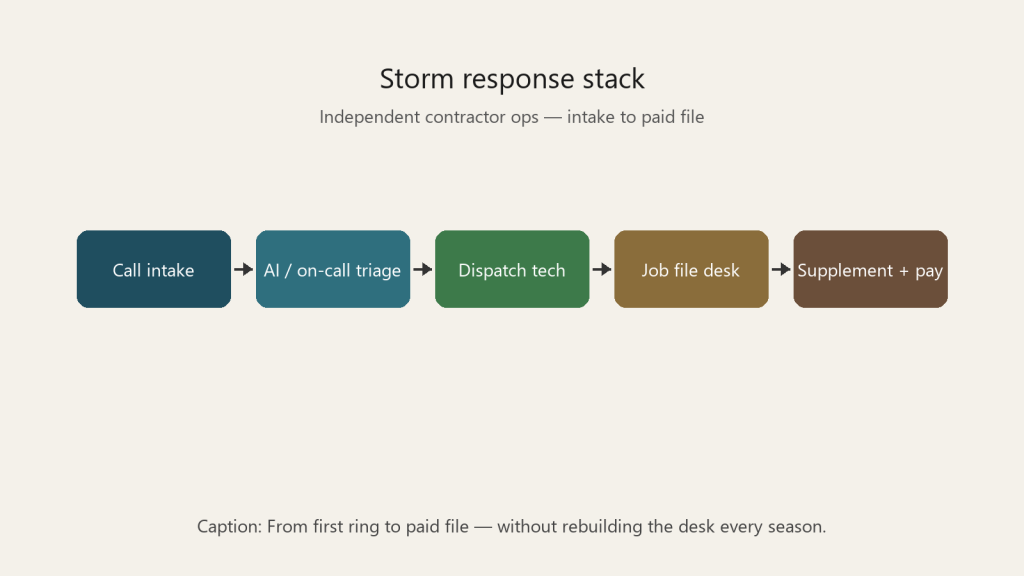
How an independent wins a 12-building portfolio
Win building one with a walkthrough and a first-call agreement. Perform so the invoice matches the authorization. Send the regional a one-page closeout. Ask for buildings two through four on the same terms. The regional is loyal to not getting surprised. Recurring-revenue mechanics are in the Cintas model. Pre-sign commercial doors on one corridor using the multifamily playbook.
Storm work is surge. Program work is the building that calls you every time a supply line fails. Build the program first. Use storm capacity only when it does not break the SLA you sold at home.
When the franchise should win
Say no, or partner, when the account requires bonding, multi-state mobilization, or a rate sheet you cannot hit without losing money. Do not try to out-advertise SERVPRO on residential Google during a named storm.
Questions
Do facility managers refuse independents on principle?
Some procurement teams do. Most on-site FMs do not, if the packet is complete and the response is real.
What should I put in front of an FM this week?
A walkthrough date, a one-page SLA, proof of insurance, and an emergency readiness packet for one building.
Get the independent stack
The Vault is the recurring-revenue system rebuilt for independents: ERA kit, TPA fast-track, sales sequence, and the AI Visibility Audit for your city. One email. No sales call.
The Vault · AI visibility · Field App · QBR