Direct Answer: Before transmitting any contents claim packet to a carrier, TPA, or public adjuster, the senior estimator must pass six hard gates: arithmetic and tax/freight parity, room-to-box custody trace, cleanable vs. total-loss pile separation, LKQ source verification on high-value lines, zero unverified closed-box guesses, and synchronized photo-to-line numbering.
.md twin for estimator QA and carrier file documentation.
Most carrier contents delays are self-inflicted in the final hour before upload. An estimator finishes pricing 380 lines at 4:45 PM, hits export inside XactContents or Xactimate, and emails a bare ESX or PDF spreadsheet without checking whether total-loss items bled into cleanable box counts, whether a discontinued toaster pulled a phantom $400 reseller link, or whether half the photo index still sits on a technician’s phone.
As documented in The Adjuster Desk: One Standard, Two Chairs, a carrier desk reviewer only approves what the file proves without detective work. Running this six-gate pre-send QA checklist — aligned with ANSI/IICRC S320 and Verisk claims workflow standards — turns erratic submissions into fast first-pass settlements.
Six-Gate Pre-Send Claim Submission QA Protocol
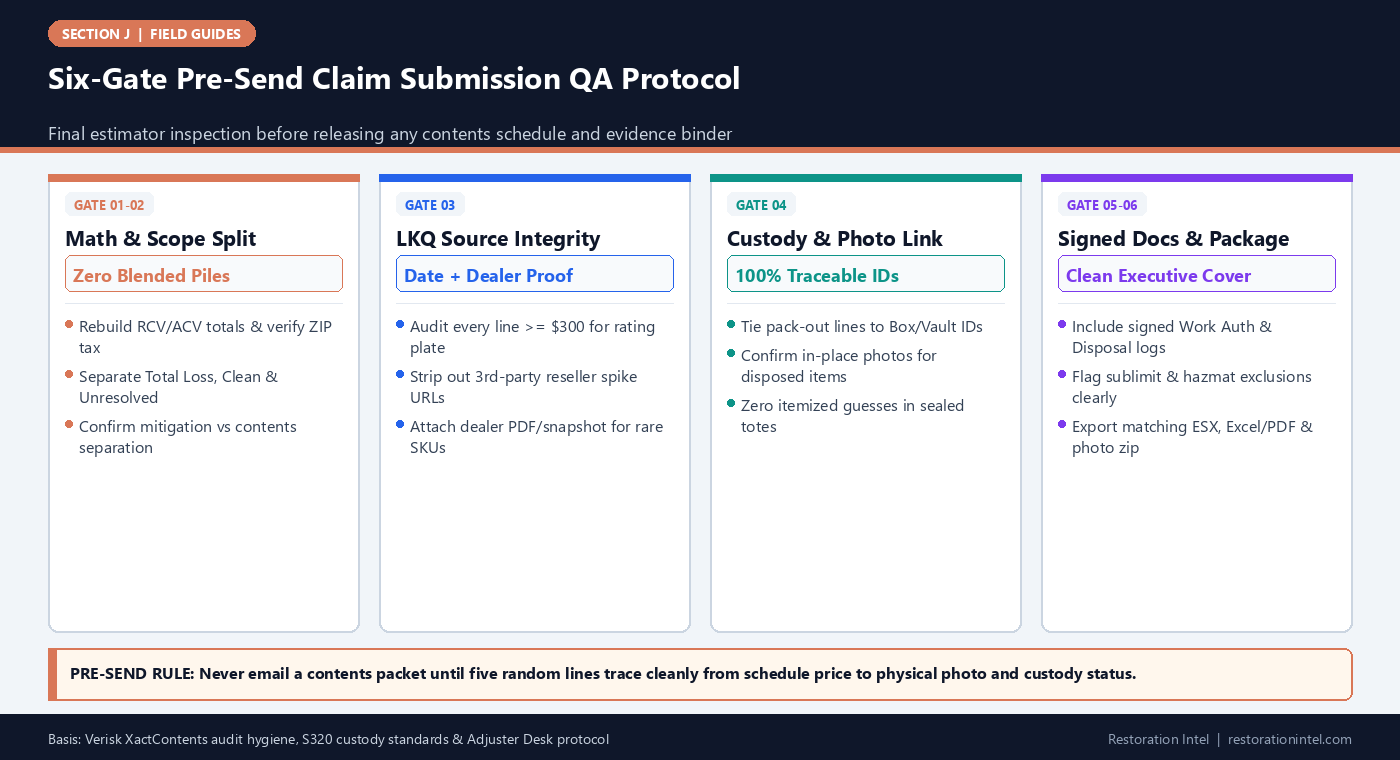
Pre-Send Estimator QA Gate Matrix (Six Verification Checks)
Complete every gate below before moving a job status from Estimating QA to Submitted; hold any file failing a Red-Flag check.
| QA Gate | Exact Items to Verify | Pass Criteria | Common Pre-Send Failure | Immediate Fix Before Send |
|---|---|---|---|---|
| 1. Arithmetic, Tax & Freight Parity | Line extensions, quantities, depreciation holdbacks, local loss-ZIP sales tax, shipping/rigging | Line sum rebuilds cover sheet total to the penny; tax applies uniformly at loss ZIP rate | Double-taxing retail URLs or omitting freight on heavy appliances/gym gear | Reset tax flags globally; break out verified LTL freight cleanly |
| 2. Disposition Pile Separation | Clean & Return vs. Non-Salvageable Total Loss vs. Unresolved / Pending OEM Quote | Three distinct sections or clean status column; zero mixed cleaning + replacement on same item | Charging pack-out cleaning labor AND replacement RCV on the identical sofa | Reconcile disposition tags; move unresolved specs to explicit supplement hold |
| 3. Tier-1 LKQ & Rating-Plate Audit | All lines >= $300-$500, electronics, tools, appliances, and sublimit goods | 100% carry verified brand/model or clear spec tier + authorized dealer comp w/ date | Phantom 3rd-party marketplace SKU spikes or generic 'TV – Large' placeholder text | Replace reseller outliers with authorized current-gen LKQ match + snapshot |
| 4. Custody & Sealed-Box Hygiene | Vault/box barcode mapping, non-salvage in-place photos, closed homeowner totes | Pack-out lines link to Box/Vault ID; disposed lines carry in-place proof; zero guessed tote contents | Itemizing 20 unverified ornaments inside a taped cardboard box marked 'Xmas' | Revert sealed totes to `[UNOPENED – VERIFY]` until physically unpacked & shot |
| 5. Policy & Special-Limit Flags | Jewelry, firearms, cash, fine art, commercial BPP, hazmat exclusions, subrogation holds | Sublimited and excluded items segregated cleanly with zero silent category burying | Hiding a $4,000 commercial camera or firearm collection inside 'Living Room Misc' | Tag sublimit category explicitly and verify bailee/hazmat exclusion notes |
| 6. Binder Assembly & File Naming | Cover summary sheet, ESX/Excel/PDF exports, labeled photo folders, signed authorizations | Consistent Claim #, readable filenames, working hyperlinks/PDFs, signed Chain-of-Custody | Broken local `C:\` image paths, missing work auth, or raw unnumbered IMG_4921.jpg dumps | Package self-contained PDF/ZIP binder and run a 5-line random spot trace |
Why One Unaudited Estimator Shortcut Delays Payment on 400 Clean Lines
Adjusters rarely reject an entire contents submission because of one typo — they reject it because one obvious credibility error signals nobody checked the rest of the file. If an examiner clicks three random lines on page four and finds a $1,200 replacement price from an obscure reseller for a $120 toaster, or spots pack-out cleaning billed on a refrigerator already claimed as total loss, the file shifts straight from fast-pass desk review into full line-by-line audit.
Installing a formal Pre-Send Estimator Gate breaks that cycle permanently. Just as structural estimators audit drying logs against Xactimate equipment days before billing, contents estimators should spend fifteen minutes auditing the completed valuation summary sheet and photo index before anything leaves the outbox.
- Run the 5-Line Random Trace: Pick five lines across different rooms and verify each one has an unambiguous item description, valid price basis, clear condition photo, and confirmed custody/disposal disposition.
- Never double-dip cleaning and total loss: Audit every condemned item to confirm cleaning/deodorization labor was removed unless pre-authorized triage testing occurred.
- Keep mitigation and contents invoices distinct: Do not bury structural debris tear-out or drying fans inside personal property schedules.
Auditing High-Dollar Lines, Sealed Boxes, and Observed vs. Reported Labels
Every claim submission divides into three epistemic piles: items field crews physically inspected and photographed (`Observed`), items the insured described from memory after complete incineration (`Reported`), and unresolved items awaiting OEM diagnostic bench reports (`Pending`). Blending reported fire-ash memory items silently into observed pack-out rows without labeling them invites immediate fraud-desk scrutiny.
Similarly, check every closed homeowner tote and bulk pantry lot during QA. If a technician logged a sealed plastic bin from a basement corner, confirm the draft schedule shows a transparent `Sealed Storage Tote – Pending Inspection` placeholder rather than fabricated interior items — preserving total integrity across the submission packet.
- Separate Observed vs. Reported cleanly: Attach homeowner signed memory-loss affidavits when claiming totally incinerated rooms.
- Inspect every line over $300-$500 manually: Confirm legible rating-plate proof and authorized mainstream retail comps rather than stale database prices.
- Verify all exclusions match signed releases: Attach signed non-salvage disposal authorizations (J-05) and chain-of-custody forms (J-04).
Formatting the Packet So Both Carrier and Public Adjusters Move Fast
Format determines speed. Sending a carrier a 1,400-photo unordered zip file alongside an unindexed spreadsheet forces the desk examiner to waste two hours hunting for kitchen appliances. Organize the packet with a clean one-page executive summary at the front showing RCV, ACV, recoverable depreciation, clean-vs-replace subtotals, and key sublimit/subrogation flags.
Name every exported artifact cleanly (`ClaimNumber_InsuredLastName_ContentsSchedule_YYYY-MM-DD.pdf`), keep room folders synchronized to schedule room headers, and embed clickable dealer comp snapshots for any non-catalog specialty asset.
- Lead with a 1-page Summary Cover: Display line counts, room-by-room RCV/ACV rollups, and open pending items up front.
- Match photo folder names to schedule rooms: If the schedule says `Primary Bedroom`, do not name the folder `Master_Upstairs_2`.
- Archive the exact sent snapshot: Save a locked copy of the transmitted ESX, PDF, and photo binder locally so future supplement discussions compare against the exact submitted baseline.
Practitioner Verification Checklist (J-20)
- Verify full arithmetic parity (unit price x quantity, local loss-ZIP sales tax, and freight) between line items and the cover summary sheet.
- Separate Clean & Return, Total-Loss Replacement, and Pending/Unresolved lines into distinct totals with zero duplicate cleaning/replacement charges.
- Audit 100% of Tier-1 lines (>=$300-$500) for legible brand/model proof, valid condition grades, and authorized dealer LKQ links (zero 3rd-party reseller spikes).
- Trace every packed line to a Box/Vault ID and every disposed line to an in-place photo plus signed disposal authorization.
- Run the 5-Line Random Trace test across exported schedule, photo folder, and custody sheet before hitting Send.
Standards, Authority References & Related Reading
Primary standards, insurance definitions, and sibling Restoration Intel guides referenced in this brief:
- Verisk XactContents Platform Overview
- Verisk Xactimate Estimating Platform
- Verisk Property Claims Solutions
- ANSI/IICRC S320 Standard for Professional Contents Restoration
- Related Guide: Preparing the Final Contents Valuation Summary Sheet for Fast Carrier Sign-Off
- Related Guide: Field Guide: Chain-of-Custody Form Elements & Pack-Out Sign-Off Template
- Related Guide: Field Guide: Verisk XactContents & Symbility Field-Mapping Reference Sheet
- Related Guide: The Adjuster Desk: One Standard, Two Chairs
- Related Guide: Which Xactimate Line Items Do Adjusters Actually Approve?
.md twin for desk QA and team training.Frequently Asked Questions
What is the single most common reason a contents packet gets kicked back by a desk adjuster?
Missing price basis or vague descriptions on high-value items (for example, ‘TV’ or ‘Couch’ without size, brand, or comp source), followed closely by mixing cleanable and total-loss items into one undifferentiated total.
Should estimators include unresolved or pending-inspection items in the initial submission?
Yes — list them explicitly in a separate Pending/Unresolved section with clear next steps (such as awaiting OEM teardown quote) rather than hiding them or guessing a placeholder dollar amount.
How long should the Pre-Send Estimator QA Gate take?
On a standard 250-to-400-line residential loss, running the six-gate check and a 5-line random trace takes roughly 15 to 25 minutes — far faster than answering a carrier audit kick three weeks later.
Should raw unedited phone filenames like IMG_4021.jpg stay in the claim binder?
If your estimating tool links photo IDs directly inside line items, keep that index intact; otherwise organize exported photos into room-labeled folders or numbered PDF contact sheets matching schedule line IDs.