Direct Answer: Spoiled food and temperature-sensitive stock must be photographed in an orderly flat-lay or shelf-spread BEFORE sanitary disposal — capturing item/brand counts, refrigerator or cooler temperature logs, power-outage timestamps, wholesale invoices (for commercial), and signed disposal authorization so spoilage claims clear adjuster review without turning into biohazard holding zones.
.md twin for estimator QA and carrier file documentation.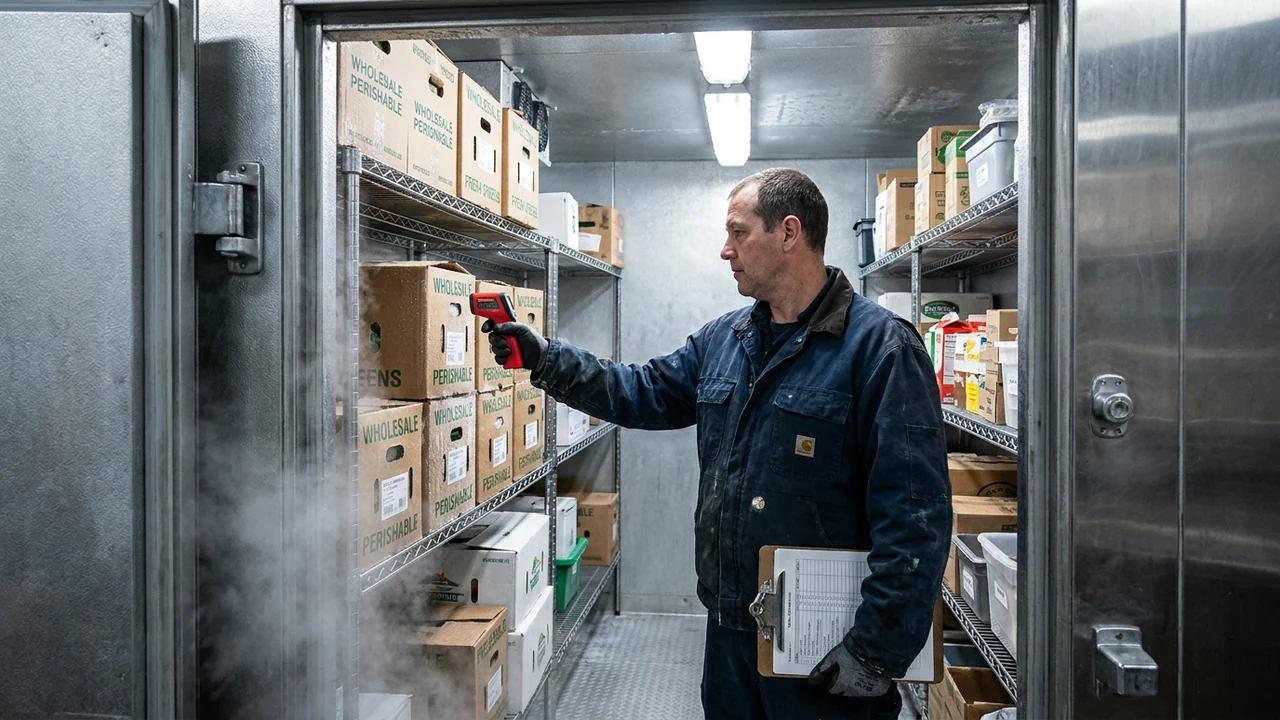
Power outages, fire/smoke penetration, and floodwater turn refrigerators, chest freezers, and commercial walk-in coolers into urgent sanitation hazards within 24 to 48 hours. Crews cannot pack rotting meat, dairy, or thawed seafood into restoration vaults, yet dumping three hundred dollars — or thirty thousand dollars in a restaurant cooler — straight into a roll-off dumpster with zero visual proof guarantees claim denial.
Whether documenting a homeowner’s freezer under casualty loss principles or a commercial grocery walk-in under ANSI/IICRC S320 and S700 smoke/odor rules, field teams need a fast 20-minute documentation protocol that captures indisputable item counts, temperature/outage evidence, and sanitary disposal compliance before a single bag hits the trash.
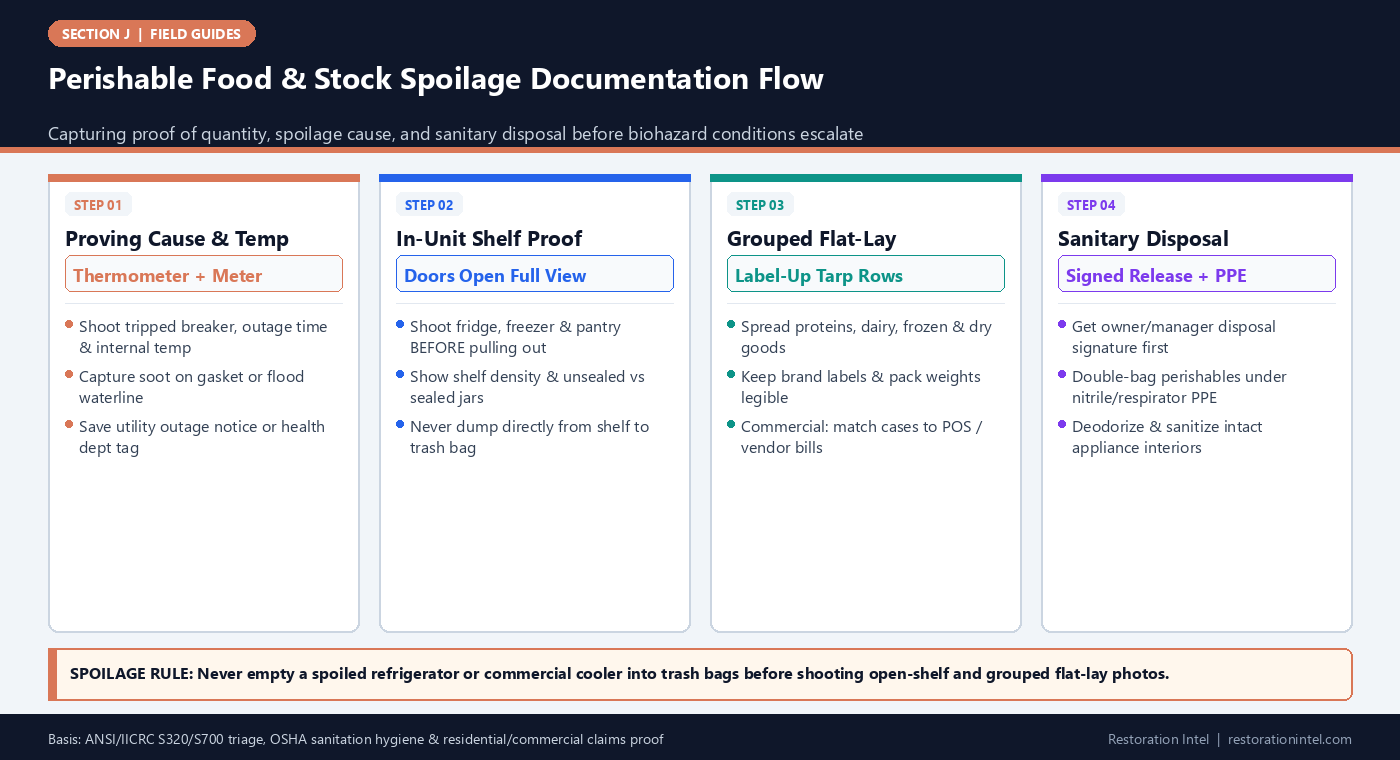
Perishable Food & Stock Spoilage Documentation Flow
Residential vs. Commercial Perishable Loss Documentation Requirements
Tailor documentation depth to property type and policy class; commercial losses require invoice and health-code traceability beyond retail snapshots.
| Loss Context | Peril / Causation Proof | Inventory & Quantity Proof | Pricing / Valuation Basis | Sanitary Disposal Gate |
|---|---|---|---|---|
| Residential Fridge & Chest Freezer (Power Loss / Fire) | Digital probe temperature (>41 deg F), tripped breaker photo, utility outage log, or gasket soot | Open-door full shelf overview + grouped tarp/counter flat-lay showing cuts, brands & counts | Retail local grocery LKQ or itemized unit averages (check food-spoilage endorsement cap) | Signed residential Disposal Auth (J-05) before double-bagging & bin haul |
| Residential Pantry & Dry Goods (Smoke / Flood) | Shelf soot swipe, flood tide mark on lower boxes, or moisture meter on cardboard cartons | Front-facing shelf sweep + pull-out rows separating porous/open goods from sealed glass/cans | Retail grocery replacement; exclude obviously expired/empty containers | Check policy rule on factory-sealed metal cans vs. porous boxes/screw-top jars |
| Restaurant / Café Walk-In Cooler & Prep Line | Continuous temp-logger printout, compressor failure/power shutoff timestamp, health inspector hold | Case-by-case video + open-rack count sheet tied to vendor SKU descriptions and weight/case | Wholesale distributor invoice cost (Sysco/US Foods/local purveyor), NOT menu selling price | Health dept condemnation notice + manager sign-off + commercial dumpster/grease log |
| Grocery / Specialty Market Display Cases | Outage duration log, refrigeration alarm history, smoke odor/sprinkler discharge photos | Aisle-by-aisle shelf count + POS perpetual inventory export snapshot at time of loss | Verified wholesale landed cost (COGS) minus any authorized salvage recovery | Carrier/adjuster inspection window or pre-approved video-inventory waiver prior to dump |
| Clinic / Pharmacy / Lab Cold Storage | NIST-traceable refrigerator data logger CSV/PDF showing temperature excursion window | Lot number, NDC/SKU, vial/unit count, and manufacturer stability excursion letter | Wholesale acquisition invoice + controlled-substance witness log (DEA/state rules) | NEVER dump pharmaceuticals in standard trash; follow licensed medical/DEA destruction |
Why Open-Door Shelf Shots Plus Label-Up Flat-Lays Clear Spoilage Fast
Residential homeowners frequently ask crews to ‘just throw the rotten meat out right now’ while the power is still off. If a technician obliges by scooping everything straight into black contractor bags, the adjuster later receives a handwritten list reading ‘Freezer food: $650’ with zero visual proof. Even when policies include a $500 or $1,000 refrigerated-food sublimit, unsubstantiated guesses stall payout.
A clean two-step camera sequence takes fifteen minutes and protects the claim completely: first snap wide open-door photos of every refrigerator, freezer, and pantry shelf before touching a package; second, lay items out in neat category groups (frozen meats, dairy, condiments, dry pantry) on a disposable poly sheet with labels and package weights facing up so every cut, brand, and quantity is countable.
- Capture the temperature and clock: Hold a digital instant-read thermometer or infrared gun inside the fridge cavity with the current date/time visible.
- Separate porous vs. hermetically sealed: In smoke or clean-water losses, document porous paperboard boxes, spices, and screw-top jars separately from intact welded tin cans (following local health guidance).
- Do not claim empty jars or decades-old freezer burn: Honest sorting builds instant credibility on the legitimate claim lines.
Commercial Perishables: Wholesale Invoices, POS Exports, and Health-Code Holds
Commercial restaurant, catering, grocery, and medical cold-chain losses scale quickly from hundreds of dollars to tens of thousands — and carry strict valuation boundaries. As covered in commercial stock valuation, spoilage claims reimburse the business’s verified wholesale replacement cost (plus applicable freight), never retail menu or shelf markup.
Before hauling a single case out of a commercial walk-in, request three records from the manager: the past 30 days of food-distributor invoices, the point-of-sale or perpetual inventory report, and any continuous cooler temperature-logger printout or local health-department condemnation tag. When total spoiled stock exceeds $2,500, notify the adjuster immediately for either on-site inspection or written video-audit disposal clearance.
- Verify carrier inspection before dumping big commercial coolers: Unless health officials mandate immediate emergency disposal, get written adjuster waiver first.
- Count by unopened case vs. partial open pan: Log `3 full 40-lb cases chicken breast` separately from opened prep-table pans.
- Never dispose of medical vaccines or pharmaceuticals casually: Require pharmacist/clinic leadership and licensed medical-waste destruction manifests.
Sanitary Handling, Odor Extraction, and Appliance Salvageability
Leaving rotting protein inside a residential refrigerator for five days while waiting on adjuster permission often ruins the refrigerator itself. Putrescent liquids leak down defrost drains into sealed bottom insulation foam, creating permanent cadaverine/ammonia odors that total an otherwise intact $2,500 appliance.
With proper PPE (nitrile gloves, eye protection, and organic vapor respirators), photograph and clear spoiled perishables on Day 1 once disposal authorization is signed, double-bag waste cleanly, remove removable crisper drawers for enzymatic washing, and document any persistent gasket or drain-pan staining before deciding whether the unit is cleanable or total loss.
- Clear drains and drip pans immediately: Pooled meat juice underneath the compressor evaporator pan is the main source of irreversible refrigerator odor.
- Unplug and prop doors open post-cleanout: Never leave a cleaned, unpowered refrigerator closed tightly with damp gaskets, or mold blooms inside 48 hours.
- Attach disposal haul photos: Snap one photo of the double-bagged waste load and signed witness sheet (J-05) to close the custody loop.
Practitioner Verification Checklist (J-21)
- Photograph internal cavity temperatures, tripped breakers, outage logs, soot gaskets, or flood waterlines before touching spoiled food.
- Capture wide open-door shelf overviews followed by organized, label-up flat-lay tarp photos separating proteins, dairy, dry goods, and sealed cans.
- On commercial coolers, collect the past 30 days of wholesale purveyor invoices, POS stock reports, temperature logs, and any health-department hold notice.
- Obtain written homeowner/manager disposal authorization (and adjuster clearance on large commercial losses) prior to double-bagging and haul-off.
- Sanitize removable drawers, inspect compressor drip pans, and prop unpowered fridge doors open after clear-out to prevent permanent appliance odor.
Standards, Authority References & Related Reading
Primary standards, insurance definitions, and sibling Restoration Intel guides referenced in this brief:
- ANSI/IICRC S320 Standard for Professional Contents Restoration
- ANSI/IICRC S700 Fire & Smoke Restoration Standard
- OSHA Hazard Communication Standard (HazCom)
- IRS Publication 547: Casualties, Disasters, and Thefts
- Related Guide: Stock, Consumables, and Perishables Valuation in Commercial BPP Claims: Wholesale Cost vs Selling Price
- Related Guide: Small-Dollar Bulk Line Grouping: Preventing Mispriced Averages on Kitchen Utensils, Hardware, and Pantry Goods
- Related Guide: Field Guide: Non-Salvageable Disposal Authorization & Witness-Log Template
- Related Guide: Field Guide: Photographic Proof Angles Required to Substantiate Odor, Corrosion, and Hidden Moisture
- Related Guide: Field Guide: Customer Release & Authorization Language Checklist (Work Auth, Cleaning Risk, and Disposal)
.md twin for desk QA and team training.Frequently Asked Questions
Can crews throw away spoiled refrigerator food on Day 1 without waiting for the adjuster?
On residential losses, yes — provided you first shoot open-shelf photos, organized label-up flat-lay photos proving item counts, temperature/outage proof, and a signed owner disposal authorization. On large commercial losses, get rapid adjuster approval or health-dept notice first.
Are commercial restaurant food losses paid at menu price or wholesale invoice price?
Standard commercial stock policies pay verified wholesale replacement cost (landed purveyor invoice cost) rather than retail menu selling price; lost sales margin falls under Business Income coverage if endorsed.
What if canned pantry goods were exposed to smoke or floodwater?
Label and document them separately. Factory-sealed welded metal cans exposed to clean smoke can sometimes be sanitized per public health guidance, whereas Category 3 flood sewage contamination or heat-bulged cans typically require disposal.
Why should an emptied, unpowered refrigerator never have its doors closed?
Trapped residual humidity inside an unpowered cabinet triggers rapid mold growth on rubber door gaskets within 24 to 48 hours, turning a cleanable appliance into a total loss.