Direct Answer: Lumping drawers and shelves into vague 'miscellaneous lot' lines triggers carrier rejections and underprices specialty items; practitioners prevent average-price distortion by stratifying small-dollar goods into counted quality tiers, separating specialty cookware or pro fasteners from consumables, and anchoring lot quantities to wide-angle plus drawer-open photos.
.md twin for estimator QA and carrier file documentation.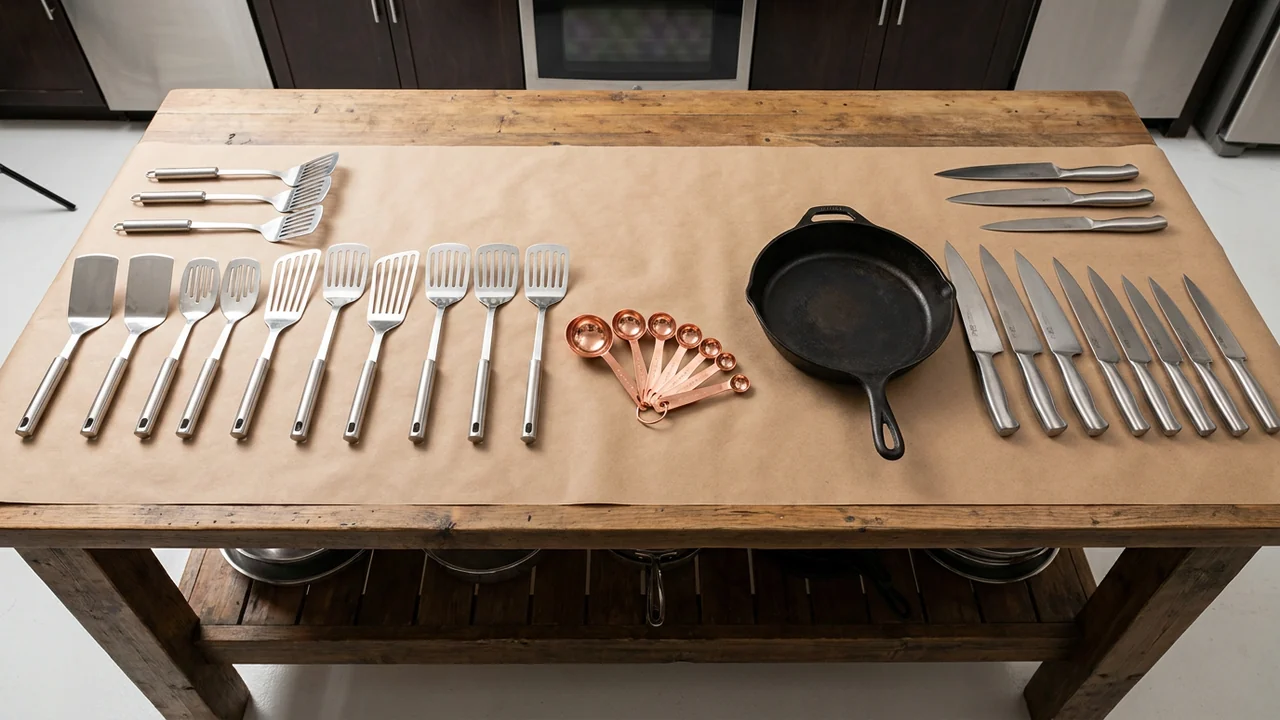
Every large residential or commercial contents loss contains hundreds of low-unit-value items: spatulas, spice jars, drywall anchors, hangers, cables, toiletries, and pantry staples. Logging every $3 wooden spoon as a standalone line item with three photographs blows up labor budgets without improving claim accuracy. Yet going to the opposite extreme—typing ‘Lot of kitchen misc — Qty 1 — $650’—is one of the fastest ways to earn a red-line disallowance at the carrier desk.
The root failure in bulk line grouping is uncontrolled averaging. When a drawer holds ten $2 stamped utensils alongside two $140 forged chef knives and a $90 copper-core saucepan, collapsing them into a single blended ‘kitchenware lot’ either drags the high-grade pieces down to discount-store pricing or looks inflated to an examiner who only sees a generic label. Applying structured tier-grouping inside XactContents keeps dense rooms both fast to capture and audit-proof.
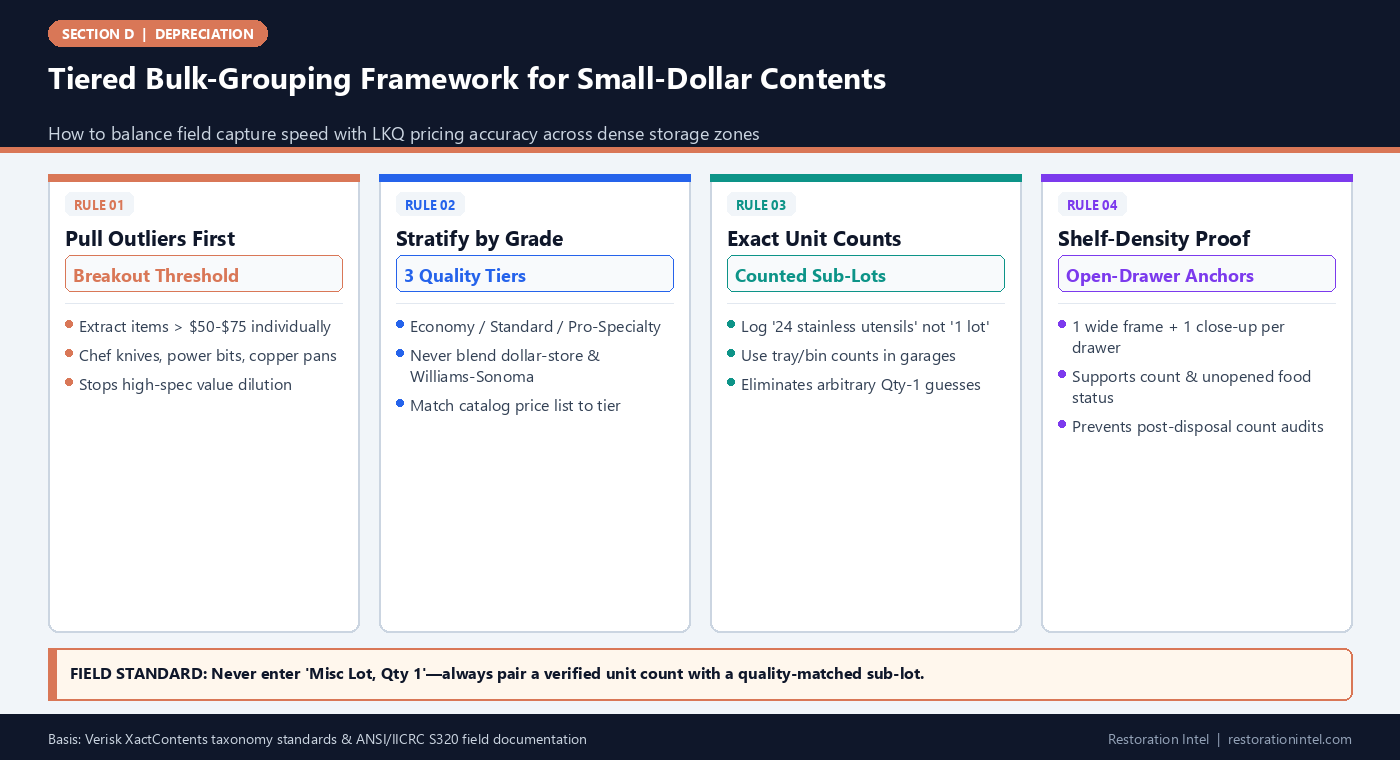
Tiered Bulk-Grouping Framework for Small-Dollar Contents
Bulk Grouping Rules Across High-Density Small-Dollar Zones
Practical breakout thresholds, grouping units, and depreciation handling for dense residential and light-commercial storage.
| Zone / Category | Items to Pull Individually | Approved Bulk Sub-Lot Structure | Photo Evidence Standard | Depreciation & Pricing Pitfall |
|---|---|---|---|---|
| Kitchen Utensils & Gadgets | Forged chef knives, mandolines, thermometer probes, specialty mixers | Group by material/type: Silicone/Nylon tools (Qty), Stainless tools (Qty), Bakeware | Open-drawer overhead shot showing full spread + brand stamp sample | Blending stamped plastic tools with forged steel sets |
| Pantry & Dry Food Goods | Specialty saffron/truffle oils, bulk protein tubs, infant formula, wine | Group by shelf type: Canned goods (Qty), Spices/jars (Qty), Boxed dry goods | Shelf-by-shelf front-facing frame proving unopened seal & density | Opened vs unopened perishables policy limits & expiration |
| Garage Fasteners & Hand Tools | Ratcheting wrenches, torque tools, specialty pliers, router bits | Counted socket/bit sets; organized fastener bins by bin count or box weight | Open toolbox drawers + pegboard wide shot + organizer bin grid | Lumping Snap-on/Klein tools into generic hardware-lot averages |
| Closet Linens, Socks, & Basics | Cashmere knits, tailored dress shirts, designer activewear | Count by garment class & tier: Cotton tees (Qty), Dress socks (Qty), Bath towels | Drawer/shelf layers splayed slightly + close-up of representative tags | Over-depreciating brand-new unopened multipacks |
| Bath, Cosmetics, & Medicine | Prescription devices, high-end skincare/fragrance bottles | Group by unit count: Standard toiletries (Qty), Mid-tier hair/skin care (Qty) | Vanity cabinet open-door shot showing bottle labels & fill levels | Excluding partially used vs sealed items inconsistently |
Why 'Misc Lot — Qty 1' Triggers Immediate Carrier Pushback
From a desk examiner’s standpoint, a line reading ‘Drawer contents — Qty 1 — $400’ is unauditable. There is no way to confirm whether the drawer held eight stainless utensils or forty, no way to verify unit replacement price against RCV retail norms, and no way to apply an accurate depreciation schedule when plastic measuring cups sit mixed with cast-iron cookware.
Even worse, uncounted bulk lines invite arbitrary cuts. If an estimator writes $400 for an uncounted lot, an examiner routinely reduces it to $100 or $150 because neither party has unit counts on record. Converting that exact same drawer into three specific lines—for instance, 14 stainless cooking utensils, 6 silicone spatulas, and 2 forged chef knives logged individually—turns a disputed guess into a five-second approval.
- Kill the ‘Qty 1 Lot’ habit: Every grouped line should carry an actual counted item quantity and unit description (e.g., ’18 glass spice jars’).
- Never mix lifespans: Keep perishable consumables (zero recoverable holdback, short shelf life) separate from durable steel or ceramic goods.
- Show representative quality: One close-up photo showing two or three brand stamps inside a drawer validates the quality tier for the whole sub-lot.
Setting Clean Breakout Thresholds Before Technicians Enter the Room
Field technicians lose huge amounts of time when they have to guess on the fly which small items deserve their own line. Before a pack-out or total-loss walkthrough begins, project managers should set a clear unit-value breakout rule—commonly $50 to $75 RCV per item—plus a short list of mandatory individual categories regardless of drawer density.
Any object above the threshold—a Wüsthof paring knife, a Fluke voltage tester, a Le Creuset dutch oven, or a specialty skincare serum—gets pulled out of the bulk count and logged on its own line with brand and model proof. Everything below the threshold flows smoothly into stratified bulk lines by room and material grade, keeping capture speed high without sacrificing high-margin accuracy.
- Mandatory kitchen breakouts: Chef knives, cast iron, clad stainless cookware, small electrics, and specialty coffee gear.
- Mandatory garage breakouts: Branded hand tools, torque/calibration gear, battery packs, and specialty automotive or woodworking jigs.
- Zero double-counting check: Physically slide pulled outliers aside before shooting the remaining bulk drawer photo so items are never counted twice.
Handling Pantry Goods, Spices, and Open vs Unopened Consumables
Kitchen pantries and bathroom vanities create recurring disputes around half-used bottles and perishable groceries. While ANSI/IICRC S320 addresses contamination triage (noting that porous food packaging and unsealed consumables exposed to smoke, soot, or Category 2/3 water are non-salvageable), carriers differ on how they price partially consumed items and pantry spices.
Standardizing how pantry lines are grouped prevents flat disallowances. Count whole shelves by container type—canned goods, dry boxed goods, glass spice jars, cooking oils—and note approximate fill status or sealed condition transparently. On power-outage or fridge-spoilage losses, check whether the policy carries a specific food-spoilage sublimit before spending excessive labor cataloging low-cost condiments.
- Bottle-tier split: Separate everyday grocery spices ($4-$6) from specialty imported oils, vanilla beans, or saffron ($20-$60+).
- Seal visibility: Shoot pantry shelves straight-on so examiners can verify factory seals, container counts, and size formats (bulk warehouse vs standard).
- Fridge/freezer sublimit check: Verify refrigerated food sublimit caps (often $500) early so capture labor stays proportional to recoverable coverage.
Auditing Software Bulk Defaults Against Actual Retail Equivalents
Estimating software catalogs include handy generic macro lines like ‘Average Kitchen Utensil’ or ‘Standard Spice Bottle.’ While useful for speed, blind reliance on catalog averages introduces subtle bias depending on the home’s real inventory profile. An economy catalog default undervalues a serious home cook’s drawer, while a luxury default overstates a college rental apartment.
Desk estimators should run a quick sanity check on every bulk unit price before exporting. Compare the software average against a current multi-pack retail equivalent from a mainstream merchant—such as a 12-piece stainless utensil set or a 20-jar spice rack—and document that benchmark inside the bulk-line note. As emphasized in inventory enrichment workflows, turning pack-out counts into defensible priced lines depends on transparent LKQ calibration.
- Multipack sanity check: Divide verifiable multipack retail prices by unit count when catalog single-item averages look stale or inflated.
- Regional pantry alignment: Adjust spice and dry-goods averages when shelf photos clearly document organic, specialty, or bulk-club packaging.
- Uniform bulk depreciation: Apply realistic average depreciation across durable bulk sub-lots while zeroing or separating unopened stock where policy allows.
Practitioner Verification Checklist (D-17)
- Pull every individual item above your breakout threshold ($50-$75 RCV) out of drawers and bins before counting bulk sub-lots.
- Replace vague ‘Misc Lot, Qty 1’ descriptions with counted unit quantities stratified by material and quality tier.
- Capture one full-frame open drawer or shelf-density photo per bulk group so unit counts and product tiers are visually verifiable.
- Separate perishable or opened consumables from durable kitchenware, hardware, and tools to keep depreciation tables accurate.
- Sanity-check software bulk unit averages against live retail multipack pricing and note the quality tier in the line comments.
Standards, Authority References & Related Reading
Primary standards, insurance definitions, and sibling Restoration Intel guides referenced in this brief:
- Verisk XactContents Platform Overview
- IRMI Insurance Glossary: Replacement Cost Value (RCV)
- IRMI Insurance Glossary: Depreciation
- ANSI/IICRC S320 Standard for Professional Contents Restoration
- Related Guide: RCV vs ACV Fundamentals in Contents Claims: How Replacement Cost, Depreciation, and Holdbacks Actually Work
- Related Guide: Like Kind and Quality (LKQ) Replacement Matching: Rules for Discontinued Brands and Obsolete Models
- Related Guide: Field Guide: Useful-Life Quick-Reference Ranges Across 40 Common Household & Office Categories
- Related Guide: Field Guide: Emergency Food & Perishable Stock Loss Documentation Checklist (Residential & Commercial)
- Related Guide: A Pack-Out Record Is Not a Priced Inventory
.md twin for desk QA and team training.Frequently Asked Questions
Do adjusters require individual photos of every fork, spice jar, and screwdriver?
No. Open-drawer or shelf-wide density photographs showing clear item counts and overall quality grade, paired with counted sub-lot lines, satisfy carrier audit standards without wasting hours on single-spoon photos.
What is the right dollar threshold for breaking an item out of a bulk group?
Most contents divisions break out items individually once unit RCV reaches $50 to $75, along with any branded chef knives, power-tool accessories, or specialty cookware regardless of size.
How should partially used cosmetics, spices, or pantry bottles be handled?
Document whether containers were factory-sealed or partially consumed. Depending on carrier guidelines, sealed items receive full LKQ RCV while opened consumables may be grouped at average remaining utility or subject to spoilage rules.
Why do carriers reject 'Box of Kitchen Misc – Qty 1' lines?
Because an uncounted Qty 1 line hides both item count and quality grade, making it impossible for a desk examiner to verify replacement unit pricing or apply the right depreciation lifespan.