Direct Answer: A clean pack-back requires verifying reconstruction readiness before loading trucks, scanning every box barcode off the ramp into its target room, unboxing fragile and Tier-1 items in view of the homeowner, and logging any missing or transit-damaged goods on a formal Exception Sheet within 48-72 hours so legitimate claim supplements stay separate from contractor transit liability.
.md twin for estimator QA and carrier file documentation.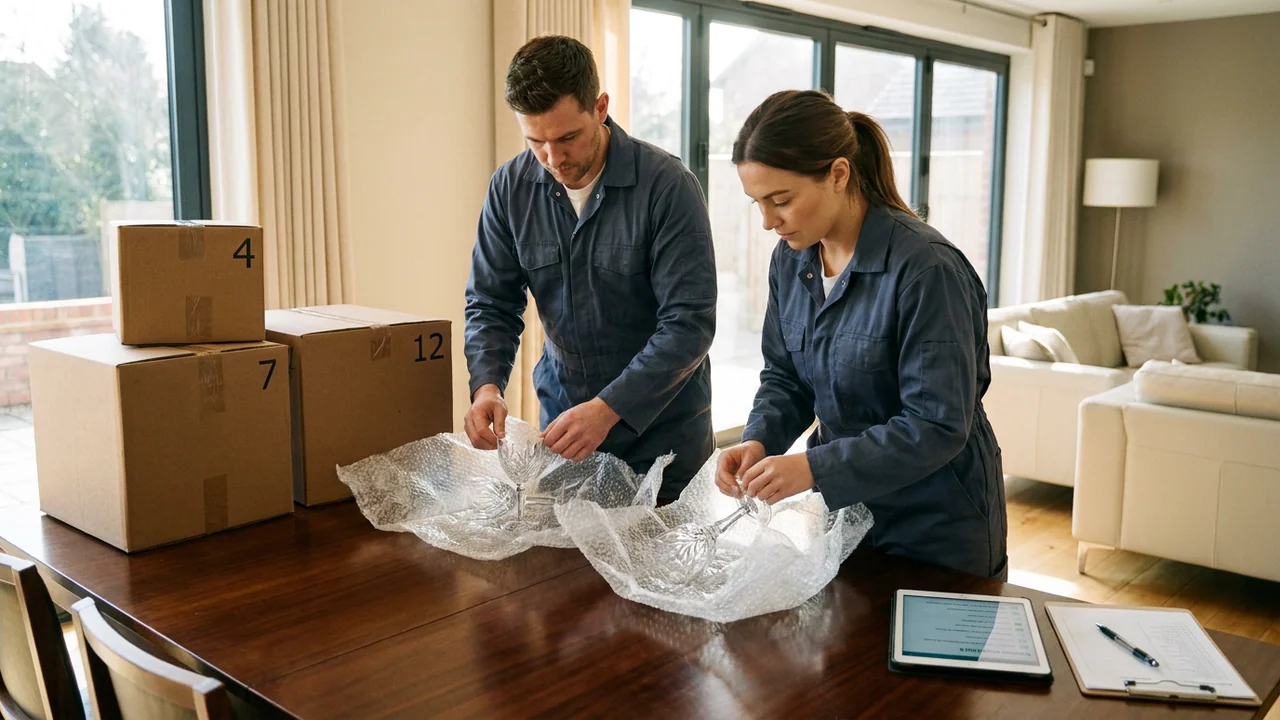
Many restoration companies do outstanding emergency triage, meticulous pack-out, and spotless ultrasonic cleaning — then lose customer goodwill and five-star reviews on the very last day during reset. Trucks roll up while drywall dust still coats baseboards, boxes get stacked four high in the garage instead of their destination rooms, and nobody knows whether a cracked porcelain lamp happened during the fire, inside the vault, or on the tail-lift.
Under ANSI/IICRC S320 chain-of-custody closure and RIA service standards, the pack-back is not a casual move-in — it is a controlled audit closing the custody loop opened on Day 1 (J-04). Running a formal reset gate, unpack protocol, and exception reconciliation protects both the homeowner and the contractor.
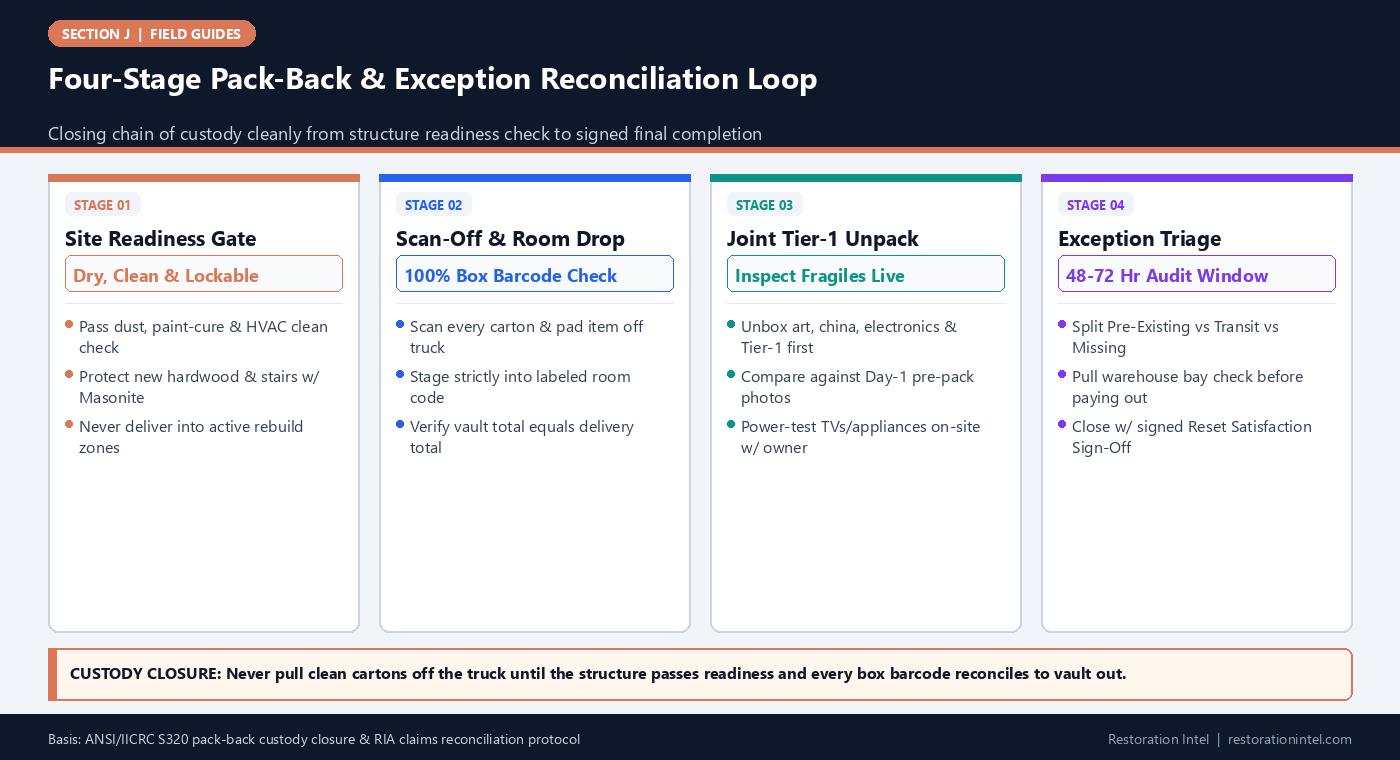
Four-Stage Pack-Back & Exception Reconciliation Loop
Reset & Exception Reconciliation Matrix: Separating Pre-Existing, Claim, and Transit Issues
Classify every discrepancy discovered during unpack against the Day-1 photo roll before assigning financial responsibility or issuing a supplement.
| Exception Category | Observed Reset Trigger | Immediate Verification Step | Root-Cause Evidence Check | Correct Resolution Path |
|---|---|---|---|---|
| 1. Missing Box / Missing Furniture Piece | Box ID `BOX-114` or oak side chair missing at truck scan-off | Check truck bay, warehouse vault rack, cleaning line, and sibling job staging immediately | Compare Day-1 Pack-Out Log (J-04) + warehouse receiving scan history | Locate & deliver priority; if unrecovered, file internal lost-item claim against pre-loss valuation |
| 2. Missing Item Inside Intact Box | Carton arrives sealed, yet owner reports specific watch/vase absent | Check remaining boxes in same room code, packing paper layers, and J-06 Owner-Retained Exclusion log | Review open-box photo taken before tape seal + verify if item moved to total-loss disposal | If confirmed omitted from cleaning return and absent from disposal/exclusion logs, reconcile via PM audit |
| 3. Newly Discovered Peril Damage | Soiled rug or smoky lamp reveals hidden heat blister or stain post-unpack | Photograph damage cleanly alongside original box ID and pre-clean notes | Check Day-1 pre-pack photos and warehouse clean-bench photos | If peril-caused and missed in initial scope, submit transparent carrier supplement — not transit liability |
| 4. Pre-Existing Wear / Old Fracture | Owner notices scratched dresser top or chipped chair leg during placement | Pull Day-1 Pre-Pack Inspection macro photos (J-12) on tablet live | Side-by-side timestamped Day-1 photo showing identical pre-loss scratch | Review calmly with homeowner; zero contractor transit liability applies |
| 5. Confirmed Transit / Cleaning Damage | Freshly crushed carton corner, snapped mirror frame, or cleaning chemical haze | Photograph carton crush/break immediately BEFORE removing debris from room | Compare intact Day-1 pre-pack photo against broken reset photo | Log on Exception Sheet; route to in-house repair vendor, craftsman, or contractor bailee insurance |
| 6. Electronics Fail Power-On Test | TV, soundbar, or microwave fails to boot after placement | Verify wall outlet power, surge strip switch, and remote batteries first | Check pre-pack function log and soot/moisture notes | If fire/water peril caused hidden board failure, submit OEM diagnostic supplement to carrier |
Why Site Readiness Checks Must Happen 48 Hours Before Pack-Back Trucks Load
Pressured by general contractors or homeowners eager to move back in before a holiday weekend, contents managers sometimes schedule pack-back while painters are still sanding trim or HVAC ducts haven’t had final post-construction vacuuming. Moving cleaned sofas and pressed clothing into a dusty, humid, uncommissioned house destroys weeks of deodorization work in two hours.
Forty-eight hours before pulling vaults out of racking, send a supervisor — or require timestamped contractor photos — confirming four site prerequisites: final post-construction clean complete, interior paint cured dry (zero tack), conditioned HVAC running normally with fresh filters, and operational locks/utilities turned on. Floor protection (Masonite or Ram Board) goes down before the first dolly crosses the threshold.
- Never stack boxes in active work zones: If one bedroom still needs carpet installation, hold that room’s cartons in vault or clearly sign a homeowner-directed garage drop waiver.
- Protect newly refinished floors: Lay corner guards on fresh drywall corners and clean Masonite sheets along main hallways before unloading.
- Bring fresh wardrobe hangers and clean totes: Replace any scuffed transit cartons quietly at staging so reset feels crisp and restorative.
Running Live Barcode Scan-Off and Joint Tier-1 Unpack With the Homeowner
Custody ends smoothly when the homeowner sees the math work in front of them. As items come off the liftgate, a dedicated lead scans every box barcode (`BOX-001`..`BOX-185`) and blanket-wrapped piece against the manifest while crews carry cartons straight into the matching labeled room.
Do not rush out the door leaving forty taped dish-packs sitting on the dining floor unless the contract explicitly excludes unpacking. Prioritize unboxing Tier-1 fragiles, artwork, crystal, and primary electronics while the homeowner is present, plug in televisions and kitchen appliances for a quick power-on sanity check, and flatten empty cardboard cartons for haul-away at day’s end.
- Keep pre-pack tablet photos open: Having Day-1 photos ready instantly resolves 90 percent of ‘wait, was that scratch always there?’ moments on the spot.
- Audit total carton count before truck departure: Never leave the driveway with a missing vault scan unresolved; check the truck deck and confirm any delayed specialty items (like a piano or fine art in conservation).
- Capture clean room-reset completion photos: Shoot wide overview shots of each reset room showing furniture upright, intact, and free of transit debris.
Reconciling Exceptions Calmly Inside a 48-to-72-Hour Window
Even the tightest warehouse occasionally misplaces a carton onto an adjacent bay or cracks a lampshade corner during unloading. How the crew handles that exception determines whether the job closes peacefully or turns into a hostile dispute. Issue a numbered Exception & Reconciliation Form whenever a gap surfaces — recording exact box ID, item description, Day-1 photo reference, and whether the homeowner has a short window (such as 48 to 72 hours for self-unpacked boxes) to report concealed breakage.
Separating carrier-payable peril supplements (like internal TV board corrosion discovered at power-on) from contractor transit/handling responsibility prevents companies from paying out-of-pocket for pre-existing or peril-caused defects while taking fast ownership of genuine crew accidents.
- Check the J-05 Disposal & J-06 Exclusion logs first: Half of ‘missing’ reset items were either handed directly to the homeowner on Day 1 (jewelry/medications) or signed off for non-salvage disposal.
- Sweep warehouse receiving bays within 24 hours: Trace any un-scanned box ID through warehouse rack audit logs immediately.
- Close with a signed Reset Sign-Off: Record delivered box count, confirmed exceptions (if any), and clean completion date to release final storage billing.
Practitioner Verification Checklist (J-22)
- Verify post-construction cleaning, paint cure, active HVAC, and floor/corner protection 48 hours before loading pack-back trucks.
- Scan 100% of boxes and furniture pieces off the truck against the vault manifest and place directly into matching labeled rooms.
- Unbox Tier-1 fragiles, crated art/mirrors, and major electronics with the homeowner present and verify power-on status.
- Cross-check any reported missing or damaged item against Day-1 Pre-Pack photos (J-12), Disposal logs (J-05), and Legal Exclusions (J-06) before assigning fault.
- Log unresolved shortages or transit breaks on a dated Exception Sheet and secure final signed Reset Completion & Custody Closure.
Standards, Authority References & Related Reading
Primary standards, insurance definitions, and sibling Restoration Intel guides referenced in this brief:
- ANSI/IICRC S320 Standard for Professional Contents Restoration
- Restoration Industry Association (RIA)
- Verisk XactContents Platform Overview
- IRMI Insurance Glossary: Salvage
- Related Guide: Field Guide: Chain-of-Custody Form Elements & Pack-Out Sign-Off Template
- Related Guide: Field Guide: Standard Abbreviations and Box-Labeling Taxonomy for Multi-Crew Vaults
- Related Guide: Field Guide: Pre-Pack Inspection of Pre-Existing Damage and Wear-and-Tear Documentation
- Related Guide: Field Guide: Customer Release & Authorization Language Checklist (Work Auth, Cleaning Risk, and Disposal)
- Related Guide: A Pack-Out Record Is Not a Priced Inventory
.md twin for desk QA and team training.Frequently Asked Questions
How do you handle a homeowner who reports an item broken or missing two weeks after reset?
If the crew unpacked the box jointly and signed a clean Reset Completion sheet, compare against Day-1 pre-pack photos and the signed Exception Sheet. For boxes the homeowner chose to unpack themselves, establish a clear written post-delivery inspection window (typically 48-72 hours) in your release language.
Should contents crews deliver boxes back into a house while contractors are still sanding drywall?
No. Delivering cleaned soft goods and electronics into active drywall dust or uncured paint re-contaminates the contents and voids cleaning guarantees. Wait for verified site readiness.
What if an appliance or TV works physically in the box but fails to turn on at pack-back?
Check wall breakers first, then verify against pre-pack notes and soot/moisture logs. If fire heat or water caused hidden internal board failure, document an OEM diagnostic supplement for the carrier rather than treating it as transit damage.
Where do most 'missing items' turn up during reconciliation?
In three places: homeowner-retained high-sensitivity items logged on Day 1 (jewelry, passports, meds), non-salvageable items signed off on the Disposal Log, or mis-slotted cartons sitting in an adjacent warehouse vault bay.