Direct Answer: Before touching property on a loss site, restoration operations should use counsel-reviewed authorization checklists covering four core operational clauses — Emergency Work & Pack-Out Access, Inherent-Vice & Specialty Cleaning Risk, Non-Salvageable Disposal Witness Sign-Off, and Storage/Reset Custody Terms — recognizing that this field checklist is for legal counsel review, not legal advice.
.md twin for estimator QA and carrier file documentation.
Technical skill never rescues a restoration contractor who moves forward on handshake verbal promises. When a panicked homeowner says ‘just throw that ruined couch away and clean whatever else you can save’ on Friday afternoon — only to ask Monday morning where their heirloom leather sofa went — the crew’s only defense is clear, signed, plain-English authorization captured before work began.
Operational Disclaimer (Not Legal Advice): Laws governing home improvement contracts, consumer rescission periods, bailee liability, and warehouseman’s liens vary sharply by state. This guide serves strictly as an operational checklist for your company’s legal counsel to review and draft into binding contract language aligned with ANSI/IICRC S320 and RIA operational boundaries — never as standalone legal advice.
Four Authorization Checkpoints for Counsel Review
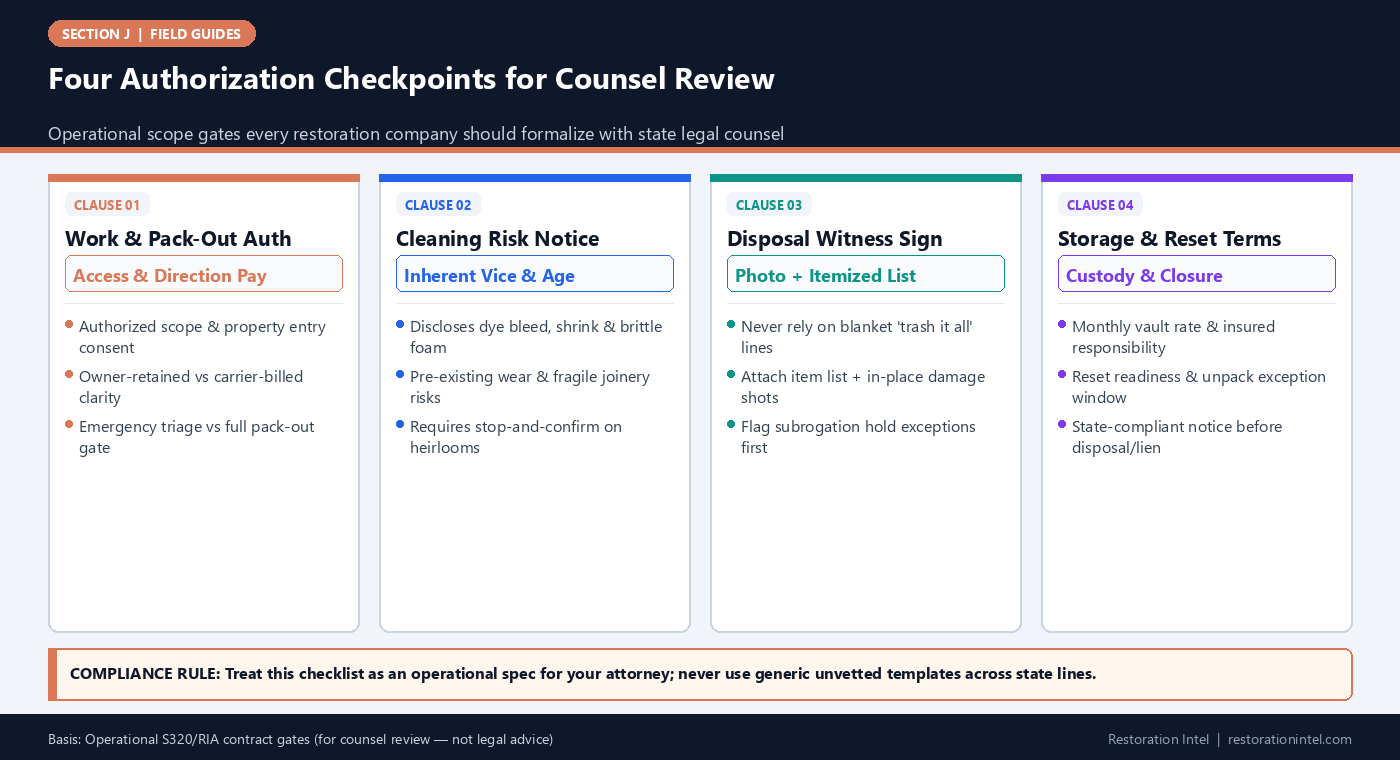
Customer Release & Authorization Operational Checklist (For Legal Counsel Review)
Review these five operational release checkpoints with licensed state counsel to ensure your field paperwork closes every recurring claim gap.
| Authorization Checkpoint | Operational Trigger on Site | Key Element Counsel Must Address | Common Field Gap to Prevent | Linked Supporting Proof |
|---|---|---|---|---|
| 1. Emergency Stabilization & Access Auth | Crew arrival prior to pack-out or deodorization | Scope boundary, utility/access permission, insured payment responsibility if coverage denied, statutory notice/rescission language | Starting pack-out on verbal consent or relying solely on an insurance adjuster email | Timestamped pre-work walkthrough photos & signed digital auth |
| 2. Pack-Out Custody & Exclusion Sign-Off | Loading salvageable contents into cartons/trucks | Acknowledgment of counted boxes/pieces, high-sensitivity exclusions (meds, cash, firearms, jewelry), and hazmat non-transport | Homeowner claiming packed cash or jewelry disappeared when crew never touched it | Signed Pack-Out Inventory + J-06 Legal Exclusion Receipt |
| 3. Specialty Cleaning & Inherent-Vice Release | Wet-cleaning antique textiles, silk rugs, aged foam, or veneer furniture | Informed consent that aged dyes, weak glue joints, brittle rubber backing, or smoke-baked finishes may react unpredictably during restoration | Expecting zero-risk showroom results on 30-year-old silk drapery saturated in soot | Close-up pre-clean photos (J-12) + pre-test consent line |
| 4. Non-Salvageable Disposal Authorization | Condemning food, porous soft goods, or ruined electronics before haul-off | Explicit itemized or box-lot list, owner confirmation of abandonment, and hold check for carrier inspection or subrogation | Using one vague line ('discard ruined basement') with zero itemization or photos | In-place damage macros + Witness Log (J-05) + dump receipt |
| 5. Storage Billing, Reset & Exception Window | Warehouse vault intake and final home pack-back | Monthly storage rate disclosure, coverage vs. declared value limits, site-readiness conditions, and post-delivery inspection window | Unpaid multi-month vault storage after claim disputes or open-ended missing-item claims months later | Vault-in receipt + signed Reset Completion & Exception Sheet (J-22) |
Why Blanket Work Authorizations Fail During Cleaning and Disposal Disputes
A single-page generic ‘Work Authorization and Direction to Pay’ drafted ten years ago for water extraction rarely covers the nuances of contents restoration. Extracting water from carpet pad is straightforward; immersing vintage wool draperies, deodorizing smoke-saturated particleboard dressers, or tossing a garage full of ruined holiday keepsakes into a roll-off dumpster triggers completely different owner expectations.
When crews rely on one blanket signature collected at 2:00 AM during emergency board-up to justify disposing of personal belongings three days later, misunderstandings erupt. Separating operational authorizations into clear, modular gates — Work/Access, Cleaning Risk, Disposal Witness, and Storage/Reset — ensures the homeowner reads and understands the exact decision happening at each stage.
- Never use ‘discard all damaged items’ boilerplate: Ask your counsel to pair disposal releases with an attached itemized schedule or specific photo-logged lot list.
- Verify signer authority: Confirm the person signing is the named insured, spouse, or documented corporate officer — not a neighbor, minor, or unauthorized tenant.
- Check subrogation before any disposal signature: Even when a homeowner begs to throw away a burst washing-machine hose or burned space heater, issue a spoliation hold (J-25) first.
Structuring Inherent-Vice and Specialty Cleaning Risk Disclosures With Counsel
Soot, moisture, and age weaken materials silently before a restoration technician ever touches a sponge. Latex rug backings turn brittle and crumble when washed; unfixed vegetable dyes bleed during wet extraction; aged glue joints soften under humidity; and heat-stressed leather cracks when conditioned. None of those material vulnerabilities are caused by technician negligence — they represent pre-existing inherent vice aggravated by the peril.
Without clear pre-cleaning risk disclosure reviewed by counsel and signed before wet processing or thermal deodorization starts, the contractor risks absorbing replacement cost on marginal heirlooms. Always pair a written Cleaning Risk Release with a pre-test spot check on delicate textiles, high-value rugs, and vintage finishes, documenting the homeowner’s choice either to attempt restoration with disclosed risk or escalate to the adjuster for replacement.
- Stop and disclose before processing high-risk items: Flag antique finishes, silk/rayon blends, delicate electronics, and family heirlooms explicitly on a line-item risk sheet.
- Align with carrier salvage rules: Keep adjuster notice clean under salvage/restoration feasibility when test cleaning shows irreversible bleeding or shrinking.
- Leave clean digital audit trails: Timestamped tablet signatures paired with pre-clean macro photos prevent ‘I never knew it could shrink’ disputes.
State Statutory Rules, Warehouse Liens, and Counsel Sign-Off
Every operational point in this checklist must pass through a licensed attorney in the state where the loss occurs before hitting field tablets. Many jurisdictions enforce strict statutory font sizes, consumer three-day right-to-cancel notices, assignment-of-benefits (AOB) prohibitions, and formal certified-mail procedures before a warehouseman’s storage lien can ever be exercised.
Treat this Field Guide strictly as the operational shopping list you hand your legal counsel: ‘Here are the five real-world field moments where our crews touch customer property, face cleaning uncertainty, dispose of waste, or hold goods in vaults — please draft compliant, state-specific forms for each gate.’
- Audit state AOB and contract statutes annually: Insurance and home-repair contract laws shift frequently across states.
- Verify storage valuation disclosures: Have counsel align your warehouse receipt liability limits with standard bailee/inland-marine insurance coverage.
- Deliver signed copies immediately: Email or print a clean copy of every signed authorization straight to the homeowner on the same day.
Practitioner Verification Checklist (J-24)
- Have licensed state legal counsel draft and approve all customer work authorizations, cleaning-risk waivers, disposal releases, and storage contracts (never rely on this operational checklist as legal advice).
- Confirm the signer is a named insured or authorized corporate representative before starting pack-out or disposal.
- Require separate itemized or lot-referenced Disposal Authorizations backed by in-place photos — never blanket ‘trash everything’ checkboxes.
- Obtain signed Cleaning Risk / Inherent-Vice disclosures prior to wet-cleaning or deodorizing delicate textiles, antique veneers, silk rugs, or heat-stressed leather.
- Check for subrogation/spoliation holds (J-25) and carrier inspection requests before allowing a homeowner to sign off on discarding any origin appliance or failed plumbing part.
Standards, Authority References & Related Reading
Primary standards, insurance definitions, and sibling Restoration Intel guides referenced in this brief:
- ANSI/IICRC S320 Standard for Professional Contents Restoration
- Restoration Industry Association (RIA)
- IRMI Insurance Glossary: Salvage
- IRMI Insurance Glossary: Subrogation
- Related Guide: Field Guide: Chain-of-Custody Form Elements & Pack-Out Sign-Off Template
- Related Guide: Field Guide: Non-Salvageable Disposal Authorization & Witness-Log Template
- Related Guide: Field Guide: High-Sensitivity Legal Exclusions — Firearms, Medications, Cash, Jewelry, and Passports
- Related Guide: Field Guide: Pre-Pack Inspection of Pre-Existing Damage and Wear-and-Tear Documentation
- Related Guide: Field Guide: Homeowner Reset, Unpack Verification, and Missing/Damaged Item Reconciliation Protocol
.md twin for desk QA and team training.Frequently Asked Questions
Is this checklist a ready-to-use legal contract template?
No. This guide is strictly an operational checklist detailing the field gates restoration companies need covered; a licensed attorney in your operating state must draft and approve the actual contract and release wording.
Why isn't one signature on the Day-1 Work Authorization enough to throw away ruined items?
Blanket emergency authorizations rarely document specific items, confirm adjuster/subrogation clearance, or prove informed homeowner consent on individual keepsakes — making itemized Disposal Witness Logs essential.
What does 'inherent vice' mean on a cleaning risk release?
It refers to built-in material fragility or pre-existing aging — such as unstable dyes, dry-rotted rubber backing, or weakened hide glue — that may fail during normal industry-standard cleaning even when technicians follow every S320 protocol.
Can a homeowner sign a disposal release for a burst washing machine hose on Day 1?
Never discard a failed appliance, braided supply line, or electrical origin device even if the homeowner signs a release — first check for subrogation potential and issue a spoliation hold under J-25.