Direct Answer: In Category 1 and Category 2 pipe-burst losses, restorability depends on water category at the moment of contact, substrate porosity, dwell time before stabilization, and whether total pack-out, wet processing, drying, and storage costs stay safely below replacement value.
.md twin for estimator QA and carrier file documentation.
Deciding what gets packed out for restoration versus listed as non-salvageable is the highest-stakes field judgment on any pipe-burst loss. Unlike fire or sewage events where thermal charring or gross fecal contamination makes many decisions obvious, Category 1 (sanitary supply water) and Category 2 (grey water containing soaps, food soils, or degraded standing water) losses sit in a grey zone where similar-looking items behave completely differently once wet.
Under the ANSI/IICRC S500 Water Damage Standard and ANSI/IICRC S320, technicians must evaluate both hygienic cleanability and structural integrity before committing an item to a truck. Solid kiln-dried oak dining chairs exposed to clean copper-pipe spray for four hours usually dry and clean cleanly. A particleboard media console sitting in the exact same puddle swells at the cam-lock joints and loses structural fastener hold permanently.
Equally important is the economic boundary defined in IRMI salvage principles and Salvage Is a Window, Not a Service. An item can be technically cleanable on a bench yet economically non-salvageable once pack-out labor, antimicrobial treatment, climate-controlled vault storage, and redelivery approach or exceed Like-Kind-and-Quality (LKQ) replacement cost.
Cat 1–2 Pipe-Burst Triage Matrix: Restorable vs Non-Salvageable
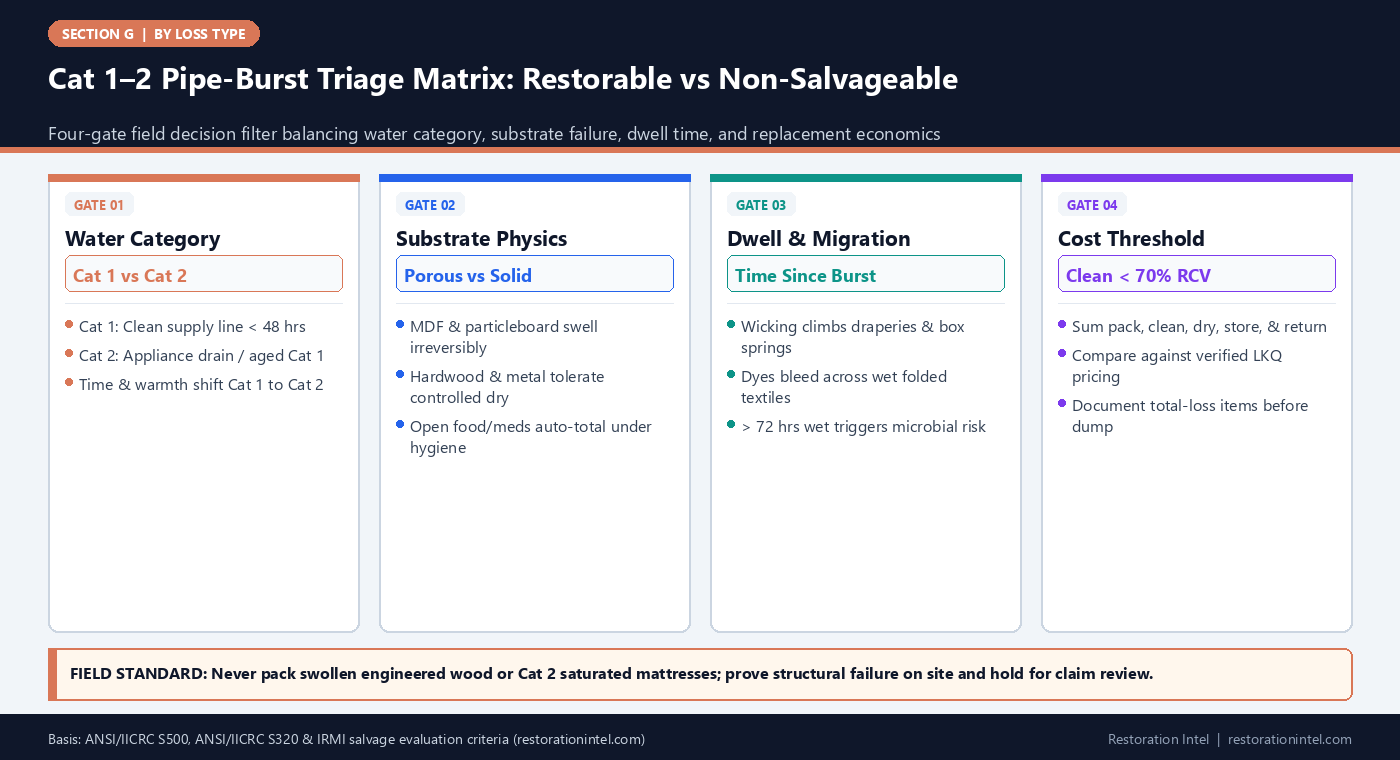
Category 1 vs Category 2 Pipe-Burst Restorability Matrix by Material Class
Field triage baselines assuming rapid stabilization within 24–48 hours versus delayed discovery past 72 hours.
| Contents Material Class | Cat 1 (< 48 Hr Exposure) | Cat 2 (Grey Water Exposure) | Primary Failure Mechanism | Recommended Triage Action |
|---|---|---|---|---|
| Particleboard / MDF Case Goods | Non-salvageable if base or edges swelled | Non-salvageable across wetted panels | Irreversible binder breakdown, veneer lift, fastener pull-out | Document swelling with scale photos; schedule total loss |
| Solid Hardwood Furniture | Restorable with controlled dehumidification | Restorable if cleaned/sanitized before swelling | Finish blushing, miter joint separation if dried too rapidly | Pack to climate-controlled drying; pad and monitor EMC |
| Upholstered Sofas & Mattresses | Often restorable via extraction + rapid dry | Mattresses usually non-salvageable; sofas case-by-case | Deep foam microbial growth, dye migration, decking stain | Check inner foam/ticking; Cat 2 mattresses default total loss |
| Folded Clothing & Washable Linens | Restorable via specialty wet cleaning | Restorable with sanitize + hot/enzyme cycle | Cellulose dye bleed, mildew odor after 48–72 hours | Segregate bleeding darks immediately into breathable totes |
| Consumer Electronics & Appliances | Restorable only if unpowered & dried fast | Non-salvageable if grey water entered boards | Mineral bridging, solder corrosion, food-soil residue | Inspect PCB/motors; isolate unpowered until bench test |
| Books, Photos & Paper Files | Restorable via desiccant or freeze-drying | Usually non-salvageable unless vital records | Coated page blocking, ink feathering, starch mold growth | Freeze vital records within 48 hrs; batch-log trade books |
How Water Category Shifts Between Discovery and Triage
A classic mistake on pipe-burst jobs is treating the plumbing source as permanent proof of water category. Under ANSI/IICRC S500, water originating from a clean copper riser or braided toilet supply line begins as Category 1, yet it rarely stays Category 1 once it travels across dirty subfloors, pet-hair carpets, HVAC floor registers, or garage storage boxes. When clean water picks up organic soils or sits stagnant at room temperature for more than 48 to 72 hours, biological activity escalates the environment toward Category 2 or even Category 3.
Contents crews arriving on day two or day three of a slow ceiling leak must classify items by the condition of the water surrounding them during triage, not what the homeowner assumes came out of the pipe. A vanity cabinet base sitting in soapy laundry drain overflow or stagnant carpet-pad leachate requires Category 2 decontamination protocols and stricter porous-goods triage than a freshly sprayed linen closet caught twenty minutes after a burst.
Documenting water source, travel path, standing duration, and room temperature on the initial triage log establishes why two rooms in the same house receive different restorability calls. That distinction prevents desk examiners from applying clean-water wipe-down assumptions to contents that soaked in degraded grey water behind closed closet doors.
- Time-clock audit: Record estimated time of pipe failure versus mitigation arrival on the loss intake form to establish Cat 1-to-Cat 2 degradation exposure.
- Pathway check: Inspect floor dust, pet zones, basement sump splash, and appliance discharge traps before labeling wet textiles Category 1.
- Thermal multiplier: Elevated indoor heat from summer outages or closed-up vacant homes accelerates microbial amplification inside boxed paper and textiles.
Structural and Porous Material Thresholds Under S320
Even pure Category 1 water destroys engineered wood products faster than most policyholders expect. Modern flat-pack dressers, kitchen islands, laminate bookshelves, and speaker cabinets rely on urea-formaldehyde resins and compressed wood fibers that absorb moisture along unsealed bottom edges and dowel holes. Once those fibers expand past their elastic limit, drying never restores the original profile; joints stay loose, drawers bind, and veneers bubble.
By contrast, ANSI/IICRC S320 emphasizes evaluating material composition before condemning furniture. Solid oak, maple, or walnut frames with finish blushing often respond well to controlled ambient dehumidification followed by cabinet-maker touch-up. Similarly, solid-brass hardware, stoneware, crystal, and sealed stainless cookware are almost universally restorable after Cat 1 or Cat 2 exposure once washed and dried before mineral pitting sets in.
Textiles and multi-layer composites sit in the middle. Coated-paper glossy books fuse together into solid bricks (blocking) if allowed to air-dry slowly rather than entering vacuum freeze-drying within 48 hours. Mattresses saturated with Category 2 water cannot be reliably extracted and sanitized through deep quilting and foam layers, making hygienic replacement the standard practitioner call.
- Bottom-edge inspection: Always tilt engineered wood case goods and check rear particleboard panels where unsealed edges wick water silently.
- Open consumables rule: Opened dry pantry goods, spices, cosmetics, prescription medications, and pet food touched by Cat 1 or Cat 2 water are non-salvageable on hygiene grounds.
- Leather and suede caution: Direct saturation stiffens and shrinks finished leather; rapid heat drying ruins hides—stabilize gently and evaluate specialty leather-cleaner feasibility.
Electronics, Appliances, and Hidden Corrosion Windows
Electronics caught in a ceiling pipe burst present a split failure mode that tricks inexperienced crews. An espresso machine, AV receiver, or desktop tower that looks clean on the outside after a Category 1 shower may survive if power was cut immediately, capacitors were discharged, and technicians rinse circuit boards with deionized water before controlled low-temperature dehydration. Turn that same unit on to ‘test if it still works’ while damp, and internal shorting destroys power boards instantly.
Category 2 water raises the bar dramatically because dissolved detergents, food fats, and conductive minerals leave ionic residues underneath surface-mount chips and inside sealed relays. Even after drying, microscopic salt bridges cause delayed dendritic corrosion months after the claim closes. Manufacturers’ safety warnings on kitchen appliances, power tools, and medical devices such as CPAP machines routinely prohibit field reconditioning once internal insulation or motors have been submerged.
For high-value electronics and motorized home equipment, field crews should never guess restorability by wiping the exterior casing. Tag the unit for specialist bench inspection or manufacturer safety verification, photograph the serial plate and internal watermarks, and record whether the device was energized during the leak.
- Zero-power rule: Never plug in wet electronics or appliances on site to verify damage; tag and document moisture ingress before testing.
- Medical and life-safety devices: CPAP units, infant monitors, smoke alarms, and GFCI power strips exposed to water are non-salvageable due to safety liability.
- Warranty voidance check: Document OEM void-if-wet stickers and submerged UL-listed motor housings to substantiate replacement requests.
Economic Salvage Limits: When Cleanable Still Means Total Loss
Technical cleanability is only half of the triage equation. Under standard property claim workflows overseen by the Restoration Industry Association (RIA) and carrier TPA guidelines, restoring a low-value item whose pack-out, wet-cleaning, deodorizing, climate-controlled storage, and return-delivery costs total 80 to 120 percent of buying a new replacement makes no financial sense for either the policyholder or the insurer.
Consider a $180 laminated bookcase, a $90 synthetic area rug, or ten pairs of everyday athletic shoes soaked by a bathroom supply line. Washing, antimicrobial dipping, rack drying, odor verification, inventory tracking, and vaulting those items for 30 days during drywall and flooring reconstruction can easily exceed replacement cost. Attempting to restore economically underwater items inflates mitigation invoices and triggers justified carrier pushback.
Before packing marginal Cat 1–2 items, crew leads and estimators should run a quick restore-vs-replace screen on mid- and low-tier goods. Presenting the adjuster with a transparent economic comparison—showing exact cleaning/handling hours alongside LKQ retail pricing—turns a potential dispute into a clean total-loss sign-off.
- Pack-and-store burden test: Include both cleaning labor and projected reconstruction storage duration when testing economic salvageability.
- Pair-or-set awareness: Check whether condemning two soaked dining chairs in a matching six-chair set affects set continuity before finalizing partial salvage.
- Sentimental exception lane: Family heirlooms, framed photographs, and irreplaceable keepsakes bypass strict economic caps when the insured elects restoration.
Practitioner Verification Checklist (G-02)
- Verify actual water category at the item contact surface (accounting for travel path and >48–72 hr stagnation) before assigning salvage status.
- Inspect bottom rails, rear panels, and cam-lock joints on all engineered wood furniture for irreversible swelling or veneer separation.
- Condemn opened food, pharmaceuticals, cosmetics, life-safety electronics, and Category 2 saturated mattresses prior to pack-out.
- Prohibit energizing wet electronics or appliances on site; isolate power and capture serial plates plus internal water-entry proof.
- Screen low- and mid-value wet goods against combined pack-out, processing, and storage cost before committing them to restoration.
Standards, Authority References & Related Reading
Primary standards, insurance definitions, and sibling Restoration Intel guides referenced in this brief:
- ANSI/IICRC S500 Water Damage Standard
- ANSI/IICRC S320 Standard for Professional Contents Restoration
- IRMI Insurance Glossary: Salvage
- Restoration Industry Association (RIA)
- Related Guide: Salvage Is a Window, Not a Service
- Related Guide: Clean & Grey Water (Cat 1–2) Pipe-Burst Losses: Damage Evidence & Forensic Photography Rules
- Related Guide: Clean & Grey Water (Cat 1–2) Pipe-Burst Losses: Cleaning Methodology & Processing Documentation
- Related Guide: Clean & Grey Water (Cat 1–2) Pipe-Burst Losses: Carrier Scope Justification & Total-Loss Defense
- Related Guide: A Price Tag on a Lost Item Is Worth Nothing
.md twin for desk QA and team training.Frequently Asked Questions
Can particleboard furniture ever be saved after a clean-water pipe burst?
If only the top surface received brief droplets that were wiped dry immediately before water entered seams or raw edges, it may survive. Once water reaches unsealed bottom rails, dowel holes, or MDF cores and causes swelling or joint loosening, the damage is permanent and non-salvageable.
How long does Category 1 pipe-burst water stay clean before turning Category 2?
ANSI/IICRC S500 notes that clean water degrades rapidly when it contacts contaminants or remains stagnant; in typical indoor temperatures, 48 to 72 hours of stagnation or contact with soiled floors, carpet pads, or drains shifts the environment to Category 2 or worse.
Are mattresses exposed to a grey-water washing machine overflow restorable?
Generally no. Category 2 water carries detergents, organic soils, and bacteria deep into quilting and polyurethane foam layers that cannot be reliably flushed, sanitized, and verified pathogen-free throughout the core.
Why do carriers deny cleaning charges on inexpensive water-damaged items?
Because property policies follow economic indemnity: if pack-out, specialty cleaning, drying, and warehouse storage cost nearly as much as or more than replacing the item at Like-Kind-and-Quality pricing, replacement is the more economical settlement path.