Direct Answer: Processing Cat 1–2 pipe-burst contents requires pairing substrate-appropriate cleaning and sanitization with dated facility logs—recording equilibrium moisture return, EPA-registered disinfectant dwell times, textile care outcomes, and post-cleaning QA sign-offs.
.md twin for estimator QA and carrier file documentation.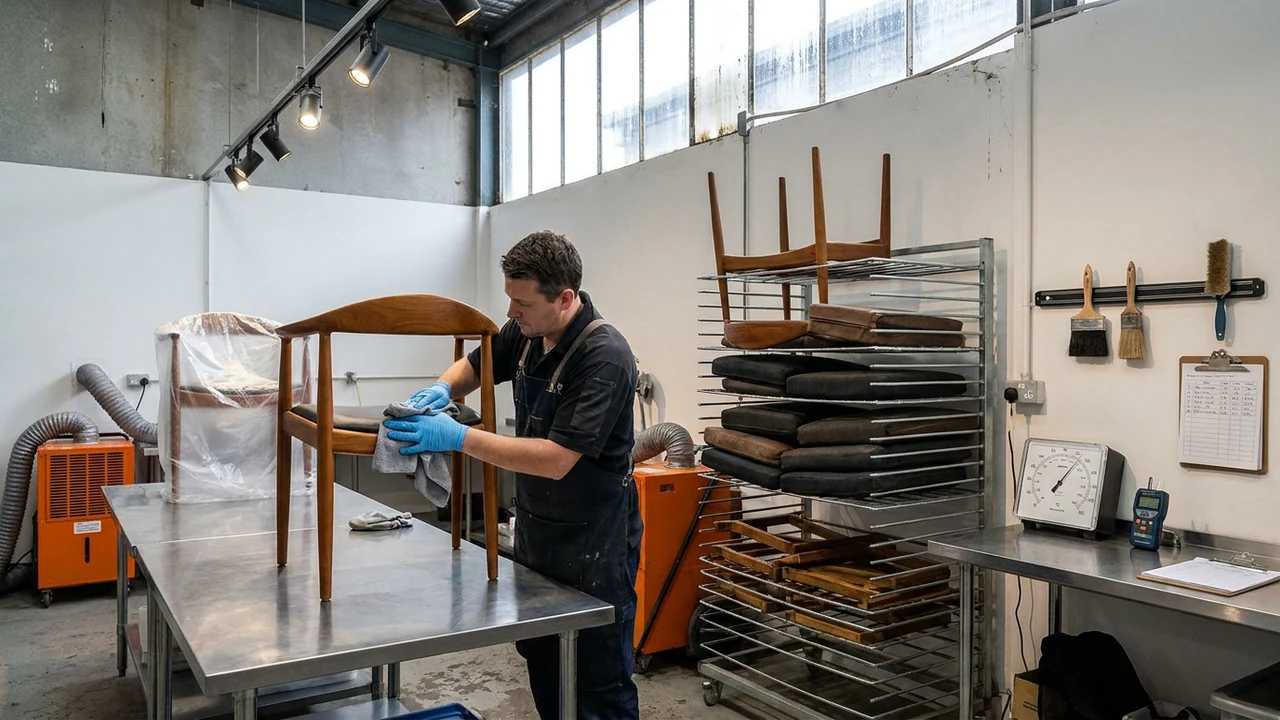
Once wet contents reach the restoration facility, the difference between profitable, repeatable processing and costly claim rework lies in method discipline and batch documentation. Category 1 clean water and Category 2 grey water demand distinctly different chemical and mechanical workflows, yet both share one rule: wiping an item dry is never the same as verifying it is clean, odor-free, and dimensionally stable.
Under ANSI/IICRC S320 and ANSI/IICRC S500, Category 1 contents focus on rapid moisture removal, mineral/dust wiping, and preventing secondary mold or corrosion, whereas Category 2 contents require physical soil extraction followed by targeted antimicrobial sanitization and clean-water rinsing where skin or food contact applies.
Equally critical is proving the work happened. As highlighted in The Specialty Codes and Contents Cleaning SLAs by Category, desk examiners routinely challenge lumped ‘contents cleaning’ hours in Xactimate unless invoices are backed by intake moisture states, processing batch logs, and post-restoration QA verification.
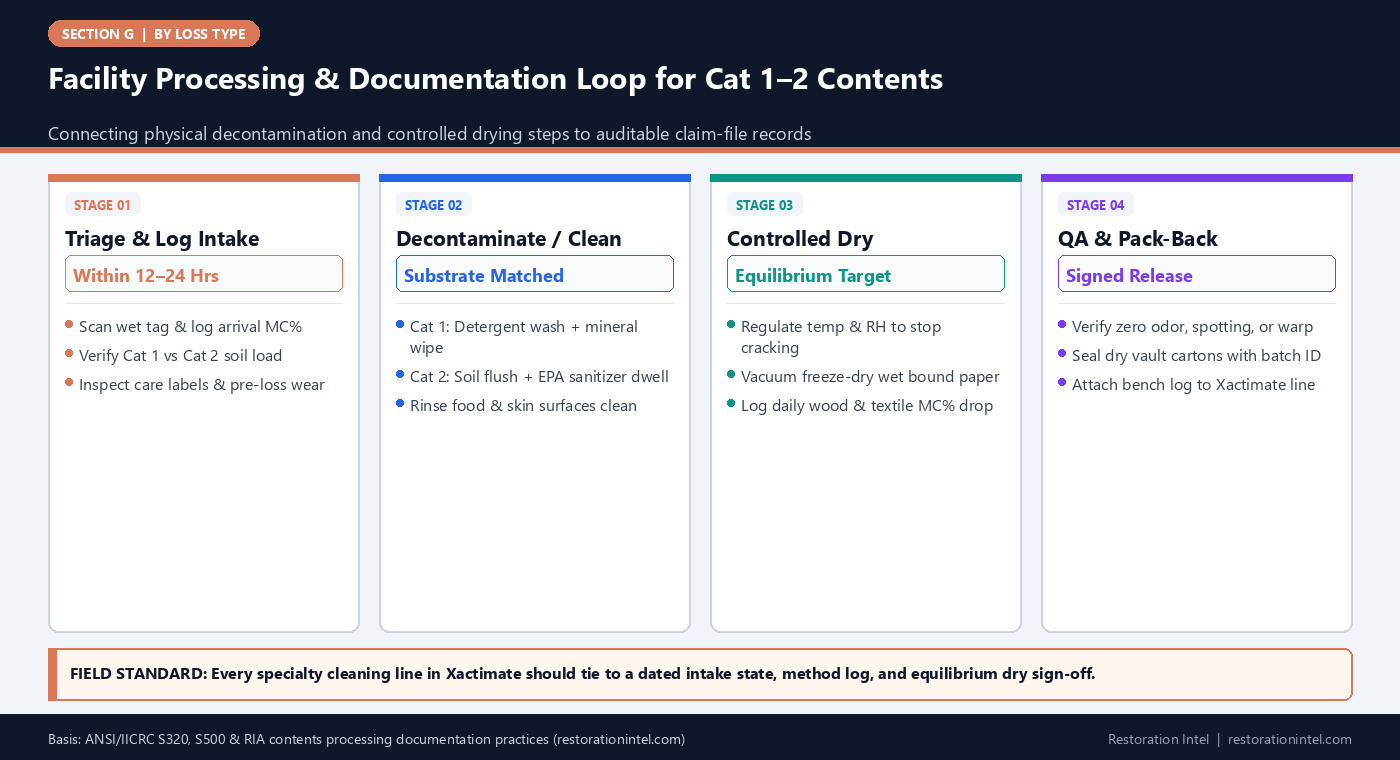
Facility Processing & Documentation Loop for Cat 1–2 Contents
Cat 1 vs Cat 2 Processing Methods and Required Documentation Records
Standardized facility treatment protocols and the exact documentation artifacts needed to substantiate specialty processing charges.
| Asset Category | Cat 1 Processing Method | Cat 2 Processing Escalation | Key Technical Risk | Required Processing Documentation |
|---|---|---|---|---|
| Hard Goods (Glass, Ceramic, Metal) | Neutral detergent hand wash or ultrasonic bath; spot-free rinse | Pre-wash soil removal + EPA-registered sanitizer dwell + potable rinse | Hard-water mineral etching or rust on unplated steel | Batch count, chemical dwell log, post-dry visual QA check |
| Solid Wood & Finished Furniture | Gentle damp soil wipe, controlled 45–50% RH drying, cabinet touch-up | Sanitizing wipe safe for finish, odor treatment, controlled EMC dry | Finish blushing, veneer lift, or checking if dried too fast | Daily wood pin/pinless MC% log until matching local EMC (7–10%) |
| Washable Textiles & Bedding | Esporta/wet-clean cycle with mild detergent, colorfastness test | Sanitizing additive/enzyme pre-soak, controlled hot/warm extract | Shrinkage, dye bleed, or latent musty odor if damp > 48 hrs | Care-label exception log, wash batch ticket, moisture/odor sign-off |
| Upholstery & Area Rugs | Low-moisture hot-water or solvent extraction + high-airflow rack dry | Sub-surface flush, antimicrobial treatment, flat-rack dry & groom | Cellulosic browning, backing delamination, dye migration | Pre-test dye check, extraction moisture reading, dry-weight check |
| Books & Vital Documents | Air-dry interleaved or vacuum freeze-drying for coated stock | Disinfection limits on paper; freeze-dry + HEPA/surface clean only | Cockling, ink run, or glossy page fusing (blocking) | Chamber cycle ticket, page-moisture verification, salvage count |
| Electronics & Small Appliances | Non-energized disassembly, DI-water rinse, drying oven (<120°F) | Bench teardown; condemn if grey-water soils penetrated PCBs | Capacitor shock hazard, delayed mineral salt corrosion | Serial log, bench diagnostic notes, insulation/function test sheet |
Distinguishing Category 1 Cleaning From Category 2 Sanitization
Applying identical cleaning chemistry to every water loss wastes labor on Category 1 items and under-treats Category 2 hazards. When contents are exposed strictly to fresh Category 1 supply water and stabilized quickly, the primary goals are removing dissolved minerals, drywall dust, and suspended building debris while returning moisture content to ambient equilibrium before microbial growth begins.
Category 2 grey water introduces soaps, food proteins, skin oils, and opportunistic bacteria from laundry drains, dishwashers, or aged standing puddles. Under ANSI/IICRC S320, technicians cannot rely on fragrance or quick disinfectant spritzing over soil film—organic residues neutralize most sanitizers. Category 2 items require physical detergent washing or extraction first to strip soils, followed by an EPA-registered disinfectant/sanitizer held for the full label-specified wet contact time.
On items that contact food or bare skin—such as dishes, utensils, children’s toys, cutting boards, and bed linens—label compliance requires a clean potable-water rinse after disinfectant dwell. Logging the exact EPA registration number, dilution ratio, dwell time, and rinse step shields both the contractor and the homeowner.
- Clean-before-sanitize rule: Always record the mechanical detergent wash or extraction step prior to disinfectant application on Cat 2 goods.
- Label dwell verification: Track wet contact duration (typically 3–10 minutes per product label) rather than mist-and-wipe shortcuts.
- Potable rinse gate: Perform and log a final fresh-water rinse on cookware, dishes, baby gear, and pet bowls after antimicrobial treatment.
Controlled Drying Physics: Protecting Wood, Textiles, and Paper
Rushing the drying curve inside a warehouse causes more visible damage than the original pipe burst. Hardwood dressers, dining tables, piano cabinets, and framed oils cannot be blasted with direct high-heat air like structural framing studs. Rapid surface evaporation dries outer wood fibers faster than internal moisture can diffuse outward, creating case-hardening, split joints, and warped tabletops.
Controlled contents drying rooms maintain steady airflow, moderate temperatures (typically 70°F–80°F), and gradual relative humidity reduction (40%–50% RH) while technicians track wood moisture content against local equilibrium moisture content (EMC, commonly 7%–10% in conditioned interiors). Only after a piece stabilizes at EMC and finishes are inspected for blushing does it move to touch-up or vault wrapping.
Bound books, family photo albums, and coated-paper documents follow specialized preservation physics. Leaving wet glossy-paper books on open racks causes starch-coated pages to weld permanently together. Loading stabilized wet paper into vacuum freeze-drying chambers sublimates ice directly from solid to vapor without passing through a liquid phase, preserving legibility and binding integrity.
- Daily moisture curve logs: Record morning and afternoon moisture readings on representative solid-wood pieces until equilibrium stabilizes.
- Textile dry-check before bagging: Verify seams, waistbands, and thick quilt batting are 100% dry before placing textiles into vault wardrobes or boxes.
- Freeze-dry batch tickets: Attach chamber entry/exit dates and weight-loss verification to all document and archival restoration claims.
Managing Specialty Risks: Electronics Bench Work and Care-Label Exceptions
Some of the highest-dollar disputes in Category 1–2 processing come from damaged textiles and electronics that looked straightforward on intake. Silk blouses, wool rugs, dry-clean-only drapery, and mixed-fiber upholstery can shrink, felt, or suffer cellulosic browning even when technicians follow standard wet-cleaning charts—especially if the water damage itself already broke down sizing or set dyes.
Before submerged or grey-water-soaked textiles enter wash or solvent processing, technicians should inspect manufacturer care tags, perform a discrete dye-bleed swab test, and note pre-existing conditions or manufacturer disclaimers. Communicating care-label risks through a signed textile processing waiver before washing ‘dry-clean-only’ garments soaked in grey water prevents post-claim surprise liability.
Similarly, any electronics selected for Category 1 recovery should pass through a documented bench sequence: intake visual/serial log, non-energized disassembly, deionized-water flushing of mineral residues, controlled low-temperature dehydration (<120°F), and post-dry continuity/safety testing. If corrosion or board delamination appears during bench inspection, switch the unit immediately to non-salvageable with bench photos attached.
- Colorfastness test log: Photograph cotton-swab dye transfer tests on rugs and high-value garments before selecting wet vs dry cleaning.
- Bench-fail pivot rule: Convert electronics immediately to non-salvageable if post-wash PCB inspection reveals pitted traces or swollen transformers.
- Odor clearance check: Verify zero residual musty or grey-water odor at warm ambient air before clearing any textile or cushion to vault storage.
Connecting Bench Logs to Xactimate and Carrier QA Deliverables
Even flawless restoration craftsmanship gets discounted at desk review if the paper trail stops at the truck ramp. When an estimator bills specialty textile processing, electronics decontamination, or hardwood drying room hours in Xactimate, examiners look for concrete proof that the hours matched actual items and verifiable technical steps.
Under RIA operational standards, the cleanest claim files link every line-item charge back to four lightweight bench artifacts: the intake condition & moisture record, the dated batch or chamber processing sheet, before-and-after verification photos on high-value items, and the final QA release signature moving the item into dry vault storage.
Organizing facility documentation by room and original box/tag ID keeps the estimating desk aligned with field custody. When the policyholder receives their contents back at rebuild completion, that same QA sheet becomes the final delivery sign-off confirming every restored box returned clean and intact.
- Batch-to-line cross-reference: Print the wash batch or drying chamber ID directly inside the Xactimate/XactContents line-item F9 note.
- Before/after proof pairs: Capture post-cleaning photos of high-value rugs, wood pieces, and appliances showing stain removal and finish recovery.
- Zero-gap vault handoff: Record the exact date an item leaves wet processing and enters climate-controlled storage so storage billing aligns cleanly.
Practitioner Verification Checklist (G-05)
- Log intake moisture readings, Category 1 vs Category 2 classification, and pre-existing damage notes within 12–24 hours of facility arrival.
- Enforce mechanical detergent soil removal prior to EPA-registered disinfectant dwell time and potable rinsing on Category 2 food/skin items.
- Monitor solid-wood moisture content daily in controlled 45–50% RH drying chambers until reaching local equilibrium moisture content.
- Document dye-bleed pre-tests, care-label exceptions, and electronics bench diagnostics before committing marginal items to full processing.
- Link every specialty processing charge in Xactimate to dated batch logs, before/after photos, and final QA vault-release signatures.
Standards, Authority References & Related Reading
Primary standards, insurance definitions, and sibling Restoration Intel guides referenced in this brief:
- ANSI/IICRC S320 Standard for Professional Contents Restoration
- ANSI/IICRC S500 Water Damage Standard
- Restoration Industry Association (RIA)
- Verisk Xactimate Estimating Platform
- Related Guide: Clean & Grey Water (Cat 1–2) Pipe-Burst Losses: Non-Salvageable vs Restorable Criteria
- Related Guide: Clean & Grey Water (Cat 1–2) Pipe-Burst Losses: Pack-Out Sequencing & Cross-Contamination Containment
- Related Guide: Clean & Grey Water (Cat 1–2) Pipe-Burst Losses: Carrier Scope Justification & Total-Loss Defense
- Related Guide: Contents Cleaning SLAs by Category
- Related Guide: The Specialty Codes
.md twin for desk QA and team training.Frequently Asked Questions
Is spraying a disinfectant on wet Category 2 items enough without washing?
No. Organic soils, soaps, and grease in Category 2 grey water deactivate disinfectants or block surface contact. S320 and S500 practices require detergent cleaning or extraction first, followed by full label dwell time.
How dry must solid wood furniture be before wrapping for storage?
Wood furniture should return to local indoor equilibrium moisture content (typically 7–10% MC depending on region) before wrapping or vaulting so trapped moisture does not trigger finish blushing or mold.
Why do restoration facilities use deionized water on Category 1 wet electronics?
Tap water contains conductive dissolved minerals that leave corrosive salt films across circuit boards once evaporated. Deionized (DI) water flushes contaminants safely prior to controlled low-heat dehydration.
What proves specialty contents cleaning hours to an insurance desk examiner?
Dated facility intake logs, wash or drying-chamber batch sheets tied to original box/tag IDs, chemical dwell records for Cat 2 items, and before/after QA photos of restored assets.