Direct Answer: During the first 24 hours of a mold or prolonged-humidity loss, contents teams must protect worker respiratory health under OSHA 1910.134, avoid uncontrolled air movers that aerosolize spores, establish S520 Condition 1–3 boundaries, and stabilize indoor humidity before disturbing or packing out personal property.
.md twin for estimator QA and carrier file documentation.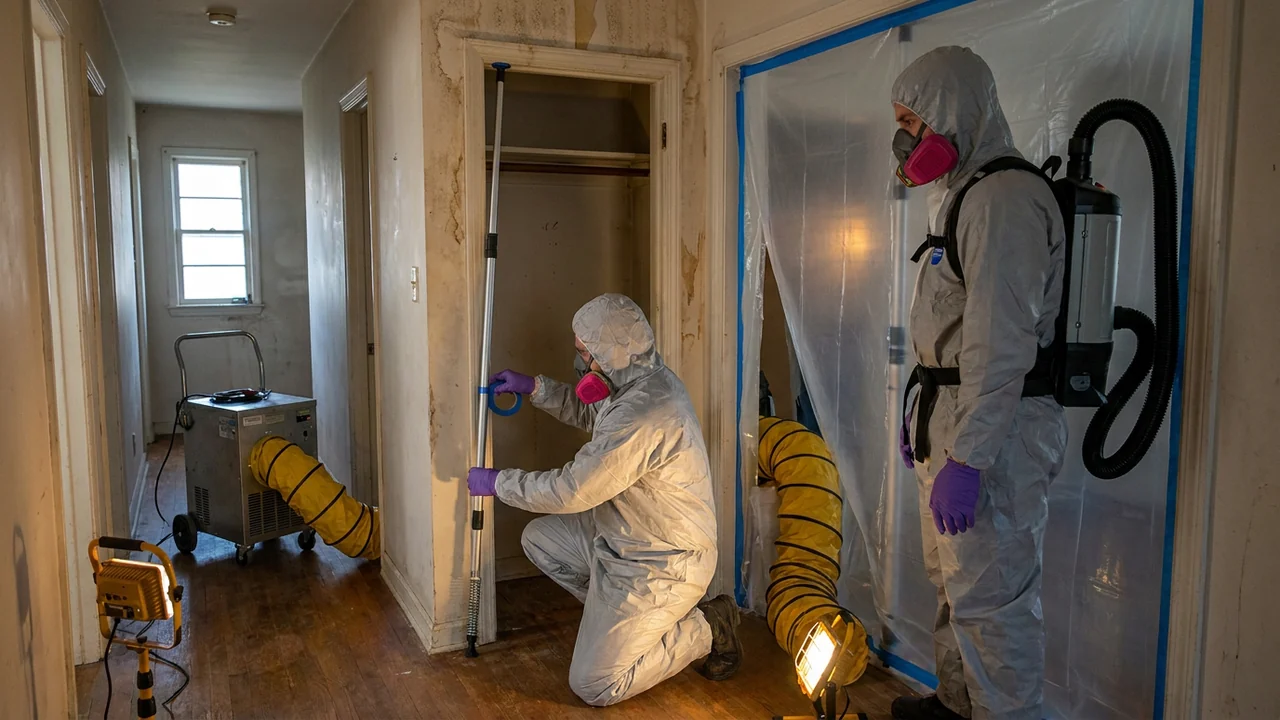
Microbial contents losses behave completely differently from sudden clean-water pipe bursts in the first 24 hours. When crews walk into a home or commercial suite after a slow plumbing leak, extended HVAC outage, or seasonal vacancy, fungal colonies are already established on drywall, framing, and stored belongings—meaning the immediate priority shifts from rapid wet-extraction airflow to containment and aerosolization control.
The single worst mistake a first-responder crew can make on a mold loss is setting up high-velocity axial air movers inside a colonized room. Blasting dry air across active hyphal mats strips millions of spores and fragments into the airstream, turning a localized Condition 3 closet or crawlspace issue into a structure-wide Condition 2 contents contamination event under ANSI/IICRC S520.
Following US EPA mold remediation guidance and OSHA 1910.134 respiratory protection standards during day-one triage keeps crews safe, isolates clean rooms from colonized zones, and preserves accurate baseline documentation for the adjuster and Indoor Environmental Professional (IEP).
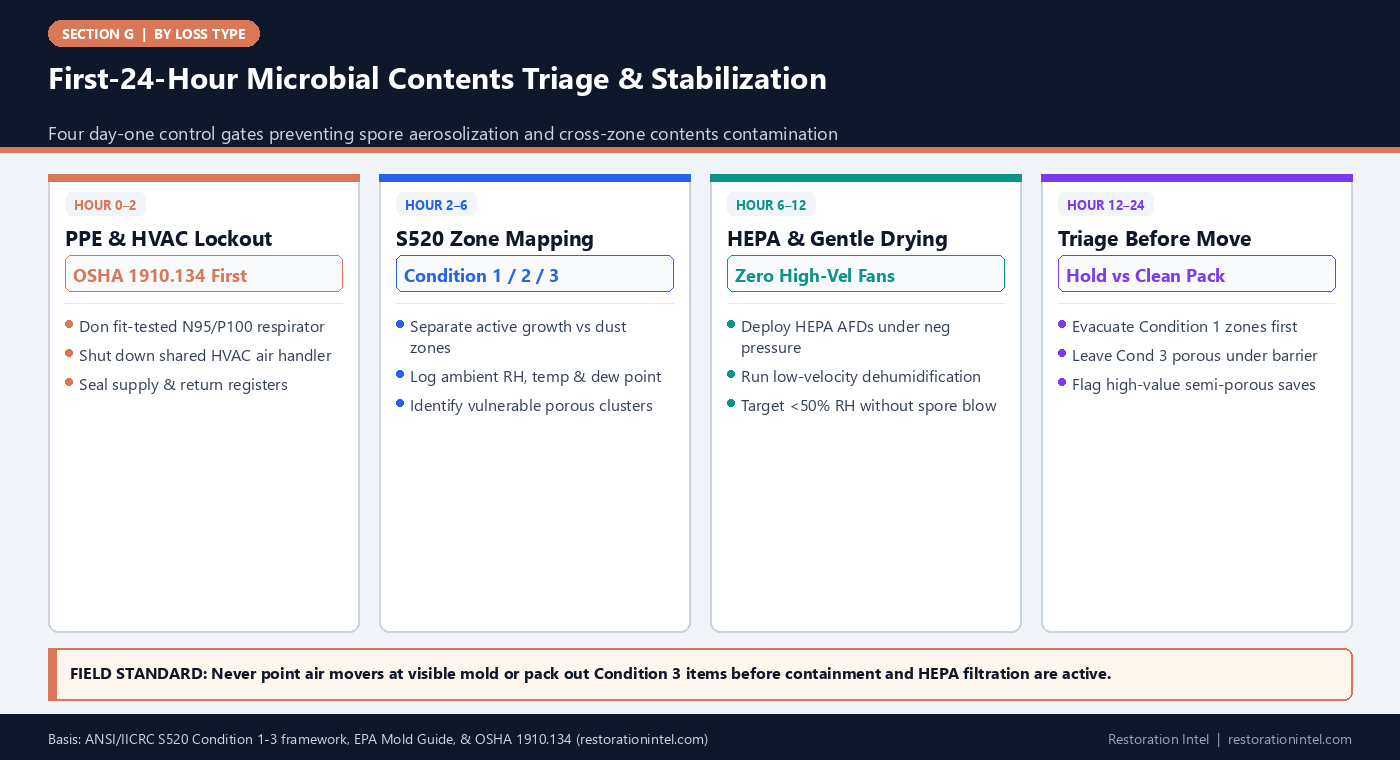
First-24-Hour Microbial Contents Triage & Stabilization
Day-One Microbial Triage Matrix by ANSI/IICRC S520 Condition & Material Class
Initial 24-hour field decisions balancing worker safety, environmental stabilization, and contents preservation.
| Zone / Content Profile | S520 Condition | Immediate Airflow / Containment Action | First-24-Hour Contents Triage | PPE / Safety Minimum |
|---|---|---|---|---|
| Unaffected Rooms (Isolated Wings) | Condition 1 (Normal Ecology) | Verify positive or neutral pressure vs work zone; keep doors closed | Priority pack-out or poly dust-draping before containment breach | Standard work attire; monitor boundary |
| Adjacent Rooms (Settled Dust/Spores) | Condition 2 (Settled Spores) | Shut off HVAC; establish HEPA air scrubbing before box handling | HEPA-vac exterior hard surfaces before relocating to clean staging | Fit-tested N95 or P100 + disposable gloves |
| Active Mold on Non-Porous (Glass, Metal) | Condition 3 (Active Growth) | Isolate with 6-mil poly and negative-pressure HEPA AFD | Stabilize humidity; stage for controlled HEPA + damp-wipe cleaning | Half/full-face P100 respirator, Tyvek, eye protection |
| Active Mold on Semi-Porous (Solid Wood) | Condition 3 (Active Growth) | Stabilize RH <50% gently; no direct air-mover impingement | Assess structural integrity vs surface growth; protect from warping | Half/full-face P100, Tyvek, nitrile gloves |
| Active Mold on Porous (Mattress, Sofa, Paper) | Condition 3 (Active Growth) | Leave inside negative-air containment; do not dry-brush or shake | Photo-document in place for condemnation review; keep contained | Half/full-face P100, full Tyvek, eye seal |
| HVAC Supply & Closet Cold Spots | Condition 2 / 3 Mixed | Lock out blower motor; mask grilles with poly and painter's tape | Empty adjacent closet garments into sealed bags only after HEPA setup | P100 respirator, coveralls, boot covers |
PPE, Respiratory Protection, and HVAC Lockout Before Entry
First-24-hour stabilization begins on the threshold, not inside the affected closet or basement. Before crews move furniture or open colonized storage totes, the project lead must assess visible growth extent, musty VOC intensity, and whether sensitive populations occupy adjacent suites. Under OSHA 1910.134, any employee wearing tight-fitting respirators such as N95 filtering facepieces or elastomeric P100 half-face masks requires medical clearance, fit testing, and training inside a written respiratory protection program.
Alongside personal PPE—disposable hooded coveralls, nitrile gloves, and non-vented goggles—the immediate mechanical step is shutting down central HVAC equipment serving the affected zone. Running a forced-air furnace or air conditioner pulls disturbed spores into return plenums and distributes Condition 2 contamination into untouched bedrooms and contents closets within minutes.
Technicians should seal supply registers and return grilles inside affected zones using 6-mil polyethylene sheeting and low-residue tape before disturbing any stored boxes. Recording the exact timestamp of HVAC lockout and initial PPE deployment protects both worker compliance and claim defensibility.
- Verify respirator fit: Enforce clean-shaven sealing surfaces for tight-fitting half-face or full-face P100 elastomeric respirators in Condition 3 zones.
- Lock out air handlers: Switch thermostats off, pull disconnects if needed, and seal affected room vents prior to moving contents.
- Ban dry sweeping or household vacuums: Standard shop vacuums without true sealed HEPA exhaust blow microscopic spores straight back into the room.
Establishing Condition 1, 2, and 3 Baselines Under ANSI/IICRC S520
Accurate day-one triage relies on the three-condition framework defined in ANSI/IICRC S520. Condition 1 represents a normal fungal ecology typical of clean, well-maintained interiors. Condition 2 describes settled spores or fungal fragments deposited from a nearby Condition 3 source without active hyphal growth on the surface itself. Condition 3 indicates actual active mold growth—visible or confirmed—accompanied by reproductive structures and biomass.
For a contents crew, that distinction drives every physical handling choice. Contents sitting inside a Condition 1 upstairs bedroom should be protected or packed out before containment barriers ever come down downstairs. By contrast, contents inside a Condition 3 basement or utility room cannot simply be loaded onto a clean moving truck alongside Condition 1 furniture.
As reinforced in Two Standards, One Truck, documenting room-by-room Condition boundaries alongside ambient temperature, relative humidity, and dew-point readings on day one gives adjusters an objective map showing why certain rooms needed full containment while others required preventive isolation.
- Zone-by-zone floor sketch: Label every room and walk-in closet as Condition 1, 2, or 3 on the initial intake diagram.
- Psychrometric snapshot: Log indoor vs outdoor temperature and RH (noting prolonged readings above 60% RH that sustain colonization).
- IEP referral trigger: Flag large commercial suites, complex hidden cavities, or medically sensitive occupant claims for independent IEP sampling before invasive tear-out.
Stabilizing Humidity Without Triggering Spore Aerosolization
Moisture control is essential on day one because active fungal growth stalls once relative humidity drops below roughly 55 to 60 percent and surface equilibrium moisture falls below growth thresholds. Yet aggressive drying tactics copied from Category 1 pipe-burst jobs—specifically placing high-velocity air movers directly toward wet drywall or moldy furniture—create severe cross-contamination.
Instead, crews should deploy HEPA-filtered Air Filtration Devices (AFDs) first to scrub airborne particulates and establish negative pressure inside localized containment chambers, followed by low-velocity dehumidification positioned so exhaust streams do not impinge directly onto colonized surfaces. Targeting 40 to 50 percent RH halts further microbial proliferation while preventing rapid over-drying that cracks antique wood veneers or shrinks heirloom leather.
While humidity drops, technicians should resist the urge to spray consumer bleach or unverified fogging agents across contents. Per US EPA mold remediation guidance, dead mold spores remain allergenic and toxicogenic, so physical source removal—not chemical masking—must remain the operational goal.
- HEPA before dehumidification: Start HEPA air scrubbers to capture airborne spores before activating dehumidifiers.
- Deflect dehumidifier exhaust: Angle unit discharge away from visibly colonized upholstery, rugs, and wall cavities.
- Protect moisture-sensitive heirlooms: Avoid dropping RH abruptly below 35 percent in rooms housing solid-wood musical instruments, fine art, or leather.
First-24-Hour Triage Gates: What Moves, What Stays Contained, and What Gets Held
Unlike clean-water losses where crews race to get every wood table out of standing water within hours, premature pack-out on a mold loss often spreads spores into hallways, elevators, and warehouse vaults. Day-one triage separates items into three controlled tracks: clean-zone protection, high-value stabilization, and contained hold-for-inspection.
Unaffected Condition 1 rooms get cleared or sealed first. High-value non-porous and semi-porous items inside Condition 2 or 3 zones—such as electronics, sealed hardwood heirlooms, metal tools, or essential legal records—are isolated inside negative-air containment, gently HEPA-vacuumed on exterior surfaces, and transferred only if the cleaning facility has a dedicated quarantine bay as described in Cat 3 & Microbial Pack-Out Protocols.
Meanwhile, heavily colonized porous furnishings—mattresses, upholstered sectionals, pressed-wood bookcases, and damp cardboard archives—should remain undisturbed inside containment until photo documentation is complete and the carrier approves condemnation or remediation scope under ANSI/IICRC S320.
- Never mix clean and dirty loads: Keep Condition 1 household goods out of transport vehicles handling Condition 2/3 microbial lots.
- Leave porous Condition 3 undisturbed: Photograph colonized mattresses and sofas in place inside containment rather than dragging them through clean hallways.
- Separate essential personal records: Identify passports, medications, and critical business drives early for priority HEPA surface decontamination.
Practitioner Verification Checklist (G-19)
- Equip all field personnel with fit-tested OSHA 1910.134 respiratory protection, eye seal, and disposable PPE before entering Condition 2/3 spaces.
- Shut down HVAC air handlers and seal supply/return vents in affected zones prior to moving any contents or opening colonized closets.
- Map S520 Condition 1, 2, and 3 room boundaries and log baseline temperature, relative humidity, and moisture readings on day one.
- Deploy negative-pressure HEPA air filtration and low-velocity dehumidification (<50% RH) with zero high-velocity air movers aimed at visible mold.
- Isolate Condition 1 clean-room contents first while holding Condition 3 porous items inside containment until photo/adjuster inspection gates clear.
Standards, Authority References & Related Reading
Primary standards, insurance definitions, and sibling Restoration Intel guides referenced in this brief:
- ANSI/IICRC S520 Mold Remediation Standard
- US EPA Mold Remediation in Schools and Commercial Buildings / Guide
- OSHA 1910.134 Respiratory Protection Standard
- ANSI/IICRC S320 Standard for Professional Contents Restoration
- Related Guide: Mold & Prolonged Humidity Microbial Losses: Non-Salvageable vs Restorable Criteria
- Related Guide: Mold & Prolonged Humidity Microbial Losses: Damage Evidence & Forensic Photography Rules
- Related Guide: Mold & Prolonged Humidity Microbial Losses: Pack-Out Sequencing & Cross-Contamination Containment
- Related Guide: IICRC Cat 3 Contents Pack-Out Protocol
- Related Guide: Two Standards, One Truck: Documentation When the Brand and the Scorecard Disagree
.md twin for desk QA and team training.Frequently Asked Questions
Why should crews avoid putting standard air movers in a mold-affected room on day one?
High-velocity air movers directed at colonized walls or furnishings aerosolize millions of mold spores and fragments, spreading Condition 3 contamination into previously clean Condition 1 rooms and contents.
When is OSHA 1910.134 triggered during a mold contents triage?
Whenever employees wear tight-fitting respirators such as N95s or elastomeric P100 half-face/full-face respirators inside Condition 2 or Condition 3 microbial environments, OSHA 1910.134 requires medical evaluation, annual fit testing, and formal respiratory program compliance.
Should Condition 1 contents be packed out before setting up containment in a Condition 3 room?
Yes, whenever layout permits. Securing or removing unaffected Condition 1 belongings before disturbing Condition 3 areas prevents accidental cross-contamination along shared hallways and entryways.
Can spraying antimicrobials on day one replace packing out or condemning moldy contents?
No. Both ANSI/IICRC S520 and US EPA mold guidance emphasize physical removal of fungal biomass rather than killing spores in place, because dead mold fragments and allergens still trigger sensitization and fail Condition 1 cleanliness criteria.