Direct Answer: Microbial pack-out sequencing requires clearing or sealing Condition 1 areas first, isolating Condition 2 and 3 rooms under 6-mil poly containment and negative-pressure HEPA filtration, HEPA-vacuuming and encapsulating restorable items before exit, and keeping dirty loads quarantined from clean warehouse vaults.
.md twin for estimator QA and carrier file documentation.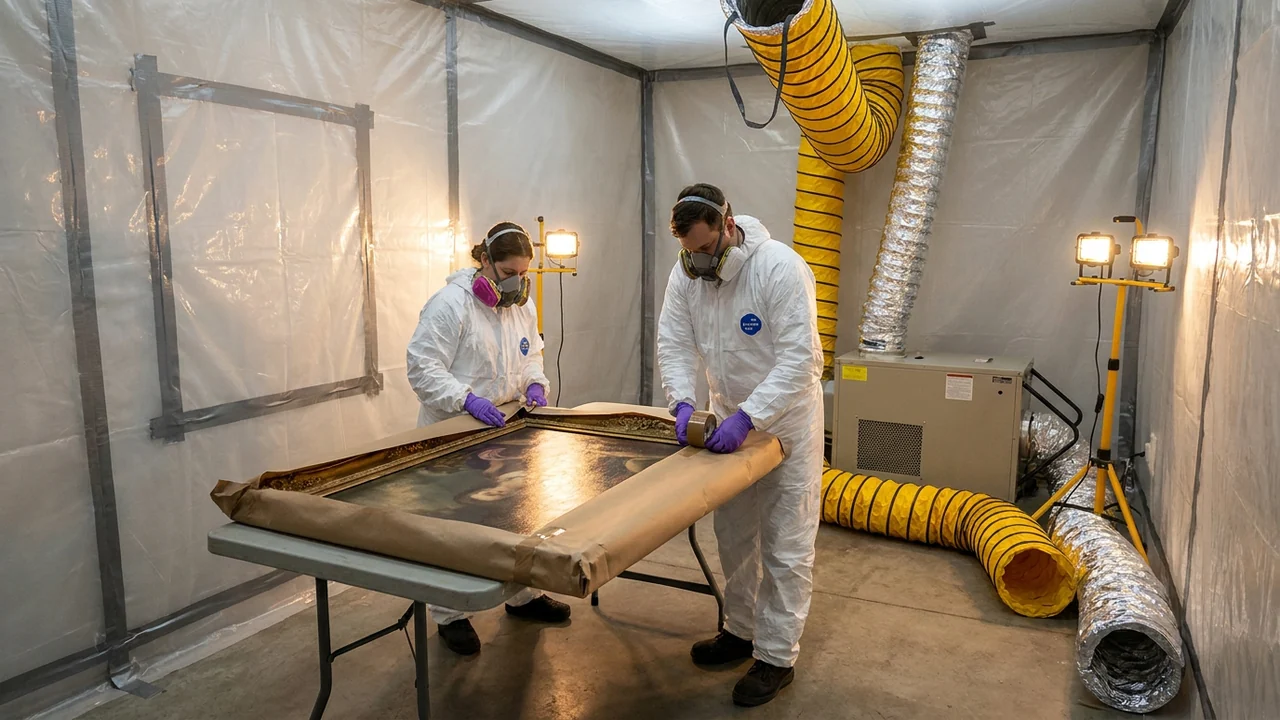
On a clean-water or routine pack-out, efficiency is measured by how fast boxes move down the hallway and onto the truck. On a mold or prolonged-humidity loss, moving colonized or spore-dusted furnishings down an uncontained hallway turns a single-room microbial problem into a whole-building cross-contamination liability.
Proper sequencing under ANSI/IICRC S520 and ANSI/IICRC S320 flips normal pack-out habits upside down. Crews secure Condition 1 clean rooms first, build negative-pressure containment around Condition 2 and 3 rooms, HEPA-vacuum and poly-encapsulate restorable items inside the controlled work zone, and pass sealed packages through a dedicated pass-through airlock before touching clean transport dollies.
Protecting crew respiratory health under OSHA 1910.134 and OSHA 1910.132 PPE rules while enforcing strict warehouse quarantine ensures remediated belongings never cross-contaminate other policyholders’ stored property.
Microbial Pack-Out Sequencing & Containment Architecture
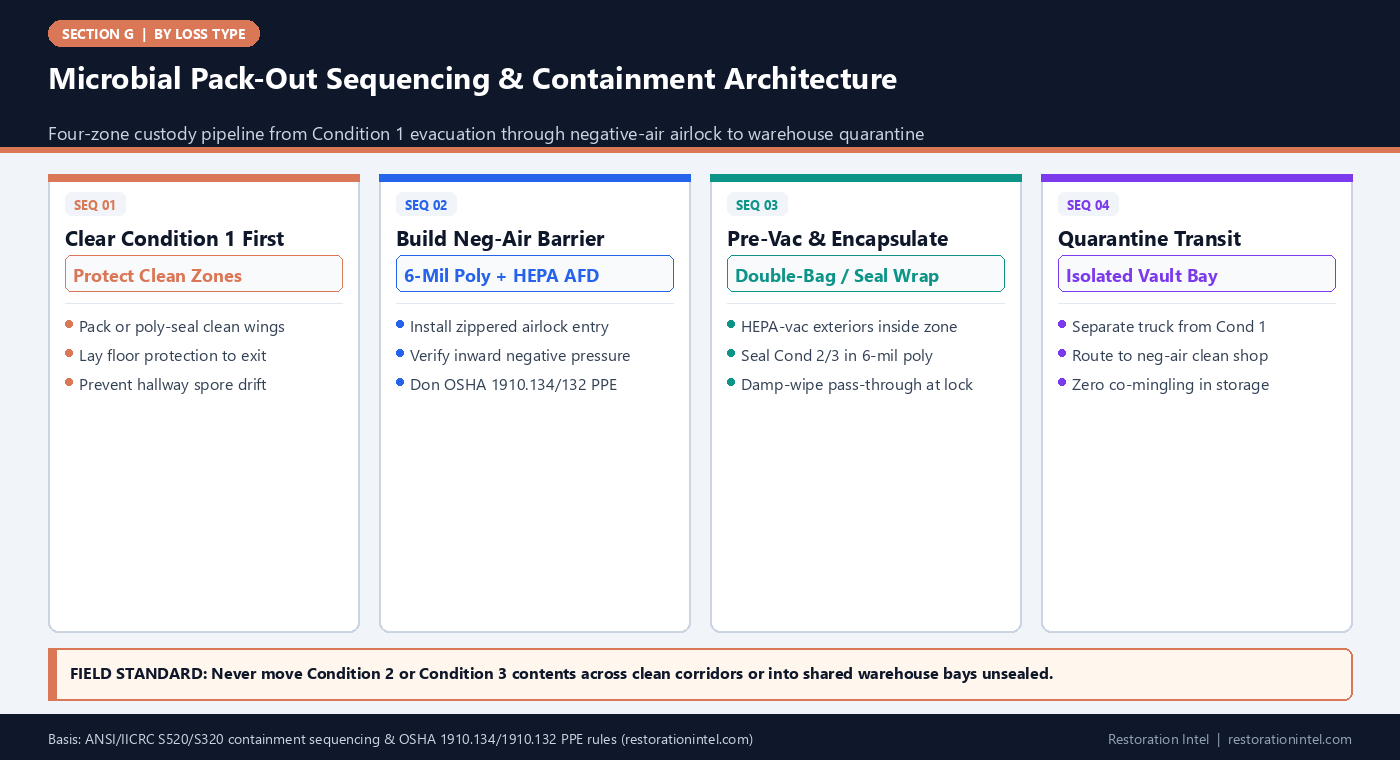
Microbial Pack-Out Sequencing, Containment & Custody Controls
Stage-by-stage containment barriers, PPE requirements, and cross-contamination checkpoints across the pack-out workflow.
| Workflow Stage | Zone Status | Engineering / Barrier Control | Custody & Packaging Rule | Crew Hygiene / PPE Gate |
|---|---|---|---|---|
| 1. Condition 1 Pre-Clearance | Condition 1 (Clean) | Positive/isolated from affected wing; HVAC locked out | Standard clean cartons & pad-wrap; load into clean truck or safe room | Clean workwear; zero dirty boots or tools inside zone |
| 2. Containment & Airlock Build | Boundary Setup | 6-mil poly walls, zipped doorways, HEPA AFD vented outside or scrubbed | Verify negative pressure via manometer or flutter strip before entry | Stage PPE donning/doffing station outside airlock |
| 3. In-Zone Pre-Cleaning & Wrap | Condition 2 / 3 (Dirty) | Continuous HEPA scrubbing; zero dry sweeping or shaking | HEPA-vac loose spores off hard exteriors; double-bag or 6-mil wrap & tape | Fit-tested P100 respirator, hooded Tyvek, eye seal, double gloves |
| 4. Airlock Pass-Through Transfer | Decon Chamber | Two-stage zippered chamber between dirty zone and clean hallway | Damp-wipe exterior of sealed poly/totes inside airlock; hand to clean runner | Dirty crew stays inside; clean runner stays outside airlock |
| 5. Non-Salvageable Disposal Exit | Condition 3 Waste | Dedicated waste route; keep path swept/HEPA-vac'd post-exit | Double-bag 6-mil waste bags (gooseneck tape seal) after photo/adjuster sign-off | Doff outer boot covers & coveralls upon exiting dirty cycle |
| 6. Transport & Warehouse Intake | Quarantine Bay | Dedicated microbial box truck or sealed poly-lined trailer bulkhead | Unload directly into negative-pressure microbial processing bay, never main vault | HEPA-vac & wipe truck deck, dollies, and blankets post-delivery |
Why Condition 1 Must Move Out Before Condition 3 Barriers Open
Sequencing errors happen when crews treat a microbial pack-out like a moving job—starting at the front door or basement stairs and carrying contaminated furniture straight through untouched living spaces. Even with floor runners down, carrying an unwrapped Condition 3 armchair past open linen closets sheds spores into clean fabric folds and onto hallway walls.
Under ANSI/IICRC S520, contents work should protect clean Condition 1 zones first. Where the layout forces crews to carry sealed microbial loads through clean corridors to reach the driveway, either pack out Condition 1 rooms onto a clean truck first or drape stationary Condition 1 furnishings under taped 6-mil polyethylene sheeting before breaching affected rooms.
Establish clear physical demarcation lines with signage so crew members never wander between clean staging areas and active mold rooms wearing dusty coveralls. As emphasized in Cat 3 & Microbial Pack-Out Protocols, two-team separation—a ‘dirty’ containment team and a ‘clean’ runner team operating across an airlock—is the most reliable way to preserve corridor cleanliness.
- Clean-first sequence: Clear or seal Condition 1 spaces before opening colonized closets or crawlspaces.
- Two-team handoff: Keep containment technicians inside the negative-air zone and clean runners on the exterior hallway side.
- Protected egress path: Line exit hallways with overlapping floor protection and HEPA-vacuum the path after transfer.
Engineering Negative-Pressure Containment and Airlocks During Pack-Out
Plastic sheeting taped loosely over a doorway is not containment—every time someone zips open the flap or carries out a dresser, positive air currents puff spore-laden air into the clean hallway. Effective microbial pack-out containment requires framing secure 6-mil flame-retardant polyethylene barriers sealed to ceilings, walls, and floors, paired with a dedicated two-chamber decontamination airlock.
Place a true HEPA-filtered Air Filtration Device inside the containment perimeter, exhausted to the exterior where permitted or configured for verified negative pressure across the airlock boundary. Confirm airflow direction visually using a flutter strip or digital differential pressure manometer so air always pulls inward from clean hallways toward the dirty work zone.
Keep air-scrubber intake pre-filters clean throughout heavy pack-out shifts; clogged pre-filters choke airflow, collapse negative pressure differential, and silently defeat the containment barrier while crews are moving bulky furniture.
- Verify inward airflow: Check pressure differential or doorway flutter strips at the start of every shift and after large furniture exits.
- Two-stage airlock chamber: Use weighted overlapping flaps or dual-zipper chambers large enough to wipe down wrapped items and doff outer PPE.
- Change pre-filters on schedule: Inspect AFD primary and secondary filters frequently when disturbing dusty basements or attics.
Pre-Vacuuming, Encapsulation, and OSHA PPE Compliance at the Threshold
Never place un-vacuumed Condition 2 or 3 furniture into corrugated cardboard boxes inside a dirty room and carry those boxes out bare. Cardboard absorbs ambient moisture, traps loose spores in fluted seams, and cannot be damp-wiped clean at the airlock. Instead, restorable items should be lightly HEPA-vacuumed inside containment to remove loose surface spores, wrapped in sealed 6-mil polyethylene sheeting or placed inside heavy-duty plastic totes, and taped shut prior to transfer.
At the decontamination chamber, the exterior of every wrapped package or plastic bin must be damp-wiped by a technician before the clean runner places it onto a clean hallway dolly. Non-salvageable porous debris—already photographed and cleared for disposal—is double-bagged in 6-mil poly bags using twisted gooseneck tape seals before leaving containment.
Throughout these steps, maintain strict compliance with OSHA 1910.134 respiratory standards and OSHA 1910.132 PPE rules: double-gloving so outer contaminated gloves peel off before touching clean handles, sealed goggles, and clean doffing sequences so workers do not inhale settled dust off their own coveralls.
- Ditch cardboard in Condition 3 zones: Use wipeable plastic totes or sealed 6-mil poly wrap instead of porous cardboard cartons.
- Airlock wipe-down gate: Every wrapped asset or sealed bin gets damp-wiped at the airlock threshold before meeting a clean dolly.
- Gooseneck-seal disposal bags: Twist, fold over, and tape 6-mil waste bags so air bursts do not blow spores during loading.
Transport Segregation and Warehouse Quarantine Vault Rules
Cross-contamination does not stop at the homeowner’s curb. Loading wrapped Condition 2/3 microbial furniture into the same box truck or warehouse vault holding clean fire-restored sofas or Condition 1 storage vaults risks spreading spores across unrelated claims—a catastrophic operational and liability failure under ANSI/IICRC S320.
Microbial lots require dedicated transport segregation—either separate box trucks assigned to dirty microbial runs or strictly separated, poly-partitioned compartments when only Condition 1 and Condition 2 sealed loads share a multi-zone haul. Every reusable moving pad, ratchet strap, and dolly used in microbial transit must be laundered, sanitized, or HEPA-vacuumed before returning to clean inventory.
At the contents processing facility, receive microbial lots directly into a negative-pressure quarantine bay equipped with dedicated HEPA air scrubbing and staging racks. Only after items complete cleaning and pass post-remediation verification should barcode status flip to ‘Clean / Ready for Vaulting’ and move into standard climate-controlled storage.
- Zero shared vault bays: Maintain physical separation between dirty Condition 2/3 receiving zones and Condition 1 clean storage.
- Barcode status gates: Lock warehouse software or tag systems so uncleaned microbial items cannot be slotted into clean rack locations.
- Sanitize transport gear: HEPA-vacuum and damp-wipe truck floors, ramps, and E-track rails immediately after unloading microbial lots.
Practitioner Verification Checklist (G-22)
- Secure or pack out Condition 1 rooms before breaching Condition 2/3 containment barriers whenever site layout allows.
- Construct 6-mil poly containment with a two-stage airlock and verify inward negative pressure using a HEPA-filtered AFD.
- Enforce OSHA 1910.134 fit-tested respirators and OSHA 1910.132 PPE with two-team dirty/clean airlock handoffs.
- HEPA-vacuum loose spores, wrap restorable goods in sealed 6-mil poly or wipeable plastic totes, and damp-wipe exteriors at the airlock.
- Transport microbial lots in segregated vehicles directly to a negative-pressure warehouse quarantine bay, never shared clean storage.
Standards, Authority References & Related Reading
Primary standards, insurance definitions, and sibling Restoration Intel guides referenced in this brief:
- ANSI/IICRC S520 Mold Remediation Standard
- ANSI/IICRC S320 Standard for Professional Contents Restoration
- OSHA 1910.134 Respiratory Protection Standard
- OSHA 1910.132 Personal Protective Equipment Standard
- Related Guide: Mold & Prolonged Humidity Microbial Losses: First-24-Hour Contents Triage & Stabilization
- Related Guide: Mold & Prolonged Humidity Microbial Losses: Damage Evidence & Forensic Photography Rules
- Related Guide: Mold & Prolonged Humidity Microbial Losses: Cleaning Methodology & Processing Documentation
- Related Guide: IICRC Cat 3 Contents Pack-Out Protocol
- Related Guide: Contents Cleaning SLAs by Category
.md twin for desk QA and team training.Frequently Asked Questions
Why shouldn't crews use standard cardboard boxes inside a Condition 3 mold room?
Cardboard is porous cellulose that traps airborne spores in fluted edges and cannot be damp-wiped clean at an airlock. Use wipeable plastic bins or sealed 6-mil polyethylene sheeting inside Condition 2/3 zones.
What does a two-team airlock handoff mean during a mold pack-out?
One crew works inside negative-pressure containment wearing full PPE to HEPA-vacuum, wrap, and damp-wipe items at the airlock, while a second clean-side crew receives the wiped packages onto clean dollies without ever entering the dirty zone.
Can microbial-affected contents be stored in the same warehouse rack as clean fire or water vaults?
No. Uncleaned Condition 2 or Condition 3 lots must be quarantined in a dedicated negative-pressure receiving and processing bay until physical source removal and verification are complete.
How do crews verify containment is actually under negative pressure during pack-out?
Monitor inward airflow across the containment barrier continuously using a digital differential pressure manometer or doorway flutter strips, and inspect HEPA AFD pre-filters frequently so dust buildup does not drop airflow.