Direct Answer: During the first 24 hours of a chemical, hazmat, asbestos, or lead-soot loss, contents teams must reverse standard speed-first pack-out instincts: establish perimeter barrier tape, halt unverified handling before friable fibers or toxic dust are aerosolized, screen SDS and building-era hazards, and trigger licensed Industrial Hygienist (IH) sampling prior to touching personal property.
.md twin for estimator QA and carrier file documentation.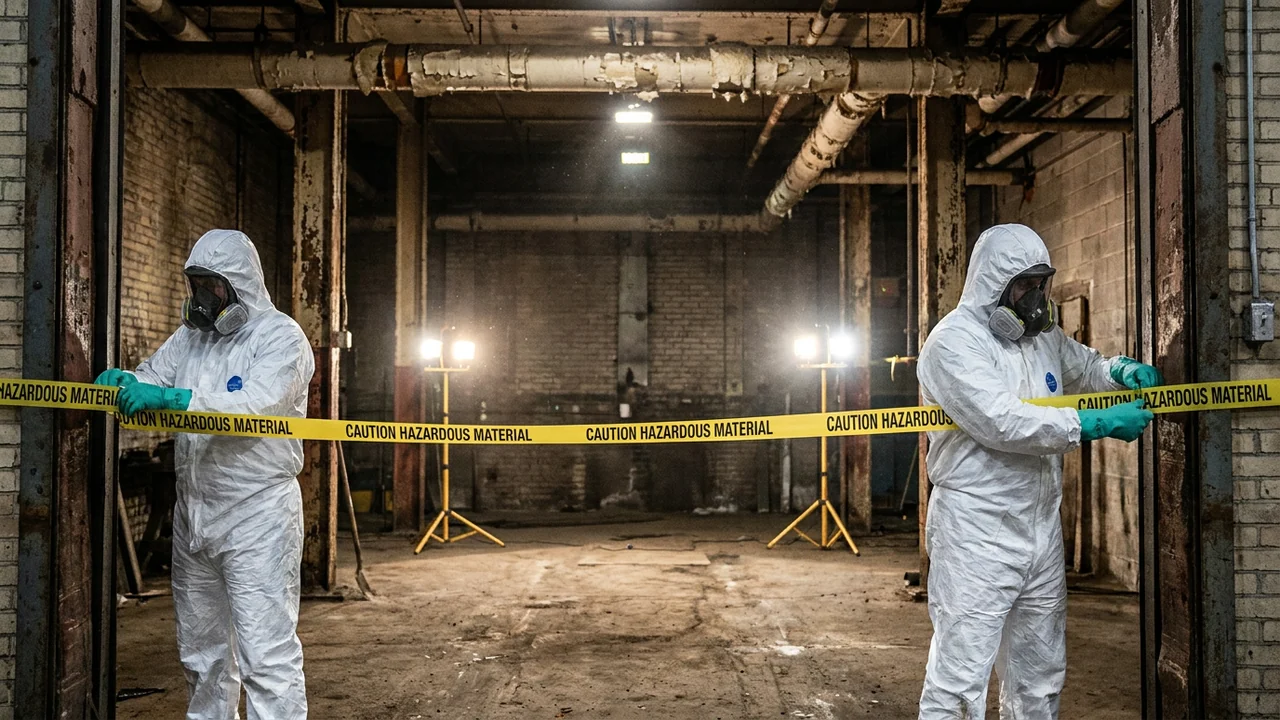
On routine clean-water or light-smoke losses, contents crews earn their keep by moving fast inside the opening 24 hours. When a loss involves chemical releases, unknown hazmat drums, disturbed asbestos-containing materials (ACM), or lead-bearing soot from older structures and industrial fires, unscreened speed turns an insurance claim into an exposure event and a regulatory violation. Disturbing damaged thermal pipe wrap, sweeping lead-painted plaster debris, or wiping spilled solvent off shop tooling without clearance spreads microscopic contamination into clean zones and exposes workers and occupants.
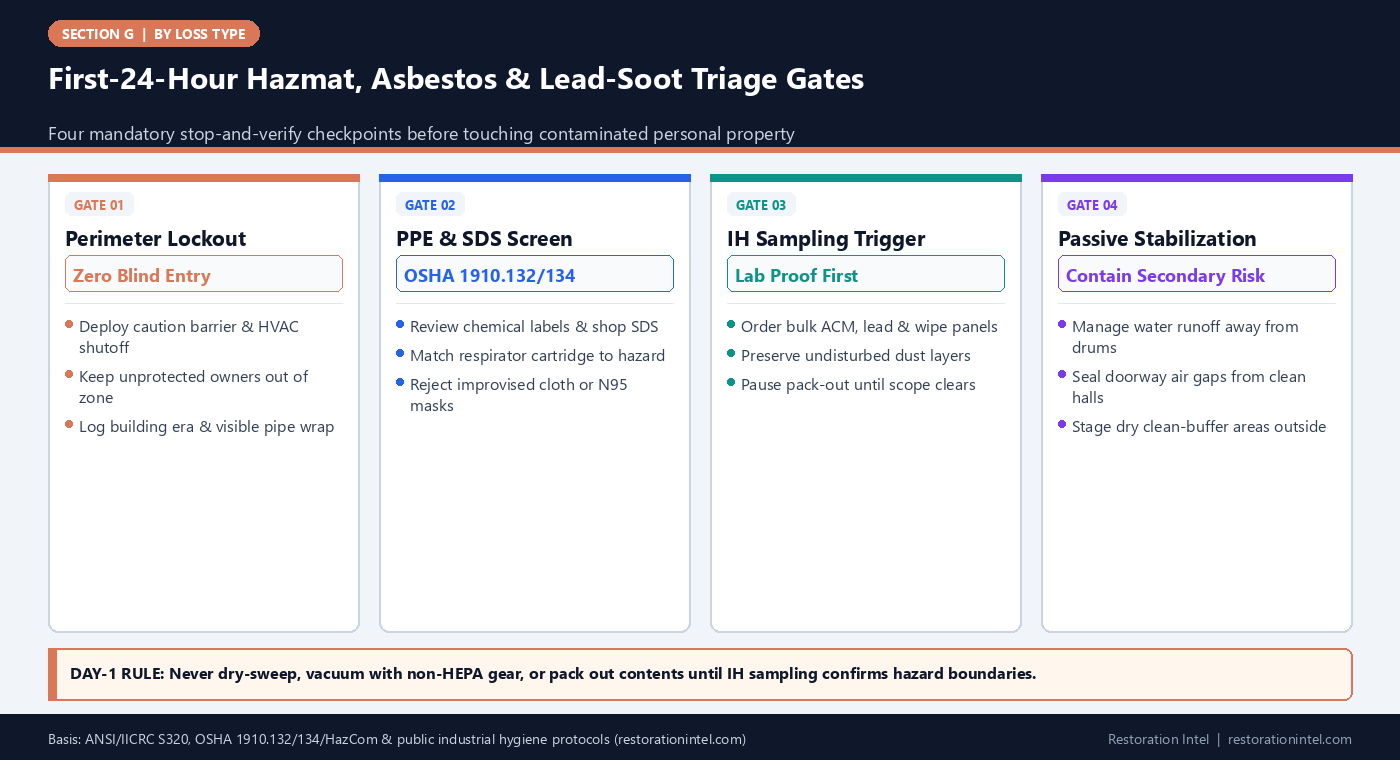
First-24-hour stabilization under these conditions follows a hold-and-verify sequence anchored to OSHA 1910.132 PPE standards, OSHA 1910.134 respiratory protection, and ANSI/IICRC S320 custody discipline. Before a single tote is opened, the lead technician locks down physical access, documents observable hazard indicators from outside the drop zone, and coordinates with the project manager, carrier adjuster, and credentialed environmental consultant.
Restoration contents contractors do not provide legal opinions, regulatory compliance determinations, or environmental-engineering clearances. Federal, state, and municipal asbestos (NESHAP/AHERA), lead (EPA RRP), and hazardous-waste transport rules dictate who may disturb, bag, or haul contaminated substrates, so Day-1 triage must record boundaries clearly and wait for licensed abatement or Industrial Hygienist sign-off.
First-24-Hour Hazmat, Asbestos & Lead-Soot Triage Gates
First-24-Hour Hazard Screening & Stabilization Matrix by Contamination Class
Operational Day-1 actions separating safe non-intrusive stabilization from activities restricted to licensed abatement or hazmat specialists.
| Contamination Hazard Class | Primary Day-1 Field Indicator | Immediate Stabilization Action | Prohibited Crew Conduct | Mandatory Clearance Gate |
|---|---|---|---|---|
| Friable Asbestos (ACM) | Pre-1980 building with torn pipe lagging, sprayed ceiling fallout, or damaged floor tile | Tape perimeter, shut down HVAC air handlers, and seal adjoining clean corridors | Dry sweeping, shop-vac extraction, or handling fiber-dusted soft goods | Licensed asbestos inspector bulk sampling and abatement work plan |
| Lead Paint Dust & Lead-Soot | Alligatoring pre-1978 trim after fire/water impact, or industrial soldering/battery bay soot | Restrict foot traffic, lay tack mats at thresholds, and record visible dust boundary | Dry brushing, compressed-air blowdowns, or unprotected sand/scrape prep | Certified lead assessor XRF or wipe testing and RRP/abatement scope |
| Unknown Industrial Chemicals | Leaking unlabeled drums, ruptured shop totes, acrid vapor odor, or etched concrete | Evacuate zone, photograph placards/labels via zoom, and isolate floor drains | Smelling containers, mixing absorbents blindly, or loading unmanifested liquids | Hazmat team or IH atmospheric screening and RCRA waste characterization |
| Lithium-Ion Battery Residue | Thermal-runaway cell debris, hydrofluoric/corrosive off-gassing, or scorched EV/tool packs | Confirm thermal stability with thermal camera, isolate outdoors if safe per fire marshal | Submerging damaged packs indoors or sealing venting cells in airtight totes | Fire/hazmat clearance and specialized corrosive-residue protocol |
| Hydrocarbon & Fuel Oil Spills | Ruptured heating-oil tank, hydraulic line blowout, or diesel-soaked warehouse pallets | Deploy compatible absorbent socks around clean aisles and ventilate per safety lead | Running unrated electrical fans in vapor plumes or bagging fuel-soaked rags in vaults | Vapor LEL check and environmental contractor spill-remediation sign-off |
| Pool, Lab & Reactive Oxidizers | Wetted chlorine tabs, acid/base bottles mixed in floodwater, or crystalline crusts on shelves | Maintain standoff distance, keep water off dry oxidizers, and notify hazmat responder | Neutralizing unknown spills with bleach/vinegar or co-packing reactive jugs | Licensed chemical disposal manifest and air-monitoring clearance |
Why Standard Day-1 Pack-Out Speed Fails on Hazmat, Asbestos, and Lead-Soot Scenes
Conventional contents workflows equate early box counts with project momentum. On a clean-water pipe break, delaying pack-out by 48 hours allows swelling in wood furniture and microbial growth on textiles, as outlined in Salvage Is a Window, Not a Service. In chemical, asbestos, and lead-soot events, however, the primary risk within the first 24 hours is mechanical disturbance and human exposure, not ordinary moisture dwell time.
Moving a sofa covered in disturbed pipe-insulation debris or rolling a toolbox across lead-laden soot turns localized fallout into an airborne plume that contaminates previously clean rooms, stairwells, and transport vehicles. Worse, once unprotected workers carry fibers or heavy-metal dust onto a box truck or into a shared warehouse vault, a manageable room containment expands into a multi-claim cross-contamination crisis.
Experienced project leads therefore treat the opening 24 hours as an isolation and intelligence-gathering window. Securing the site, verifying HVAC shutoff so air handlers do not recirculate particulates, and documenting why contents remain untouched pending testing protects both occupant health and the carrier’s downstream claim file.
- Stop-work authority: Empower any field technician to halt capture immediately upon spotting suspect pipe wrap, unlabeled chemical drums, or pre-1978 flaking paint debris.
- HVAC airlock first: Coordinate with property maintenance or mitigation leads to shut down central air systems before opening interior doors.
- Clean-buffer preservation: Lock off unaffected rooms early so verified clean belongings never share hallways with contaminated zones.
Conducting Non-Intrusive Hazard Screening Without Disturbing Regulated Dust or Fibers
Day-1 screening relies on visual indicators, building records, and Safety Data Sheets (SDS) governed by the OSHA Hazard Communication Standard rather than improvised field testing. Technicians should look for construction era clues—such as 9×9 vinyl tiles, corrugated asbestos duct wrap, vermiculite attic insulation, or chalking pre-1978 painted millwork—alongside commercial inventory risks like solvent cabinets, automotive fluids, plating baths, and battery storage racks.
Every observation during the initial walkthrough must happen without stirring settled particulate. Crews must not pull drop cloths off covered machinery, test-wipe soot off painted surfaces to read serial numbers, or open sealed chemical cabinets without verified respiratory and dermal protection. Telephoto smartphone zoom or high-lumen work lights positioned at the threshold let leads record drum placards and room conditions safely.
When fire suppression water has mixed with unknown shop chemicals or lithium-ion battery runoff, atmospheric hazards can persist long after flames are out. Crew leads must verify LEL, oxygen, and toxic-gas clearance from qualified responders before authorizing entry even for perimeter photography.
- SDS binder retrieval: On commercial losses, ask the facility manager for digital or off-site SDS records before entering chemical storage bays.
- Zero-contact rule on suspect ACM: Never pinch, peel, or bag suspect insulation fragments to inspect them; leave sample collection strictly to licensed inspectors.
- Thermal and off-gas check: Treat water-damaged or scorched lithium-ion tool packs and mobility batteries as active thermal/chemical hazards until cleared.
Coordinating Industrial Hygienist Sampling, OSHA Controls, and Emergency Secondary-Peril Stabilization
When structural water intrusion threatens high-value contents inside an un-cleared hazmat or ACM zone, stabilization cannot simply ignore spreading moisture. Instead, the project manager coordinates with the Industrial Hygienist and licensed abatement contractor to execute targeted containment-first measures: sandbagging or berms outside thresholds, controlled dehumidification positioned in clean buffer zones where airflow will not agitate dry dust, and negative-pressure HEPA filtration engineered by qualified personnel.
Meanwhile, field crews slated to support eventual pack-out must clear medical evaluation, quantitative fit testing, and cartridge selection under OSHA 1910.134 plus dermal barrier selection under OSHA 1910.132. Standard nuisance dust masks and bare-wrist coveralls provide zero defensible protection against sub-micron asbestos fibers, lead fume, or organic vapors.
Establishing a clear division of labor during the first 24 hours prevents scope overlap. Licensed abatement firms handle bulk ACM removal, regulated structural demolition, and hazardous-waste drumming, while properly credentialed contents crews prepare segregated documentation and post-clearance pack-out plans.
- Negative air without dust whip: Never point high-velocity axial air movers into dry asbestos, lead, or chemical powder deposits.
- Written IH sampling matrix: Request specific lab panels covering asbestos TEM/PLM, lead-dust wipe/AAS, and target volatile or corrosive residues.
- PPE staging outside hot line: Set up donning, doffing, and disposable boot-cover stations on clean poly before any cleared entry begins.
Structuring Day-1 Documentation, Access Logs, and Regulatory Scope Boundaries
Carriers and third-party administrators (TPAs) routinely scrutinize Day-1 billing on hazmat jobs because stabilization charges accrue before a single item is cleaned. A timestamped Day-1 stabilization log—recording barrier placement, HVAC isolation, emergency contacts notified, and the exact hazard triggers awaiting IH testing—justifies standby delays and specialized mobilization without looking like unexplained idle time.
As emphasized in A Pack-Out Record Is Not a Priced Inventory, initial field records must stay strictly factual. Technicians log observable room conditions, apparent contamination pathways, and visible asset classes without guessing chemical identities or making premature policy coverage promises to the insured.
Finally, written customer acknowledgments on Day 1 must clarify that restoration personnel cannot transport regulated hazardous wastes, opened reactive chemicals, or uncleared asbestos-contaminated textiles in standard moving trucks. Clear expectations on day one prevent homeowner or plant-manager friction when restricted goods must remain under abatement hold.
- Entry/exit sign-in sheet: Maintain a strict hot-zone access log showing time, personnel credentials, and respirator check for every entry.
- Separate stabilization from pack-out: Code perimeter containment, hazard screening, and IH coordination on their own clean documentation trail.
- Regulatory scope disclaimer: Document in writing that legal waste classification and environmental clearance decisions rest solely with licensed specialists and governing authorities.
Practitioner Verification Checklist (G-31)
- Deploy caution perimeter tape, lock interior doors, and verify HVAC shutdown before any crew member enters a suspected ACM, lead-soot, or chemical zone.
- Obtain Safety Data Sheets (SDS), building construction age, and container placard photos from a safe standoff distance prior to PPE selection.
- Verify OSHA 1910.132 PPE and OSHA 1910.134 respirator medical/fit clearance before authorizing entry into any screened hazard boundary.
- Engage a qualified Industrial Hygienist or licensed abatement specialist to run bulk, wipe, or air sampling before disturbing settled dust or residues.
- Log all Day-1 containment actions, standby holds, and regulatory scope disclaimers in the claim file before scheduling pack-out or disposal.
Standards, Authority References & Related Reading
Primary standards, insurance definitions, and sibling Restoration Intel guides referenced in this brief:
- OSHA 1910.132 Personal Protective Equipment Standard
- OSHA 1910.134 Respiratory Protection Standard
- OSHA Hazard Communication Standard (HazCom)
- ANSI/IICRC S320 Standard for Professional Contents Restoration
- Related Guide: Chemical, Hazmat, Asbestos & Lead-Soot Contamination Losses: Non-Salvageable vs Restorable Criteria
- Related Guide: Chemical, Hazmat, Asbestos & Lead-Soot Contamination Losses: Damage Evidence & Forensic Photography Rules
- Related Guide: Chemical, Hazmat, Asbestos & Lead-Soot Contamination Losses: Pack-Out Sequencing & Cross-Contamination Containment
- Related Guide: Salvage Is a Window, Not a Service
- Related Guide: A Pack-Out Record Is Not a Priced Inventory
.md twin for desk QA and team training.Frequently Asked Questions
Should contents technicians bag asbestos-dusted items during the first 24 hours to speed up mitigation?
No. Disturbing friable asbestos-containing debris without licensed abatement credentials and containment engineering violates regulatory controls in most jurisdictions and aerosolizes fibers onto clean property. Lock down the perimeter and wait for Industrial Hygienist sampling and abatement clearance.
Why is normal high-velocity structural drying prohibited on lead-soot or chemical-powder losses?
High-velocity air movers blow microscopic heavy-metal particulates, asbestos fibers, and dry chemical powders throughout the structure, turning a localized containment boundary into a whole-building cross-contamination event.
What PPE baseline is required before entering a screened chemical or lead-soot contents room?
Entry requires task-specific hazard assessment under OSHA 1910.132 and respiratory protection matched to the contaminant under OSHA 1910.134—typically P100 particulate or combination organic-vapor/acid-gas cartridges with full Tyvek coveralls and chemical-resistant gloves—rather than standard dust masks.
Who determines whether contaminated contents require regulated hazardous-waste disposal?
A credentialed environmental consultant, Industrial Hygienist, or licensed hazardous-waste contractor determines RCRA waste characteristics and local disposal rules. Restoration contents teams document physical condition and coordinate custody once classification is issued.