Direct Answer: In chemical, hazmat, asbestos, and lead-soot losses, non-salvageable versus restorable triage hinges on material porosity, deep-matrix fiber or toxin entrapment, clearance testability, and full-cycle economics: porous textiles, unsealed wood, and paper usually condemn when penetrated by regulated toxins, while non-porous metals, glass, and sealed machinery may restore if decon plus disposal stays below replacement cost.
.md twin for estimator QA and carrier file documentation.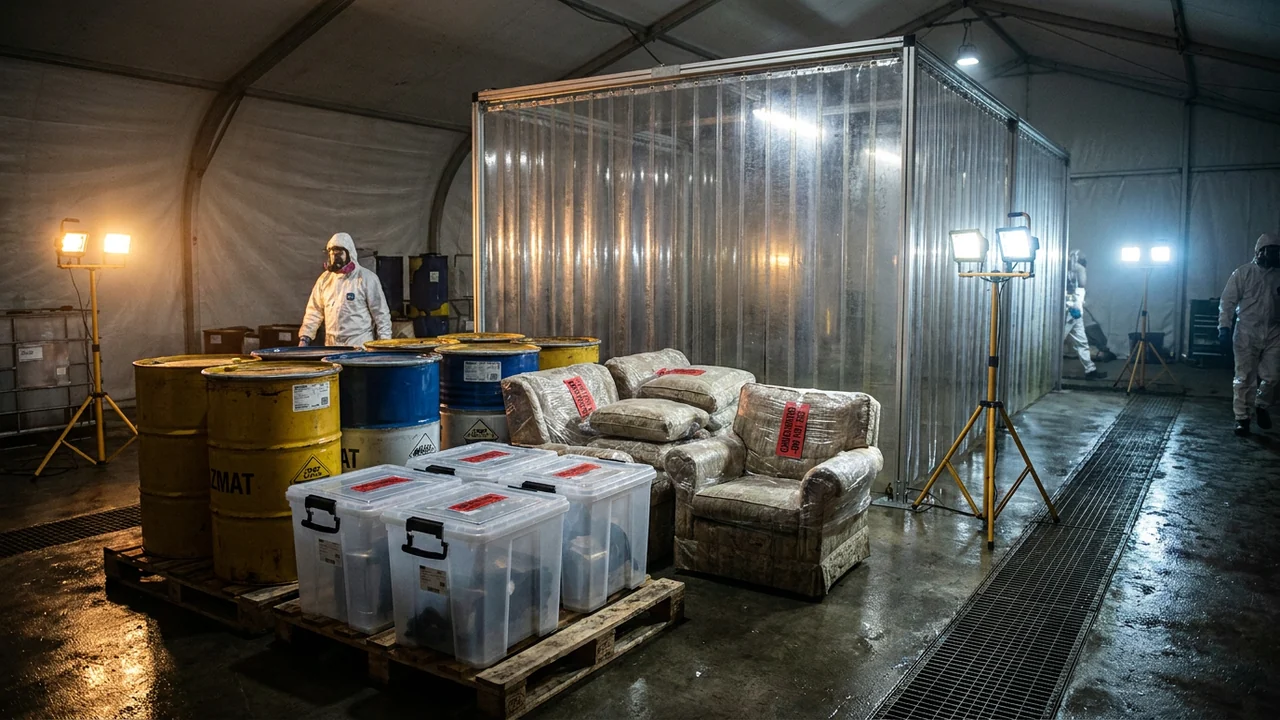
Deciding what can be cleaned safely and what must be condemned looks completely different on a hazmat, asbestos, or lead-soot loss than on an ordinary water or wood-smoke claim. Under normal fire restoration, open-cell upholstery or solid-oak dressers often respond well to HEPA vacuuming, dry-cleaning sponges, and thermal deodorization. When the soot carries lead particulates, friable asbestos fibers, or absorbed industrial solvents, a cosmetically clean exterior can still fail clearance wipe testing or off-gas toxic vapors months later.
Defensible triage combines material-science limits under ANSI/IICRC S320 and ANSI/IICRC S700 with federal waste frameworks under the US EPA Hazardous Waste Framework and IRMI salvage definitions. Every restorable recommendation must answer two questions: can decontamination return the surface to verified clearance levels without damaging function, and does total restoration cost—including PPE, containment, testing, and wastewater disposal—remain lower than Like-Kind-and-Quality (LKQ) replacement?
Because state asbestos abatement rules, EPA lead standards, and RCRA hazardous-waste generator classifications govern disposal legality, restoration contractors must not issue standalone legal waste determinations. Instead, contents leads apply documented physical triage rules and incorporate Industrial Hygienist lab findings before locking final non-salvageable or restorable lists.
Non-Salvageable vs Restorable Triage Matrix for Hazmat & Toxic Soot
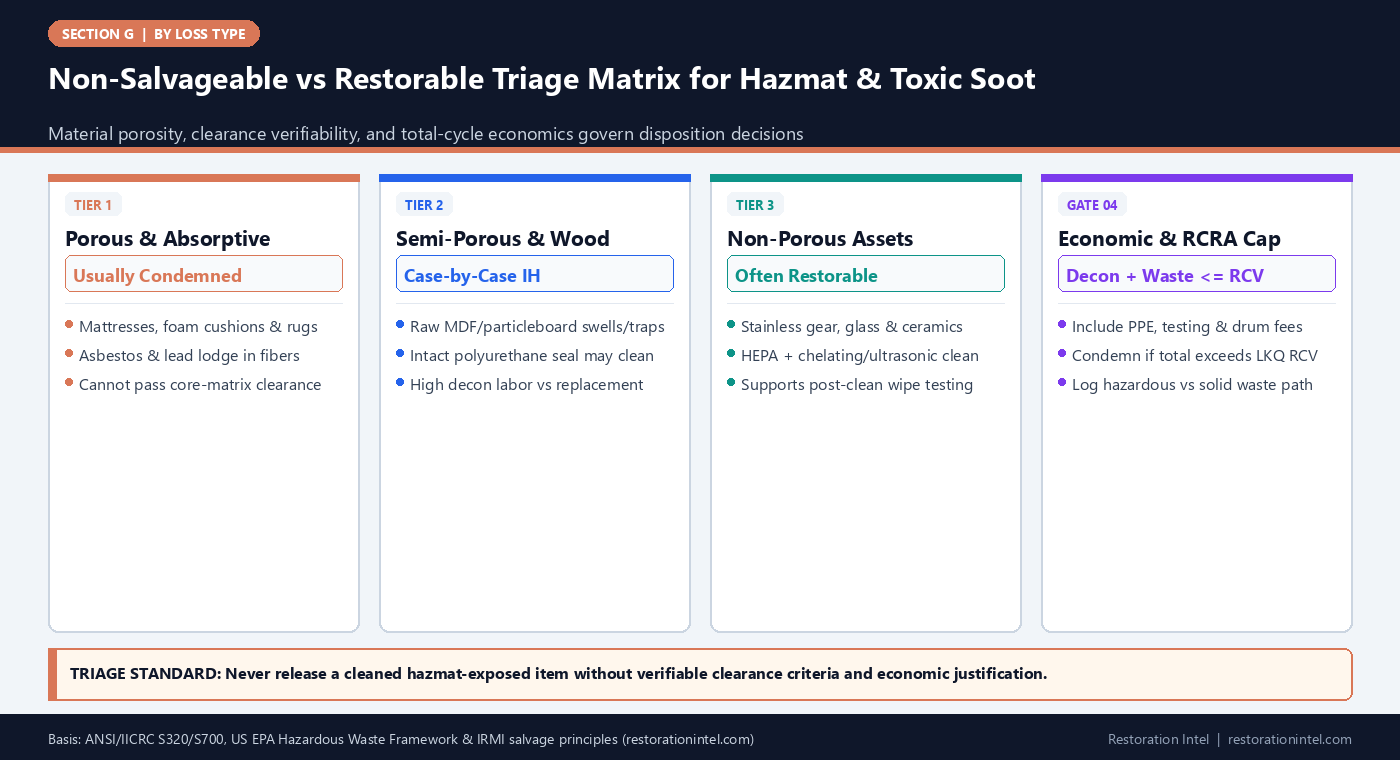
Material-Class Triage Criteria Across Asbestos, Lead-Soot, and Chemical Losses
Practitioner salvageability matrix linking substrate physics to decontamination feasibility and carrier documentation requirements.
| Contents Material Class | Retention Mechanism | Asbestos / Lead-Soot Disposition | Chemical / Solvent Disposition | Verification & Cost Gate |
|---|---|---|---|---|
| Upholstery, Mattresses & Area Rugs | Open-cell foam, batting, and woven pile trap sub-micron particulates deep below surface | Typically non-salvageable when friable ACM or heavy lead-soot penetrates weave | Non-salvageable if volatile solvents, fuel, or corrosive liquids soaked padding | High decon failure risk plus liability; photograph red-tagged items before manifested disposal |
| Paper Archives, Books & Cardboard | Cellulose fibers wick liquid chemicals and lock electrostatic lead/asbestos dust | Usually non-salvageable unless sealed inside closed metal file cabinets pre-loss | Condemned if wetted by chemical splash; vital records require specialized vault freeze/copy | Verify whether digital cloning or certified replacement costs less than specialist decon |
| Unsealed Wood & Particleboard | Exposed end-grain, laminate seams, and raw MDF absorb liquids and resist wet scrubbing | Condemned on porous backs/undersides; intact factory-lacquered faces evaluated by IH | Non-salvageable when chemical stains or odors penetrate unsealed joints or veneers | Compare HEPA-wet-HEPA labor plus clearance swab cost against mid-grade furniture RCV |
| Stainless Steel, Glass & Glazed Ceramic | Impermeable smooth surface allows particulate removal without matrix absorption | Restorable via controlled HEPA vacuuming, surfactant/chelating wash, and clearance wipe | Restorable unless strong acids/alkalis permanently etched or pitted food-contact finish | Verify zero surface etching and document negative post-clean wipe results |
| Commercial Machinery & Hard Tooling | Dense painted or bare alloys hold surface dust in crevices, cooling fins, and oil films | Restorable for high-value units via full teardown, ultrasonic bath, and IH wipe clearance | Evaluate seal/gasket chemical attack and corrosion creep before approving restoration | Justify only when rebuild + decon + calibration remains well below replacement cost |
| Consumer Electronics & Circuit Boards | Cooling fans draw corrosive smoke, lead dust, and conductive residues onto PCBs | High risk of internal fiber re-entrainment; low-value consumer units usually total loss | Corrosive acid-gas or battery electrolyte often destroys multi-layer trace reliability | Reserve restoration for high-dollar commercial servers/lab gear with OEM-backed testing |
Porosity Physics: Why Soft Goods, Paper, and Unsealed Particleboard Fail Hazmat Triage
In ordinary smoke or clean-water claims, immersion washing and ozone/hydroxyl treatment rescue many residential textiles and upholstered frames. Under asbestos, lead-soot, or chemical contamination, porosity turns from an estimating detail into a hard health barrier. Chrysotile or amphibole asbestos fibers measure a fraction of a micron wide and embed mechanically inside cotton batting, polyurethane cushion foam, carpet backing, and unsealed corrugated cardboard.
Lead-bearing soot behaves similarly when older lead paint burns or industrial battery/soldering smoke settles onto fabrics. Even when surface vacuuming removes visible blackening, subsequent compression—sitting on a sofa cushion or sleeping on a mattress—pumps residual heavy-metal dust back into the breathing zone. Because non-destructive core testing cannot certify that every internal fiber pocket is free of asbestos or lead, Industrial Hygienists routinely recommend condemning porous soft goods exposed to uncontained fallout.
Chemical spills add a second failure mechanism: sorption and persistent off-gassing. Petroleum distillates, chlorinated solvents, pesticides, and industrial resins migrate into wood fibers, plastics, and foam where aqueous detergents cannot extract them without destroying the item itself.
- Closed-cabinet exception check: Items sealed inside gasketed metal safes or intact zip-sealed storage bins may escape particulate intrusion if exterior seams test negative before opening.
- Perishable and food-contact rule: Any open pantry stock, unsealed dry goods, or porous wooden cutting boards exposed to chemical spray or lead-soot must be condemned immediately.
- Infant and medical sensitivity: Apply zero-tolerance total-loss standards to cribs, plush toys, respirators, and home medical disposables exposed to hazmat fallout.
Evaluating Non-Porous Assets, Sealed Finishes, and Precision Machinery for Decontamination
Non-porous materials—including 304/316 stainless steel cookware, commercial kitchen tables, tempered glassware, glazed ceramics, stone slabs, and sealed machined tooling—represent the strongest candidates for successful decontamination. Because contaminants sit on the external boundary rather than soaking into an open cell matrix, controlled mechanical capture and wet chemical lifting can strip residues down to verifiable background levels.
Even on non-porous goods, restorers must inspect seams, welds, gaskets, and electrical housings carefully. A stainless steel commercial mixer may have an impermeable bowl and housing, yet harbor asbestos fibers inside cooling fan shrouds or rubber drive seals. Likewise, sealed factory-lacquered hardwood cabinetry can sometimes be HEPA-vacuumed and wet-wiped if intact, whereas raw underside particleboard edges on the same piece cannot.
High-dollar mechanical and laboratory equipment warrants a component-level feasibility check before condemnation. Replacing custom industrial CNC tooling or medical imaging carts can take months of lead time, making engineered teardown and certified ultrasonic cleaning both faster and more economical than waiting on factory backorders.
- Substrate integrity test: Reject restoration if acid, alkali, or solvent exposure pitted chrome plating, crazed enamel, or softened plastic housings.
- Crevice and fan inspection: Include motor housings, keyboard membranes, and gasket channels in the feasibility check—not just flat tabletops.
- Food-contact compliance: Verify that any chemical-cleaning agent used on commercial kitchenware leaves zero toxic residue and meets food-safe rinse criteria.
Chemical Compatibility, Residue Toxicity, and Hidden Functional Degradation
Chemical losses frequently cause delayed failure that looks minor during Day-1 inspection. Acidic combustion gases from PVC wiring or lithium-ion battery venting combine with ambient humidity to form hydrochloric or hydrofluoric acid films on bare copper, zinc-plated fasteners, and precision optics. Without immediate buffering and neutralization, pitting corrosion advances underneath clean-looking surfaces weeks after the claim closes.
Odor perception is an unreliable triage instrument in chemical contamination. Many toxic materials—including lead dust, asbestos fibers, and low-vapor-pressure plasticizers or heavy metals—have no detectable odor at hazardous concentrations, while harmless fragrance residues can mask hazardous solvent carryover. Triage decisions must rely on known chemical identity from SDS/lab assays rather than the crew lead’s nose.
Furthermore, consumer-grade electronics exposed to heavy lead-soot or corrosive chemical mists almost never justify multi-stage PCB cleaning. The labor required to disassemble, ultrasonically clean, dry, and bench-test a $700 television or residential laptop exceeds replacement value while leaving residual warranty and reliability risk.
- Never rely on smell alone: Asbestos and lead particulates are odorless; require lab wipe or microscopy metrics rather than olfactory checks.
- Account for warranty voiding: Document when OEM manufacturers void safety certifications on medical, electrical, or child-safety gear after hazmat exposure.
- Check elastomer swelling: Inspect rubber seals, hydraulic hoses, and power cord jackets for tackiness or cracking caused by solvent contact.
The Full-Cost Salvage Formula: When Decontamination Plus Manifested Disposal Exceeds LKQ
Under IRMI salvage valuation concepts, restoring an item makes economic sense only when total restoration cost remains meaningfully lower than replacing it with like kind and quality. On hazmat jobs, estimators routinely undercount true restoration cost by pricing only bench wiping time while forgetting the supporting compliance overhead.
A realistic hazmat restoration cost model includes containment mobilization, negative-air filtration, single-use PPE kits, specialized chelating chemistry, segregated transport, post-clean Industrial Hygienist clearance swabs, and regulated disposal of contaminated wash water and spent filters. When a $350 microwave or a $600 laminate bookcase requires $450 in containment, decon labor, and clearance testing, condemning it as a constructive total loss protects the carrier from paying more to clean an asset than it costs new.
Conversely, where non-salvageable items must be discarded, estimators must also budget manifested disposal fees. Under the EPA Hazardous Waste Framework, regulated asbestos or RCRA-hazardous contents cannot enter ordinary municipal roll-offs; capturing accurate drum counts, weights, and manifest fees early prevents nasty supplement shocks at claim close.
- Include clearance cost per batch: Factor IH lab wipe/air confirmation charges into restorable vs replace break-even math.
- Apply constructive total loss consistently: Condemn low-to-mid-tier items whenever full-cycle decon exceeds roughly 70–80 percent of verified LKQ RCV.
- Segregate hazardous from clean debris: Never co-mingle uncontaminated cardboard with red-tagged hazmat waste inside expensive manifested drums.
Practitioner Verification Checklist (G-32)
- Classify every affected room’s contents by material porosity (porous, semi-porous, non-porous) against verified IH contaminant lab results.
- Condemn porous upholstered goods, mattresses, open paper, and unsealed particleboard penetrated by friable asbestos, lead-soot, or absorbed chemicals unless cleared by IH testing.
- Inspect non-porous machinery, electronics, and cookware for hidden cooling-fan cavities, gasket degradation, or corrosive acid etching before marking restorable.
- Calculate full-cycle restoration cost—including PPE, containment, decon labor, clearance swabs, and wastewater disposal—against current LKQ replacement RCV.
- Separate non-salvageable items into clearly labeled, sealed waste streams and confirm licensed hazmat/abatement disposal rules before haul-off.
Standards, Authority References & Related Reading
Primary standards, insurance definitions, and sibling Restoration Intel guides referenced in this brief:
- US EPA Hazardous Waste Framework
- ANSI/IICRC S320 Standard for Professional Contents Restoration
- ANSI/IICRC S700 Fire & Smoke Restoration Standard
- IRMI Insurance Glossary: Salvage
- Related Guide: Chemical, Hazmat, Asbestos & Lead-Soot Contamination Losses: First-24-Hour Contents Triage & Stabilization
- Related Guide: Chemical, Hazmat, Asbestos & Lead-Soot Contamination Losses: Damage Evidence & Forensic Photography Rules
- Related Guide: Chemical, Hazmat, Asbestos & Lead-Soot Contamination Losses: Carrier Scope Justification & Total-Loss Defense
- Related Guide: Salvage Is a Window, Not a Service
- Related Guide: The Adjuster Desk: One Standard, Two Chairs
.md twin for desk QA and team training.Frequently Asked Questions
Can upholstered sofas or mattresses exposed to friable asbestos or lead-soot be cleaned and returned?
In nearly all residential and commercial cases, no. Sub-micron asbestos fibers and lead-bearing soot embed deep inside open-cell foam and fabric weaves where wet or dry cleaning cannot achieve verified internal clearance, making condemnation the standard risk-based recommendation.
When are stainless steel appliances or commercial tools considered restorable after chemical or lead-soot exposure?
Impermeable non-porous assets are often restorable when they show no permanent acid etching or thermal distortion, internal electrical cavities can be isolated or cleared, and total containment, cleaning, and IH clearance testing cost less than LKQ replacement.
Why do items sometimes fail economically even when they are physically cleanable?
Because hazmat decontamination carries fixed overhead—PPE, negative-pressure enclosures, waste-water containment, and post-clean IH wipe tests. Low- and mid-value household items quickly exceed their replacement value once compliant decon labor and testing are included.
Can restoration crews throw condemned hazmat or lead-soot contents into a regular construction dumpster?
Not without verified waste characterization. Depending on contaminant concentration and state/federal RCRA or NESHAP regulations, condemned items may require licensed packaging, manifesting, and disposal at a permitted hazardous or asbestos-accepting facility.