Direct Answer: During initial loss-walkthrough intake, a Restoration Project Manager or Contents Division Lead must lock down signed work authorizations, map affected room boundaries and policy sublimit risks, separate structural mitigation from contents custody, and commit to realistic SLA timelines before a single pack-out box enters the truck.
.md twin for estimator QA and carrier file documentation.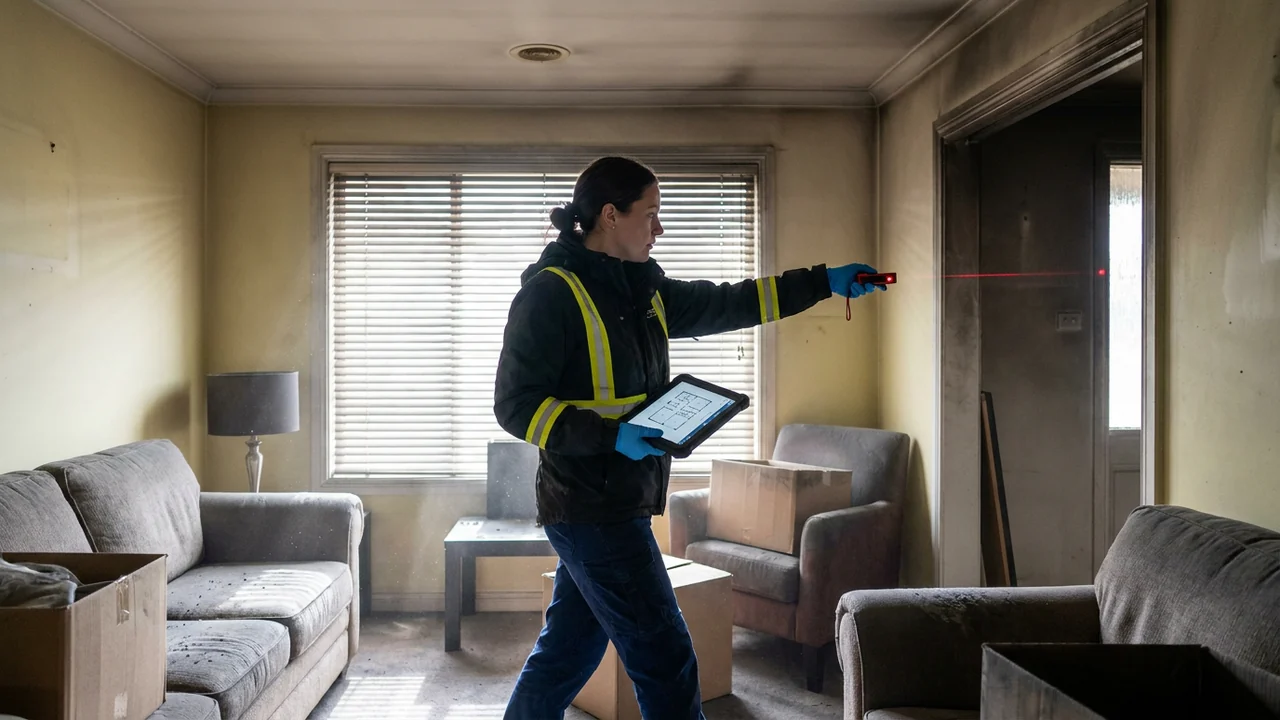
Most margin erosion inside a contents division happens during the first ninety minutes on site, long before an estimator opens XactContents or a crew tapes a wardrobe box. When a Restoration Project Manager (RPM), Contents Division Lead, or General Manager treats the initial walkthrough as an informal handshake rather than a structured intake gate, downstream teams inherit unpriced scope, unsigned authorizations, and surprise warehouse bottlenecks.
From an executive and division P&L standpoint, initial intake serves two masters simultaneously. It protects the policyholder’s property and expectations under ANSI/IICRC S320 custody principles while validating whether the company actually has the vault space, labor bandwidth, and carrier approval pathway to execute profitably. Accepting an oversized pack-out without checking storage capacity or carrier pre-authorization triggers unbilled double-handling and aging accounts receivable.
Treating the first walkthrough as a formal underwriting and logistics gate transforms contents from an unpredictable side hustle into a controllable business unit. Standardized room triage, early sublimit screening, and clear separation between mitigation and contents contracts allow Restoration Industry Association (RIA) minded operators to launch crews cleanly while keeping carrier adjusters aligned from day one.
Day-One Contents Intake Gate for Division Leads
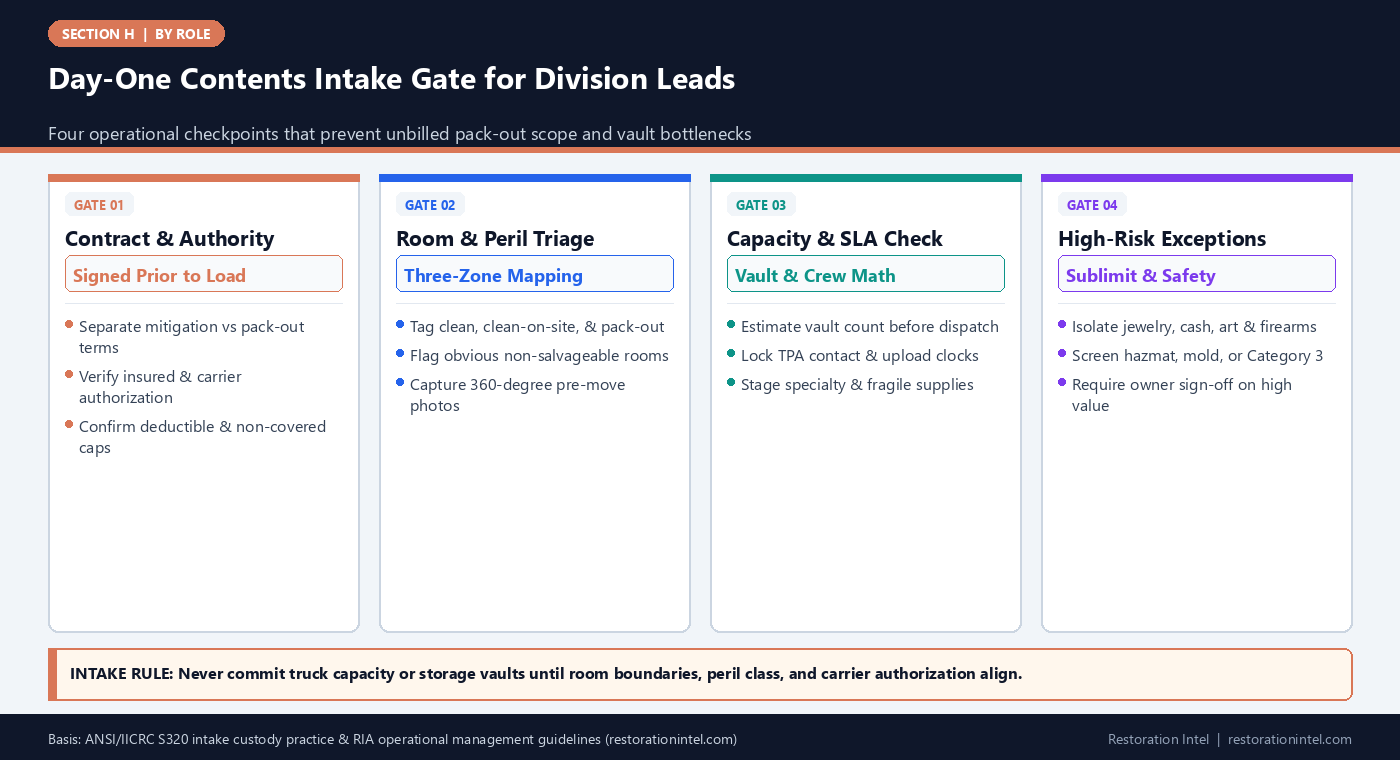
Initial Walkthrough Intake Decisions & Executive Escalation Thresholds
Division leads use structured intake thresholds during the first site visit to match field deployment to carrier authorization and warehouse capacity.
| Intake Checkpoint | Minimum Field Standard | Commercial / Large-Loss Adjustment | Carrier / TPA Risk If Skipped | Decision Owner |
|---|---|---|---|---|
| Authorization Split | Separate signed contents pack-out and storage agreement from emergency water/board-up work authorization | Obtain corporate officer signature plus COI/leaseholder release for tenant improvements | Carrier disputes pack-out necessity or refuses storage billing after emergency phase | RPM / Division Lead |
| Peril & Salvage Window | Classify Cat 1/2/3 water, light/heavy smoke, or microbial exposure inside first 24 hours | Coordinate industrial hygienist or environmental clearance before crew entry | Secondary mold or soot etching converts restorable goods into unapproved total loss | Lead Estimator / RPM |
| Vault & Truck Forecast | Convert affected square footage into estimated box count and palletized vault slots | Reserve overflow climate-controlled racks and dedicated box trucks before mobilization | Double-handling onto temporary trailers erodes gross margin by 10 to 18 points | General Manager |
| Sublimit & Leave-Behind Log | Require insured to retain cash, prescriptions, firearms, jewelry, and vital papers | Document IT servers, proprietary records, and leased equipment serials with site manager | Bailee liability exposure and uncovered theft or loss claims against contractor | RPM / Crew Lead |
| TPA & Carrier SLA Clock | Log carrier claim number, program portal deadline, and preliminary scope photo timestamp | Establish written cadence for phased room approvals with general adjuster | Automatic scorecard penalties and delayed interim draw approvals | Contents Division Lead |
| Total-Loss Hold Gate | Quarantine suspected non-salvageable rooms with full panoramic and close-up photos | Arrange joint walkthrough with carrier consultant before any commercial disposal | Zero reimbursement for prematurely discarded inventory without model/condition proof | Division Lead / Adjuster |
Separating Emergency Stabilization From Full Pack-Out Authorization
On a chaotic loss site—especially an evening pipe burst or a morning structure fire—homeowners and facility managers want everything moved immediately so repairs can begin. Experienced division leads resist the urge to roll full pack-out crews under a generic emergency mitigation signature. Mitigation authorization covers extraction, structural drying, and emergency manipulation of contents off wet flooring; it rarely constitutes carrier-approved authorization for off-site boxing, transport, facility cleaning, and multi-month climate-controlled storage.
As outlined in Salvage Is a Window, Not a Service, the first 24 hours belong to stabilization triage rather than blind boxing. Moving wet or soot-coated items before capturing baseline photos and confirming whether a room is clean-on-site, manipulate-in-place, pack-out, or non-salvageable locks the company into labor and storage costs that a desk examiner may later reject as unnecessary.
Owners and General Managers should enforce a two-tier contract structure in the field. Tier one authorizes immediate stabilization, board-up, and photo documentation; tier two triggers only after the RPM calculates rough box volume, verifies adjuster contact, and secures signed acknowledgement of storage rates, access rules, and non-covered item exclusions.
- Explicit scope boundary: State clearly on the intake sheet which rooms require off-site pack-out versus room-to-room manipulation.
- Preliminary carrier notice: Send a same-day photo brief and estimated vault count to the adjuster before mobilizing a four-person pack-out crew.
- Non-covered contingency clause: Ensure the insured understands personal payment responsibility if coverage is denied or policy limits exhaust.
Sizing Vault Demand, Crew Allocation, and Specialty Subcontractors Up Front
Nothing stalls a profitable contents division faster than underestimating physical cubic footage during intake. A 2,400-square-foot home with minimal clutter might pack into six standard wooden vaults, whereas a densely furnished residence with full garage shelving and seasonal attic storage can easily consume fourteen to eighteen vaults plus oversized pallet racking. Guessing volume casually leads to mid-job truck reloads, unscheduled overtime, and congested warehouse aisles.
Division leads should walk every closet, pantry, basement bay, and garage perimeter while scoring room density on a simple low/medium/high scale. Pairing density scores with fragile-item counts—chandeliers, oversized glass, stone tabletops, upright pianos, and commercial server racks—determines whether third-party crating, art handlers, or appliance disconnects are needed before day two.
General Managers must tie intake volume directly to warehouse capacity tracking. If existing long-term rebuild holds already occupy 85 percent of climate-controlled bays, accepting a massive commercial pack-out without pre-arranging overflow racking forces unbillable re-stacking across the shop floor.
- Density multiplier check: Walk every closed door and off-site shed before quoting crew days or truck trips.
- Heavy & specialty flags: Identify safes, pool tables, commercial kitchen lines, and fine art so specialty riggers are scoped as pass-through line items.
- Supply staging manifest: Convert intake room counts into exact box, dish-pack, wardrobe, and crating counts before crews leave the yard.
Screening Policy Sublimits, High-Liability Assets, and Leave-Behind Protocols
Standard homeowners and commercial property policies impose strict sublimits and exclusions on cash, bullion, jewelry, watches, furs, firearms, fine art, and business property at a residence. Packing a jewelry box or a safe full of collectible coins into a standard warehouse vault transfers massive bailee liability onto the restoration company without generating meaningful restoration revenue.
During the initial walkthrough, the RPM must execute a mandatory Leave-Behind Protocol with the property owner present. High-liability personal items—medications, passports, deeds, laptops, currency, firearms, and unscheduled fine jewelry—should remain in the insured’s direct custody whenever safe to retrieve, documented by a signed leave-behind inventory sheet with photo proof.
For commercial losses, intake requires verifying ownership boundaries between building fixtures, tenant improvements, business personal property, and third-party leased machinery. Aligning these boundaries with IRMI replacement cost classification principles keeps leased copiers or customer-owned inventory from contaminating the insured’s claim packet.
- Zero-custody list: Never pack prescription narcotics, live ammunition, unsecured currency, or perishable food into storage vaults.
- High-value appraisal alert: Flag items visibly exceeding $2,500 per unit for specialist inspection rather than standard cleaning labor.
- Signed exclusion receipt: Capture both signatures and timestamps whenever the insured removes or retains items during intake.
Locking TPA Portal Timers and Stakeholder Communication Cadence
For contractors operating inside third-party administrator (TPA) managed repair networks, the clock starts at assignment acceptance, not when the warehouse team finishes unpacking boxes. Missing initial customer contact, preliminary photo upload, or rough-order-of-magnitude (ROM) reserve estimates inside the first 24 to 48 hours triggers automated scorecard deductions regardless of how well the crew cleans.
As covered in Contents Cleaning SLAs by Category, different carrier programs enforce strict milestone gates for initial triage, non-salvageable lists, and itemized pack-out schedules. The RPM must translate those program rules into job-level calendar locks during intake so the estimating desk and warehouse supervisor know the exact hour each deliverable is due.
Establishing a clear communication cadence with the homeowner, property manager, and desk examiner on day one eliminates frantic status calls later. Sending a concise intake summary email within four hours of walkthrough completion—confirming room scope, leave-behind exclusions, next arrival window, and target estimate delivery—sets professional authority across the entire claim.
- Same-day ROM reserve: Give the adjuster an honest directional range for pack-out, cleaning, and storage so claim reserves are set accurately.
- Single point of contact: Designate one RPM email and phone line for insured and adjuster questions to prevent conflicting verbal commitments.
- Pre-pack baseline archive: Upload wide-angle untouched room photos before moving furniture so pre-existing wear and layout are indisputable.
Practitioner Verification Checklist (H-01)
- Obtain separate, signed contents pack-out and storage authorization prior to loading any items into company trucks.
- Complete 360-degree untouched baseline photographs of every affected room, closet, cabinet interior, and storage bay.
- Execute and co-sign the Leave-Behind Protocol covering currency, jewelry, firearms, medications, vital records, and daily electronics.
- Calculate estimated vault count, specialty rigging needs, and warehouse bay availability before dispatching pack-out crews.
- Deliver a same-day intake summary and preliminary ROM scope range to both the policyholder and assigned adjuster/TPA portal.
Standards, Authority References & Related Reading
Primary standards, insurance definitions, and sibling Restoration Intel guides referenced in this brief:
- ANSI/IICRC S320 Standard for Professional Contents Restoration
- Restoration Industry Association (RIA)
- Verisk XactContents Platform Overview
- IRMI Insurance Glossary: Replacement Cost Value (RCV)
- Related Guide: Restoration Project Manager & Contents Division Lead: Capture & Documentation Execution Workflow
- Related Guide: Restoration Project Manager & Contents Division Lead: Team Handoff Between Field Capture and Desk Estimating
- Related Guide: A Pack-Out Record Is Not a Priced Inventory
- Related Guide: Salvage Is a Window, Not a Service
- Related Guide: Contents Cleaning SLAs by Category
.md twin for desk QA and team training.Frequently Asked Questions
Should a project manager pack out contents on the same day as emergency water extraction?
Only when immediate removal is required to protect items from ongoing collapse, severe microbial growth, or active mitigation demolition, and only after baseline photos and written contents authorization are secured. Rushing full pack-outs without scope alignment frequently creates disputed storage charges.
What items should never enter a restoration contractor's pack-out truck?
Contractors should exclude live ammunition, firearms (unless specialized bonded arrangements apply), prescription medications, cash, negotiable securities, fine jewelry, vital legal documents, perishable foods, and open hazardous chemicals unless explicitly contracted under hazmat protocols.
How do division leads prevent surprise warehouse congestion from large intakes?
Convert every walkthrough room density score into projected wooden vault equivalents and oversized pallet spaces before crew dispatch, cross-checking against live warehouse bay utilization.
Why separate mitigation work authorizations from contents pack-out contracts?
Carriers evaluate emergency water mitigation and off-site contents restoration under distinct policy coverages and review standards. Separate authorizations clarify scope approval, storage terms, and customer liability if limits are exceeded.