Direct Answer: A disciplined capture and documentation workflow requires standardized room-by-room sweep sequences, unambiguous box-to-item custody labeling, legible rating-plate and damage evidence photography, and end-of-shift reconciliation so field crews produce estimator-ready records without second trips.
.md twin for estimator QA and carrier file documentation.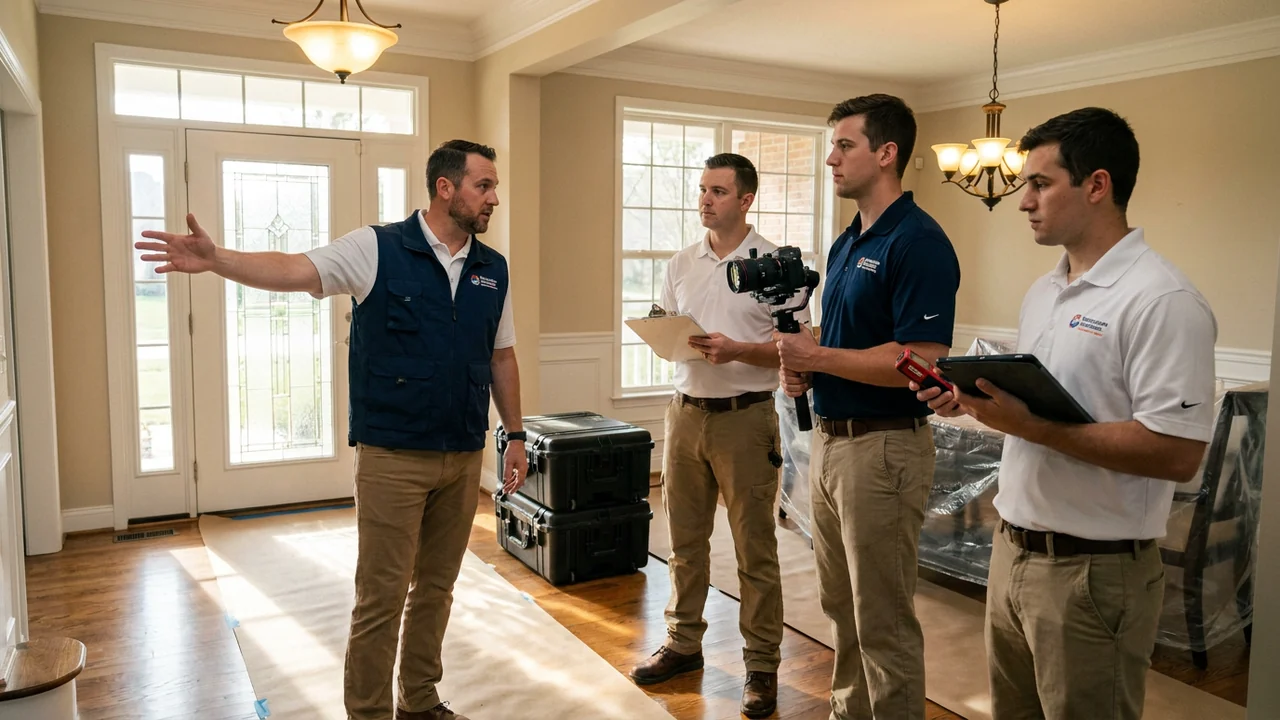
Even an airtight initial scope falls apart if field capture turns into improvised photography and vague box labels. When crew leads write ‘Kitchen Misc’ on twenty cartons and upload three hundred unlabeled smartphone photos into a shared folder, the estimating desk spends hours guessing what is inside each box while adjusters challenge whether items were ever damaged.
For Restoration Project Managers, Contents Division Leads, and General Managers, field documentation is not administrative busywork—it is the manufacturing floor of claim revenue. Every line item billed in Xactimate or supported inside a non-salvageable schedule relies on evidence captured before packing paper wraps around the object.
Operating under ANSI/IICRC S320 chain-of-custody standards means designing a repeatable execution workflow that works identically across Tuesday residential pack-outs and weekend commercial multi-crew deployments. Clear sweep rules, consistent barcode architecture, and daily shift reconciliation keep recall high, eliminate duplicate uploads, and give RIA-aligned leadership live visibility into job completion.
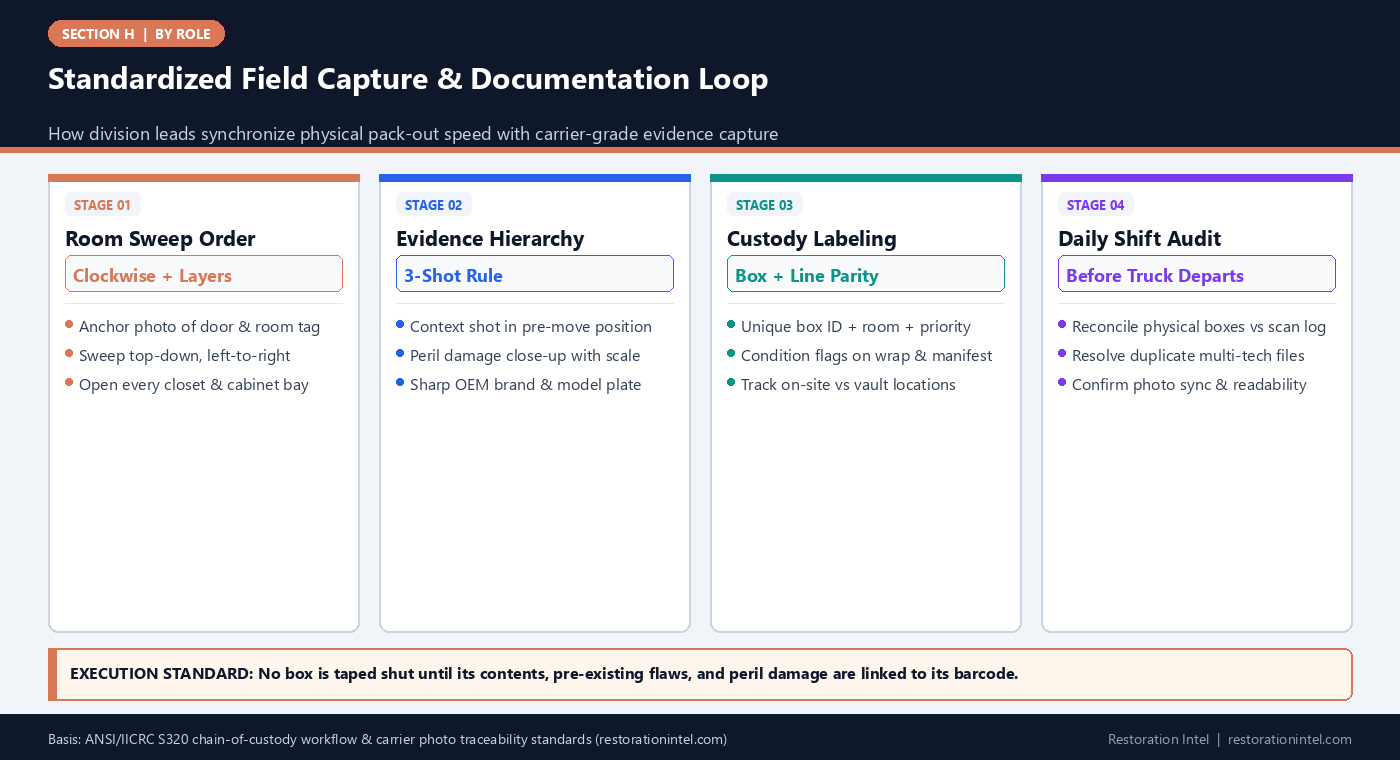
Standardized Field Capture & Documentation Loop
Field Capture Workflow Standards by Asset Class and Crew Role
Standard operating parameters that keep multi-person pack-out teams fast on site while supplying clean metadata for desk estimating.
| Asset / Task Tier | Mandatory Photo & Metadata Rule | Box / Tagging Convention | Common Multi-Crew Failure | Supervisor Check |
|---|---|---|---|---|
| Room Anchor & Perimeter | Wide-angle entry doorway photo plus 4-corner sweep before any item moves | Assign standardized room code (e.g., KIT-01, MBR-01) across all devices | Two techs name the same room 'Den' and 'Living Room', splitting schedules | Verify unified room dictionary at morning huddle |
| Tier 1 Appliances & Electronics | Context photo, damage/soot proof, plus macro shot of OEM model/serial tag | Individual asset tag attached directly to chassis or cord wrap | Glare or soot obscures model suffix, causing entry-level LKQ substitution | Spot-check 100% of rating-plate legibility before load-out |
| Casegoods & Upholstered Furniture | Four-side condition check documenting scratches, joints, and fabric grade | Pad-wrap barcode tag matched to pre-move room ID and cushion count | Pre-existing wear disputed at delivery because back/bottom photos were skipped | Require underside/corner wear photos prior to wrapping |
| Dense Smalls (Pantries / Closets) | Open-shelf context shot before pull; lot count grouped by category/material | Carton barcode listing room, box number, priority level, and item family | Generic 'Misc Box' labels force unpack-to-estimate bottlenecks in warehouse | Enforce max 20% generic wording; require descriptive sub-groups |
| Fragiles, Glass & Artwork | Pre-wrap surface & frame corner shots plus backing/signature detail if any | Double-wall or mirror-pack carton marked FRAGILE + orientation arrows | Packing frames together without corner protection causes transit claims | Verify dedicated crate/mirror-pack count against manifest |
| Split-Shift Sync & Reconciliation | Upload and index all shift media on job Wi-Fi/LTE before truck departure | Scan final vault load manifest against room exit count | Duplicate photo uploads or un-synced tablet queues distort item totals | Run daily shift count parity check before crew clocks out |
Enforcing Room-Sweep Discipline and Multi-Tech Naming Hygiene
The single biggest technical breakdown in field documentation happens when three technicians work different corners of the same house simultaneously without a locked room taxonomy. One technician labels an upstairs loft ‘Bonus Room,’ another calls it ‘Bedroom 4,’ and a third logs boxes under ‘Upstairs Hall.’ When those records reach estimating, identical assets get counted twice or orphaned from their room context.
Division leads solve this at the morning tailgate before the first roll of tape comes out. The Crew Lead walks the perimeter and hangs physical painter’s-tape room ID cards on every doorway—KIT-01, FAM-01, MBR-01, GAR-01—matching the exact room list created in the capture app. Every technician captures the doorway card as the first frame of that room’s photo sequence.
Inside each room, crews follow a strict clockwise, top-to-bottom sweep: ceiling fixtures and wall hangings first, then upper shelving, tabletops, lower drawers, and finally floor-level furniture. Systematic sweep geometry ensures closed vanity drawers and bottom pantry racks are never skipped during end-of-day fatigue.
- Single room dictionary: Lock room names across every tablet on site before packing begins.
- Doorway anchor frames: Require a room-card photo whenever a technician transitions between spaces.
- Zone ownership: Assign one lead pair per room boundary rather than letting four technicians roam across floors randomly.
Balancing Box-Level Packing Speed Against Item-Level Evidence
General Managers constantly wrestle with the tension between production speed and granular documentation. If a crew spends forty-five minutes photographing every single coffee mug in a residential kitchen, labor hours explode past carrier allowances. Conversely, as explored in A Pack-Out Record Is Not a Priced Inventory, pure box-level logs that ignore item specs push all discovery work onto expensive warehouse unpacking benches.
High-performing divisions solve this with a tiered capture rule built around asset value and cleanability. Everyday low-value items (plates, linens, pantry dry goods, paperbacks) are photographed cleanly on the shelf or counter in open-face group shots and packed into tightly categorized cartons (‘KIT-01 Box 04: Everyday Ceramic Dinnerware, 24 pcs’). High-value appliances, electronics, specialty tools, and damaged furniture receive dedicated three-shot forensic sequences.
Where operations adopt AI-assisted photo indexing or optical character recognition (OCR), governance benchmarks such as the NIST AI Risk Management Framework reinforce a practical field lesson: automated labeling only stays reliable when human technicians frame well-lit, unobstructed shots and validate ambiguous outputs rather than treating software tags as infallible.
- Three-shot Tier 1 rule: Capture context, damage closeup, and legible OEM rating plate on every appliance, TV, and power tool.
- Smart shelf-group shots: Photograph dense closets and pantries open and well-lit before boxing by uniform commodity group.
- Priority box coding: Tag Priority-1 boxes (daily cookware, work attire, infant supplies) visibly so warehouse teams process them first.
Capturing Pre-Existing Condition and Peril Evidence Without Slowing Crews
Every contents division eventually faces the dreaded delivery-day accusation: ‘That dresser leg was never chipped before you packed it.’ Without pre-move condition proof, the contractor absorbs repair or replacement costs straight out of net profit—even when the damage predated the loss by a decade.
Project managers should train crews to capture rapid four-corner condition sweeps on all wood casegoods, upholstered sofas, and specialty decor before a moving blanket touches them. Portable LED work lights eliminate shadowy basement or soot-darkened room blur, which is the primary culprit behind rejected damage photos and unreadable serial tags.
Equally important is tying peril evidence directly to cleaning justification. Under S320 principles and carrier audit norms, documenting particulate soot layering, water wicking lines on furniture feet, or odor-affected porous padding at the moment of intake turns cleaning scope from an opinion into a verifiable record. Referencing standardized specialty cleaning codes in field notes also cues estimators accurately when ultrasonic, ozone/hydroxyl, or dry-cleaning methods are required.
- Auxiliary lighting rule: Require cordless LED flood or inspection lights in windowless basements, closets, and fire-charred rooms.
- Pre-wrap flaw callouts: Photograph existing scratches, loose veneer, water rings, or torn upholstery with a quick verbal or app tag.
- Peril-to-method tagging: Note soot type (dry, wet, protein), water category, or mold presence directly on the box/item record.
Daily End-of-Shift Reconciliation and Multi-Device Sync Controls
Large residential pack-outs and commercial losses routinely span multiple days and rotating crews. Without an end-of-shift reconciliation ritual, photo queues stall offline on personal devices, two technicians re-photograph the same credenza on day two, and truck manifests arrive at the warehouse short two cartons that were left in a hallway staging area.
The Crew Lead must run a mandatory fifteen-minute gate check before releasing trucks from the loss site each afternoon. Physical carton counts loaded onto the vehicle are matched one-for-one against digital manifest totals, tablet sync status is verified to 100 percent cloud/server upload, and any remaining unpacked rooms are physically taped off with clear next-day continuation markers.
For General Managers tracking multi-site production, enforcing this daily sync cadence eliminates the classic Friday afternoon scramble where a missing tablet stalls Monday estimating. Clean daily batches also allow the estimating desk to begin pricing day-one rooms while crews finish day-two pack-out.
- Truck-to-tablet parity: Physical box count rolled onto the ramp must equal the digital manifest count before the liftgate closes.
- Continuation tape lines: Mark exact stop boundaries in unfinished rooms so day-two crews never double-capture or skip shelves.
- Zero orphaned device media: Confirm every field tablet uploads full-resolution images before crews depart site.
Practitioner Verification Checklist (H-02)
- Post standardized room ID cards at every doorway and sync identical room names across all crew tablets before starting.
- Capture untouched doorway and four-corner baseline sweeps in every room prior to moving or wrapping furniture.
- Enforce three-shot forensic evidence (context, damage, legible OEM rating plate) on all Tier 1 appliances, electronics, and equipment.
- Use portable LED lighting and pre-wrap condition photos to document pre-existing wear, scratches, and soot/water damage lines.
- Complete end-of-shift physical box count versus digital manifest reconciliation and confirm 100% photo upload before truck departure.
Standards, Authority References & Related Reading
Primary standards, insurance definitions, and sibling Restoration Intel guides referenced in this brief:
- ANSI/IICRC S320 Standard for Professional Contents Restoration
- Restoration Industry Association (RIA)
- Verisk Xactimate Estimating Platform
- NIST AI Risk Management Framework
- Related Guide: Restoration Project Manager & Contents Division Lead: Initial Scope & Loss-Walkthrough Intake
- Related Guide: Restoration Project Manager & Contents Division Lead: Team Handoff Between Field Capture and Desk Estimating
- Related Guide: Field Contents Technician & Pack-Out Crew Lead: Capture & Documentation Execution Workflow
- Related Guide: A Pack-Out Record Is Not a Priced Inventory
- Related Guide: The Specialty Codes
.md twin for desk QA and team training.Frequently Asked Questions
How can crews capture carrier-grade documentation without doubling pack-out labor hours?
Separate capture rigor by asset tier: apply full three-shot rating-plate forensics to appliances, electronics, and high-value items while using well-lit open-shelf group photos and descriptive commodity labels for dense everyday smalls.
What is the fastest way to stop duplicate entries during multi-day pack-outs?
Assign locked room dictionaries, place visible tape boundary markers at shift stop points, and require a physical-to-digital box count reconciliation before trucks leave each day.
Why do adjusters reject dark or blurry damage photos from fire and basement losses?
Desk reviewers cannot verify soot density, wicking height, or OEM model identifiers from underexposed frames, leading to generic low-tier replacements or scope cuts. Portable cordless LED lights solve this immediately.
Should field technicians assign replacement dollar values during pack-out?
No. Field technicians should focus on complete physical recall, accurate condition notes, room custody, and clear brand/model photography, leaving LKQ sourcing and policy valuation to the estimating desk.