Direct Answer: Field crews manage non-salvageable lists and high-dollar exceptions by staging condemned goods in an isolated hold zone for full forensic documentation and signed disposal authorization before haul-off, while routing sublimited, irreplaceable, or ultra-high-value assets through dual-custody sign-offs, owner-retention agreements, or specialized transport rather than standard cartons.
.md twin for estimator QA and carrier file documentation.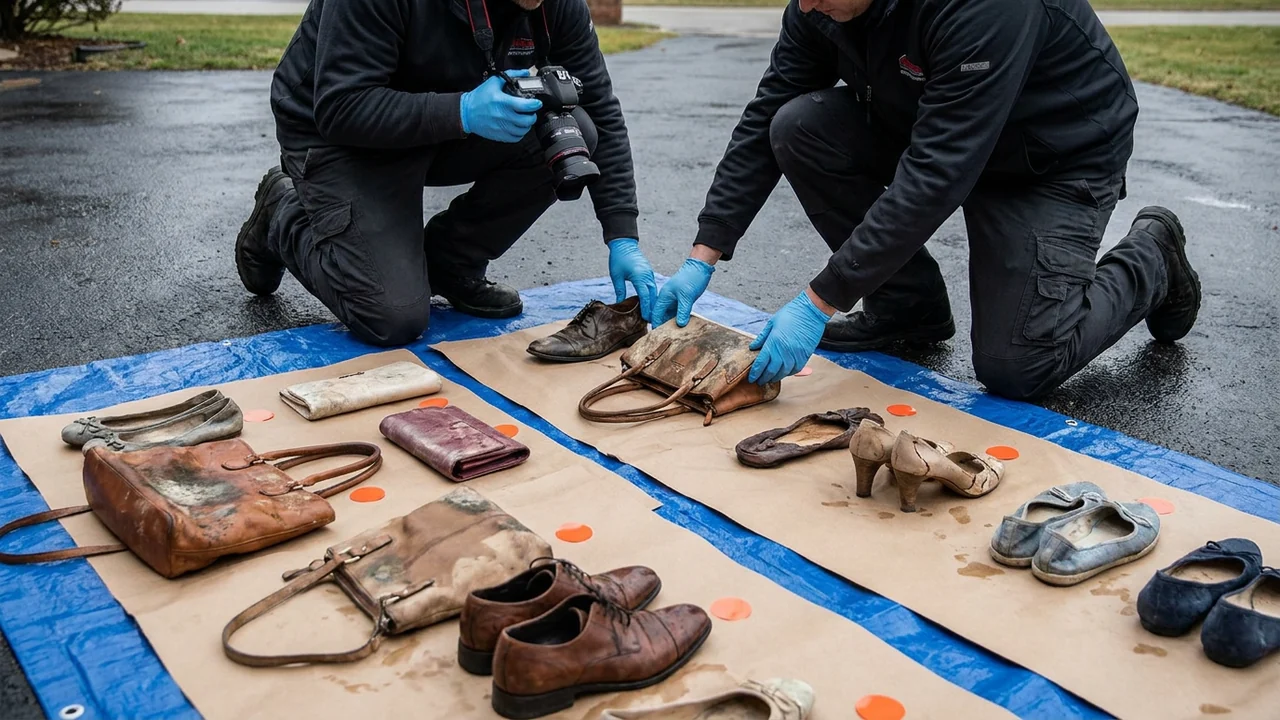
Nothing creates sharper conflict on a property claim than throwing something away too fast—or stuffing a $15,000 watch or uninsurable heirloom into an ordinary cardboard moving box. On active loss sites, the Field Contents Technician and Pack-Out Crew Lead sit right at the decision point between restorable property, condemned waste, and high-dollar exceptions that exceed normal crew handling limits.
Under ANSI/IICRC S320, throwing away damaged property solely because it smells bad or looks ruined destroys the policyholder’s and carrier’s physical proof unless proper documentation and authorization precede disposal. Meanwhile, under IRMI salvage principles, insurers retain legal interest in inspected salvageable or total-loss property until settlement or release. Premature haul-off without receipts turns a straightforward disposal into a spoliation dispute.
Equally dangerous is treating every expensive object like standard household goods. High-dollar fine art, firearms, jewelry, cash, wine collections, medical devices, and commercial servers carry policy sublimits, legal chain-of-custody risks, and fragile handling thresholds that demand strict exception protocols during pack-out.
Non-Salvageable Hold & High-Dollar Exception Protocol
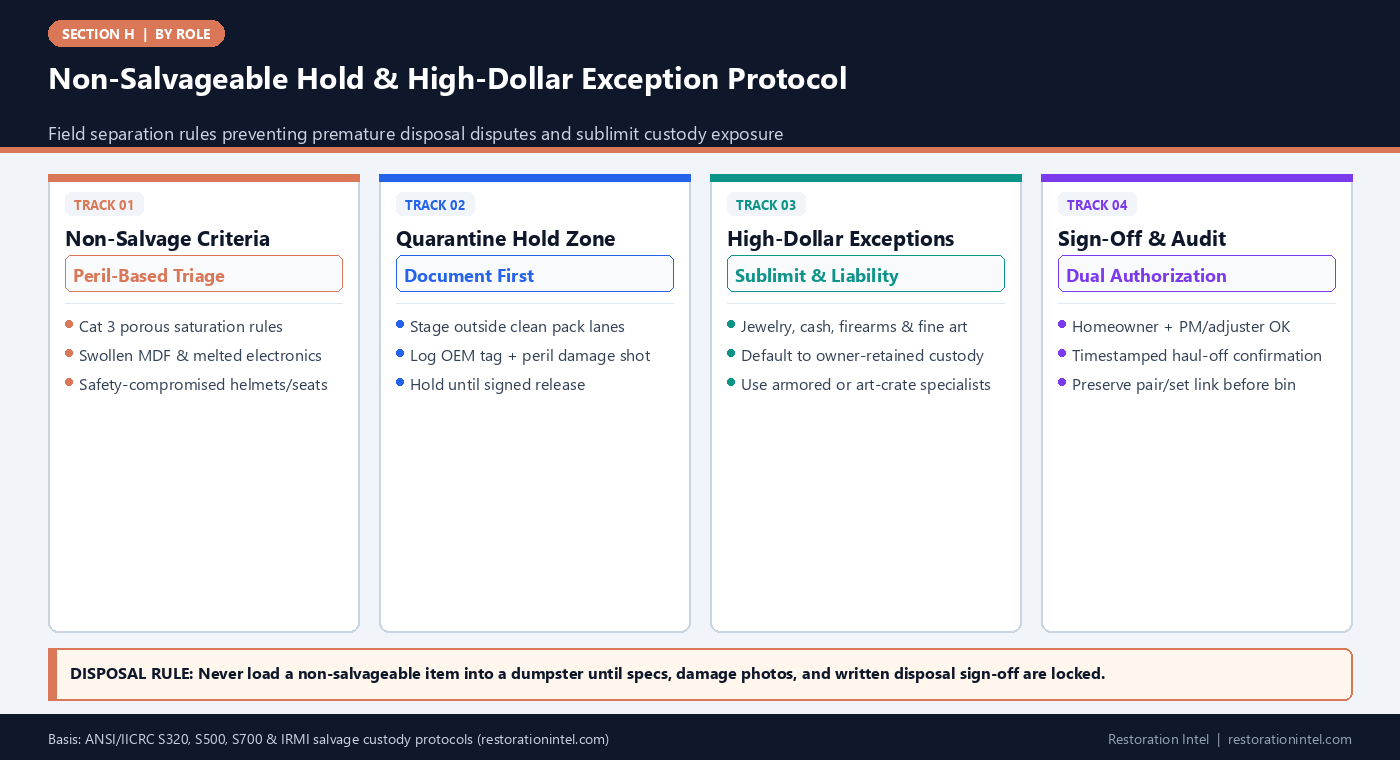
Field Triage & Custody Matrix for Non-Salvageable and High-Dollar Exceptions
Crew Leads route condemned items and high-liability assets through distinct holding, documentation, and sign-off gates.
| Item or Risk Class | Primary Peril Trigger | Field Action & Staging | Required Proof Before Movement | Custody & Sign-Off Rule |
|---|---|---|---|---|
| Porous Cat 3 Goods (Mattresses, Rugs, Upholstery) | Sewage or floodwater saturation per S500 | Quarantine in outdoor or poly-lined hold zone; do not load on clean vault truck | Room context, saturation height, OEM/brand tag, quantity count | Written homeowner and adjuster/PM disposal release before haul-off |
| Swollen Particleboard & Melamine Furniture | Water wicking, delamination, structural sag | Tag Non-Salvageable in place or move to hold zone; strip intact hardware/glass if needed | Close-up of seam swelling, core separation, overall dimensions | Signed total-loss inventory sheet before demolition dumpster load |
| Heat-Warped Appliances & Soot-Corroded Electronics | High-heat char, melted wiring, acidic soot per S700 | Unplug, keep isolated from dry goods; never test-power damaged units | Sharp rating-plate macro, thermal warp photo, cord/plug condition | Hold for electronics vendor bench check or written adjuster disposal approval |
| Safety-Critical Gear (Car Seats, Helmets, Med Devices) | Impact, smoke exposure, water immersion, heat | Flag manufacturer/safety replacement rule; segregate from usable children's gear | Manufacturer date label, model tag, peril exposure context | Notify owner immediately; document destruction/strap-cut only after release |
| Jewelry, Bullion, Cash, Negotiable Instruments | Any peril (theft/sublimit liability) | Do NOT pack in standard cartons; photograph in place only if owner present | Item count & sealed tamper-bag inventory if emergency evacuation forced | Default to homeowner-retained custody with signed exclusion receipt |
| Firearms, Ammunition & Regulated Collectibles | Any peril (federal/state transfer rules) | Do NOT handle loaded firearms or load ammunition on standard box truck | Threshold photo only; call owner, licensed FFL, or law enforcement escort | Owner retains direct custody or arranges licensed FFL transfer |
| Fine Art, Antiques, Wine & Server Hardware | High dollar (> $2,500/unit) or fragile calibration | Pause standard crew lift; isolate room access and log environmental specs | Dimensioned front/back/signature shots, frame/canvas damage macro | Escalate to PM for art handler crating, climate wine transport, or IT imaging |
Field Criteria for Non-Salvageable Calls Without Cross-Contamination
Field technicians are not insurance adjusters, so they never declare ‘coverage denied’ or promise policy payouts. What they do evaluate on site is physical cleanability and health safety under ANSI/IICRC S320, S500, and S700. Certain items cross an objective physical line: porous upholstery, mattresses, pillows, and carpets saturated by Category 3 sewage or floodwater, as outlined in IICRC Cat 3 Contents Pack-Out Protocol; delaminated particleboard shelving; opened food and cosmetics exposed to smoke or water; and heat-deformed plastics or electronics.
Equally clear are life-safety exclusions where cleaning cannot restore certified protection. Child safety seats exposed to fire heat, water immersion, or falling debris; bicycle and motorcycle helmets; expired or contaminated CPAP/respiratory tubing; and smoke-damaged child cribs belong on the non-salvageable exception list regardless of exterior appearance.
Once an item is flagged non-salvageable, physical separation must happen immediately. Leaving wet, sewage-soaked cushions or sour protein-fire plastics inside the same staging garage as cleanable boxed heirlooms transfers odor and microbial spores straight onto restorable goods.
- Clean-truck boundary: Never load condemned Cat 3 or visibly moldy waste onto the same enclosed box truck carrying restorable vaults.
- Safety-gear rule: Flag child car seats, crash helmets, life vests, and medical respiratory supplies for specialist/manufacturer replacement evaluation.
- Opened consumables check: Group opened pantry goods, spices, cosmetics, and medications for transparent lot photography before disposal approval.
The Quarantine Hold Zone: Document-Before-Disposal Discipline
The single most expensive mistake a pack-out crew can make during emergency mitigation is tossing ruined items into a roll-off dumpster before they are counted, measured, and photographed. Even when a sofa is visibly soaked in raw sewage, the policyholder still needs an accurate line-item total-loss schedule to collect ACV and RCV benefits—and the carrier still has the right to inspect salvage or verify damage under IRMI salvage terms.
To balance urgent health-hazard removal with evidence preservation, Crew Leads establish a marked Quarantine Hold Zone—either on poly sheeting in the driveway, a garage bay, or a fenced staging pad. Every non-salvageable item gets staged in logical rows, tagged with its origin room, photographed for brand/material/dimensions/damage, and entered onto the Non-Salvageable Schedule.
Haul-off happens only after two checks clear: (1) the Crew Lead or estimator confirms photo quality and item counts are complete, and (2) the project manager delivers written homeowner and adjuster authorization (or documented emergency health-hazard protocol if local code bars holding bio-waste overnight).
- Driveway poly layout: Space held items on clean plastic sheeting rather than piling them in a crushed heap so every model tag and chair leg remains countable.
- Lot-count photos: For discarded clothing, pantry cans, or ruined toys, lay items out in countable rows of five or ten before shooting.
- Timestamped disposal receipt: Take one final overview shot of the signed release sheet beside the cleared hold zone at haul-off.
High-Dollar, Sublimited, and Liability-Restricted Assets
Standard pack-out insurance and warehouse vault coverage are built for household goods, not six-figure watch collections, rare firearms, or fine art on stretcher bars. Many homeowner policies cap theft or unscheduled loss on jewelry, furs, silverware, firearms, and cash at narrow sublimits. When a field tech drops an unscheduled diamond bracelet or antique revolver inside a random bedroom carton, the restoration company inherits massive uninsured custody liability.
The Crew Lead must train every helper on a strict ‘Hands-Off and Escalate’ rule for restricted categories: cash, coins, jewelry, watches, prescription narcotics, firearms, ammunition, legal titles, original art over $2,500, wine collections, and business servers. Whenever the owner is on site, leave those assets in place, photograph them only with the owner standing beside them if necessary for condition proof, and have the owner remove them under a signed exclusion log.
If a home is uninhabitable and an owner cannot take immediate possession of fine art, grand pianos, or delicate antiques, pause packing on those pieces and notify the project manager to dispatch custom wood-crating specialists, climate-controlled transport, or certified art handlers.
- Jewelry & cash rule: Never box loose cash, bullion, watches, or fine jewelry into standard warehouse vaults; transfer directly to the owner with a signed receipt.
- Firearms & ammo lock: Do not clear chambers, pack loaded weapons, or transport ammunition in crew vans; require direct owner custody or licensed FFL pickup.
- Fine-art pause: Flag unframed canvases, brittle gilt frames, heavy marble sculpture, and grandfather clocks for dedicated specialty crating.
Managing Multi-Party Authorization and Exception Logs
High-stress losses often involve conflicting voices—a frantic homeowner demanding that ruined furniture leave the driveway immediately, a mitigation crew needing floor space cleared for air movers, and a desk adjuster who has not yet visited the property. The Crew Lead protects everyone by keeping exception paperwork crystal clear and non-adversarial.
Use a dedicated Non-Salvageable & High-Dollar Exception Form separate from the clean pack-out manifest. Every line lists the origin room, item description, physical reason for non-salvage recommendation or special handling, photo IDs, and clear signature blocks for the homeowner and project manager. Explaining to the homeowner that documenting the sofa for ten minutes protects their full replacement check turns impatience into cooperation.
Back at the warehouse, any high-dollar restorable item that *is* packed under written authorization—such as a designer handbag routed for specialty fire deodorization—travels in a numbered, tamper-evident security tote carried in the truck cab or locked security cage rather than general pallet vaults.
- Separate exception ledger: Never bury condemned items or high-dollar valuables inside generic clean-box manifests; track them on dedicated sheets.
- Tamper-evident high-value totes: Seal authorized high-value restorable items in numbered security totes logged by two crew members at pickup and dock check-in.
- Emergency bio-waiver backup: When sewage health hazards force same-day haul-off before an adjuster arrives, capture double macro documentation plus PM written sign-off.
Practitioner Verification Checklist (H-13)
- Isolate all non-salvageable porous, swollen, or bio-contaminated goods in a dedicated hold zone separate from clean pack-out lanes.
- Capture full room context, brand/model tags, dimensions, and peril damage photos for every non-salvageable item prior to disposal.
- Obtain documented homeowner and project manager/adjuster authorization before loading any condemned item into a dumpster or haul-off truck.
- Enforce immediate owner retention or specialist escalation for cash, jewelry, firearms, ammunition, fine art, and business servers.
- Log all authorized high-value restorable transfers in tamper-evident security totes with dual-signature pickup and warehouse dock verification.
Standards, Authority References & Related Reading
Primary standards, insurance definitions, and sibling Restoration Intel guides referenced in this brief:
- ANSI/IICRC S320 Standard for Professional Contents Restoration
- ANSI/IICRC S500 Water Damage Standard
- ANSI/IICRC S700 Fire & Smoke Restoration Standard
- IRMI Insurance Glossary: Salvage
- Related Guide: Field Contents Technician & Pack-Out Crew Lead: Pricing, LKQ Sourcing & Valuation Defensibility
- Related Guide: Field Contents Technician & Pack-Out Crew Lead: Quality Assurance Review & Pre-Submission Audit
- Related Guide: Restoration Project Manager & Contents Division Lead: Handling Non-Salvageable Lists & High-Dollar Exceptions
- Related Guide: IICRC Cat 3 Contents Pack-Out Protocol
- Related Guide: Contents Restoration After Fire: Pack-Out Protocols, Cleaning Methods, and Insurance Inventory
.md twin for desk QA and team training.Frequently Asked Questions
Can a pack-out crew throw away sewage-soaked rugs immediately if the homeowner asks?
Only after documenting item count, approximate size, material, and saturation damage in a hold zone and capturing written homeowner and PM/adjuster disposal sign-off so the claim schedule remains defensible.
What should technicians do if they find cash, jewelry, or a handgun in a dresser drawer?
Stop packing that drawer immediately, keep hands off firearms and ammunition, alert the Crew Lead and homeowner, and document direct transfer to the owner on a signed exclusion log.
Why are child car seats and bike helmets listed as non-salvageable after smoke or water exposure?
Safety equipment manufacturers and testing standards warn that heat, smoke chemicals, and water immersion can weaken webbing, foam liners, and latches in ways invisible to surface cleaning.
How should high-value restorable items travel if the homeowner authorizes pack-out?
Place authorized high-value items into numbered, tamper-evident security totes verified by two crew members, and store them in a locked security cage at the warehouse rather than general pallet racks.