Direct Answer: Although desk estimators research retail comps and build final schedules, field technicians and crew leads control valuation defensibility by capturing four physical proof anchors—OEM model identifiers, construction materials, measured dimensions, and pre-loss condition—plus accurate handling complexity and pair-or-set relationships before items are packed or discarded.
.md twin for estimator QA and carrier file documentation.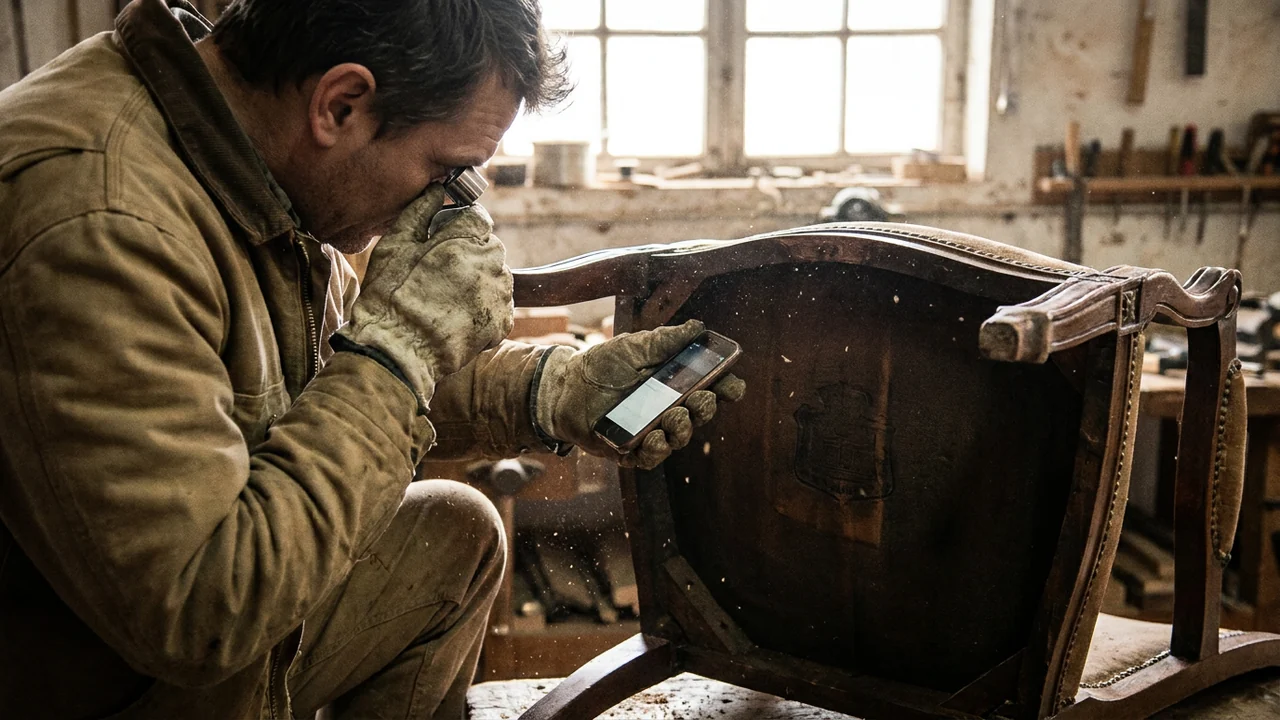
Ask a field technician about Like-Kind-and-Quality (LKQ) pricing and the common answer is, ‘That’s the estimator’s job.’ Technically, selecting retail comparable SKUs inside XactContents or Symbility happens at a desk. Yet in real claim disputes, eighty percent of LKQ pricing haircuts happen because the field crew failed to capture the physical evidence required to separate a $3,200 solid walnut dining table from a $390 printed-veneer big-box lookalike.
When an adjuster audits a contents schedule, unsubstantiated line items get defaulted to entry-level retail pricing. Without clear macro proof of dovetail joinery, triple-ply stainless cookware, commercial power-tool brushless motors, or custom window drapery pleating, even the sharpest estimator cannot defend mid-to-upper replacement tiers—and the policyholder pays the difference out of pocket.
Field crews also directly influence how labor and salvage economics hold up under ANSI/IICRC S320 and IRMI salvage principles. Documenting true item quality prevents cleanable heirloom goods from being misclassified as cheap disposables—and prevents pack-out handling fees from being trimmed when heavy, fragile, or multi-piece assets demand extra crew time.
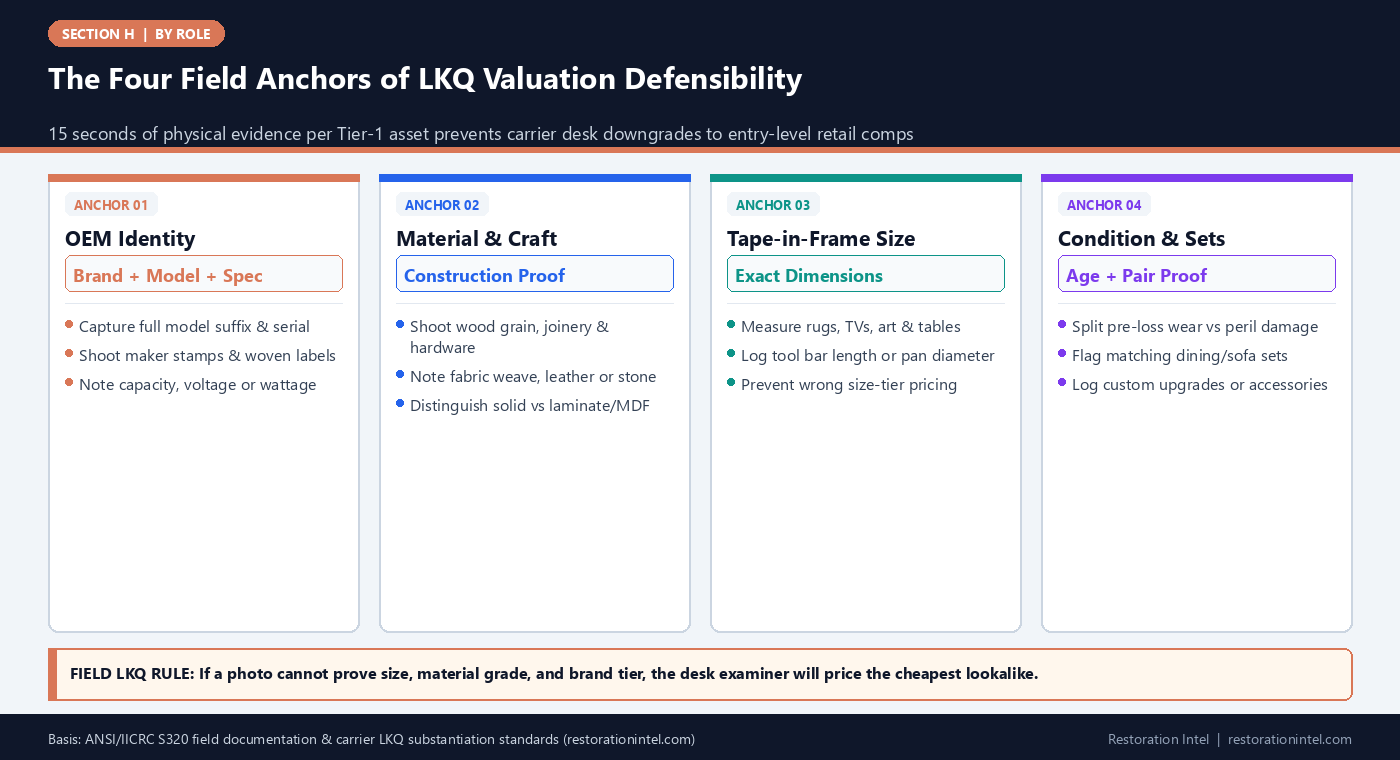
The Four Field Anchors of LKQ Valuation Defensibility
Field Evidence Requirements to Defend LKQ Tiers Across Common Goods
Specific visual and measurement details field crews must capture on site so estimators avoid default low-tier retail replacements.
| Asset Type | Low-Tier Default Risk Without Proof | Field Evidence Anchor to Capture | Estimated Capture Time | Impact on Claim Scope |
|---|---|---|---|---|
| Sofas, Chairs & Case Goods | Flat-pack veneer or polyester promotion grade | Under-cushion woven maker tag, drawer dovetail/slide joint, leg attachment, tape width/depth | 20 seconds | Defends solid hardwood/top-grain leather LKQ and justifies specialized wood refinishing |
| Area Rugs & Window Coverings | Machine-made synthetic mat or basic vinyl blinds | Corner underside weave/knot density, fiber content tag, blackout lining, tape measure length x width | 20 seconds | Separates hand-knotted wool/custom lined drapery from off-the-shelf replacements |
| Kitchen Small Appliances & Cookware | Generic plastic countertop unit or thin aluminum set | Base rating plate, tri-ply/copper rim edge shot, blade/motor wattage spec, full piece count | 15 seconds | Justifies prosumer stainless and heavy-duty motor tiers plus ultrasonic cleaning |
| Televisions & Audio Gear | Base LED model at minimum screen size | Rear model label showing exact series code (OLED/QLED/4K), diagonal check, mounted bracket/soundbar | 15 seconds | Prevents multi-hundred-dollar model-series drops inside electronics schedules |
| Power Tools & Workshop Gear | Brushed consumer DIY combo kit | Battery platform voltage/Ah, brushless badge, chuck/blade size, model plate on motor housing | 15 seconds | Protects contractor-grade brushless pricing and keeps charger/battery kits paired |
| Musical Instruments & Hobby Gear | Student starter bundle | Internal sound-hole label or headstock serial, case grade, bow/optic/lens markings | 25 seconds | Triggers high-value specialty appraisal routing rather than generic toy/sporting pricing |
Why LKQ Defensibility Is Won or Lost Before the Truck Rolls
Desk examiners review dozens of contents schedules every week, and their default defense against inflated claims is simple: if a line item lacks objective proof of brand, material, or size, adjust it down to standard big-box replacement cost. As noted in A Pack-Out Record Is Not a Priced Inventory, estimators cannot manufacture quality details in the office after a box truck has driven off or a disposal crew has emptied a basement.
Field technicians do not need to memorize retail price lists to protect valuation accuracy. They simply need to capture what makes an item demonstrably different from its cheapest cousin. A close-up showing mortise-and-tenon oak joinery, forged full-tang knife bolsters, or a stitched hand-tufted rug backing takes ten seconds on site and gives the estimator undeniable proof for higher-tier LKQ sourcing.
Equally critical is documenting accessories and modular components while they are still attached or grouped together. A high-end stand mixer photographed with its stainless pasta roller, grain mill, and extra bowl tells a completely different valuation story than an unlabeled mixer body sitting alone on a vault shelf.
- Four-anchor habit: For every asset estimated over $250, verify the photo stack shows brand/model, material detail, dimension scale, and condition.
- Hidden-tag check: Look inside coat linings, under tabletops, inside drawer side rails, and on the underside of pottery or lamp bases for maker marks.
- Kit & attachment grouping: Photograph vacuums, camera bodies, food processors, and power tools with their full attachment sets laid out together.
Tape-Measure Discipline, Material Proofs, and Pre-Loss Condition Evidence
Human eyes and wide-angle phone lenses distort scale constantly. A ten-by-fourteen-foot wool rug shot from a corner doorway can easily look like an eight-by-ten mat to a desk reviewer, and a twenty-four-inch commercial monitor looks identical to a thirty-two-inch ultrawide display without scale reference. Keeping a high-contrast locking tape measure or folding scale stick clipped to every tech’s belt solves scale ambiguity permanently.
Material close-ups carry just as much weight as dimensions when OEM labels have worn off or never existed. Custom upholstered sofas, built-in bookcases, boutique lighting fixtures, and solid stone serving pieces rarely have printed barcodes. A crisp macro shot of solid marble veining, heavy cast-brass hinges, hand-blown glass pontil marks, or heavy-gauge stainless stamping anchors the quality tier cleanly.
Condition documentation cuts both ways and builds massive credibility with desk examiners. Recording honest pre-loss wear—such as minor sofa arm pilling or an existing scratch on a dining leaf—proves the crew is not hiding pre-loss depreciation, while sharply framing fresh soot pitting, water delamination, or thermal warping tied directly to the loss.
- Tape-in-frame standard: Lay a readable tape measure across rug widths, framed artwork, shelving spans, and television bezels when model labels are absent.
- Underside & edge macro: Shoot edge thickness on tabletops, stone slabs, and cookware rims so veneer/hollow-core cannot be confused with solid stock.
- Honest wear notes: Log pre-existing scratches or faded sun-bleaching separately from fresh peril staining to establish fair depreciation baselines.
Protecting Pack-Out Labor, Specialty Handling, and Restoration vs. Replacement Math
Valuation defensibility is not limited to replacement prices on total-loss goods; it also governs whether the carrier approves the real cost of packing, transporting, and cleaning restorable contents. As highlighted in The Hands Were Always the Bottleneck, a large share of contents margin leaks away when crews fail to log why a room took twice the standard carton hours.
Under ANSI/IICRC S320 and RIA estimating expectations, specialty labor requires visual justification. If a technician spends forty-five minutes wrapping a multi-tier crystal chandelier or building a custom cardboard-and-foam cradle for an oversized oil painting, one before-and-after packing photo plus an elapsed-time note transforms an adjuster question into an approved line item.
Field notes also inform the restore-versus-replace threshold before money is wasted cleaning unrecoverable items. Capturing a crisp brand/model shot alongside clear evidence of swollen particleboard or corroded circuit boards lets the estimator compare cleaning cost against verified LKQ value immediately.
- Specialty pack-time proof: Photograph custom-crated glass, multi-arm chandeliers, and heavy stone tops mid-wrap with dimensions noted.
- Material-count log: Track exact mirror packs, wardrobe cartons, dish packs, and heavy-duty pads used per room rather than estimating from memory at shop.
- Early clean-vs-replace flag: Alert the estimator on site when low-cost particleboard furniture or heavily corroded smalls will cost more to pack and clean than replace.
Capturing Pair-or-Set Dependencies and Avoiding Valuation Traps
One of the most overlooked field details is documenting matched sets before pack-out separates them across different vaults or between restoration and disposal piles. When two of eight custom dining chairs suffer catastrophic soot or sewage saturation while six remain cleanable, or when one speaker in a matched studio pair melts, the policy’s pair-or-set handling depends on proving all pieces belonged to a unified, matched ensemble.
Field crews should photograph complete sets together in place—full dining tables surrounded by all chairs, matching bedside lamps, modular sectional pieces locked together, and matched luggage nested in sequence—before separating any single unit into a non-salvageable hold zone. Recording ‘Chair 1 and 2 of 8-piece matched set’ inside both the hold log and the clean-pack manifest keeps the estimator and adjuster aligned.
Finally, crews must avoid verbal price guessing inside official logs. Writing ‘Homeowner says vase worth $4,000’ inside a field capture note hurts credibility when an appraiser later values it at $350, or vice versa. Record physical markings, signatures, provenance labels, and measurements strictly as observable facts, and let the desk or licensed appraiser establish dollar figures.
- Group-shot before split: Always photograph matched chairs, lamps, stereo speakers, and china place settings as complete sets before separating damaged units.
- Zero unverified dollar guesses: Never enter verbal owner price estimates into custody descriptions; log objective specs, signatures, and receipts if offered.
- Provenance & receipt photo: If a policyholder hands over original purchase invoices or appraisal certificates on site, scan or photograph them cleanly into the claim folder.
Practitioner Verification Checklist (H-12)
- Capture all four valuation anchors (OEM tag, material close-up, tape-in-frame dimensions, and condition state) on every asset over $250.
- Keep a high-contrast tape measure on every packing belt to document sizes for rugs, art, flat-screens, tools, and custom drapery.
- Photograph matched sets (dining chairs, lamps, modular sofas, luggage, stereo pairs) together before separating salvageable and non-salvageable pieces.
- Log exact specialty packing materials, custom crating dimensions, and heavy-lift labor conditions with mid-pack photo proof.
- Record strictly observable physical attributes and provenance documents without guessing unverified dollar values in field notes.
Standards, Authority References & Related Reading
Primary standards, insurance definitions, and sibling Restoration Intel guides referenced in this brief:
- ANSI/IICRC S320 Standard for Professional Contents Restoration
- Verisk XactContents Platform Overview
- IRMI Insurance Glossary: Salvage
- Restoration Industry Association (RIA)
- Related Guide: Field Contents Technician & Pack-Out Crew Lead: Team Handoff Between Field Capture and Desk Estimating
- Related Guide: Field Contents Technician & Pack-Out Crew Lead: Handling Non-Salvageable Lists & High-Dollar Exceptions
- Related Guide: Restoration Project Manager & Contents Division Lead: Pricing, LKQ Sourcing & Valuation Defensibility
- Related Guide: A Pack-Out Record Is Not a Priced Inventory
- Related Guide: The Hands Were Always the Bottleneck
.md twin for desk QA and team training.Frequently Asked Questions
Why should field techs carry a tape measure if they aren't estimating prices?
Because wide-angle photos distort size. A tape measure in the frame proves exact dimensions for rugs, artwork, unbranded furniture, and tools so the estimator can select the true Like-Kind-and-Quality tier.
What should a technician do when an antique or custom furniture piece has no brand label?
Photograph overall proportions with a tape measure, then shoot macro close-ups of wood grain, drawer dovetails, hardware stamps, underside markings, and fabric weave so the estimator or appraiser can substantiate custom craftsmanship.
Should crew leads write down dollar values the homeowner quotes during pack-out?
No. Record physical attributes, signatures, and copies of any receipts or appraisals the owner shares, but avoid logging unverified verbal dollar estimates in custody records.
How do field crews protect pair-or-set claims during triage?
Take a group photo of the full matched set in situ before separating damaged units, and explicitly note the total piece count (such as ‘2 of 6 matching chairs’) in both the clean pack log and non-salvageable list.