Direct Answer: Contents Estimators manage non-salvageable lists and high-dollar exceptions by anchoring every condemnation to ANSI/IICRC S320 economic or contamination criteria, isolating total-loss schedules cleanly from restoration labor invoices, and routing sublimited or specialty assets through structured exception holds prior to disposal.
.md twin for estimator QA and carrier file documentation.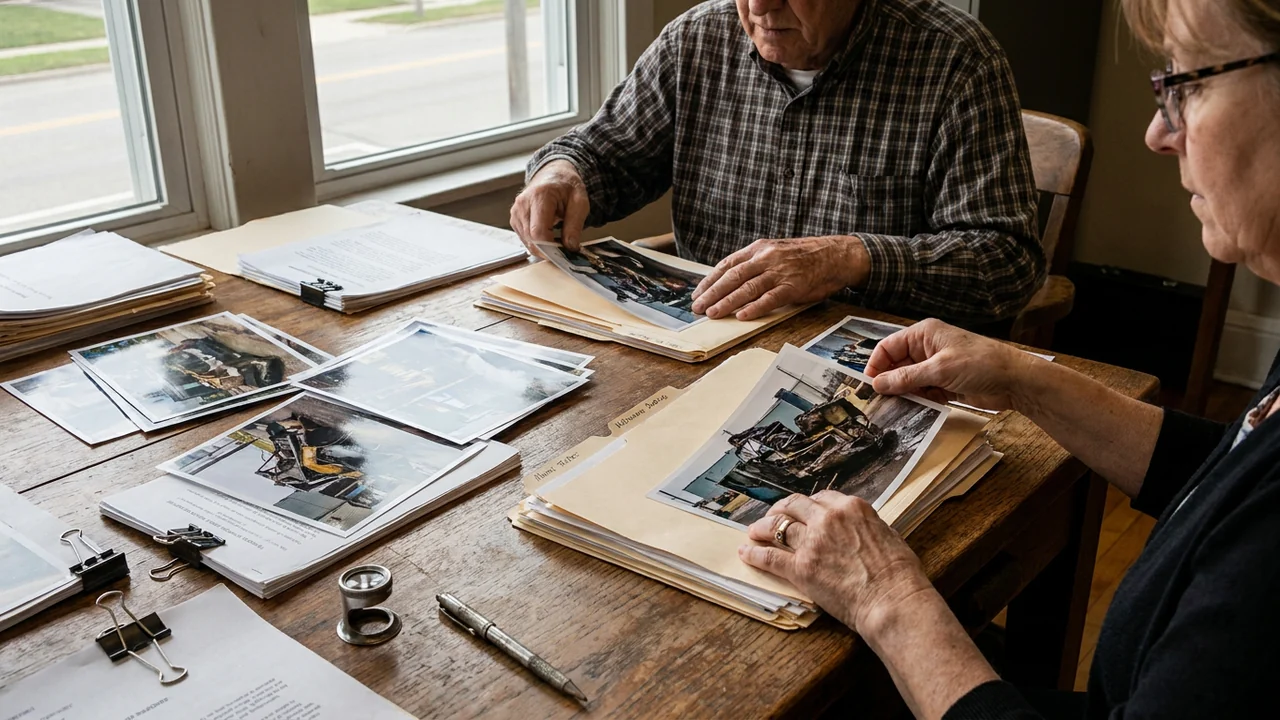
Non-salvageable schedules and high-dollar exceptions are where contents claim packets encounter the sharpest carrier resistance. Standard everyday clean-and-return items rarely stall settlement once chain of custody is clean, but a single disputed $18,000 commercial sewing machine, a condemned Category 3 mattress batch, or a blended spreadsheet mixing cleaning labor with total-loss RCV can freeze payment across an entire file.
Under ANSI/IICRC S320 principles, an item belongs on a non-salvageable list for one of two objective reasons: physical/hygienic non-restorability (such as porous materials saturated by Category 3 sewage or charred beyond structural integrity) or economic infeasibility, where the documented cost to pack, clean, deodorize, and return an item approaches or exceeds its Replacement Cost Value (RCV). The Contents Estimator and Claim Packet Specialist translates those field triage calls into structured, audit-proof sub-schedules.
High-dollar exceptions require an equally disciplined workflow. Jewelry, fine art, firearms, silverware, musical instruments, commercial inventory, and matched luxury sets often trigger policy sublimits, pair-or-set clauses, or specialist inspection requirements. Isolating exceptions cleanly keeps routine claim lines moving while protecting high-value recovery.
Non-Salvageable & High-Dollar Exception Routing Workflow
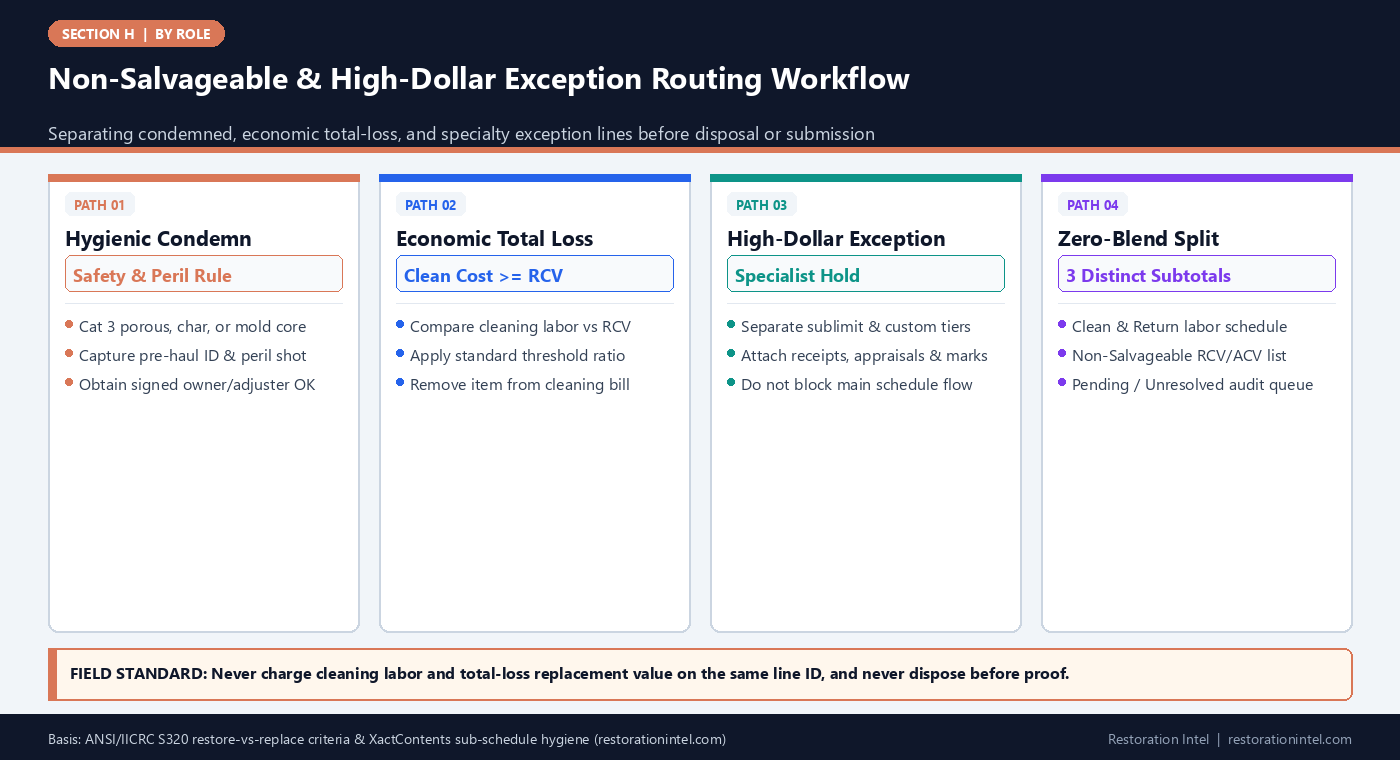
Non-Salvageable & High-Dollar Exception Decision Matrix
How the Contents Estimator classifies, proves, and routes non-routine assets inside the claim packet.
| Exception Category | Condemnation / Routing Trigger | Mandatory Proof Before Action | Packet Placement | Critical Error to Avoid |
|---|---|---|---|---|
| 1. Hygienic / Structural Total Loss | Cat 3 sewage saturation, deep char, melted plastics, or toxic chemical contact | Overview location shot + close-up damage + brand/model tag + signed disposal log | Non-Salvageable Sub-Schedule (RCV/ACV) | Hauling debris before capturing size, brand, and pre-loss quality tier |
| 2. Economic Total Loss | Estimated pack-out, cleaning, deodorization, and storage exceeds practical RCV threshold | Side-by-side cleaning estimate vs verified LKQ replacement price note | Non-Salvageable Sub-Schedule + zero cleaning fee | Billing pack-out/cleaning labor AND claiming RCV on the same item |
| 3. Specialty Sublimit Assets | Jewelry, watches, firearms, silverware, furs, fine art, currency, or business stock | Macro front/back photos, maker marks, serial numbers, and owner appraisals/receipts | Flagged Exception Schedule (Sublimit-Sensitive) | Burying high-value collectibles inside generic 'Bedroom Box' rows |
| 4. Commercial / Technical Equipment | POS systems, lab gear, dental/medical tools, CNC/shop machinery, server racks | Rating plate, serial, OEM technician diagnostic report, and calibration loss note | High-Dollar Commercial Exception Packet | Declaring specialized equipment salvageable without OEM warranty verification |
| 5. Matched Sets & Antiques | Partial damage to discontinued china, sectional upholstery, or heirloom furniture | Intact + damaged piece photos, maker stamp, and set-availability check | Exception / Pair-or-Set Review Tab | Discarding damaged piece before adjuster inspects matched remaining set |
| 6. Disputed / Borderline Items | Items where field crew and homeowner disagree on restorability or sentimental risk | Neutral condition photos, S320 restoration feasibility note, and pending flag | Pending / Unresolved Queue (Hold for Sign-Off) | Making unilateral disposal calls or padding cleaning scope without approval |
Proving Non-Salvageability Through Objective Thresholds and Pre-Disposal Evidence
Saying an item was ‘ruined by smoke’ or ‘soaked in water’ is not enough to satisfy a desk examiner reviewing a $45,000 non-salvageable list weeks after demolition. Every condemned line must carry objective justification rooted in either physical/hygienic peril standards or transparent restore-versus-replace economics.
For hygienic condemnations—such as mattresses, box springs, upholstered particleboard furniture, and open paper goods exposed to Category 3 sewage or toxic chemical residues—the estimator ensures the field record links the room’s peril classification directly to the affected porous lines. Before disposal occurs, the packet must hold two non-negotiable visual proofs: context showing the item damaged in place, and close-up identification establishing its dimensions, material grade, and brand/model where legible.
For economic total losses, the estimator runs a clean mathematical test inside XactContents or the working workbook: when pack-out, specialty cleaning, ozone/thermal deodorization, and storage costs exceed a defensible percentage of current LKQ RCV (commonly 60 to 80 percent depending on carrier guidelines and depreciation risk), recommending replacement saves the claim money. Documenting that side-by-side comparison turns a subjective opinion into an easy adjuster approval.
- Pre-disposal gatekeeper: Confirm photo completeness and written owner/adjuster release before authorizing haul-off on non-salvageable items.
- Economic math note: Show projected cleaning cost alongside verified RCV whenever condemning borderline restorable goods.
- Zero double-dipping: Audit every condemned line to confirm any emergency stabilization or handling charge is either justified separately or stripped from restoration billing.
Segregating Total-Loss, Cleanable, and Pending Piles With Zero Overlap
One of the four core rules highlighted in A Pack-Out Record Is Not a Priced Inventory is strict separation between items destroyed, items to be cleaned and returned, and items still awaiting a decision. Blending all three dispositions into a single undifferentiated spreadsheet forces adjusters to untangle the math manually—and usually triggers a blanket hold on the entire invoice.
The Contents Estimator structures the claim packet into mutually exclusive sub-schedules linked by unique Item IDs. Sub-schedule A carries clean-and-return contents tied to pack-out custody and Xactimate restoration line items. Sub-schedule B carries verified non-salvageable items with LKQ RCV, depreciation inputs, and disposal confirmation.
Sub-schedule C holds borderline or diagnostic-pending items—such as electronics awaiting bench testing or HVAC-exposed appliances awaiting manufacturer clearance—so uncertain items never stall undisputed payouts on the rest of the file.
- Mutually exclusive Item IDs: Ensure zero line ID appears on both the cleaning invoice and the total-loss RCV schedule.
- Distinct summary totals: Present separate subtotals for Restoration Scope, Non-Salvageable RCV/ACV, and Pending Diagnostics.
- Cross-referenced custody: Keep disposal manifests and warehouse box tags mapped to the exact same Item ID tree.
Managing High-Dollar Exceptions, Sublimits, and Specialist Appraisals
High-dollar exceptions require specialized handling precisely because standard retail web searches fail on them. A 19th-century oil painting, a custom commercial espresso bar, a grand piano with smoke infiltration, or a firearm collection cannot be priced accurately with generic catalog entries—and trying to force them into standard lines creates immediate valuation disputes.
When intake or field capture flags a high-dollar asset, the estimator pulls it into an Exception Tracking Log without delaying the baseline household or office schedule. The packet captures high-resolution maker marks, serial numbers, provenance notes, existing appraisals, and—where cleaning or repair might void OEM warranties—written diagnostics from an authorized service center.
For categories commonly subject to policy sublimits, the estimator labels them clearly by asset class (jewelry, silverware, fine art, tools/business property) so the adjuster can apply policy-level caps accurately without requesting a full file re-sort.
- Decouple exceptions from baseline flow: Submit the verified main contents schedule promptly while flagging high-dollar items as Pending Appraisal/OEM Review.
- Warranty & calibration proof: Obtain written OEM or certified repair-tech statements before condemning commercial or medical gear.
- Preserve damaged remnants: Hold high-value damaged parts in secure custody until the adjuster or specialty appraiser completes inspection.
Coordinating Disposal Releases and Salvage Transparency
Premature disposal is one of the fastest ways to lose a contents dispute. If an insured or carrier questions why an $8,000 sectional or commercial refrigeration unit was discarded without inspection, a missing release signature leaves the contractor exposed.
Before any non-salvageable list moves to final haul-off, the estimator verifies that the packet includes timestamped in-place damage photos, clear identification evidence, a written non-salvageable itemization, and documented sign-off according to the carrier’s and property owner’s authorization rules. Where an item retains salvage or scrap value—such as commercial stainless fixtures or undamaged components—the estimator flags it cleanly for adjuster salvage-direction instructions rather than assuming ownership.
Building this release discipline into the claim packet protects both margin and reputation, aligning the team with the approval standards outlined in Which Xactimate Line Items Do Adjusters Actually Approve?.
- Signed non-salvageable authorization: Pair every disposal manifest with itemized IDs and photo proof before dumpster loading.
- Adjuster hold window: Respect carrier inspection holds on high-dollar condemned assets until written release is logged.
- Salvage disclosure note: Explicitly document any item with potential third-party salvage recovery so the carrier directs disposition.
Practitioner Verification Checklist (H-21)
- Anchor every non-salvageable line to either objective S320 hygienic/structural peril proof or a side-by-side cleaning-cost vs. LKQ RCV comparison.
- Verify pre-disposal context photos, rating plates, and written owner/adjuster release before any condemned asset leaves the property.
- Maintain strict mutual exclusivity across Clean-and-Return, Non-Salvageable RCV/ACV, and Pending/Diagnostic schedules with zero duplicate IDs.
- Isolate high-dollar, commercial, pair-or-set, and sublimit-sensitive items into a tracked Exception Log with maker marks and OEM/appraisal support.
- Preserve damaged high-value remnants in secure custody until carrier inspection or written salvage disposition instructions are received.
Standards, Authority References & Related Reading
Primary standards, insurance definitions, and sibling Restoration Intel guides referenced in this brief:
- ANSI/IICRC S320 Standard for Professional Contents Restoration
- IRMI Insurance Glossary: Replacement Cost Value (RCV)
- IRMI Insurance Glossary: Pair or Set Clause
- Verisk XactContents Platform Overview
- Related Guide: Contents Estimator & Claim Packet Specialist: Pricing, LKQ Sourcing & Valuation Defensibility
- Related Guide: Contents Estimator & Claim Packet Specialist: Quality Assurance Review & Pre-Submission Audit
- Related Guide: A Pack-Out Record Is Not a Priced Inventory
- Related Guide: Which Xactimate Line Items Do Adjusters Actually Approve?
- Related Guide: How Do I Write an Estimate in Xactimate?
.md twin for desk QA and team training.Frequently Asked Questions
When does a restorable item qualify as an economic total loss?
When the documented cost to pack out, clean, deodorize, store, and return the item—combined with residual wear or warranty risk—approaches or exceeds the current verified Like-Kind-and-Quality replacement cost.
Can a contractor bill pack-out and cleaning labor on an item also listed as total loss?
Generally no, unless specific emergency stabilization or authorized diagnostic teardown occurred prior to condemnation with documented approval. Routine cleaning labor and total-loss RCV on the same line ID will trigger immediate adjuster rejection.
How should high-dollar specialty items be handled if appraisals take extra time?
Isolate them into a dedicated Pending Specialist Valuation or Exception tab while submitting the completed baseline inventory, so undisputed household or business lines are not held hostage by one complex asset.
What documentation is mandatory before discarding non-salvageable contents?
Timestamped in-place damage photos, close-up brand/model/condition identification, an itemized non-salvageable list tied to room origin, and written disposal authorization from the property owner and/or adjuster.