Direct Answer: Custom millwork, architectural audio, and smart-home integrations lose tens of thousands of dollars in claims when lumped into generic cabinet or electronics allowances; owners protect true replacement cost by vaulting cabinet shop drawings, species/finish schedules, hidden rack wiring maps, and commissioning invoices before a loss.
.md twin for estimator QA and carrier file documentation.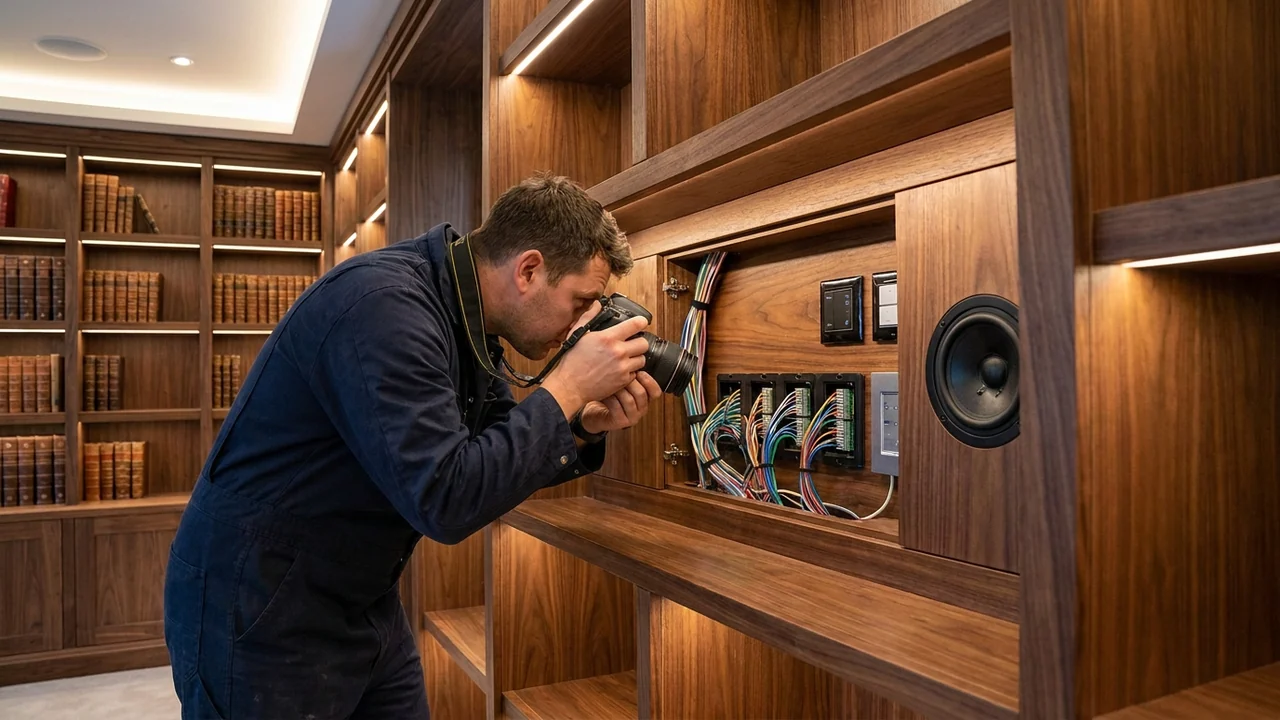
Custom architectural millwork, recessed architectural speakers, motorized shading, and centralized smart-home racks represent some of the most severely under-documented assets in residential and executive commercial properties. Because drivers sit behind paintable grilles, tubular motors sit inside ceiling pockets, and custom joinery hides inside closed drawers, ordinary room photos make bespoke craftsmanship look indistinguishable from stock builder-grade finishes.
Once smoke, water, or heat damages an integrated system, generic post-loss estimates routinely price bare commodity hardware while missing wood species, custom stain formulas, dealer rack-wiring engineering, and scene-programming labor. Preserving integrator invoices, CAD shop drawings, and configuration backups pre-loss protects genuine Replacement Cost Value (RCV) and Like-Kind Quality matching.
Just as important, tagging permanently affixed architectural elements separately from removable rack electronics helps structure and contents teams under ANSI/IICRC S320 keep scope boundaries clean while leaving formal coverage classification to licensed adjusters.
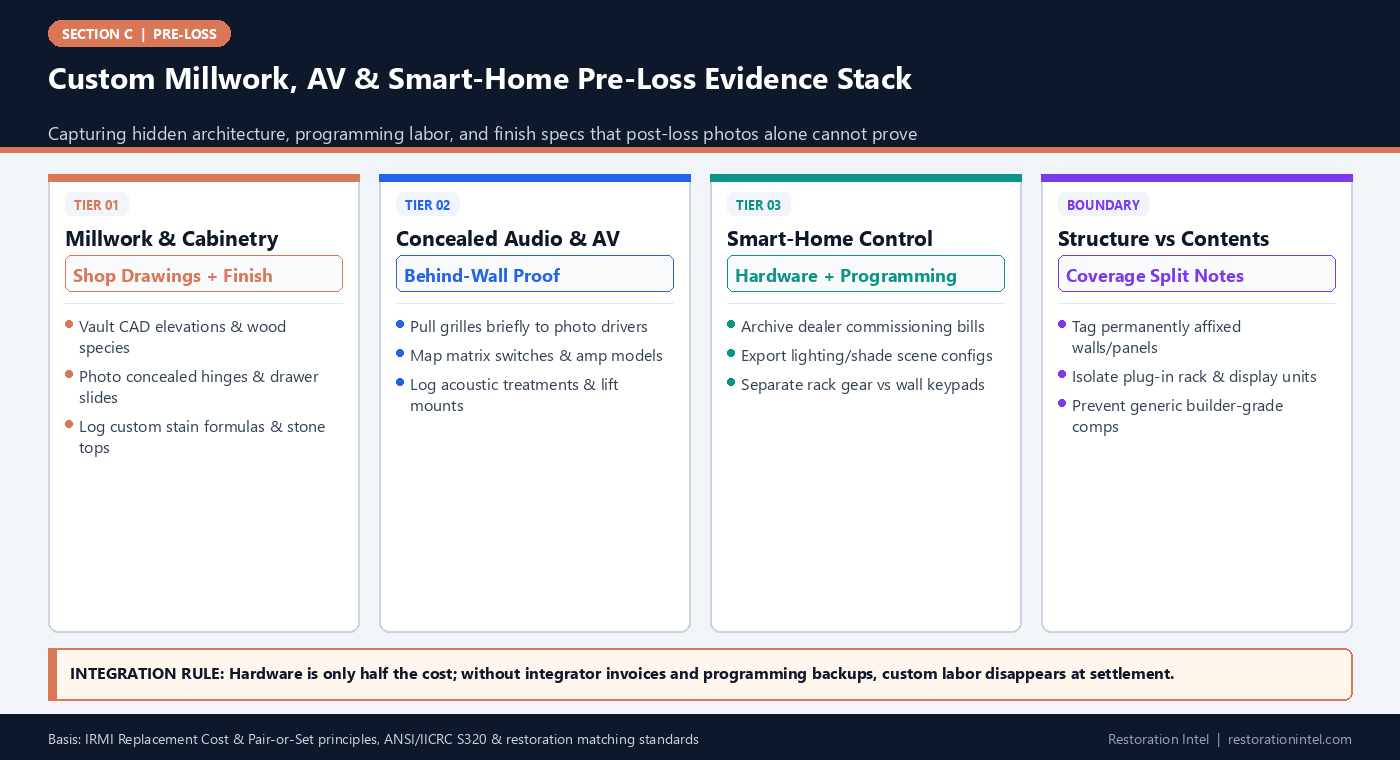
Custom Millwork, AV & Smart-Home Pre-Loss Evidence Stack
Custom Architectural & Smart-Integration Pre-Loss Documentation Matrix
Required pre-loss proof separating structural fixtures from portable equipment across custom woodwork, architectural AV, lighting control, and motorized shading systems.
| Custom System Category | Why Generic Post-Loss Photos Fail | Mandatory Pre-Loss Visual Capture | Paper / Digital Proof to Vault | Claim Boundary & Matching Watchout |
|---|---|---|---|---|
| 1. Custom Library, Closet & Kitchen Millwork | Charred or swollen wood obscures veneer grade, solid-core joinery, and custom hardware | Doors open showing dovetail boxes, soft-close hardware stamps, lighting strips, and grain detail | Cabinetmaker shop drawings, wood species/stain formula sheet, and final fabrication invoice | Prevent builder-grade box-store cabinet comps; note matched room-wide finish continuity |
| 2. In-Wall & In-Ceiling Architectural Speakers | Paintable grilles look identical from floor level whether drivers cost $150 or $2,500 | Temporarily pop magnetic grilles to photograph driver branding, back-boxes, and cutout serials | AV integrator invoice, speaker model schedule by room, and rough-in wiring diagram | Permanently recessed speakers often sit on structure side while amplifiers sit in contents |
| 3. Central AV Rack, Matrix & Network Gear | Melted or water-shorted black rack chassis lose front labels and rear port wiring maps | Front rack overview + rear-panel cable labels, UPS battery tags, and chassis serial stickers | Rack elevation PDF, dealer system summary, and active network/IP map backup | Separate rack-mounted removable electronics from structural low-voltage cabling in walls |
| 4. Lighting Control, Keypads & Dimmer Panels | Engraved wall keypads and centralized dimming enclosures look like plain switches to untrained eyes | Close-up of engraved keypad faceplates and open low-voltage lighting panel directory | Dealer lighting schedule, scene-programming backup file, and commissioning labor invoice | Re-programming labor after panel replacement is a major cost easily missed without invoices |
| 5. Motorized Shades & Automated Drapery | Hidden ceiling pockets conceal tubular motors, custom brackets, and sheer/blackout fabrics | Valance/pocket angle showing motor housing, control wire/RF tag, and fabric weave close-up | Window-by-window dimension sheet, fabric SKU, motor model, and integrator install receipt | Matched window-wall sets rely on dye-lot continuity and calibrated limit programming |
| 6. Home Theater Seating, Acoustic Panels & Projectors | Custom acoustic fabric wraps and motorized screen lifts appear as ordinary drywall or upholstery | Under-seat motor tag, projector mount plate, acoustic panel frame edge, and screen housing | Theater design layout, seating leather/motor tier invoice, and calibration report | Custom multi-seat row frames and paired acoustic treatments carry pair-or-set dependency |
Why High-End Millwork and Integrated Tech Get Priced Down to Commodity Tiers
After a fire or second-floor pipe burst, custom interiors suffer a double documentation penalty. Physically, water warps quartersawn oak paneling and shorts out hidden rack processors just as fast as particleboard and consumer soundbars. Evidentiary wise, generic wide-angle photos cannot distinguish custom architectural craftsmanship from stock retail hardware.
Without shop drawings or integrator invoices, an insurance desk reviewer sees ‘built-in bookcase’ or ‘ceiling speakers’ and substitutes standard builder-grade estimating allowances. Even worse, when smoke ruins a centralized lighting processor or audio matrix, the replacement estimate often prices bare hardware boxes while ignoring the dealer engineering, rack dressing, and custom programming hours required to make the system function again.
Documenting these assemblies pre-loss preserves exact material grade and commissioning labor under Replacement Cost Value (RCV) and Like-Kind Quality matching standards.
- Invisible engineering value: Shop drawings, CAD elevations, and dealer programming files carry as much value as raw lumber or metal.
- Grille and pocket blind spots: Recessed speakers, ceiling shade motors, and hidden AV racks hide their brand tiers behind drywall.
- Matched-set sensitivity: Replacing one damaged custom cabinet door or motorized shade often forces finish matching across the entire room.
Capturing Custom Millwork: Shop Drawings, Joinery, and Finish Formulas
Effective pre-loss capture for custom cabinetry, wainscoting, coffered ceilings, and bespoke closet systems combines a five-minute physical walkthrough with the builder’s original fabrication records. While closed doors show the overall aesthetic, estimators need open-door proof of internal construction.
During walkthrough capture, open representative cabinet doors and drawers to show dovetail solid-wood boxes, concealed soft-close hinge stamps, interior LED channel lighting, stone edge profiles, and pull-out metal organizers. Narrate room dimensions and note any specialty wood veneers, rift-cut species, or hand-rubbed lacquer finishes.
Pair those clips with the millworker’s CAD shop drawings, hardware schedule, and custom paint or stain formula cards stored inside your cloud evidence vault. If matching panels survive in adjacent zones, those archived finish formulas give reconstruction and contents teams an exact spec.
- Inside-the-box frames: Shoot drawer joinery, hinge brands, and underside stone/countertop thickness.
- Finish formula cards: Photograph paint/stain can labels and custom millwork shop tags left in mechanical rooms.
- Floor-to-ceiling continuity: Record where millwork ties seamlessly into baseboards, crown molding, and pocket doors.
Documenting Hidden AV Racks, Recessed Speakers, and Commissioning Files
Integrated audio-video and smart-home networks fail post-loss when nobody knows what sits behind magnetic speaker grilles or inside a smoked equipment closet. Once a loss occurs, missing model identity destroys valuation.
Pre-loss documentation takes less than 30 minutes when organized by system layer. First, gently pop one magnetic speaker grille per zone to photograph the driver label and note how many identical units sit in that room. Second, shoot the front and rear of every central AV rack—including amplifier chassis, matrix switches, surge conditioners, and labeled patch cables.
Third, request a current PDF system summary and cloud configuration backup from your AV integrator once installation stabilizes. Saving that dealer backup file alongside original hardware-plus-programming invoices proves both physical component tiers and legitimate dealer configuration labor if hardware must be replaced.
- Pop-a-grille check: Never assume recessed speaker models are written on the wall—photograph one unit per room tier.
- Back-of-rack cable tags: Clear photos of labeled HDMI/Cat6 bundles speed bench testing and reinstallation after pack-out.
- Export dealer backups: Keep current lighting, shade, and control processor config files off-site in cloud storage.
Separating Real Property Fixtures From Portable Contents Pre-Loss
Custom integrations routinely straddle the line between building structure (Coverage A / real property) and personal property (Coverage C / contents). Permanently glued or built-in cabinetry, hardwired wall keypads, recessed ceiling speakers, and structural low-voltage cabling typically attach to the building, whereas freestanding rack amplifiers, streaming boxes, tabletop remotes, and plug-in subwoofers sit on the contents side.
Pre-loss documentation should never guess legal policy coverage—only a licensed adjuster or broker interprets specific policy endorsements. Instead, the pre-loss register tags each asset cleanly as Permanently Affixed / Built-In versus Removable / Rack-Mounted so structure and contents estimators under ANSI/IICRC S320 and RIA practices never double-count or drop items between two desks.
Applying clean boundary tags and documenting matched sets in advance also aligns with IRMI Pair-or-Set principles when custom window-wall shades or multi-zone theater arrays suffer partial damage.
- Affixed vs. plug-in tags: Label built-in millwork/recessed speakers apart from removable rack hardware in your master list.
- Architectural plan tie-in: Link custom system schedules directly to room numbers on archived floor plans.
- No coverage guesswork: Keep factual asset records sharp and let licensed policy professionals classify Coverage A vs C.
Practitioner Verification Checklist (C-15)
- Vault cabinetmaker shop drawings, wood species/stain formulas, and open-door photos of drawer joinery and specialty hardware.
- Pop one magnetic speaker grille per zone and photograph driver tags, plus shoot front/rear views of every AV and network rack.
- Export dealer lighting, motorized shade, and control-processor configuration backups off-site alongside itemized programming invoices.
- Measure and log window-by-window shade dimensions, motor models, and fabric SKUs inside the digital readiness folder.
- Tag permanently affixed assemblies separately from removable rack electronics so structure and contents teams avoid duplicate or dropped scope.
Standards, Authority References & Related Reading
Primary standards, insurance definitions, and sibling Restoration Intel guides referenced in this brief:
- ANSI/IICRC S320 Standard for Professional Contents Restoration
- Restoration Industry Association (RIA)
- IRMI Insurance Glossary: Replacement Cost Value (RCV)
- IRMI Insurance Glossary: Pair or Set Clause
- Related Guide: High-Value Personal Property Sublimits: Identifying Jewelry, Firearms, Silver, and Art Before a Loss
- Related Guide: Tenant Improvements and Betterments vs Contents: Pre-Loss Lease Boundary Mapping for Commercial Tenants
- Related Guide: Converting Architectural Plans and Matterport/3D Scans Into Pre-Loss Contents Baselines
- Related Guide: Reconstruction Materials Matching & Like-Kind Quality Standards
- Related Guide: A Price Tag on a Lost Item Is Worth Nothing
.md twin for desk QA and team training.Frequently Asked Questions
Why isn't a wide-angle room video enough for custom millwork and built-in audio?
Wide shots cannot capture wood species, dovetail drawer construction, recessed speaker driver brands hidden behind paintable grilles, or custom lighting/automation programming hours.
Should dealer programming and commissioning invoices be vaulted alongside hardware receipts?
Yes. In smart-home and architectural AV systems, engineering, rack dressing, and scene programming represent a major share of replacement cost that hardware-only price lookups overlook.
Are built-in cabinetry and smart-home gear classified as structure or contents?
Permanently affixed millwork, wall keypads, and recessed speakers frequently sit on the building/structure side while plug-in rack amplifiers and tabletop controllers sit on the contents side, though exact classification depends on policy wording reviewed by a licensed adjuster.
How do I update smart-home documentation when my integrator swaps a processor or adds shades?
Request an updated PDF system schedule and configuration backup at commissioning sign-off and drop it into a dated delta folder inside your pre-loss cloud vault.