Direct Answer: A pre-loss contents baseline stalls during an active loss unless it embeds a verified emergency contact and specialty vendor tree assigning who unlocks doors, authorizes pack-out, services proprietary equipment, and approves climate-controlled transport within hours.
.md twin for estimator QA and carrier file documentation.
Property owners often spend weeks cataloging equipment, photography, and serial plates, only to watch mitigation stall at 2:00 a.m. when a sprinkler head shears over a clinic or server closet. Nobody on site knows who holds the security override code, whether the facilities director or regional VP can sign a pack-out work authorization, or which OEM technician must decommission the MRI chiller or commercial print press before restoration crews touch it.
Inside a mature pre-loss readiness program—such as the commercial dossier framework described in Emergency Readiness Plans and Document, Hold, Respond—the emergency contact and vendor tree is the operational trigger that converts static inventory data into rapid stabilization. Under ANSI/IICRC S500 and ANSI/IICRC S700, every hour of delay between water or soot contact and environmental stabilization expands secondary corrosion, dye bleeding, and microbial damage.
Embedding a tiered contact and vendor tree directly inside the contents dossier ensures arriving crews under an Emergency Services Agreement have immediate, verified escalation paths for site access, signature authority, carrier notification, and OEM equipment protection.
Four-Branch Emergency Contact & Vendor Tree Architecture
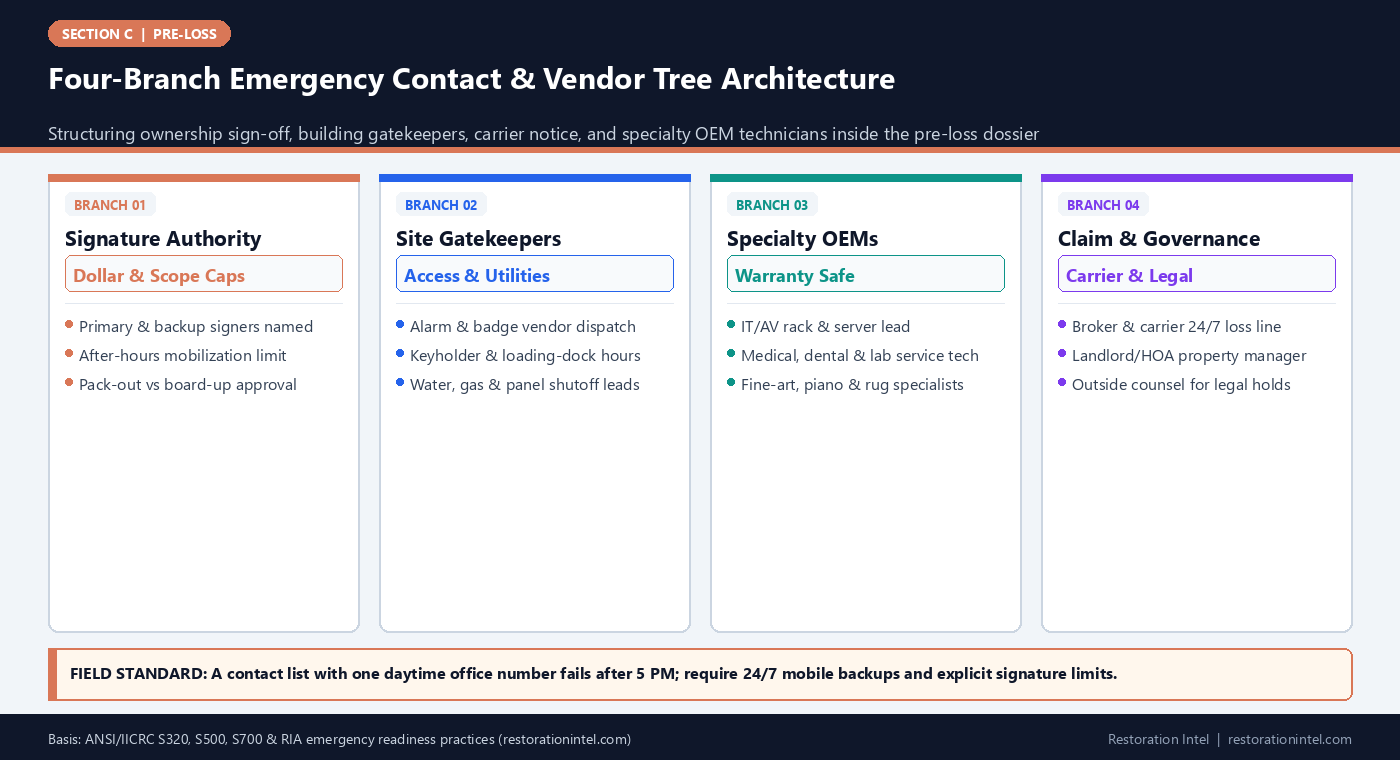
Pre-Loss Contact & Vendor Tree Matrix by Loss-Hour Function
Required fields and verification cadence for each operational role stored inside the pre-loss contents dossier.
| Tree Role / Branch | Primary & Backup Required Fields | Critical Scope Boundary | Loss-Hour Failure Prevented | Audit Refresh Cadence |
|---|---|---|---|---|
| Authorized Incident Signer | Name, title, 24/7 cell, email, dollar cap, backup officer | Distinguish stabilization sign-off from full rebuild authority | Crews idling at curb waiting for corporate sign-off | Quarterly + on leadership change |
| Building & Security Gatekeeper | Keyholder, alarm panel vendor, elevator/dock ops contact | Access hours, freight-elevator weight limits, badge protocol | Delayed extraction and locked mechanical/IT closets | Quarterly + badge vendor change |
| Property Insurance & Broker | Policy/account reference, broker rep, carrier 24/7 FNOL line | Confirm notice requirements without delaying life-safety action | Missed prompt-notice clauses or wrong claim routing | At every annual policy renewal |
| IT / Server / Telecom Lead | Managed service provider (MSP), on-call engineer, rack map ref | Controlled shutdown order before power drop or pack-out | Unplanned server corruption or severed fiber trunks | Semi-annual + MSP contract change |
| Specialty Equipment OEM | HVAC/chiller, lab, dental, print, kitchen, or elevator vendor | OEM lockout/decommission rules to preserve warranty | Technicians voiding OEM warranties during emergency move | Annual + major CapEx install |
| Fine Art / Archival / Textile | Conservator, art handler, specialty rug or document freeze vendor | Zero-touch hold list for museum/heirloom/vital records | Improper field wrapping on oil canvases or coated paper | Annual + high-value acquisition |
Separating Signature Authority From Day-to-Day Site Contacts
The most frequent bottleneck on commercial and multi-unit contents losses is confusing the person who unlocks the front door with the person authorized to bind emergency mitigation and pack-out spend. An on-site shift manager, school principal, or assisted-living night nurse may meet the crew at the curb, yet lack corporate or board authority to authorize moving high-value contents off-site to a climate-controlled vault.
Inside the pre-loss dossier, the top branch of the contact tree must explicitly map tiered signature authority. Record who can authorize immediate life-safety containment and wet extraction up to a defined ceiling, who must co-sign a full off-site pack-out or specialty freeze-drying dispatch, and who holds exclusive authority to sign off on non-salvageable disposal witness bins later in the job.
Whenever a primary decision-maker travels or leaves the organization, stale contact sheets collapse. Every Tier-1 authority entry should pair a primary executive with at least one named backup officer, direct mobile numbers (never main switchboards that route to voicemail after 5:00 p.m.), and a pre-signed Emergency Services Agreement reference so crews know the pre-agreed authorization path before dispatching trucks.
- Escalation timer rule: Define a clear fallback interval (e.g., escalate to Backup Officer #2 if Primary #1 does not respond within 20 minutes during an active water event).
- Scope-split clarity: Separate emergency stabilization sign-off from reconstruction or permanent disposal authorization.
- Landlord vs. tenant sign-off: On leased commercial suites, list both the tenant operational signer and the building property manager required for loading-dock and freight-elevator clearance.
Mapping OEM and Specialty Vendors Before Anyone Unplugs a Machine
General contents technicians are trained to document, pad, wrap, and vault standard furnishings under ANSI/IICRC S320, not to recalibrate a dental cone-beam CT scanner, purge ammonia lines, or unbolt a commercial bakery proofer. Moving sensitive machinery without manufacturer-specified transport locks or coolant purging can convert a cleanable exterior soot loss into a catastrophic mechanical failure—or void service contracts overnight.
The vendor branch of the pre-loss tree solves this before smoke clears. For every high-value or proprietary system identified during the pre-loss walk-through, record the active service vendor, emergency dispatch line, service-contract ID, and a simple operational flag: OEM Must Decommission Before Move, MSP Controlled Shutdown Required, or Standard Crew Disconnect Permitted.
Pairing that vendor tree with the physical room map prevents well-meaning emergency crews from yanking power cords or tilting unbraced precision hardware in an effort to beat rising water. Instead, the crew lead stabilizes surrounding areas, places protective poly sheeting, and triggers the pre-authorized vendor callout immediately.
- Zero-touch equipment stickers: Coordinate color-coded physical tags on mission-critical gear pointing directly to the vendor-tree entry.
- IT shutdown sequence: Document UPS battery order and off-site cloud backup verification steps alongside the MSP contact.
- Utility & suppression vendors: Include fire-sprinkler riser and alarm monitoring contacts so impaired systems can be restored or fire-watched legally.
Gatekeepers, Access Logistics, and Staging Constraints
Even with signed authorization and a full pack-out crew idling outside, physical access friction can burn half a shift. High-rise towers, medical campuses, gated residential communities, and secure warehouses enforce strict rules on freight elevators, certificate-of-insurance (COI) naming, dock clearances, and alarm passcodes.
A functional vendor and contact tree captures those gatekeepers explicitly: the security desk phone, alarm monitoring company abort code procedure (stored in an access-controlled vault rather than public folders), after-hours guard service, freight elevator dimensions and weight limits, and pre-approved COI language required by building management. Knowing before a loss that a box truck over 11 feet cannot clear the subterranean loading dock prevents sending the wrong fleet on Day 1.
Include a designated staging note on the contact sheet showing where dehumidifiers, clean pack-out totes, and debris roll-offs can legally sit without blocking fire lanes or violating municipal ordinances.
- COI pre-clearance note: Store the landlord’s exact additional-insured wording in the dossier so office admins issue compliant COIs in minutes.
- Fleet clearance specs: Record dock height, turning radius, and freight-car door dimensions right beside the building engineer’s phone number.
- Alarm & access hygiene: Never store raw PINs or master codes in unencrypted shared PDFs; reference the sealed security custodian.
Running Quarterly Tree Drills and Post-Turnover Hygiene
Emergency contact trees decay silently faster than almost any other part of a pre-loss file. Facility managers change jobs, IT providers are replaced, insurance brokers rotate at renewal, and mobile carriers change. A vendor tree printed three years ago and never tested creates false confidence until midnight arrives.
Restoration contractors managing pre-loss or Emergency Services Plan retainers should build a lightweight quarterly or semi-annual verification ping into the account rhythm. A five-minute automated or coordinator-led check asks the client to confirm three items: active authorized signers, any new specialty vendor contracts, and current 24/7 mobile numbers. Tie full tree re-verification automatically to annual insurance renewal and major personnel transitions.
Document each verification timestamp inside the dossier header. When a carrier, risk manager, or board asks how reliable the emergency readiness package is, dated contact-tree sign-offs prove active governance rather than a dusty binder.
- Test-call log: Verify after-hours dispatch numbers for critical OEMs and alarm vendors once a year rather than assuming 24/7 coverage.
- Dual-format survival: Maintain both cloud-synced mobile access and a sealed waterproof printed packet at the main security desk or off-site owner binder.
- Role-based entries: List job titles alongside personal names so turnover triggers an immediate replacement prompt.
Practitioner Verification Checklist (C-21)
- Separate 24/7 emergency stabilization signers from off-site pack-out and final disposal decision-makers, including dollar authority limits.
- Require direct mobile numbers and named backup officers for every Tier-1 signer (never switchboard-only daytime numbers).
- Map specialty OEM, IT/MSP, and art/archival vendors directly to high-value assets that require controlled shutdown or decommissioning.
- Document loading-dock clearances, freight-elevator limits, security gatekeepers, and landlord COI requirements inside the access branch.
- Schedule quarterly contact-tree pings and annual renewal audits with dated verification stamps in the dossier header.
Standards, Authority References & Related Reading
Primary standards, insurance definitions, and sibling Restoration Intel guides referenced in this brief:
- ANSI/IICRC S320 Standard for Professional Contents Restoration
- Restoration Industry Association (RIA)
- ANSI/IICRC S500 Water Damage Standard
- ANSI/IICRC S700 Fire & Smoke Restoration Standard
- Related Guide: Emergency Readiness Plans: The Sales Tool That Converts Commercial Clients
- Related Guide: Document, Hold, Respond: Three Levels of Service Inside One Emergency Services Plan
- Related Guide: Agreement Is the Product: Emergency Services Agreement
- Related Guide: Pre-Loss Documentation for Multi-Site Franchises and Chains: Creating a Standardized Store Template
- Related Guide: From Pre-Loss File to Day-1 Claim Schedule: How Estimators Reconcile Surviving vs Damaged Items After a Loss
.md twin for desk QA and team training.Frequently Asked Questions
Who should sit at the top of a commercial pre-loss emergency contact tree?
Two distinct roles: the 24/7 site gatekeeper who can physically unlock doors and isolate utilities within minutes, and the authorized financial signer (plus backup) empowered to execute emergency mitigation and pack-out agreements.
Why store OEM equipment vendors inside a contents inventory dossier?
Because specialty medical, IT, lab, and commercial production machines often require controlled shutdowns, transport locks, or fluid purging by certified vendors so emergency pack-out crews do not cause mechanical damage or void warranties.
Should alarm codes and vault combinations be printed in the main contact sheet?
No. Keep physical security credentials in an access-controlled credential vault or with a designated custodian, and list only the custodian’s contact and verification protocol in the shared operational contact tree.
How often should an emergency contact and vendor tree be updated?
Run a quick signer and vendor check quarterly, verify critical 24/7 OEM lines annually at policy renewal, and trigger an immediate update whenever key leadership, IT providers, or property managers change.