Direct Answer: Schools, houses of worship, and nonprofits face multi-owner and donor-restricted property complexity; pre-loss baselines must separate institutional assets, restricted gifts, leased gear, and third-party user property while enforcing strict student and member privacy boundaries.
.md twin for estimator QA and carrier file documentation.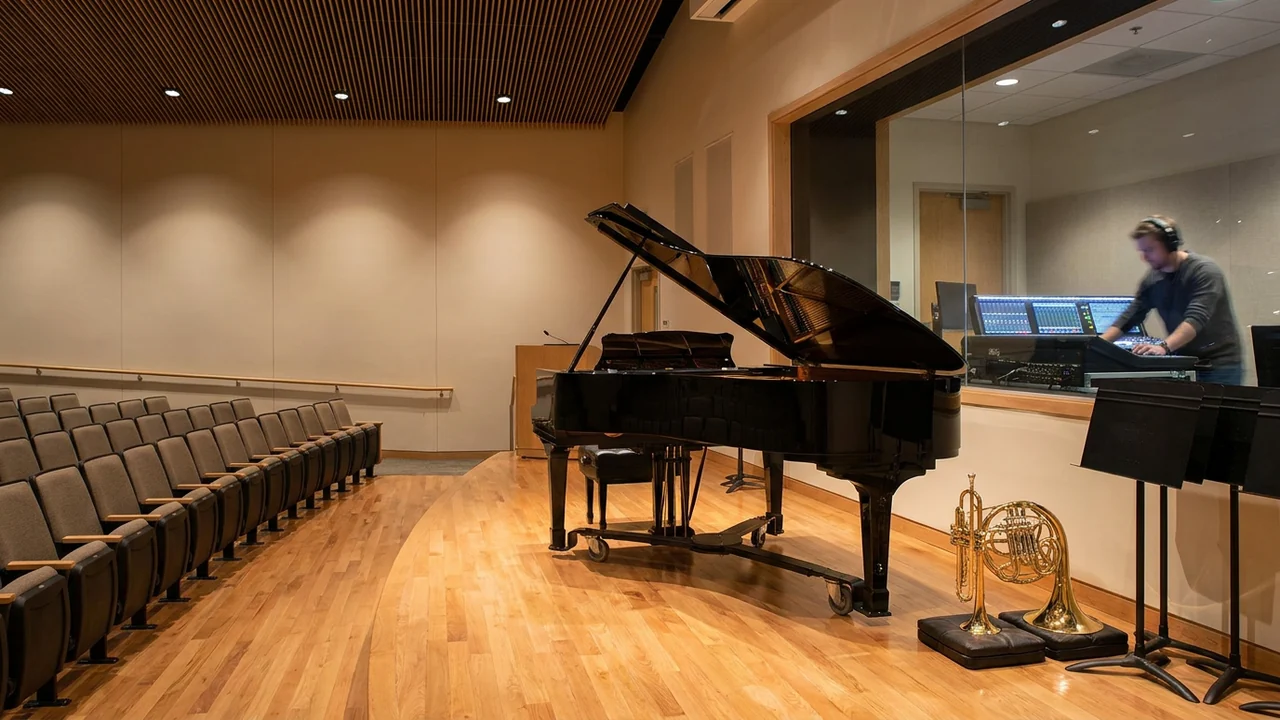
Educational campuses, churches, and 501(c)(3) nonprofits rarely operate like single-owner commercial offices. Inside a single parish hall or community school wing, one storage closet may hold institution-owned folding chairs, a grant-funded STEM robotics cart, an endowed grand piano carrying donor restrictions, a leased commercial copier, and camping gear belonging to an independent youth scout troop or weekend co-op.
When water, smoke, or storm damage strikes those shared buildings, poorly organized inventories trigger months of administrative paralysis. Adjusters and boards demand proof of what the institution actually owned versus leased or borrowed, grant auditors want serial-level traceability for restricted-fund equipment, and teachers or ministry volunteers try to recall personal classroom supplies lost in the fire.
Building a defensible institutional baseline grounded in ANSI/IICRC S320 and IRMI replacement valuation principles also demands rigorous privacy hygiene under FERPA student privacy guidance and the NIST Privacy Framework. Disclaimer: Pre-loss baselines organize physical asset evidence only and do not constitute legal, tax, endowment, or insurance coverage advice; institutions should verify policy schedules, donor gift agreements, and privacy rules with qualified legal counsel and their insurance broker.
Institutional Pre-Loss Asset & Privacy Segmentation Model
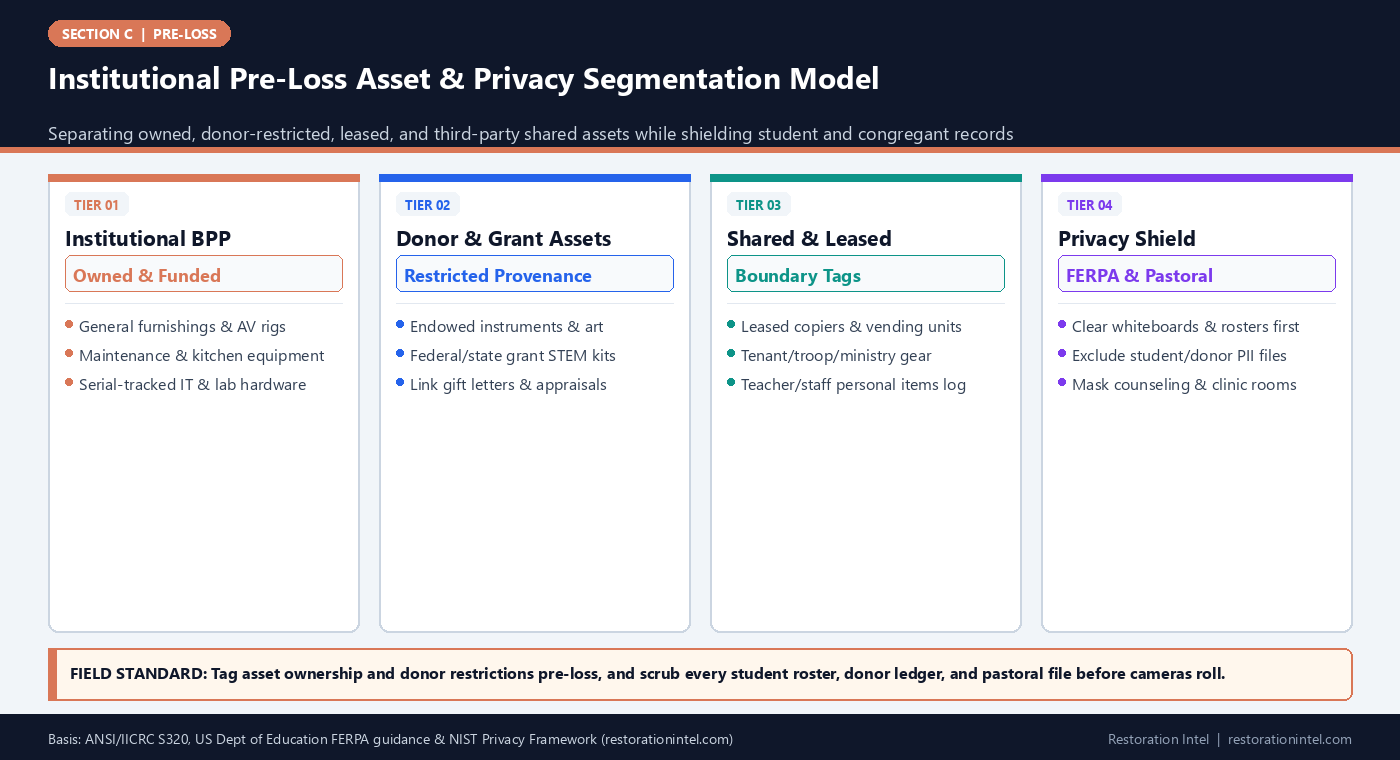
Institutional Asset Ownership Classes & Pre-Loss Documentation Controls
How schools, houses of worship, and nonprofits classify mixed-ownership property inside one room-indexed baseline.
| Asset Ownership Class | Typical Institutional Examples | Primary Post-Loss Risk | Required Pre-Loss Proof | Governance / Sign-Off Owner |
|---|---|---|---|---|
| General Owned BPP | Desks, pew cushions, sanctuary AV, commercial kitchen ranges, maintenance carts | Under-scheduled lump sums or disputed quality grades | Room-level photos, model plates, manufacturer spec sheets, purchase invoices | Facilities Director / Business Manager |
| Donor-Restricted / Endowed Items | Pipe organs, liturgical silver, stained glass (movable), named library collections | Replacement valuation gap or failure to satisfy donor-intent stipulations | Gift agreement summary, provenance notes, specialty valuation/appraisal reference | Board Treasurer / Endowment Committee |
| Grant-Funded Equipment | Title-tracked laptops, lab analyzers, adaptive-learning devices, mobile health gear | Grantor clawback or compliance audit failure if destroyed gear lacks serial trail | Grant award ID, asset tag photo, serial number, assigned room/department | Grants Administrator / Principal |
| Leased / Vendor-Owned Units | Multifunction copiers, postage meters, dish-machine chemical dispensers, water coolers | Duplicate claim filing or confusion over who insures the machine | Vendor nameplate sticker, lease contract reference, vendor emergency contact | Procurement / Office Manager |
| Third-Party / Shared-Use Gear | After-school partner kits, scout troop trailers, food-pantry freezers, visiting choir gear | Uninsured external groups expecting host policy payout without documentation | Written facility-use boundary memo + separate shelf/cage photographic log | Facility Use Coordinator / Partner Lead |
| Staff / Faculty Personal Items | Teacher classroom libraries, personal tools, pastor study books, musical instruments | Disputes over institutional coverage vs individual personal property limits | Signed annual personal-item attestation or intentional exclusion flag | HR / Department Head |
Separating General BPP From Donor-Restricted and Grant-Funded Assets
In commercial businesses, depreciation schedules and tax ledgers largely track capital equipment. In nonprofits, schools, and churches, high-value assets often enter the building outside normal purchasing channels—donated by families, bought through targeted capital campaigns, or acquired under state and federal grants that impose strict serial-tracking and disposition rules.
When those assets suffer smoke, soot, or Category 3 water damage, standard restoration triage collides with fiduciary rules. A donor-funded sanctuary instrument or historical archive may warrant specialty conservation even when a generic replacement cost analysis favors total loss, while grant-funded classroom hardware cannot simply be hauled to a dumpster without serial-level disposal verification required by the funding agency.
Adding two simple metadata columns to the pre-loss baseline—Funding_Source (General, Grant, Donor-Restricted) and Disposition_Rule (Standard Salvage Review vs Board/Grantor Approval Required)—prevents Day-1 pack-out crews from treating restricted assets like commodity furniture. Store redacted summaries of gift restrictions or grant serial rosters alongside the room photos, leaving full legal interpretation to institutional counsel and the insurance broker.
- Tag sacred and memorial items: Apply discreet non-marring inventory IDs to memorial plaques, altar furnishings, and endowed instruments so crews handle them under specialty SOPs.
- Grant serial pairing: Export grant-purchased IT and lab asset tags once a semester and match them to classroom room numbers.
- Specialty conservation contacts: Link organ builders, stained-glass studios, and textile conservators directly into the C-21 vendor tree.
Drawing Clear Boundaries Around Leased, Partner, and Staff Property
Shared community buildings invite ownership confusion. A single gymnasium storage room or church basement often houses property belonging to three or four separate legal entities: the host institution, a weekday preschool lessee, a community theater troupe, and a municipal sports league. After a pipe burst or roof collapse, overlapping claims stall while adjusters try to determine whose policy covers which rack of equipment.
Pre-loss documentation resolves physical mixing before a loss happens. Work with facility coordinators to label shared cages, cabinets, and storage alcoves by owning entity, and capture wide establishing photos showing those physical boundaries. Log leased equipment—such as copiers, coffee brewers, and commercial dishwasher chemical units—with their vendor asset stickers so mitigation teams notify the leasing company immediately rather than packing third-party property into general restoration vaults.
Similarly, establish a clear documentation rule for teachers, coaches, and clergy who bring personal books, tools, or instruments onto campus. Having staff register personal items over an institutional threshold—or clarifying via broker guidance that personal property is excluded—prevents painful misunderstandings during post-loss claim reconciliation.
- Color-coded zone signage: Use clear shelf labels (‘Property of Host School’ vs ‘Troop 14 Storage’) visible inside establishing room photos.
- Leased-gear stickers: Photograph vendor service plates on copiers and kitchen dispensers so estimators flag them outside owned BPP schedules.
- Annual teacher classroom sweep: Invite faculty at the start of the school year to photograph classroom setups before personal decor accumulates.
FERPA, Student Privacy, and Pastoral Confidentiality During Capture
Documenting classrooms, counseling suites, nurse clinics, church offices, and donor development rooms creates acute privacy exposure if crews film live workspaces indiscriminately. High-resolution 4K video or wide-angle photographs routinely pick up student names on classroom seating charts, IEP binders on desks, donor pledge cards, pastoral counseling notes, and campus security-camera monitor feeds.
Under the U.S. Department of Education’s FERPA framework and data-minimization principles in the NIST Privacy Framework, pre-loss capture teams should never record personally identifiable education, medical, or pastoral records inside a property baseline. Schedule school walkthroughs during summer or holiday breaks whenever possible, and require a staff privacy escort to execute a 60-second ‘desk and board clear’ before cameras enter any room.
Whiteboards listing student schedules, open filing drawers, computer monitors displaying SIS/ERP dashboards, and bulletin boards with student photos must be wiped, covered, or locked down prior to recording. Capture the physical furniture, shelving, and serialized hardware—never the confidential paper or screen contents sitting on top of them.
- Pre-capture privacy sweep: Cover monitors, close file cabinets, and turn over open attendance or donor binders before turning on room cameras.
- Locked-record exclusion: Record counts of locked file cabinets and safes externally without photographing open record folders inside.
- Role-restricted dossier access: Store campus floor plans and security-room baselines under institutional admin access controls rather than public volunteer drives.
Seasonal Volunteers, Turnover, and Annual Governance Refresh
Schools and nonprofits rely heavily on rotating committee chairs, volunteer treasurers, and seasonal staff. A pre-loss binder assembled by one dedicated facility volunteer often disappears into a personal Google Drive or locked closet when that volunteer steps down two years later.
To make institutional baselines durable, anchor ownership to institutional role accounts—such as facilities@ or the business office ledger—rather than personal volunteer emails. Pair the annual pre-loss refresh with existing governance milestones: back-to-school August facility readiness for schools, or the annual insurance-renewal and budget review for churches and nonprofits.
Keep the refresh lightweight: re-photograph newly outfitted labs, youth wings, or AV upgrades, reconcile retired grant assets, and verify the C-21 emergency contact tree with current board officers. That discipline ensures the institution can hand an auditable, board-approved baseline to its restoration partner within hours of any emergency.
- Institutional repository rule: Store baselines on organization-owned cloud drives with two administrative custodians, never personal volunteer accounts.
- Event-triggered updates: Capture any major AV sanctuary upgrade, library remodel, or grant equipment delivery within 14 days of installation.
- Board-ready summary sheet: Maintain a one-page executive index listing total room count, last audit date, and storage locations.
Practitioner Verification Checklist (C-22)
- Segment the pre-loss schedule into owned BPP, donor-restricted/endowed items, grant-funded hardware, leased units, and third-party shared gear.
- Execute a strict pre-capture privacy sweep in every classroom, counseling suite, clinic, and church office to exclude FERPA, medical, and donor PII.
- Photograph vendor service stickers on leased copiers and kitchen dispensers and label shared partner storage cages visibly.
- Attach funding-source and specialty-handling flags to restricted or sacred items so Day-1 crews preserve provenance and grantor audit trails.
- Anchor dossier storage to role-based institutional accounts and refresh baselines annually ahead of policy renewal or fall reopening.
Standards, Authority References & Related Reading
Primary standards, insurance definitions, and sibling Restoration Intel guides referenced in this brief:
- ANSI/IICRC S320 Standard for Professional Contents Restoration
- US Department of Education FERPA Student Privacy Guidance
- NIST Privacy Framework
- IRMI Insurance Glossary: Replacement Cost Value (RCV)
- Restoration Industry Association (RIA)
- Related Guide: Tenant Improvements and Betterments vs Contents: Pre-Loss Lease Boundary Mapping for Commercial Tenants
- Related Guide: Pre-Loss Emergency Contact and Vendor Trees Inside the Contents Dossier
- Related Guide: Pre-Loss Privacy & Access Controls: Protecting Sensitive Financial, Medical, and Security Information Inside Baselines
- Related Guide: Three Adjusters, Three Economies
- Related Guide: Two Standards, One Truck: Documentation When the Brand and the Scorecard Disagree
.md twin for desk QA and team training.Frequently Asked Questions
Why do schools and churches need separate ownership tags in a pre-loss inventory?
Because one building frequently mixes institution-owned property, donor-restricted endowments, grant-funded electronics, leased copiers, and third-party community-group gear that carry different replacement and audit rules.
How do crews avoid violating student privacy when filming classrooms pre-loss?
Shoot during school breaks when possible, have staff clear or cover whiteboards, seating charts, and open student folders beforehand, and verify no live SIS monitors or student photos appear in frame.
Should personal items brought by teachers or volunteers be included in the institutional baseline?
Only if institutional policy and the insurance broker confirm how staff property is handled; otherwise log a clear boundary note so personal items are tracked separately or explicitly excluded.
Does a pre-loss baseline determine whether a donor-restricted gift is covered for replacement cost?
No. A baseline documents physical existence, provenance, and condition; policy coverage, sublimits, and endowment obligations must be reviewed with the institution’s insurance broker and legal counsel.