Direct Answer: Pre-loss photos, 3D scans, and invoice vaults often expose tax records, medical devices, student rosters, and security codes; safe baselines apply pre-capture privacy sweeps, data minimization, FERPA/HIPAA boundary awareness, and strict role-based access.
.md twin for estimator QA and carrier file documentation.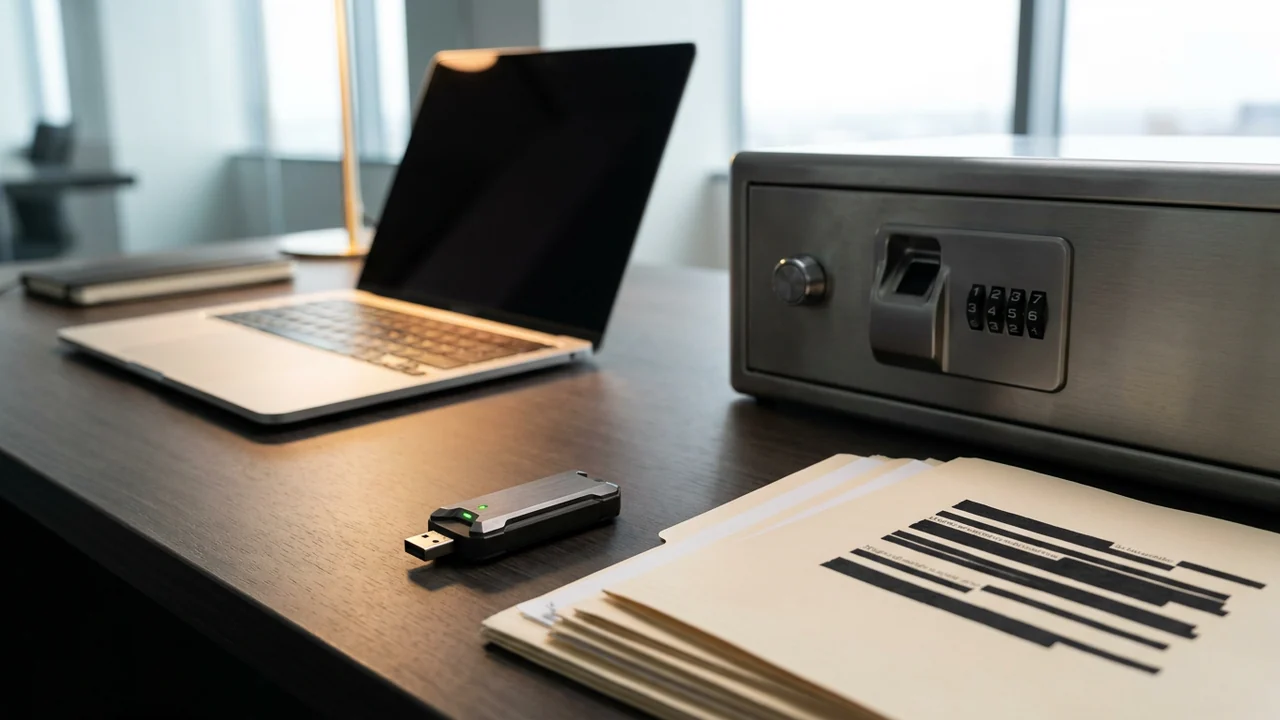
Modern smartphones capture razor-sharp 4K video and high-megapixel still frames—which turns an undisciplined pre-loss walkthrough into a high-resolution data breach waiting to happen. Walk through an average home office, medical clinic, school classroom, or corporate suite with a camera rolling, and raw footage routinely picks up unshredded tax returns, prescription bottles on bathroom counters, wall-mounted alarm codes, patient check-in monitors, student IEPs, and safe combinations taped inside closet frames.
When that unedited media sits in a shared contractor folder, syncs to an unencrypted personal tablet, or gets uploaded wholesale to an insurance portal, sensitive personal, medical, educational, and security records spread far beyond anyone’s intended audience. Worse, once a loss occurs and files pass among restoration technicians, subcontractors, desk adjusters, and third-party auditors, unredacted baselines create regulatory and liability exposure for both the property owner and the restoration firm.
Applying structured data-minimization and access-control boundaries grounded in the NIST Privacy Framework, U.S. Department of Education FERPA guidance, and ANSI/IICRC S320 custody hygiene protects occupants without sacrificing claim-ready asset proof. Legal & Regulatory Compliance Disclaimer: Operational privacy-sweep and access-control workflows described here are field hygiene practices only and do not constitute legal advice or formal HIPAA, FERPA, GLBA, or GDPR compliance certification. Regulated clinics, schools, assisted-living facilities, and financial firms must review capture protocols and vendor agreements with their designated privacy officer and legal counsel.
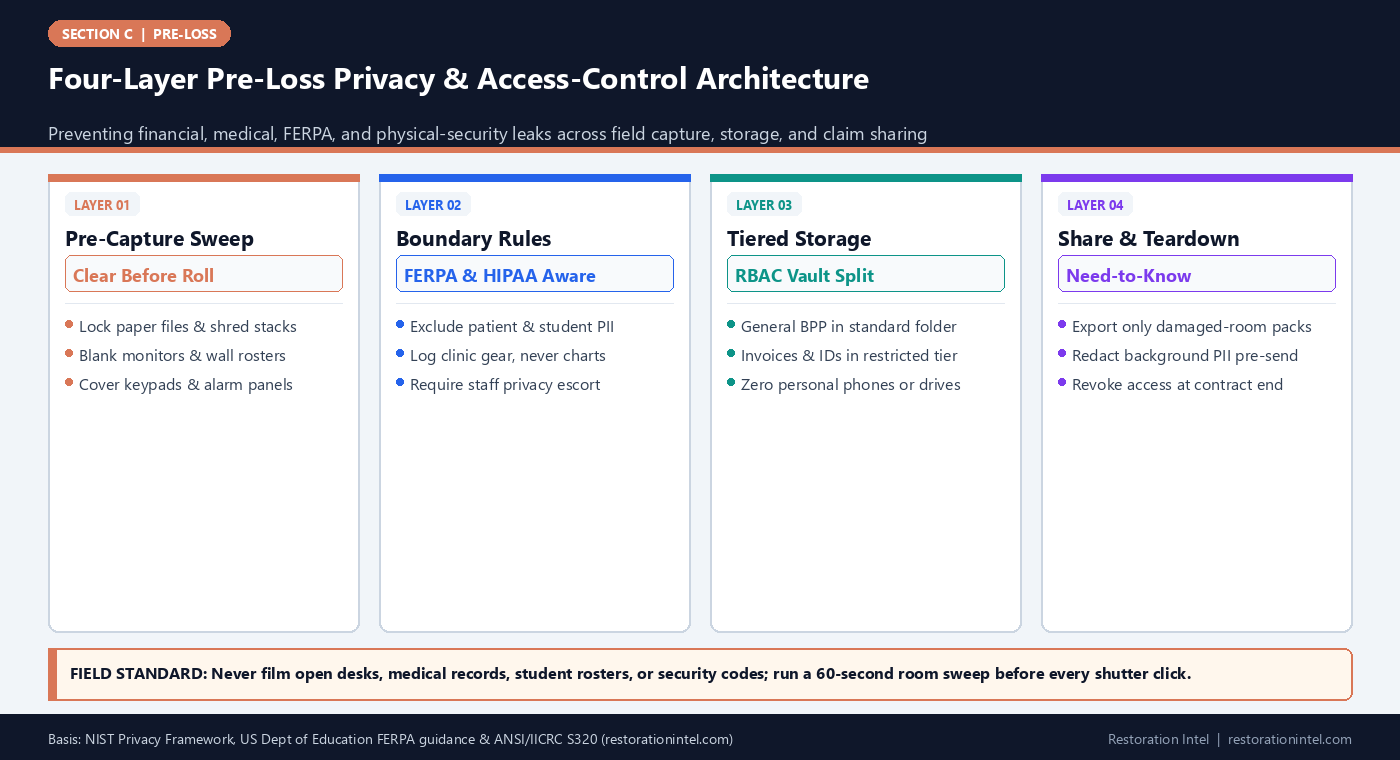
Four-Layer Pre-Loss Privacy & Access-Control Architecture
Sensitive Information Classes Inside Pre-Loss Baselines & Required Controls
Practical handling rules to prevent inadvertent exposure of financial, healthcare, educational, and security data during baseline capture.
| Sensitive Data Category | Common Capture Leak Vector | Regulatory / Liability Exposure | Pre-Capture Field Action | Storage & Access Control Rule |
|---|---|---|---|---|
| Financial & Tax Records | Open desk folders, printed W-2s, checkbooks, bank notices in home or AP offices | Identity theft, unauthorized financial account exposure | Close folders, lock file drawers, cover desk blotters before entering | Store acquisition invoices in owner-controlled vault; redact account numbers |
| Medical & HIPAA-Adjacent | Clinic patient charts, therapy schedules, prescription bottles, diagnostic monitors | Unauthorized disclosure of protected health information (PHI) | Require clinic privacy escort; blank screens & remove charts before filming | Document equipment hardware only; never store patient files in contractor drives |
| Education / FERPA Records | Classroom seating charts, IEPs, gradebooks, student-photo bulletin boards | Disclosure of protected student education records under FERPA | Shoot during school breaks or mask boards/rosters prior to camera sweep | Keep campus baselines under institutional admin RBAC control |
| Physical & Cyber Security | Alarm panel codes, key hooks, safe combinations, server IP labels, Wi-Fi passwords | Facilitates burglary, network intrusion, or unauthorized safe entry | Mask sticky notes, close server labels, shoot locked safe exterior only | Separate credentials into sealed security custodian file; never in 3D tours |
| Firearms, Safes & High-Risk Goods | Full firearm serial spreadsheets or jewelry vault layouts stored in shared crew folders | Targeted theft risk if contractor file or subcontractor portal leaks | Document locked safe class; keep detailed serials in owner-encrypted annex | Strict owner/adjuster release only after verified loss event |
The 60-Second Pre-Capture Privacy Sweep Before Cameras Turn On
Once a high-resolution image captures an unredacted bank statement or medical prescription label, deleting it everywhere—across device camera rolls, automatic cloud backups, and shared project thumbnails—is surprisingly difficult. The most effective privacy control in pre-loss documentation therefore happens before the first photo or 3D scan node is recorded.
Applying data-minimization principles from the NIST Privacy Framework, field crews and property owners should treat every workspace, bedroom, and back office to a strict 60-second privacy sweep prior to capture. Close desk drawers, flip open binders shut, lock monitor screens, wipe or drape whiteboards containing schedules or client names, tuck prescription bottles inside closed medicine cabinets, and remove sticky notes carrying alarm PINs or Wi-Fi keys.
When photographing locked file cabinets, safes, or fireproof document boxes, record the cabinet make, model, and exterior size—not the individual social security cards, tax packets, or deeds inside. As noted in IRS Publication 584 loss-record guidance, owners can track vital financial records in a separate encrypted personal register rather than exposing them in contractor walkthrough videos.
- Company-managed devices only: Never capture client pre-loss walkthroughs on technicians’ personal phones that auto-sync to personal consumer cloud galleries.
- Bathroom & nightstand rule: Keep prescription labels, IDs, and personal financial mail completely out of frame during residential sweeps.
- Monitor-blank check: Verify every workstation display is asleep or showing a blank lock screen before starting 3D or video passes.
FERPA and HIPAA-Adjacent Boundaries in Schools, Clinics, and Senior Living
Commercial restoration contractors regularly serve medical/dental practices, assisted-living communities, and K-12 or higher-ed campuses—occupancies where routine property photos can cross statutory privacy lines if crews are careless. Under the FERPA framework, schools must safeguard personally identifiable information in student education records; in healthcare and many senior-living wings, patient charts, appointment boards, and diagnostic monitors carry strict confidentiality obligations.
A restoration team performing a pre-loss contents baseline does not need to inspect, touch, or photograph patient records or student files to catalog a facility’s physical property. Establish a firm boundary protocol with the client’s designated privacy officer or facility director before arrival: a staff privacy escort enters each room first, clears or secures confidential folders and wall boards, and confirms the space is cleared for equipment-only photography.
If an inadvertent capture occurs—such as a student roster glimpsed in the corner of a wide-angle gym-office shot—quarantine and delete the raw frame immediately on site and re-shoot after covering the board, rather than leaving an unredacted frame in an archive folder.
- Escort sign-off: Require an authorized school, clinic, or assisted-living staff member to clear regulated rooms before cameras roll.
- Hardware-only scope: Capture X-ray units, dental chairs, classroom smartboards, and server racks without filming paper trays or screen output.
- Vendor agreement check: Confirm with the client’s compliance team whether facility rules require specific confidentiality or Business Associate terms prior to on-site work.
Tiered Vault Architecture and Role-Based Access Controls (RBAC)
Not every document inside a pre-loss dossier belongs in the same permission tier. A mitigation crew lead needs immediate access to the room floor map, utility shutoffs, and heavy-equipment list during a 2:00 a.m. burst pipe; that crew lead does not need access to unredacted purchase invoices, firearm serial lists, home safe locations, or executive personal schedules.
Design the baseline repository using a simple two- or three-tier Role-Based Access Control (RBAC) structure. Tier 1 (Operational Readiness) holds the floor map, room IDs, emergency contact tree, and general furnishings/BPP schedules accessible to assigned restoration PMs. Tier 2 (Valuation & Sensitive Annex) holds purchase invoices, appraisals, high-value sublimit lists, and locked-safe manifests encrypted under owner or controller control, unlocked only when a verified claim requires valuation proof.
Enforce multi-factor authentication (MFA), eliminate anonymous ‘anyone with the link’ sharing URLs on Matterport tours or cloud folders, and avoid storing sensitive baselines inside unencrypted local USB drives left in unlocked job binders.
- Zero public links: Disable public discovery and unauthenticated share URLs on every 3D tour and cloud media folder containing interior views.
- Sensitive annex split: Keep jewelry, firearm, and safe inventories separate from day-to-day maintenance and crew dispatch folders.
- Audit-log visibility: Prefer storage platforms that log who viewed or downloaded valuation and photo archives.
Need-to-Know Claim Exports, Redaction, and Contract-End Teardown
Privacy discipline continues after a loss occurs and even after a service relationship ends. When reconciling a localized water loss in a single office wing—the workflow covered in C-25—estimators should export only the pre-loss room packets, photos, and invoice proofs relevant to the impacted zones. Never attach an entire multi-suite building’s private photo archive to a claim portal for one damaged breakroom.
Before transmitting any pre-loss visual proof to an insurer, third-party administrator, or opposing subrogation expert, run a quick redaction review to blur any accidental license plates, family photos, monitor reflections, or account numbers missed during field capture. When exporting invoices, redact unrelated line items and bank/card routing digits while leaving vendor name, date, model description, and price clearly visible.
Finally, define clear retention and teardown rules inside the pre-loss or Emergency Services Agreement. If a commercial client cancels their retainer or sells the property, transfer the canonical archive to the owner on an encrypted handoff and purge contractor-side working copies on a documented schedule.
- Minimum-necessary claim pack: Export room-filtered proof packets rather than dumping whole-building archives into carrier portals.
- Invoice digit masking: Redact last-four card numbers, routing strings, and unrelated personal purchases on multi-item receipts.
- Documented offboarding: Include a written data-handoff and deletion confirmation workflow whenever a readiness agreement terminates.
Practitioner Verification Checklist (C-26)
- Run a 60-second privacy sweep before every room capture to close folders, lock drawers, blank screens, and hide alarm/Wi-Fi codes.
- Enforce staff privacy escorts and hardware-only framing in schools, medical clinics, and assisted-living rooms to respect FERPA and HIPAA boundaries.
- Split the baseline repository into Tier-1 Operational Readiness files and Tier-2 Owner-Controlled Sensitive/Valuation annexes with MFA.
- Disable public or unauthenticated 3D-scan share links and prohibit storing client baselines on technicians’ personal phones.
- Export only impacted-room proof packets to claim portals (with financial/PII redactions) and execute clean archive teardown at contract end.
Standards, Authority References & Related Reading
Primary standards, insurance definitions, and sibling Restoration Intel guides referenced in this brief:
- NIST Privacy Framework
- US Department of Education FERPA Student Privacy Guidance
- ANSI/IICRC S320 Standard for Professional Contents Restoration
- Restoration Industry Association (RIA)
- IRS Publication 584: Casualty, Disaster, and Theft Loss Workbook
- Related Guide: Pre-Loss Serial Plate and Invoice Vaulting: Organizing Digital Proof So Fire or Flood Doesn't Destroy It
- Related Guide: Pre-Loss Readiness for Healthcare and Dental Practices: Separating Leasehold Build-Out from Scheduled Equipment
- Related Guide: Pre-Loss Documentation for Schools, Churches, and Nonprofits: Managing Donor-Restricted and Shared Assets
- Related Guide: Estate, Assisted-Living, and Fiduciary Pre-Loss Inventories: Managing Heirlooms and Multi-Party Ownership
- Related Guide: Agreement Is the Product: Emergency Services Agreement
.md twin for desk QA and team training.Frequently Asked Questions
What items should always be removed or covered before filming a pre-loss walkthrough?
Open tax or financial folders, checkbooks, prescription bottles, patient or student rosters, alarm PIN sticky notes, live computer monitors, and any displayed passwords or safe combinations.
Can a restoration contractor photograph inside a medical clinic or school classroom for a pre-loss inventory?
Only with authorized institutional approval and a staff privacy escort who clears or secures confidential patient/student records first; capture physical hardware and furnishings while excluding protected records.
Why separate high-value serial lists and invoices from the main operational pre-loss folder?
Because emergency dispatch crews only need room maps and equipment specs to stabilize a building, whereas sensitive valuation invoices, safe locations, and firearm/jewelry schedules should stay behind stricter owner-controlled access.
Does following a pre-loss privacy checklist make a contractor HIPAA or FERPA certified?
No. Field privacy hygiene reduces accidental exposure, but legal compliance certification and vendor agreement obligations must be reviewed by the client’s privacy officer and legal counsel.