Direct Answer: Audio narration training boosts capture accuracy without slowing pack-out pace by drilling a five-part spoken formula—zone, count and object, material or brand tier, damage state, and target box ID—paired with steady breath cadence and acoustic control around drying equipment.
.md twin for estimator QA and carrier file documentation.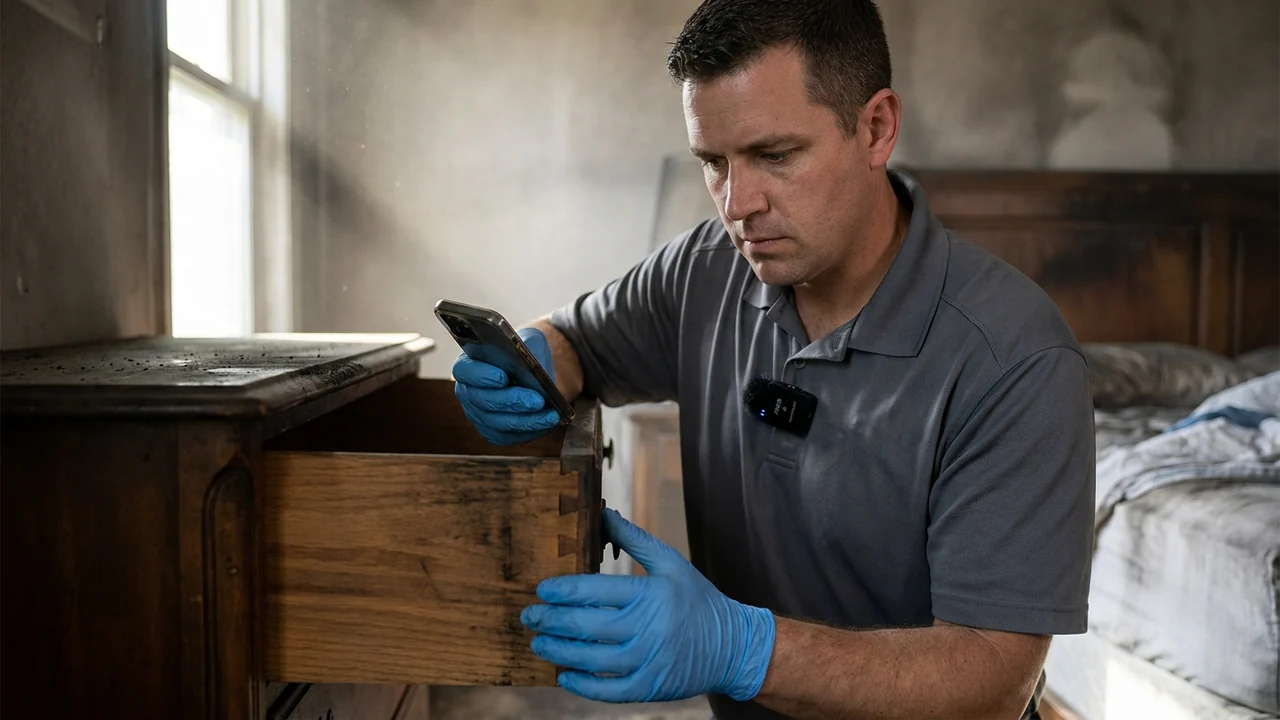
Typing line-item descriptions onto a tablet screen with gloved fingers inside a hot, soot-dusted kitchen kills pack-out momentum. A technician stops moving, pulls off a glove, pecks out ‘wooden dining chair with arms, scratched,’ and drops production to a crawl. Yet turning off descriptions altogether and recording silent walkthrough video leaves estimators staring at generic brown wood shapes with zero certainty on brand, solid-versus-veneer construction, or hidden quantity behind cabinet doors.
Clear spoken audio narration bridges that gap when crews are trained properly. A human voice moves faster than any thumb keyboard while leaving hands free to open cabinet doors, tilt nameplates, and steady fragile lamps. The catch is that untrained narration quickly degrades into filler words (‘uh, over here we got some stuff, couple of nice chairs, maybe damaged’) or disappears under roaring air movers.
Coaching field crews under ANSI/IICRC S320 documentation discipline requires treating spoken capture like aviation radio cadence: brief, standardized, front-loaded with concrete nouns and modifiers, and timed to physical camera pauses so transcription and XactContents entry happen cleanly on the first pass.
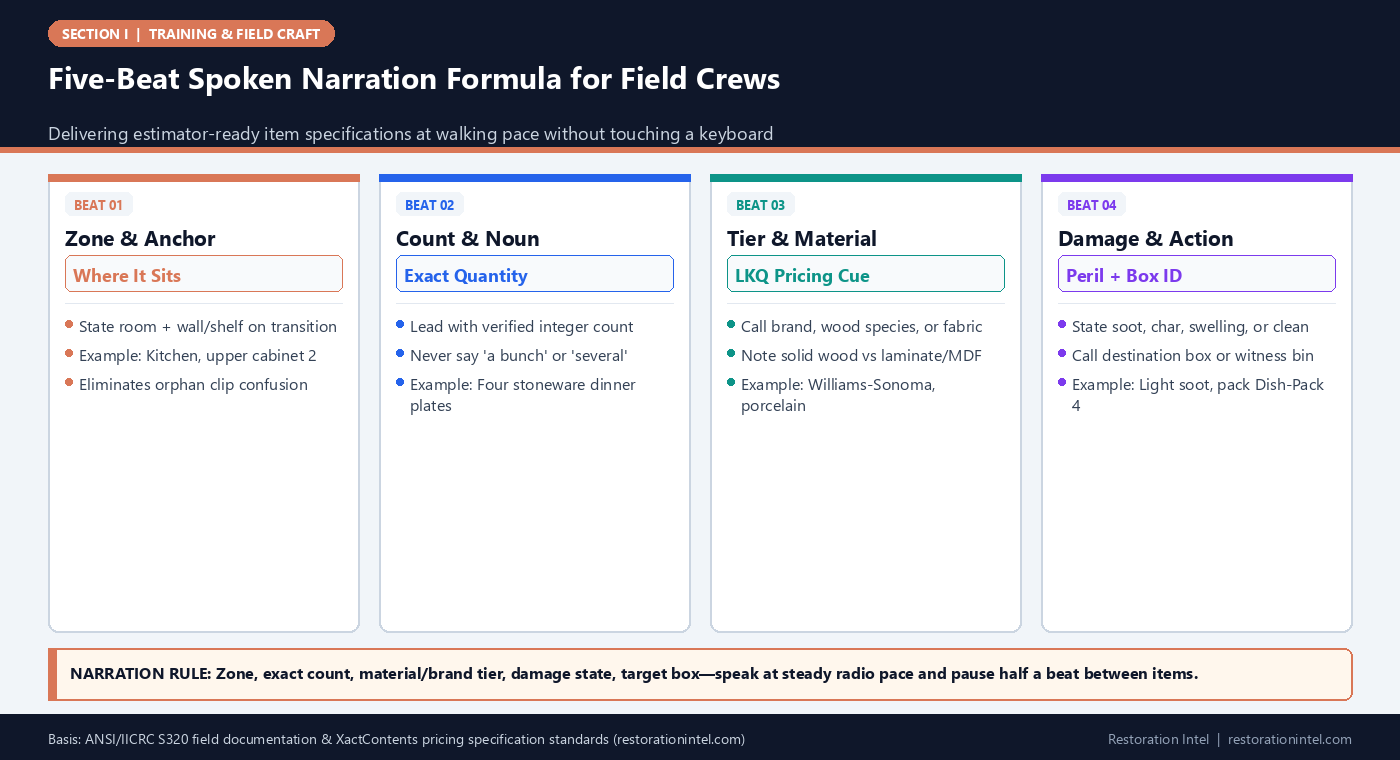
Five-Beat Spoken Narration Formula for Field Crews
Weak Field Narration vs Estimator-Ready Spoken Specifications
Practical coaching examples showing how brief phrasing adjustments transform vague audio into directly priceable inventory specs.
| Room / Item Scenario | Untrained Crew Phrasing (Weak) | Trained Five-Beat Narration (Strong) | Why the Weak Version Slows Estimating | Coaching Drill Cue |
|---|---|---|---|---|
| Dining Chair Set | Got some wooden chairs around the table, looks dirty | Dining room center, six Ethan Allen solid maple Windsor armchairs, light smoke film, tag clean-on-pad | Misses exact count, brand tier, wood vs veneer, and arm vs side chair pricing | Count chairs aloud while touching each backrest sequentially |
| Kitchen Small Appliance | Coffee maker on the counter, wet at the base | Kitchen east counter, one Breville Barista Express stainless espresso machine, standing water at base, check serial next frame | Cannot separate a $30 drip brewer from a $700 espresso machine without model callout | Read brand badge aloud before tilting for serial plate |
| Bedroom Dresser | Big dresser with stuff inside drawers | Master bedroom south wall, one Restoration Hardware six-drawer oak dresser, top swollen veneer, pack drawers into Box 14 | No size, drawer count, construction quality, or damage distinction | State drawer count + top-surface condition before opening |
| Pantry Shelving | Whole shelf of canned food and boxes | Pantry shelf three, fourteen unopened glass pasta jars, wipeable, pack Box 9; six open cereal boxes, non-salvageable witness bin | Forces manual frame-by-frame counting and hides open-consumable salvage split | Group identical containers by sealed vs open status aloud |
| Garage Power Tools | Couple red drills and chargers on the bench | Garage workbench, two Milwaukee M18 Fuel brushless hammer drills with four lithium packs, heavy soot, pack hazmat-battery tote | Misses voltage tier, brushless grade, and lithium battery safety handling | Call platform voltage + battery count on every cordless tool |
Drilling the Five-Beat Cadence Until Hands and Voice Synchronize
New technicians initially slow down while narrating because they try to invent a fresh sentence for every lamp and picture frame. Fixing that cognitive drag requires replacing free-form storytelling with one rigid five-beat template: Zone, Count and Noun, Material or Brand Tier, Peril Condition, and Action or Box Number. Once the pattern becomes muscle memory, a tech speaks specs smoothly while physically panning across a shelf.
During shop practice, leads should run timed five-minute shelf drills. Place fifteen mixed household items on a metal rack and have the technician sweep left-to-right calling out all five beats per item without pausing their feet longer than two seconds per object. If they forget a count or skip material type, the coach calls ‘tier’ or ‘count’ immediately so they correct in stride.
Crucially, teach technicians to finish speaking about item A before swinging the camera onto item B. Camera whip-pans paired with trailing sentences create audio-to-frame drift, where the spoken words ‘solid walnut’ land while the lens is already pointing at a plastic laundry basket.
- Stop the ‘some/couple’ habit: Ban vague quantifiers like ‘a bunch,’ ‘some,’ or ‘several’ during morning huddles; always speak an integer or counted bundle.
- Frame-lock pause: Hold the lens steady for one full second on each major piece as the last word finishes.
- Abbreviate repeat zones: Announce the room and wall once at bay entry, then drop straight to count, object, tier, and state for consecutive shelf items.
Solving Acoustic Noise From Air Movers, Radios, and Cross-Talk
An active restoration site is rarely a quiet studio. Axial air movers, LGR dehumidifiers, HEPA air scrubbers, and structure crews running demo saws on the floor below quickly turn built-in tablet microphones into unreadable white noise. Coaching crews to shout louder only strains throats and clips audio.
Instead, equip capture leads with directional wireless clip-on lapel microphones or compact shotgun mics positioned six to eight inches below the chin, angled away from background blowers. On severe noise days where mitigation equipment sits inside the target room, coordinate a ten-minute ‘equipment quiet window’ with the mitigation lead before sweeping critical rooms, or shut down localized fans strictly within safety rules and power them right back on at exit.
Crew cross-talk is an equally common killer of clean audio. When two packers stand five feet away debating lunch or asking for tape while a capture tech narrates a breakfront, the combined audio becomes unusable. Establish a simple ‘red-light voice’ rule: whoever holds an open capture mic has acoustic priority inside that room.
- Lapel mic placement: Clip wireless transmitters centered on the collar or Tyvek chest tab—never dangling against zipper pulls that scratch.
- Respirator articulation drill: Half-mask respirators muffle consonants; train techs to speak 20 percent slower and enunciate numbers like ‘fifteen’ vs ‘fifty.’
- Pause-and-resume discipline: Tap pause before answering crew questions or phone calls so personal chatter never pollutes claim audio.
Coaching Quality-Tier Vocabulary Without Turning Techs Into Appraisers
A field technician does not need to know retail MSRP to give an estimator golden pricing cues—they only need reliable visual and tactile vocabulary. Teaching crews twenty practical tier descriptors transforms generic ‘wooden table’ audio into specific, defensible pricing anchors inside Xactimate and XactContents.
Coach crews to spot and speak observable construction clues: solid dovetail hardwood versus stapled particleboard drawers; hand-knotted wool pile versus machine-tufted synthetic rug backing; heavy forged stainless cookware versus lightweight nonstick aluminum; leather versus bonded vinyl; and maker marks stamped on the underside of pottery or chair rails.
Equally important is teaching crews what NOT to guess aloud. Technicians should never estimate dollar value (‘this looks like a five-thousand-dollar painting’) or speculate on authenticity (‘original Picasso’) on recorded audio that may enter a carrier file. State observable facts—dimensions, medium, signature visible, gallery frame—and leave valuation to the desk.
- Underside flip cue: Train crews to tilt chairs, lamps, and porcelain bases gently to check maker stamps while narrating.
- Facts over price guesses: Ban dollar estimates in field audio; replace guesses with brand, material, size, and hardware quality.
- Damage honesty: Call out pre-existing scratches, chipped corners, or worn upholstery explicitly so carrier reviewers trust the crew’s salvage calls.
Integrating Spoken Box IDs and Bilingual Crew Consistency
Audio narration pays double dividends when it links items directly to physical custody containers in real time. As a packer loads wrapped bowls into Dish-Pack 07 or stages swollen particleboard panels into Witness Bin 02, calling out the container ID on camera creates an auditable bridge between room location and warehouse vault inventory.
On diverse crews where leads or packers switch between Spanish and English, inconsistent terminology (‘cajon’ vs ‘drawer,’ inconsistent room numbers, or untranslated object names) creates confusion during downstream transcription and QA. Using standardized bilingual prompts and room tags ensures every technician uses identical room codes, box numbers, and condition terms regardless of primary language.
Reinforce these habits through brief five-minute audio spot checks during end-of-day upload. Playing two minutes of random crew audio on speaker in the shop quickly surfaces muffled mics, missing counts, or rushed transitions before bad habits repeat across a ten-day large loss.
- Box-ID call-and-response: When capture and packing run as a pair, the packer calls out the box barcode number as items enter the carton.
- Consistent room taxonomy: Match spoken room names word-for-word to the printed doorway tape label and digital project tree.
- Morning huddle playback: Play one crisp 20-second example of great narration at the start of the week to calibrate crew pace.
Practitioner Verification Checklist (I-03)
- Drill the five-beat spoken formula (zone, integer count + noun, material/brand tier, damage state, target box ID) in weekly shop practice.
- Clip wireless lapel microphones at chest collar height away from rubbing PPE zippers and away from background air-mover airflow.
- Enforce half-second lens pauses on major items and maker stamps before panning to the next shelf bay.
- Eliminate vague quantifiers and dollar-value guesses in field audio; state observable dimensions, brands, and pre-existing wear.
- Spot-check two minutes of raw crew audio at shift close to catch muffled respirators, fan noise, or missing box-ID callouts early.
Standards, Authority References & Related Reading
Primary standards, insurance definitions, and sibling Restoration Intel guides referenced in this brief:
- ANSI/IICRC S320 Standard for Professional Contents Restoration
- Verisk XactContents Platform Overview
- Verisk Xactimate Estimating Platform
- Restoration Industry Association (RIA)
- Related Guide: The 30-Day Field Contents Technician Onboarding Curriculum: From Zero Experience to Audit-Ready Capture
- Related Guide: Room-Sweep Discipline: Teaching Technicians a Repeatable Clockwise & Top-to-Bottom Capture Pattern
- Related Guide: Macro Lighting & Focus Technique for Faded Serial Tags, Brass Nameplates, and Dark Utility Closets
- Related Guide: Spanish/English Bilingual Labeling and Audio-Prompt Standardization for Diverse Contents Crews
- Related Guide: Pre-Loss Video Narration Scripts That Actually Parse Into Itemized Inventories Later
.md twin for desk QA and team training.Frequently Asked Questions
Does speaking item specs aloud slow down pack-out production?
Only during the first few days of practice. Once technicians internalize the five-beat cadence, audio capture is substantially faster than stopping to type descriptions on a screen while keeping both hands free.
How should crews narrate when dehumidifiers and air scrubbers are running loud?
Use a wireless clip-on microphone positioned near the collar, shield against direct fan blast, pause loud fans briefly where mitigation protocols permit, or speak slower with crisp consonant enunciation.
Should technicians guess item replacement prices while narrating?
Never. Field technicians should describe observable brand names, materials, dimensions, counts, and damage conditions rather than guessing dollar values or authenticity on claim-facing recordings.
What if a technician is wearing a half-mask respirator during a soot pack-out?
Respirators attenuate high-frequency consonants and can confuse speech recognition. Train techs to clip the mic near the throat/collar below the exhalation valve and separate multi-digit counts clearly.