Direct Answer: A pre-loss walkthrough video only converts cleanly into a post-loss itemized claim schedule when the narrator speaks a consistent six-token cadence—Location Zone, Item Category/Name, Brand/Quality Tier, Quantity, Material/Condition, and Origin Anchor—while pausing long enough on each frame for visual and audio verification.
.md twin for estimator QA and carrier file documentation.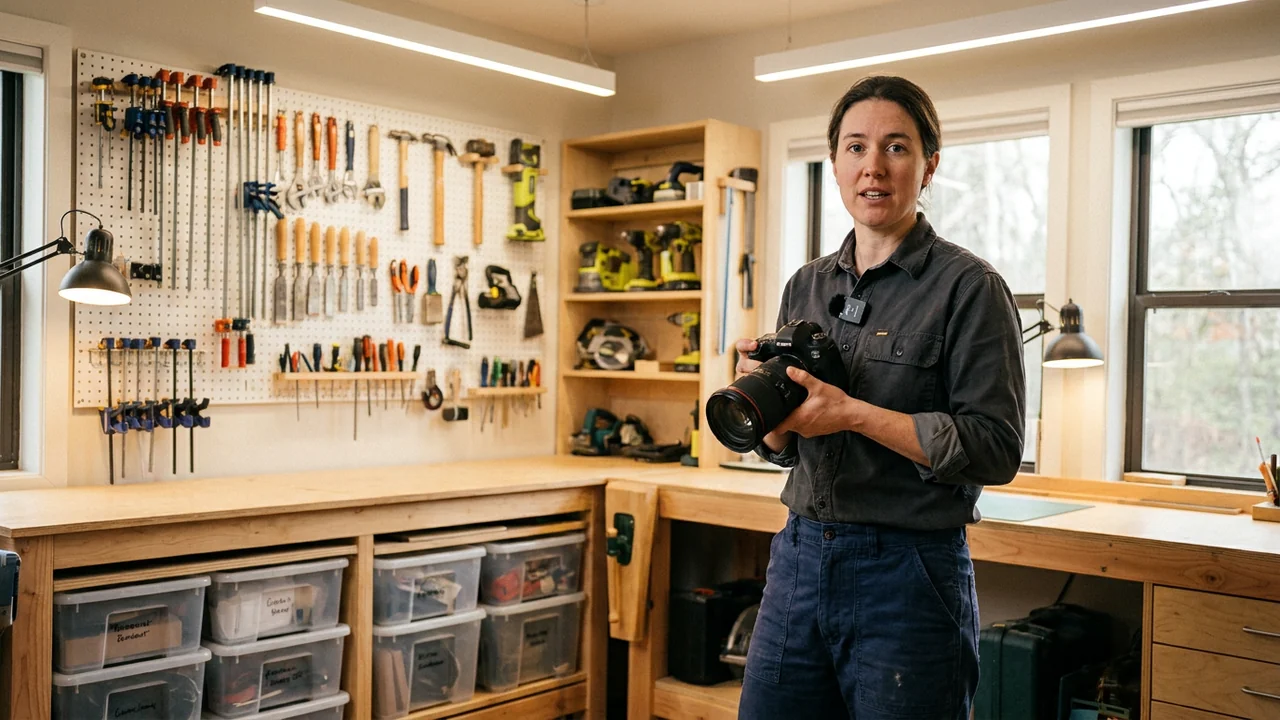
Most pre-loss walkthrough videos are painful to watch when an actual loss hits. The property owner walks briskly through a room pointing at furniture while saying, ‘Here’s our living room, we’ve got the couch, the TV, some lamps, and all the stuff in the closet.’ When a contents estimator opens that video six months later inside XactContents or Xactimate, that footage leaves the hardest pricing variables unanswered: Is the sofa top-grain leather or microfiber? Is the TV a 65-inch OLED or an entry-level LED? Are there four tailored wool suits in the closet or forty?
As highlighted in A Price Tag on a Lost Item Is Worth Nothing, estimators cannot defend Like-Kind-and-Quality (LKQ) pricing from vague labels. Whether the post-loss schedule is compiled manually by a contents specialist or parsed using speech-to-text and structured extraction tools aligned with NIST AI RMF human-review practices, output quality is strictly bounded by the spoken and visual signal captured on site.
Teaching clients and field PMs a repeatable spoken narration script turns casual smartphone footage into structured, line-item-ready evidence—without adding extra hours to the walkthrough.
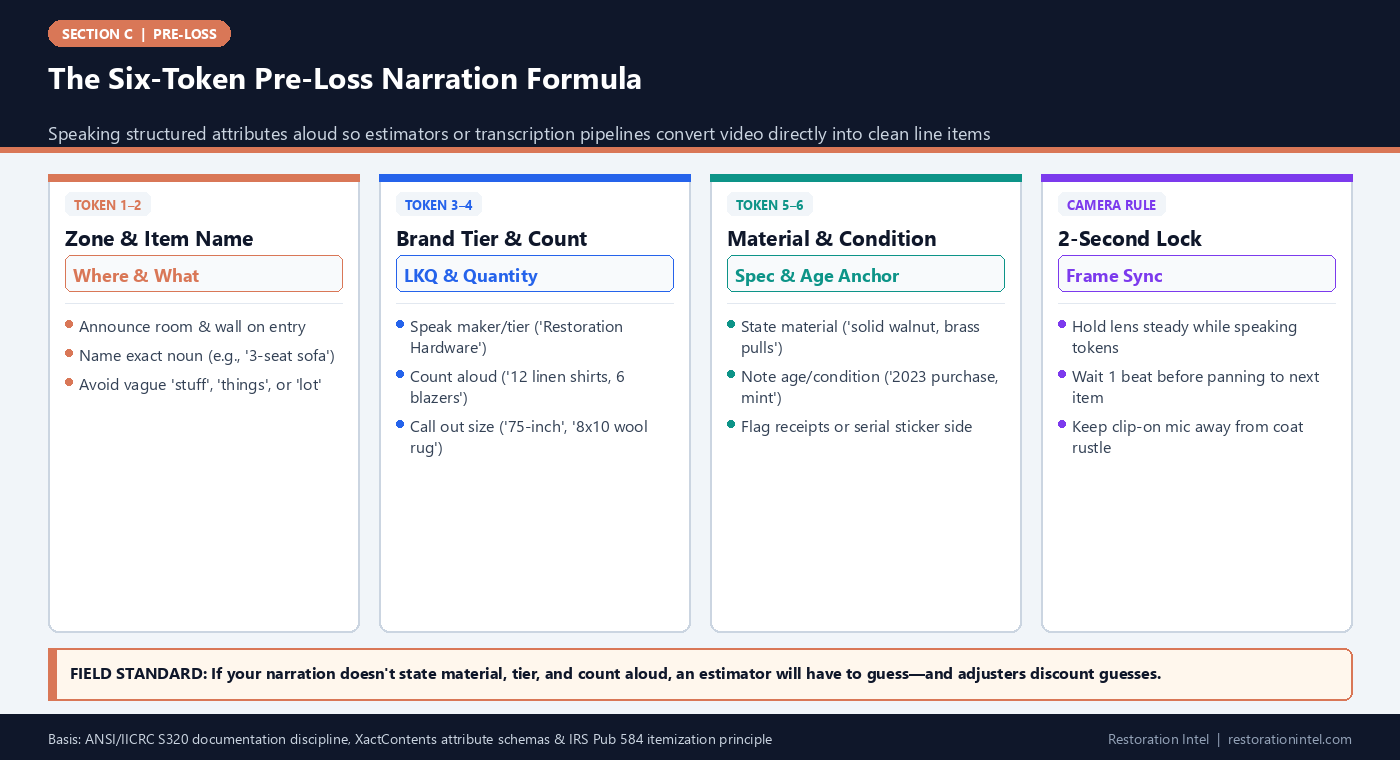
The Six-Token Pre-Loss Narration Formula
Unusable Casual Narration vs. Estimator-Ready Structured Narration
Exact spoken wording adjustments across residential and commercial rooms that convert raw video transcripts into actionable inventory specs.
| Space / Asset Group | Typical Casual Narration (Fails QA) | Structured Six-Token Script (Parse-Ready) | Visual Sync Action Required | XactContents Attribute Unlocked |
|---|---|---|---|---|
| Living Room Seating | 'Here's our nice sectional and rug in the front room.' | 'Living room, north wall: 4-piece top-grain leather sectional, Crate & Barrel, 2022, clean condition; 9×12 hand-knotted wool rug underneath.' | Pan corner-to-corner + tilt down to rug weave edge | Item type, seating capacity, material grade, brand tier, dimensions |
| Kitchen Appliance Wall | 'Got the fridge, stove, and microwave here.' | 'Kitchen, east wall: Sub-Zero 42-inch built-in stainless refrigerator, 2021; Wolf 36-inch 6-burner dual-fuel range; Bosch integrated dishwasher.' | Pause 2 seconds at eye level, then open door edge to frame rating plate | OEM brand, width/size, fuel/config class, built-in vs. freestanding |
| Primary Closet Wardrobes | 'Clothes on both sides and shoes at the bottom.' | 'Primary closet, left rod: 18 men's dress shirts, Nordstrom/Brooks Brothers tier; 6 wool suits; lower rack 9 pairs leather dress shoes.' | Slide hangers apart briefly to confirm density, then sweep shoe rack | Verified garment count, quality tier, fabric class (wool/leather) |
| Kitchen Cabinets & Drawers | 'Just normal dishes and pots and pans.' | 'Lower left island drawer: All-Clad 10-piece stainless cookware set, excellent condition; upper cabinet: 12-place ceramic dinnerware set and 16 crystal stems.' | Open drawer/door halfway and hold light steady for 2 seconds | Material (stainless/crystal), piece count, brand tier |
| Commercial Office Pod | 'Six desks with computers and monitors.' | 'Suite 200, Pod A: 6 Herman Miller Aeron chairs, 6 motorized sit-stand desks 60×30, 12 Dell 27-inch monitors, 6 docking stations, all 2023 install.' | Sweep full pod, then zoom 2 seconds on one desk label + monitor rear | Exact seat/desk model, screen size, per-station multiplier |
| Garage / Shop Tool Chest | 'All my Milwaukee tools and workbench stuff.' | 'Garage west bay: Husky 52-inch rolling tool chest; inside top drawers 8 Milwaukee M18 brushless tools, 6 batteries, 2 chargers, active use.' | Pull top 2–3 drawers open successively while counting tools | Brand platform, brushless vs. brushed tier, battery count |
Why Unscripted Walkthrough Videos Fail During Post-Loss Estimating
Walkthrough video is the fastest way to document high-volume rooms before a disaster, yet raw video carries a hidden trap: human speech naturally relies on pronouns and spatial gestures that vanish in a transcript or fast-moving clip. Saying ‘this one over here cost a fortune, and those two boxes in the corner are full of good china’ leaves a post-loss estimator staring at ambiguous pixels.
Even modern speech-to-text and structured extraction pipelines—which must always remain paired with human estimator verification per NIST AI Risk Management Framework governance—cannot invent specifications that were never spoken or shown cleanly. When a camera sweeps past an unlabeled black television or a dark mahogany credenza without pausing or naming the model tier, the downstream spreadsheet gets populated with ‘Unknown TV’ and ‘Wood Cabinet.’
Under ANSI/IICRC S320 and carrier audit practices, unattributed line items trigger automatic requests for clarification or lowest-tier replacement pricing. A disciplined script fixes the problem at the source while keeping capture time under an hour.
- No ‘this’ or ‘that’ pronouns: Always repeat the room zone and noun (‘Hall closet, top shelf: two Dyson cordless vacuums’) so isolated audio segments stand on their own.
- Compression destroys tiny text: Relying on video alone to read small brand logos on speakers or appliances fails under indoor lighting; speak the brand aloud.
- Close-the-loop timing: Spoken details only bind cleanly to the visual frame when the camera stays aimed at the subject until the sentence finishes.
The Six-Token Narration Syntax for Structured Line-Item Parsing
To make narration effortless under pressure, standardize every item callout around six predictable tokens in a fixed order: (1) Zone/Wall, (2) Item Noun, (3) Brand/Quality Tier, (4) Quantity or Size, (5) Material/Finish, and (6) Age/Condition/Anchor. For example: ‘Dining room, center: Restoration Hardware 96-inch solid oak trestle table, seats 8, 2021 purchase, very good condition; 8 upholstered linen side chairs.’
Notice how cleanly that single two-second sentence maps into XactContents and IRS Publication 584 workbook fields: Room = Dining Room; Description = Trestle Table; Manufacturer/Tier = Restoration Hardware / Luxury; Size = 96 in; Material = Solid Oak; Age = 2021; Qty = 1 table, 8 chairs. Neither a human estimator nor an automated parser has to guess a single column.
When the exact brand is unknown—such as inherited wood furniture or unbranded shelving—substitute an honest quality tier and construction cue instead of guessing: ‘Custom solid-cherry bookcase, dovetail joinery, mid-high craftsmanship, pre-2015, clean finish.’
- Fixed cadence reduces mental load: Practice the six-token rhythm on two pieces of furniture before hitting record; crews internalize it in five minutes.
- Honest tier proxies: If you don’t know the maker, state observable construction (‘solid wood vs. laminate veneer’, ‘commercial heavy-gauge stainless’, ‘handmade knotted wool’).
- Batch uniform sets aloud: Count homogeneous groupings (’24 matching hotel-grade white bath towels, clean stack’) instead of naming individual items.
Pacing, Camera Dwell Time, and Handling Multi-Item Closets Without Verbal Fatigue
The number one technical error in narrated walkthroughs is talking faster than the camera moves—or panning onto the sofa while still finishing the sentence about the bookshelf. Whenever audio and video drift out of sync, an estimator reviewing a frame-grab cannot tell which piece of furniture matches the spoken brand tier.
Enforce the ‘Point, Pause, Speak, Step’ cadence. Point the camera squarely at the target wall or open cabinet, hold completely still for half a second so optical autofocus locks, speak the concise six-token callout, pause half a second, and only then pan to the next bay. On high-density closets, kitchen pantries, and tool chests, do not try to read every jar or wrench individually—that causes verbal fatigue by minute fifteen and tempts crews to skip rooms altogether.
Instead, use category-tier bundling inside dense storage: open the pantry door, hold wide for two seconds, and narrate by shelf category (‘Three shelves dry baking goods and canned staples, approx. 60 units; lower shelf KitchenAid stand mixer, Cuisinart 14-cup processor, Vitamix blender’). That combination captures both bulk pantry density and marquee countertop appliances.
- One-subject rule per breath: Finish speaking about the credenza before swinging the lens toward the adjacent window drapery.
- Count aloud by category in closets: Group hanging garments into suits, coats, dresses, dress shirts, and casual tops with rough brand tier (‘mid-retail department store’ vs. ‘tailored designer’).
- Split long shoots into room clips: Record one separate video file per room (`04_Primary_Closet.mp4`) rather than one giant 40-minute clip so scrubbing post-loss takes seconds.
Scripts by Space Type: Living Areas, Kitchens, Commercial Suites, and Stockrooms
Different spaces emphasize different claim drivers, so tailor your spoken emphasis to the room. In residential living areas and offices, focus on furniture construction, area-rug fibers, window treatments (custom motorized shades vs. stock blinds), and wall-mounted displays. In kitchens and commercial food-service spaces, emphasize built-in vs. freestanding status, fuel type, cookware sets, and countertop small-appliance brands.
In commercial offices, medical clinics, and retail backrooms, shift your script toward repeatable workstation pods, IT/low-voltage racks, and proprietary equipment. Rather than narrating twelve identical exam rooms verbatim, narrate Room 101 in full detail as the ‘Standard Exam Pod Template’ and confirm in Rooms 102 through 112 only the serial tags or exceptions that differ.
In stockrooms and warehouses, narrate rack bay labels, SKU families, average pallet/carton fill levels, and whether inventory is seasonal or tied to an active ERP cycle count, pairing directly with Warehouse & Stockroom Pre-Loss Controls.
- Template shortcut for uniform suites: ‘Exam Room 104 matches Template A plus one Welch Allyn wall diagnostic unit, serial on still photo 14.’
- Window & flooring callout: Briefly state ‘custom Hunter Douglas motorized roller shades, 4 windows’—window coverings are routinely overlooked until burned.
- Built-in clarity cue: Explicitly say ‘freestanding’ vs. ‘hardwired/plumbed-in’ on commercial gear to prevent future leasehold vs. BPP confusion.
Quality Control: Audio Clarity, Timestamp Indexing, and Verifying Parse Readiness
Even the best narration script fails if HVAC blowers, echoing concrete warehouses, or rubbing jacket collars render speech unintelligible. Use a $20 wireless lavalier microphone clipped near the collarbone whenever recording in commercial mechanical spaces or echoes, and hold the phone slightly away from your face so heavy breathing never clips the audio track.
Before leaving the property, run a 30-second ‘parse-readiness QA check’ on two random clips. Mute the video first to test whether every frame shows clear lighting and steady pauses; then play the audio with your eyes closed to test whether you can write down room, item, tier, and count purely from the spoken words. If either half fails, re-shoot that room immediately while still on site.
Once uploaded to the cloud dossier, generate a plain-text transcript (or keep an index log of room clip filenames) alongside the video files. Storing both the raw video and a verified transcript guarantees estimators can search ‘Sub-Zero’ or ‘Aeron’ in two seconds on Day 1 of a claim.
- Clip-on mic discipline: Mute noisy exhaust fans temporarily if safe, or step close to a wall before narrating loud chiller/boiler rooms.
- Room-per-file naming: Name clips `01_Lobby.mp4`, `02_Server_Room.mp4`, `03_Kitchen.mp4` so post-loss triage targets only damaged rooms.
- Closed-eyes audio test: If a colleague cannot list three line items from your audio alone without looking at the screen, tighten your six-token cadence.
Practitioner Verification Checklist (C-04)
- Equip the walkthrough lead with a clip-on microphone, LED fill light, and a printed pocket card showing the six-token narration order.
- Record separate video clips per room/zone and announce the exact doorway room name within the first two seconds of every clip.
- Enforce the ‘Point, Pause, Speak, Step’ rhythm—holding the camera steady on each subject until the six-token callout finishes.
- Count high-density closets, drawers, and workstations aloud by category and quality tier rather than relying on vague pronouns.
- Run a closed-eyes audio check and muted visual check on sample clips before leaving site, then vault videos with searchable transcripts.
Standards, Authority References & Related Reading
Primary standards, insurance definitions, and sibling Restoration Intel guides referenced in this brief:
- ANSI/IICRC S320 Standard for Professional Contents Restoration
- Verisk XactContents Platform Overview
- Verisk Xactimate Estimating Platform
- NIST AI Risk Management Framework
- IRS Publication 584: Casualty, Disaster, and Theft Loss Workbook
- Related Guide: The Minimum Viable Pre-Loss Walkthrough: What Any Property Owner Can Capture in 45 Minutes
- Related Guide: Pre-Loss Serial Plate and Invoice Vaulting: Organizing Digital Proof So Fire or Flood Doesn't Destroy It
- Related Guide: Converting Architectural Plans and Matterport/3D Scans Into Pre-Loss Contents Baselines
- Related Guide: From Pre-Loss File to Day-1 Claim Schedule: How Estimators Reconcile Surviving vs Damaged Items After a Loss
- Related Guide: A Pack-Out Record Is Not a Priced Inventory
- Related Guide: A Price Tag on a Lost Item Is Worth Nothing
.md twin for desk QA and team training.Frequently Asked Questions
Do we need expensive AI transcription software to use this narration method?
No. The six-token script makes the video dramatically faster for human contents estimators to transcribe and price manually, while also ensuring any speech-to-text or structured extraction workflow produces clean, verifiable line items.
What if a property owner freezes up when trying to remember all six tokens on camera?
Print a one-line prompt card (‘Room -> Item -> Brand/Tier -> Count/Size -> Material -> Condition’) and tape it to the back of the smartphone or tablet case, or have a restoration PM read the prompts while the owner opens closets.
Should we speak serial numbers aloud on video?
For short, crisp labels you can read them aloud, but speaking 18-character serial strings slows momentum and invites transcription typos. State the brand and model aloud, and snap a dedicated macro still photo of the serial plate.
Is it better to record one continuous video of the whole property or separate clips per room?
Separate clips per room or zone are far superior. When a localized pipe burst affects only two rooms, estimators can pull those two clips immediately without scrubbing through 35 minutes of unrelated bedrooms.
Can we narrate rough estimated dollar values onto the video?
Avoid guessing retail replacement dollars aloud unless reading from an attached receipt in frame. Focus on observable facts—brand, model, dimensions, material, quantity, and purchase year—so estimators price accurately at current post-loss LKQ.