Direct Answer: Preventing transit and vault breakage requires engineering every carton as a load-bearing cell: double-walled dish-packs with H-taped bottom seams, crumpled-paper base and top buffers, vertical edge-standing plate orientation, snug void-free packing that eliminates internal rattle, and flush-filled lids under strict weight caps.
.md twin for estimator QA and carrier file documentation.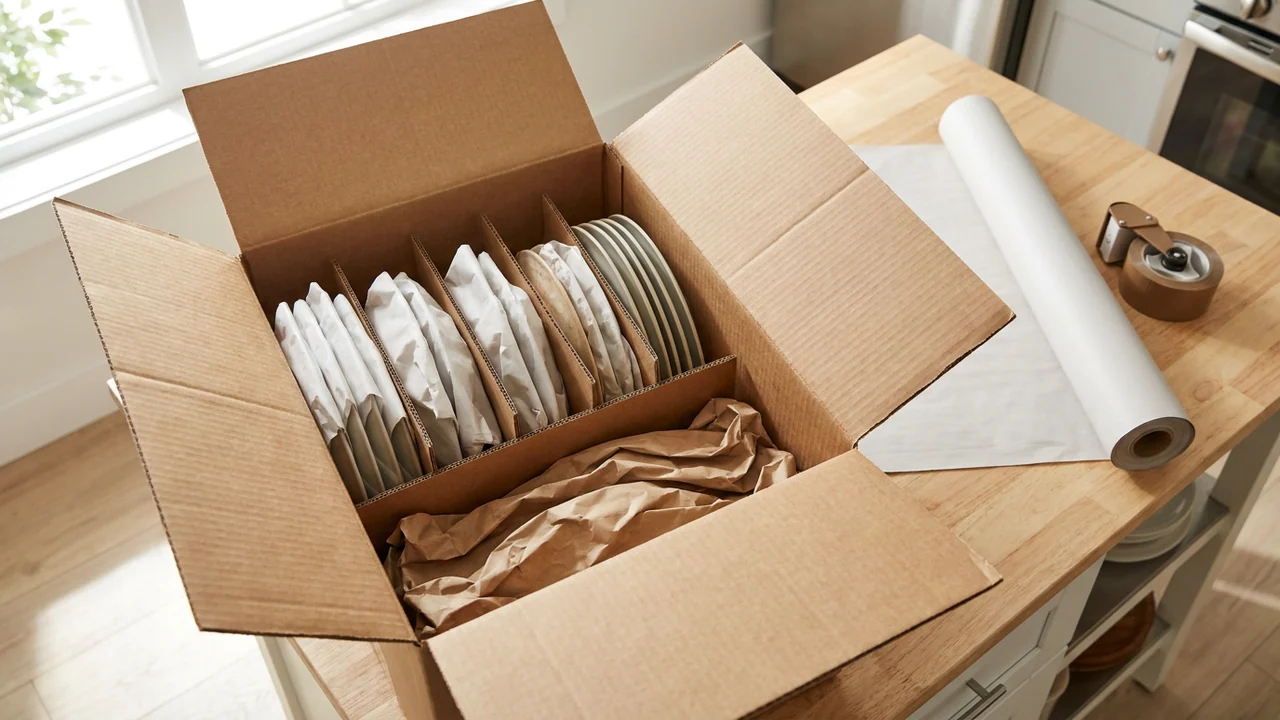
Every shattered stoneware platter or snapped figurine pulled out of a vault three months after pack-out erases profit twice: first in uncompensated replacement claims and customer trust, and second in the wasted labor spent cleaning, tracking, and storing an item that broke in transit. Yet most packing breakage is not caused by reckless truck driving—it is engineered right at the kitchen counter through bad box geometry.
Stacking dinner plates flat like pancakes puts the weight of twenty dishes directly on the brittle center span of the bottom plate. Leaving three inches of empty air at the top of a medium carton guarantees the lid collapses inward the moment another box lands on it inside a wooden vault. Using single-walled general cartons for cast-iron skillets and stoneware invites seam blowouts whenever humidity rises.
Consistent box packing craft under ANSI/IICRC S320 handling guidelines turns delicate residential and commercial pack-outs into predictable warehouse freight. When crews follow engineered dish-pack and carton-loading rules—paired with proper fragile wrapping SOPs—cartons ride over speed bumps, stack five-high in climate-controlled vaults, and unpack months later without a single chip.
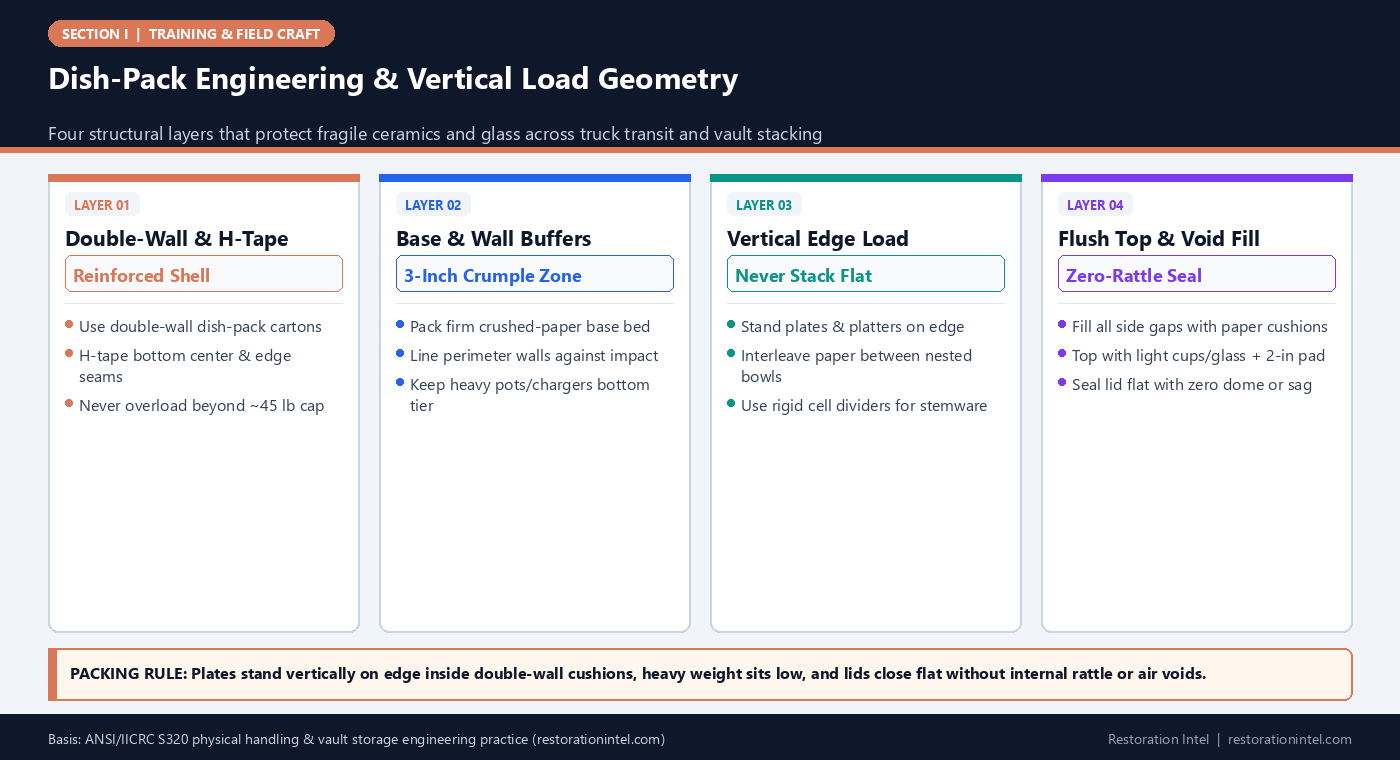
Dish-Pack Engineering & Vertical Load Geometry
Carton Selection, Weight Caps & Internal Geometry by Contents Class
Matching carton wall strength, orientation, and void-fill engineering to real-world vault stacking loads.
| Contents Class | Required Carton Type | Internal Orientation & Cushioning | Target Weight Cap | Primary Breakage Prevented |
|---|---|---|---|---|
| Dinner Plates, Platters & Baking Dishes | Double-wall Dish-Pack (18x18x28 or standard barrel) | 3-inch crushed paper bottom; wrapped plates standing vertically on edge; paper dividers between tiers | 40-45 lbs | Center-span flexural cracking from vertical vibration and overhead stack compression |
| Stemware, Crystal & Fine Glassware | Dish-Pack with corrugated cell-pack insert | Individually paper-wrapped stems/bowls stuffed inside rim; upright inside rigid cell pockets; upper tier only | 25-35 lbs | Rim chipping, stem snapping, and glass-on-glass point impact |
| Hardcover Books & Heavy Files | Small Book Carton (1.5 cu ft) | Spine-down or flat alternating bindings; never in medium/large boxes; fill voids with kraft paper | 35-40 lbs | Carton bottom blowout, spine tearing, and crew back-injury drops |
| Small Kitchen Appliances & Cast Iron | Dish-Pack bottom tier or heavy-duty 3.0 cu ft | Heavy base cushioned on crumpled paper; detach glass carafes/blades and wrap separately | 45 lbs max | Heavy metal punching through lighter ceramics or snapping plastic housings |
| Lampshades, Lightweight Decor & Pillows | Large / Extra-Large Carton (4.5-6.0 cu ft) | Never compress delicate silk/linen shades; pad bases separately; top-stack only in vaults | 20-25 lbs | Wire-frame shade distortion and permanent fabric creasing |
| Framed Art, Mirrors & Glass Tabletops | Telescoping Mirror / Picture Carton | Corner-board protectors; glass taped only on non-gilt, non-fragile frame edges or glassine-wrapped; stand vertically | 50 lbs | Corner miter separation and glass flex shatter during truck turns |
Carton Selection, H-Taping, and Weight-to-Volume Discipline
Breakage prevention starts before a single plate touches packing paper. Standard single-wall medium boxes work fine for folded linens, board games, and plastic toys, but they lose rigidity quickly under dense ceramic weight—especially in humid flood zones or multi-month storage stacks. Kitchen china, crystal, stoneware, and heavy small appliances belong strictly in double-walled dish-pack cartons whose fluted walls carry vertical stacking load without bowing.
Every box bottom gets an H-tape seal: one continuous 2-to-3-inch strip down the center seam overlapping at least three inches up the side walls, crossed by two perpendicular edge strips sealing the outer flap gaps. Single center strips peel open when boxes flex on hand trucks or absorb ambient shop moisture.
Equally important is enforcing volume-to-weight rules. Books, vinyl records, canned pantry goods, and tools go exclusively into 1.5-cubic-foot small cartons capped around 35 to 40 pounds. Filling a 4.5-cubic-foot large box with hardcover books creates a 90-pound wrecking ball that bursts seams and injures loaders.
- Rule of inverse size: The denser and heavier the object, the smaller the carton—save large boxes strictly for bulky, lightweight goods.
- Inspect used or damp stock: Never reuse crushed, damp, or soot-weakened homeowner cartons for off-site vault storage.
- Flat-seam check: Square the bottom flaps tightly before taping so the box sits level on concrete floors and pallet decks.
Bottom Buffers, Vertical Edge Loading, and Layer Separation
An unpadded carton floor transmits every road pothole and dolly bump straight into ceramic rims. Before placing any fragile item inside a dish-pack, technicians build a firm three-inch shock-absorbing bed of tightly crumpled newsprint cushions across the entire bottom perimeter—loose flat sheets compress to zero inches within minutes.
Next comes the golden rule of dish-pack engineering: plates, saucers, chargers, and serving platters always stand vertically on edge, never stacked horizontally like restaurant stacks. A vertical ceramic disc transfers downward load along its strongest curved rim rather than flexing across its thin flat center. Wrap each piece individually in two to three sheets of clean newsprint, group small stacks of two or three wrapped plates inside a cushioned bundle, and stand them side by side across the lower tier.
Once the heavy lower tier is packed tight with zero wobble, lay a rigid double-wall corrugated pad or thick paper-cushion divider flat across the top before starting the lighter upper tier—nesting bowls on edge, mugs, and cell-packed stemware. Never drop a heavy casserole dish directly above delicate wine glasses.
- Crumple density test: Base paper cushions should bounce back firmly when pressed with an open palm—flat wads give zero protection.
- Interior hollow fill: Stuff crumpled newsprint gently inside ceramic pitchers, teapots, and stemmed bowls before outer wrapping so walls resist inward pinch.
- Corrugated tier pads: Keep cut cardboard divider sheets at every packing station to isolate heavy platters below fragile glassware.
Eliminating Side Voids and Engineering Flat, Stackable Carton Tops
Inside a wooden storage vault, cartons routinely stack four to six feet high for sixty to one hundred eighty days during structural rebuilds. Two geometry mistakes cause 80 percent of vault-stack collapses: under-filled tops that dish inward under overhead weight, and over-stuffed tops that dome outward so upper boxes rock and topple.
After loading the top tier of glassware or lightweight kitchenware, pack firm paper cushions into every corner gap along the inside walls so nothing can shift laterally during truck braking. Then top the entire box with a smooth two-inch paper compression layer that brings contents dead level with the inner flap crease.
Before taping the lid shut, run the two-second crew verification test: press lightly on the center of the closed flaps and give the box a gentle side-to-side shake. If you hear any clink, feel empty give under the lid, or see the flaps bulging upward into a tent, open the box and adjust fill right at the counter.
- Corner-void packing: Pack extra crumpled paper firmly into all four vertical box corners where round bowls leave triangular air pockets.
- Zero-rattle standard: Any audible glass tap during a gentle bench shake automatically rejects the carton for immediate repack.
- Flat-top stackability: Closed flaps must meet squarely with no upward crown so vault loaders can build stable, level tiers.
Specialty Frames, Electronics Padding, and Documenting Pre-Pack Chips
Box geometry failures also happen when technicians try to squeeze oversized mirrors, framed oil paintings, or flat-screen monitors into improvised cardboard sleeves. Framed art and glass tabletops require telescoping mirror cartons sized to the frame width, padded with foam edge protectors, and carried strictly upright on edge—never laid flat under furniture in the truck.
For small kitchen electronics and ceramic lamps, remove detachable glass shades, harp finials, coffee carafes, and food-processor blades first, wrapping each component separately inside the same carton or pairing them with clear box-manifest notes so nothing vanishes between cleaning and reassembly.
Finally, protect the company before wrapping begins: if a porcelain figurine has a glued arm or a stoneware platter already carries a hairline crack, photograph the existing flaw beside its inventory tag before wrapping paper covers it. Documenting pre-existing damage separates honest prior wear from transit liability under clean chain-of-custody records.
- Pre-wrap chip photo: Capture macro proof of existing cracks, chipped rims, or loose glued joints before paper touches the piece.
- Mirror-box tape warning: Keep packing tape off gilded, painted, or delicate wood picture frames—wrap in kraft paper or glassine first.
- Separate detachable glass: Never pack a glass blender jar mounted on its motor base or a lampshade installed on a ceramic lamp.
Practitioner Verification Checklist (I-05)
- Match dense items (books, cans, stoneware) to small or double-wall dish-pack cartons under strict 35-to-45-pound weight caps.
- H-tape bottom center and edge seams on every carton and build a firm 3-inch crumpled-paper base cushion before loading.
- Stand wrapped plates, chargers, and flat platters vertically on edge rather than stacked horizontally, separating tiers with corrugated pads.
- Stuff hollow vessels and pack all four vertical corner voids until a gentle shake test produces zero internal shift or rattle.
- Finish with a 2-inch top paper cushion flush to the flap line so lids tape completely flat for safe multi-tier vault stacking.
Standards, Authority References & Related Reading
Primary standards, insurance definitions, and sibling Restoration Intel guides referenced in this brief:
- ANSI/IICRC S320 Standard for Professional Contents Restoration
- Restoration Industry Association (RIA)
- IRMI Insurance Glossary: Salvage
- OSHA 1910.132 Personal Protective Equipment Standard
- Related Guide: The 30-Day Field Contents Technician Onboarding Curriculum: From Zero Experience to Audit-Ready Capture
- Related Guide: Barcode, QR, and Color-Coded Tape Vault Labeling Systems That Survive Humidity and Stacking
- Related Guide: Fragile Glassware, Stemware, and Crystal Wrapping SOPs for Fire and Water Pack-Outs
- Related Guide: Truck Loading, Vault Mapping, and Climate-Controlled Rack Indexing for Multi-Month Claims
- Related Guide: Nobody Could Tell Me Where the Rug Was
.md twin for desk QA and team training.Frequently Asked Questions
Why should dinner plates be packed standing on edge instead of stacked flat?
Plates stacked horizontally concentrate downward compression and truck vibration across the weak flat center of the bottom dishes. Standing wrapped plates vertically on edge transfers load along the stronger outer rim.
How much empty space should remain at the top of a packed dish-pack box?
None. Finish with roughly two inches of firm crumpled packing paper flush with the top crease so the taped lid sits completely flat and supports stacked boxes above it in a vault.
What is the safe weight limit for a packed contents carton?
Cap small book cartons around 35 to 40 pounds and double-wall dish-packs around 40 to 45 pounds so cartons maintain seam strength and technicians can handle them safely without drops.
Should technicians use newspaper for wrapping fire or water contents?
Use clean unprinted newsprint packing paper, kraft paper, or white tissue instead of printed newspaper, whose ink transfers permanently onto damp porcelain, painted wood, and light upholstery.