Direct Answer: Laboratory pack-out demands pre-move OEM fluid purging and mechanical transit locks, separate temperature-controlled custody for specimens versus dry vaults for hardware, ESD and shock-monitored crating, and formal metrological or NSF/ANSI 49 recertification before clinical or research operations resume.
.md twin for estimator QA and carrier file documentation.
Moving a laboratory instrument incorrectly causes more irreversible damage than the smoke or water event that prompted the pack-out. Picking up an unpurged HPLC system lets mobile-phase acetonitrile leak onto power supplies; transporting an analytical balance without engaging its shipping lock shears the electromagnetic weigh cell; rolling an ultracentrifuge with an unlocked chamber or unremoved rotor scores spindle bearings; and stacking lab electronics inside an unconditioned residential contents truck introduces humidity corrosion and electrostatic discharge.
Under ANSI/IICRC S320 and Chain-of-Custody Pack-Out Standards, laboratory pack-out is a disciplined engineering transfer rather than a blanket-and-box move. Every instrument requires verified de-energization, EHS bio/chemical clearance, OEM-specified mechanical shutdown, and isolated storage matched to its sensitivity.
Equally critical is knowing what restoration crews must never pack: live biological specimens, select agents, controlled substances, radioactive check sources, and active hazardous reagents. EHS & Clinical Compliance Disclaimer: Restoration personnel may pack and store cleared, decontaminated physical hardware only; biological sample cold-chain transfers, select agents, radioactive materials, and hazardous chemicals require licensed couriers, EHS oversight, and qualified OEM/metrology engineers for return-to-service recertification.
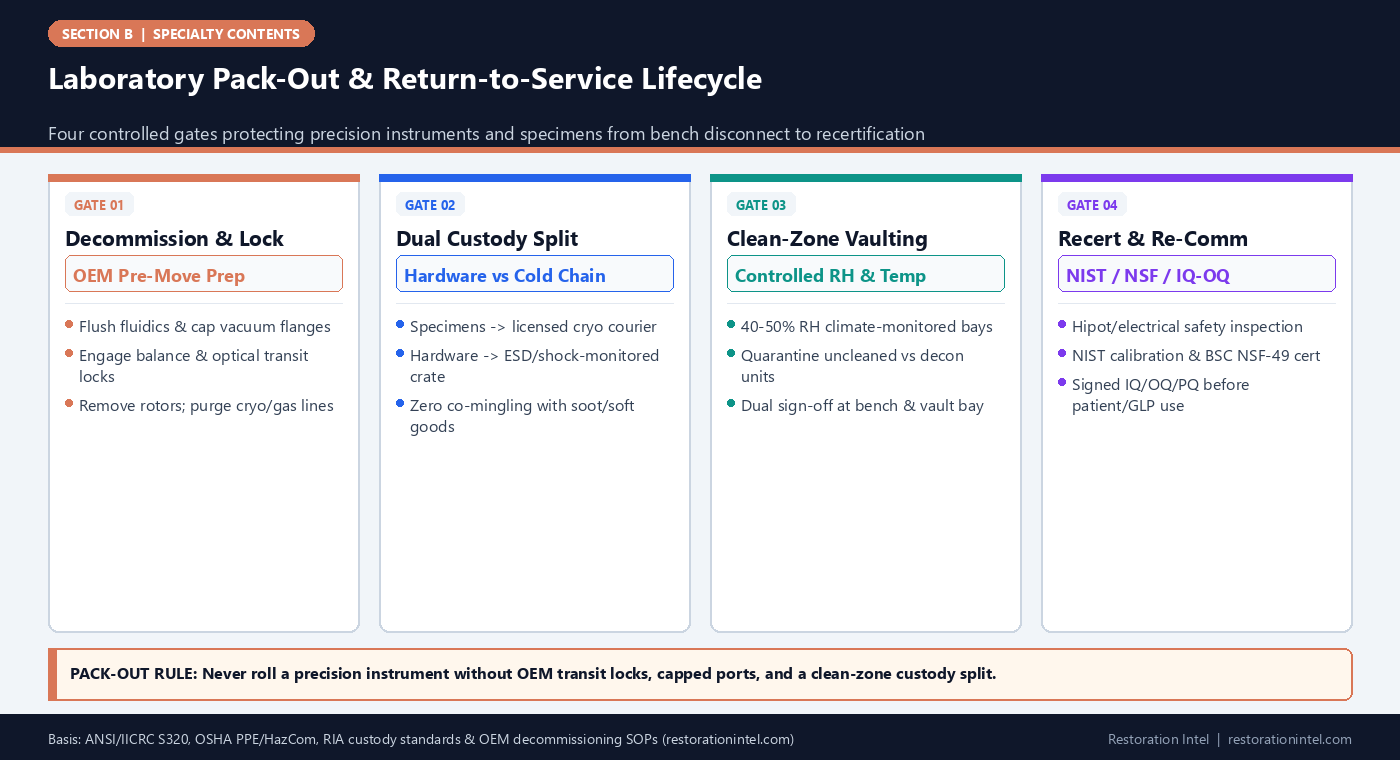
Laboratory Pack-Out & Return-to-Service Lifecycle
Laboratory Asset Pack-Out, Transport & Recertification Protocol
Required pre-move stabilization, specialized packaging, storage environment, and return-to-service gate by lab hardware class.
| Asset Category | Mandatory Pre-Move Decommissioning | Packaging & Transit Controls | Vault / Storage Requirement | Return-to-Service Recertification |
|---|---|---|---|---|
| HPLC / UHPLC & LC-MS Stacks | Flush buffers/solvents with OEM storage fluid; cap PEEK lines & KF/CF vacuum ports | ESD inner bag, custom foam-in-place crate, upright ShockWatch/TiltWatch tags | Clean climate-controlled vault (40–50% RH); never expose to ozone | OEM re-plumbing, vacuum leak check, mass calibration & OQ/PQ run |
| Analytical Balances & Microtomes | Clean pan/stage; engage OEM shipping arrestment screw; remove draft glass separately | Double-boxed rigid suspension crate; keep upright only | Vibration-isolated shelf away from forklift traffic | Leveling, internal/external NIST calibration cert & linearity check |
| Ultracentrifuges & Bench Centrifuges | EHS bio-decon bowl; remove rotors to padded cases; lock spindle/motor per OEM | Bolt-down pallet crate; wrap rotors individually with cycle logbook | Dry, climate-controlled rack; keep rotor logbook paired to rotor tag | Spindle balance check, overspeed sensor verification & PM sign-off |
| Biosafety Cabinets (BSCs) | Certified gas/VHP decon prior to disconnect; bag/seal sash & exhaust collar | Heavy air-ride flatbed/van; floor-load locking straps; zero stacking | Segregated clean indoor bay; protect HEPA plenum from dust | Post-reset NSF/ANSI 49 airflow, downflow & HEPA integrity recert |
| Microscopes & Laser Optics | Park motorized stages; remove objectives & filter cubes to padded OEM cases | Vibration-damped Pelican/foam cases; silica desiccant packs (non-dusting) | Climate-controlled security cage; logged key access | Optical alignment, laser power verification & stage calibration |
| Cryo Freezers & Biological Samples | DO NOT pack specimens with hardware; transfer samples via licensed LN2/dry-ice courier | Backup generator/LN2 monitoring if in place; empty/defrost unit before move | Continuous data-logged biorepository for samples; dry bay for empty unit | 21 CFR Part 11 thermal mapping & alarm verification before reload |
Pre-Move OEM Decommissioning, Fluid Purging, and Transit Locks
Standard contents pack-out crews are trained to wrap furniture and box dishware quickly. Turning that speed loose on a research bench creates catastrophic secondary damage claims. Before an analytical instrument leaves its counter, either the OEM field service engineer, the lab’s trained instrument custodian, or a specialist working strictly under OEM decommissioning instructions must prepare the machine for physical movement.
Fluidic instruments—HPLC pumps, autosamplers, automated stainers, and liquid handlers—must be flushed free of corrosive buffers, salts, and volatile organic solvents, left in approved storage solution or purged dry, and capped cleanly. Mass spectrometers must vent vacuum chambers gracefully, lock turbomolecular pump rotors if required by the manufacturer, and seal exposed KF or CF vacuum flanges with clean metal or Viton caps. Analytical balances, microtomes, and automated optical stages rely on mechanical shipping screws or arrestment locks that protect delicate bearings and force-restoration cells from road shock.
Equally critical is disconnecting power and data cables cleanly: follow the color-coded port-mapping discipline in Electronics Disconnection & Cable Mapping and pack OEM license dongles, calibration weights, and power bricks inside a labeled accessory pouch strapped directly to the parent crate.
- Engage every shipping lock: Verify mechanical transit screws on analytical balances, laser stages, and centrifuge drives before lifting.
- Purge and cap fluidics: Never transport instruments holding active buffers, corrosive acids, or uncapped vacuum ports.
- Keep accessories married: Bag power supplies, capillary kits, rotor keys, and software USB dongles inside a serialized pouch tied to the chassis crate.
Splitting Biological Cold-Chain Custody From Physical Hardware Pack-Out
During an emergency power outage, roof breach, or fire, lab directors panic first about temperature-sensitive biologicals: patient diagnostic specimens, frozen cell lines, tissue banks, and high-value enzymes inside -20°C and -80°C freezers. When HVAC or power fails, restoration teams are sometimes asked to stabilize or relocate freezers immediately.
Here the custody boundary must be absolute. General restoration trucks and climate-controlled contents vaults are built for furniture and dry equipment—not regulated medical specimens, infectious agents, or hazardous materials. If samples must be relocated to preserve viability, coordinate an immediate emergency transfer using a licensed biorepository or medical cold-chain courier equipped with validated dry-ice shippers, liquid-nitrogen dewars, and continuous NIST-traceable temperature data loggers.
Only after specimens are safely transferred—and the freezer has been defrosted, sanitized, and cleared by facility EHS—should the physical cabinet enter standard restoration rigging custody. Document the exact timestamp, courier manifest number, and custodian signature separating the biological chain of custody from the equipment claim file.
- Never haul active bio-specimens: Route patient samples, cell lines, and biohazards exclusively through licensed cold-chain couriers.
- Stabilize first if power is out: Coordinate temporary backup generators or dry-ice staging under Extra Expense before moving heavy -80°C cabinets.
- Continuous thermal logs: Preserve digital probe exports showing continuous cabinet temperatures across every custody handoff.
ESD Packaging, Shock Indicators, and Clean-Zone Vault Segregation
Once cleared and locked, laboratory hardware requires packaging far stricter than corrugated dish packs and moving blankets. Bare circuit assemblies, detector modules, and acquisition workstations require static-shielding ESD bags and non-shedding polyethylene foam; loose newsprint or recycled cellulose packing peanuts shed abrasive paper dust directly into optical bays and cooling vents. Heavy floor-standing equipment must be bolted or strapped to shock-absorbing pallets inside rigid crates.
Attach calibrated ShockWatch and TiltWatch indicators to the exterior of every high-value instrument crate and photograph the unactivated indicators at bench departure and again upon vault arrival. That single visual step eliminates disputes over whether a cracked optical mount happened during the fire suppression discharge or during highway transit.
Inside the restoration warehouse, quarantine laboratory hardware in a dedicated, humidity-controlled clean zone (typically 40–50% RH). Never store lab equipment alongside fire-damaged residential upholstery, inside active ozone deodorization chambers (ozone rapidly oxidizes Viton seals, silicone tubing, and elastomeric O-rings), or near dusty demolition wood crates.
- Zero paper dust or ozone: Ban newsprint wrapping and keep all lab seals, tubing, and optics strictly out of ozone treatment rooms.
- Shock & tilt telemetry: Photograph intact ShockWatch/TiltWatch stickers at pack-out, vault intake, and final lab reset.
- Clean-zone vaulting: Maintain separate racked bays for decontaminated lab gear with restricted badge/key access and barcode tracking.
Chain-of-Custody Controls for High-Value, Regulated, and Subrogation Assets
Laboratory pack-outs carry heightened legal and audit stakes: DEA-registered labs, HIPAA clinical laboratories, university federally funded grants, and potential equipment-origin subrogation files all demand unbroken paper and digital traceability. Before any box leaves the facility, secure dual signatures—crew lead and lab director or EHS representative—on a serialized manifest showing each item’s asset tag, serial number, condition grade, and container barcode.
If controlled substances, DEA Schedule II–V kits, or licensed radioactive sources exist inside the room, follow High-Sensitivity Legal Exclusions strictly: restoration personnel must never touch, transport, or vault DEA-controlled materials or licensed isotopes. Leave them under locked institutional custody and document the exclusion explicitly on the sign-off sheet.
Where an appliance or lab heater is suspected of causing the loss, log and hold the unit intact in an evidence-locked cage with tamper-evident seals per Evidence Preservation & Spoliation-Hold Rules.
- Exclude DEA & isotope items: Document that controlled drugs and radioactive check sources remained strictly in institutional custody.
- Dual-signed manifests: Capture timestamped barcode scans plus signatures at room exit, truck loading, vault placement, and reset.
- Tamper-seal evidence holds: Place suspected origin units in sealed, uncleaned custody cages pending joint engineering inspection.
Return-to-Service Recertification and IQ/OQ/PQ Sign-Off Gate
Resetting a cleaned or stored instrument back onto a lab bench is not the end of the claim—it is the start of the recertification gate. Even an instrument that sat untouched in a climate-controlled clean vault during building reconstruction has experienced power cycling, physical transport, and environmental shifts that invalidate prior calibration and validation status.
Before clinical testing or regulated research resumes, coordinate a structured re-commissioning sequence with the facility’s biomedical engineering team and OEM field engineers: electrical safety/hipot inspection, utility purity verification (lab gases and DI water), mechanical leveling, NIST-traceable metrology calibration, NSF/ANSI 49 field certification on biosafety cabinets, and full IQ/OQ/PQ operational qualification runs.
Archive every signed calibration certificate, NSF report, and OEM commissioning sign-off directly inside the claim closeout dossier alongside the unpack reconciliation sheet. That paper trail closes carrier recoverable-depreciation holdbacks cleanly and protects the laboratory during its next CAP, CLIA, FDA, or ISO 17025 audit.
- Never ‘plug-and-go’: Require electrical safety check and OEM commissioning before lab staff power up relocated analytical hardware.
- Close the validation loop: Collect new NIST calibration certificates and IQ/OQ/PQ sign-off sheets before closing the claim file.
- Reconcile at reset: Verify ShockWatch status, serial plates, and accessory pouches with the lab director during Reset & Unpack Reconciliation.
Practitioner Verification Checklist (B-11)
- Verify EHS clearance and complete OEM fluid purging, vacuum capping, and mechanical shipping locks before lifting any lab instrument.
- Separate biological specimens and temperature-sensitive reagents into licensed cold-chain couriers—never co-mingle them in general restoration vans.
- Package cleared electronics and optics in ESD-safe bags and non-shedding foam with active ShockWatch and TiltWatch indicators.
- Exclude DEA-controlled substances and licensed radioactive sources from restoration custody and record the exclusion on signed manifests.
- Store laboratory hardware in a segregated, climate-controlled clean vault zone strictly isolated from ozone chambers and soot-damaged goods.
- Schedule OEM electrical check, NIST calibration, NSF/ANSI 49 BSC certification, and IQ/OQ/PQ sign-off before releasing instruments back to service.
Standards, Authority References & Related Reading
Primary standards, insurance definitions, and sibling Restoration Intel guides referenced in this brief:
- ANSI/IICRC S320 Standard for Professional Contents Restoration
- OSHA 1910.132 Personal Protective Equipment Standard
- OSHA 1910.1030 Bloodborne Pathogens Standard
- Restoration Industry Association (RIA)
- NIST Organization of Scientific Area Committees for Forensic Science
- IRMI Insurance Glossary: Subrogation
- Related Guide: Research & Clinical Laboratories: Capture, Serial & Provenance Logging
- Related Guide: Research & Clinical Laboratories: Cleanability vs Total-Loss Triage
- Related Guide: Research & Clinical Laboratories: Valuation, LKQ Sourcing & Policy Traps
- Related Guide: Field Guide: Chain-of-Custody Form Elements & Pack-Out Sign-Off Template
- Related Guide: Field Guide: High-Sensitivity Legal Exclusions — Firearms, Medications, Cash, Jewelry, and Passports
- Related Guide: Field Guide: Evidence Preservation & Spoliation-Hold Rules on Subrogation and Arson Investigations
- Related Guide: OEM Calibration, Recertification, and Warranty Preservation Costs on Contents Schedules
.md twin for desk QA and team training.Frequently Asked Questions
Why can't restoration crews use standard ozone chambers to deodorize lab equipment?
Ozone aggressively degrades Viton seals, silicone gaskets, rubber O-rings, optical coatings, and delicate circuit-board traces inside analytical instruments. Lab hardware should be isolated in clean climate-controlled storage and decontaminated using OEM-approved methods.
Who disconnects and purges HPLC systems or mass spectrometers prior to pack-out?
Ideally the OEM field service engineer or the lab’s trained instrument custodian performs fluid purging, vacuum venting, and transit locking under documented SOPs before restoration riggers crate and move the unit.
Can a restoration vault hold -80°C frozen research samples temporarily during repairs?
No. Biological samples, clinical specimens, and regulated reagents require validated biorepository or licensed cold-chain medical couriers with continuous temperature monitoring—not general contents warehouses.
What proves an instrument wasn't damaged by the moving crew during pack-out?
Photographed pre-move mechanical transit locks, ShockWatch and TiltWatch indicators scanned at departure and delivery, ESD/foam crating photos, and dual-signed chain-of-custody manifests protect both the lab and the restoration contractor.
When is a relocated lab instrument officially ready for clinical or GLP use again?
Only after qualified OEM or biomedical engineers complete post-reset electrical safety checks, NIST-traceable calibration, biosafety cabinet NSF/ANSI 49 testing where applicable, and signed IQ/OQ/PQ operational qualification.