Direct Answer: Laboratory valuation fails when estimators price bare catalog equipment without accounting for coupled system dependencies, discontinued OEM-refurbished LKQ limits, air-ride rigging, IQ/OQ/PQ commissioning costs, and commercial policy traps like reagent-rental ownership, pollutant sublimits, and sunk R&D exclusions.
.md twin for estimator QA and carrier file documentation.
Pricing a destroyed residential living room requires retail links and a depreciation table. Pricing a damaged research or clinical laboratory requires untangling interlocking system architectures, third-party equipment contracts, and commercial policy sublimits that routinely catch general estimators off guard. A missing $14,000 detector module can sideline an entire $120,000 chromatography system; a seemingly bargain used instrument on a broker website may be unserviceable by the OEM; and an unscheduled pollutant-cleanup cap can leave the insured paying tens of thousands of dollars out of pocket for RCRA chemical disposal.
Under IRMI Replacement Cost Value (RCV) and Like Kind and Quality (LKQ) rules, an accurate laboratory claim schedule must reflect functional, regulatory, and software equivalence—not merely matching a similar brand name from an online auction listing. It must also include the mandatory ancillary costs required to return the bench to certified operation: factory crating, climate-controlled air-ride freight, cleanroom rigging, and OEM IQ/OQ/PQ commissioning.
Equally important is reading the commercial property policy’s boundaries before submitting final numbers. Policy & Valuation Disclaimer: Commercial BPP, Building, Tenant Improvements & Betterments (TIB), Valuable Papers, and Pollutant Cleanup terms vary materially across ISO and manuscript carrier forms; this brief outlines common claim-structuring mechanics and is not legal advice or coverage interpretation.
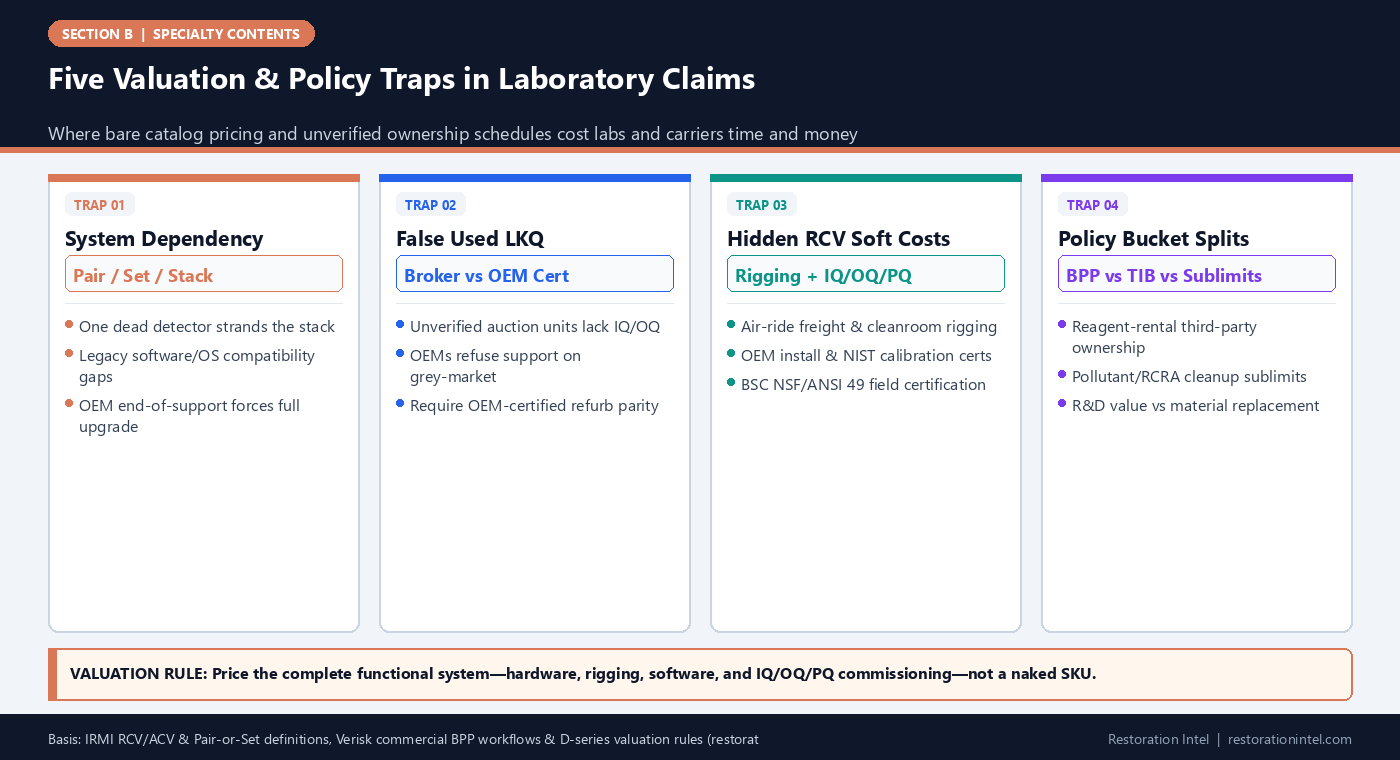
Five Valuation & Policy Traps in Laboratory Claims
Laboratory Valuation, LKQ & Policy-Bucket Mapping Matrix
How commercial estimators align lab equipment, consumables, and ancillary costs with defensible RCV/LKQ proof and policy buckets.
| Lab Cost Element | Common Estimating Mistake | Defensible LKQ / RCV Standard | Primary Policy Bucket / Trap | Required Supporting Evidence |
|---|---|---|---|---|
| Discontinued Analytical Instruments (HPLC / MS / PCR) | Using unverified online auction/eBay prices as LKQ | OEM-certified refurbished unit with warranty or current-gen OEM equivalent | Replacement Cost vs Functional Obsolescence / Pair-or-Set | Written OEM End-of-Service notice + OEM quote for compatible model |
| OEM Installation, IQ/OQ/PQ & Calibration | Omitting post-delivery commissioning from RCV schedule | Include factory install, NIST calibration, and IQ/OQ/PQ qualification | May be excluded if omitted from initial hardware RCV bid | Itemized OEM commissioning quote tied to pre-loss cal records |
| Reagent-Rental & Leased Clinical Analyzers | Claiming full asset RCV under insured's owned BPP | Route per contract indemnity terms / lessor's property coverage | Care, Custody, and Control / Third-Party Property sublimits | Executed reagent-rental or master lease agreement + lessor notice |
| Hard-Ducted Fume Hoods, DI Loops & Walk-In Cold Rooms | Putting plumbed/ducted fixtures into loose BPP contents | Classify via commercial lease TIB vs Landlord Building rules | Building vs Tenant Improvements & Betterments (TIB) split | Commercial lease repair/fixture clause + MEP install invoice |
| Custom Antibodies, Primers & Proprietary Samples | Claiming years of scientist payroll/R&D labor inside BPP | Material replacement cost (synthesis/vendor cost) unless R&D endorsed | Stock/Supplies valuation vs Valuable Papers / R&D endorsement | Vendor synthesis invoices; flag R&D/Extra Expense policy check |
| EPA RCRA Hazardous Chemical Lab-Pack Disposal | Burying hazmat disposal inside generic debris removal | Segregate regulated pollutant/hazmat cleanup and manifest fees | Pollutant Cleanup & Removal sublimit (often tightly capped) | Licensed RCRA manifest quote + itemized spoiled chemical log |
Coupled System Dependencies and the 'Pair or Set' Reality on Lab Benches
In laboratory instrumentation, replacement cost is governed by system interoperability as much as individual hardware pricing. Suppose a fire destroys the quadrupole mass detector and acquisition workstation of a seven-year-old LC-MS/MS platform, while the binary pump and autosampler survive in an adjacent room. If the OEM has discontinued that detector generation—and current detectors require updated firmware, proprietary CAN/LAN communication boards, and newer operating-system drivers incompatible with the surviving seven-year-old pump—replacing only the detector leaves the lab with an inoperable bench.
Under IRMI Pair or Set and functional-system valuation concepts, estimators must document technical backward-compatibility explicitly rather than pricing orphaned components in isolation. Obtain a written OEM compatibility statement showing whether surviving modules can integrate with current detectors, or whether a full coupled stack replacement is required to restore pre-loss analytical output.
The same dependency applies to proprietary consumables and rotors: if an ultracentrifuge chassis is discontinued and current models no longer accept the lab’s surviving titanium rotors, document the stranded accessory value clearly.
- Compatibility letter first: Request written OEM confirmation before assuming a new module will communicate with surviving legacy pumps or LIMS PCs.
- Software & OS lock-in: Price instrument-control workstations and validated software licenses alongside the detector when legacy OS drivers fail on modern hardware.
- Stranded rotor & accessory audit: Check whether surviving centrifuge rotors, objective lenses, or autosampler racks fit the proposed LKQ replacement chassis.
Sourcing Defensible LKQ on Discontinued and OEM-Certified Equipment
When a damaged analytical instrument is out of production, both contractors and desk examiners struggle with Like Kind and Quality (LKQ) sourcing. Adjusters naturally resist paying $180,000 for a flagship current-generation mass spectrometer if an eight-year-old unit was damaged; meanwhile, labs legitimately reject a $15,000 ‘as-is’ listing from an online surplus liquidator with unknown contamination history, missing vacuum pumps, and zero manufacturer support.
True LKQ for regulated clinical or research laboratories requires matching both analytical performance (detection limits, mass accuracy, throughput) and serviceability/qualification status. If the insured operated under an active OEM service contract or ISO 17025 accreditation prior to the loss, an uncertified broker unit that the OEM refuses to inspect or place under contract is not Like Kind and Quality. Defensible LKQ in that scenario is either an OEM-certified refurbished instrument carrying a factory warranty and IQ/OQ eligibility, or the nearest current-generation OEM model with appropriate depreciation applied where ACV applies.
Document three concrete comparables in the valuation packet following LKQ Matching Rules: OEM current-equivalent quote, OEM-refurbished availability check, and written end-of-support dates.
- Reject ‘as-is’ auction comps: Surplus listings without warranty, calibration history, or guaranteed OEM serviceability do not satisfy clinical/GLP LKQ.
- Verify end-of-service dates: Attach OEM end-of-life/end-of-support bulletins to justify transitioning from a discontinued model to its current successor.
- Pair ACV vs RCV clearly: Use condition-adjusted effective age supported by pre-loss NIST calibration logs per IRMI ACV principles.
Capturing Commissioning, Freight, Rigging, and Calibration in RCV
A laboratory instrument sitting on a loading dock inside a wooden crate is not a replacement—it is an unvalidated box. High-precision analytical gear requires specialized white-glove, air-ride, climate-controlled shipping; liftgate or crane rigging over tight corridors; utility hookups (high-purity gas regulators, chilled water, dedicated circuits); and on-site OEM engineering hours to run installation, operational, and performance qualification (IQ/OQ/PQ).
On a single LC-MS, confocal microscope, or biosafety cabinet replacement, crating, freight, rigging, de-installation of the condemned chassis, and post-install metrology certification routinely add 10 to 25 percent on top of the instrument SKU. Estimators who copy a bare catalog price into XactContents understate real replacement cost dramatically and force contentious supplemental claims months later.
As outlined in OEM Calibration, Recertification, and Warranty Preservation Costs, break out rigging, factory freight, initial calibration, and IQ/OQ/PQ as explicit, OEM-quoted line items tied directly to the parent asset tag.
- Quote delivered-and-commissioned: Request turnkey OEM quotes separating instrument hardware, air-ride freight, installation, and IQ/OQ/PQ.
- De-install & haul-away lines: Include specialized de-installation, oil/gas purging, and rigging labor for heavy floor-standing centrifuges and mass specs.
- BSC & hood recert fees: Price mandatory post-install NSF/ANSI 49 or ASHRAE 110 field certification on replacement cabinets and hoods.
Navigating Commercial Policy Traps: Reagent Rentals, TIBs, and Sublimits
Even a flawlessly priced equipment schedule can hit coverage walls if policy buckets are misassigned. Five recurring policy traps appear in laboratory losses: first, reagent-rental and leased clinical analyzers where legal ownership remains with the vendor or finance company; second, Tenant Improvements and Betterments (TIB) disputes over hard-ducted fume hoods, walk-in cold rooms, epoxy bench casework, and purified-water loops under the Commercial Tenant vs Landlord Split.
Third, Pollutant Cleanup and Removal sublimits—standard commercial property forms often cap hazardous pollutant extraction and disposal at a fixed dollar limit (such as $10,000 or $25,000 per premises), which an EPA RCRA lab-pack cleanup of hundreds of compromised chemical bottles can exhaust rapidly. Fourth, valuation of custom-synthesized biologicals, plasmids, or research specimens: standard BPP covers physical replacement cost of materials/media, not sunk scientist salaries or speculative IP value, unless specialized R&D, Valuable Papers, or Extra Expense endorsements apply.
Fifth, Ordinance or Law boundaries when replacing a damaged 20-year-old chemical fume hood triggers modern building codes requiring variable-air-volume (VAV) exhaust upgrades or dedicated make-up air interlocks.
- Audit vendor contracts early: Pull reagent-rental, lease, and service agreements to see who bears risk of loss before claiming hardware under BPP.
- Flag pollutant sublimit exposure: Separate RCRA chemical disposal estimates early so the insured and adjuster know if pollutant caps are approached.
- Separate material vs R&D cost: Price destroyed reagents and custom synthesis at documented vendor cost per Commercial BPP Stock & Consumables Valuation, while alerting the insured to review Valuable Papers/R&D endorsements.
Structuring a Multi-Quote Lab Claim Packet for Commercial Desk Review
Commercial contents examiners rarely reject well-organized specialty claims because of price alone; they delay files when supporting evidence is scattered across dozens of unlabeled PDFs. Build the laboratory valuation packet around a master asset schedule keyed to the field capture IDs from B-08 and the triage dispositions from B-09.
For every high-value instrument, group four documents in one subfolder: (1) serial plate, NIST calibration sticker, and damage macro photos; (2) OEM or biomedical teardown/non-recertifiability report; (3) itemized OEM turnkey replacement or repair quote (hardware + freight + rigging + IQ/OQ/PQ); and (4) ownership/lease verification.
Summarize BPP owned assets, leased/reagent-rental items, TIB/Building fixtures, and RCRA pollutant disposal in distinct summary tabs so the adjuster can issue undisputed partial advances on clean BPP items immediately while complex sublimit or lease questions are resolved.
- Bucketed summary tabs: Split owned BPP instruments, consumables/reagents, leased/third-party units, TIB fixtures, and RCRA disposal into separate rollups.
- Zero unsubstantiated lump sums: Tie every dollar of commissioning, rigging, or software licensing to a named vendor quote or tariff.
- Audit sublimit ceilings: Check pollutant, electronic data, and valuable-papers sublimits upfront as outlined in Sublimit Allocation Strategy.
Practitioner Verification Checklist (B-10)
- Evaluate coupled analytical systems for module backward-compatibility and OS/software dependencies before pricing partial replacements.
- Substantiate LKQ on discontinued instruments using OEM-certified refurbished quotes or written OEM end-of-support notices—not unverified surplus listings.
- Include crating, air-ride climate-controlled freight, cleanroom rigging, de-installation, and IQ/OQ/PQ commissioning in RCV calculations.
- Segregate leased and reagent-rental analyzers from facility-owned BPP schedules and attach underlying contract risk-of-loss clauses.
- Separate hard-ducted fume hoods, walk-in cold rooms, and utility manifolds into Building vs TIB buckets per the active commercial lease.
- Track EPA RCRA chemical disposal against commercial pollutant cleanup sublimits and price destroyed reagents at verified material replacement cost.
Standards, Authority References & Related Reading
Primary standards, insurance definitions, and sibling Restoration Intel guides referenced in this brief:
- IRMI Insurance Glossary: Replacement Cost Value (RCV)
- IRMI Insurance Glossary: Actual Cash Value (ACV)
- IRMI Insurance Glossary: Pair or Set Clause
- IRMI Insurance Glossary: Depreciation
- Verisk XactContents Platform Overview
- US EPA Hazardous Waste Framework
- Related Guide: Research & Clinical Laboratories: Capture, Serial & Provenance Logging
- Related Guide: Research & Clinical Laboratories: Cleanability vs Total-Loss Triage
- Related Guide: Research & Clinical Laboratories: Pack-Out, Chain of Custody & Recertification
- Related Guide: OEM Calibration, Recertification, and Warranty Preservation Costs on Contents Schedules
- Related Guide: Leased, Financed, and Vendor-Consigned Equipment: Handling Third-Party Ownership on a Contents Inventory
- Related Guide: Like Kind and Quality (LKQ) Replacement Matching: Rules for Discontinued Brands and Obsolete Models
- Related Guide: Sublimit Allocation Strategy When Total-Loss Specialty Items Exceed Policy Caps
.md twin for desk QA and team training.Frequently Asked Questions
Are IQ/OQ/PQ qualification and NIST calibration costs covered as part of lab equipment RCV?
Yes, in most commercial replacement-cost settlements, reasonable factory installation, initial NIST calibration, and mandatory IQ/OQ/PQ commissioning required to restore the replacement unit to its pre-loss operational state are part of full RCV when itemized on OEM quotes.
Why won't a surplus eBay listing work as LKQ for a clinical or GLP instrument?
Unverified surplus hardware typically lacks documented provenance, valid software licensing, and OEM warranty/service eligibility. If the pre-loss instrument was NIST-calibrated and OEM-supported, defensible LKQ requires an OEM-certified refurbished unit or current equivalent.
Who covers a reagent-rental diagnostic analyzer damaged in a lab flood?
Coverage depends on the vendor contract’s risk-of-loss and indemnity clauses as well as the facility’s Care, Custody, and Control or third-party property terms. Never include vendor-owned units as owned BPP without disclosing the contract.
Does a commercial BPP policy pay for years of lost R&D scientist time inside ruined cell cultures or samples?
Standard BPP generally covers physical material replacement cost of media, reagents, and stock—not historical labor or intellectual value—unless specialized R&D, Valuable Papers, or Business Income/Extra Expense endorsements provide specific coverage.
Why do lab chemical disposal bills hit policy caps so quickly?
Standard commercial property policies often carry modest Pollutant Cleanup and Removal sublimits (frequently $10,000 to $25,000), and lab-packing, profiling, and manifesting mixed laboratory chemicals under EPA RCRA is far costlier per pound than ordinary debris.