Direct Answer: Commercial stock pack-out splits inventory into three sealed pallet streams—clean/protected stock, restorable SKU lots, and quarantined total-loss stock—tracked by lot-indexed pallet manifests through climate-controlled vaulting, brand-witnessed destruction, or QA recertification.
.md twin for estimator QA and carrier file documentation.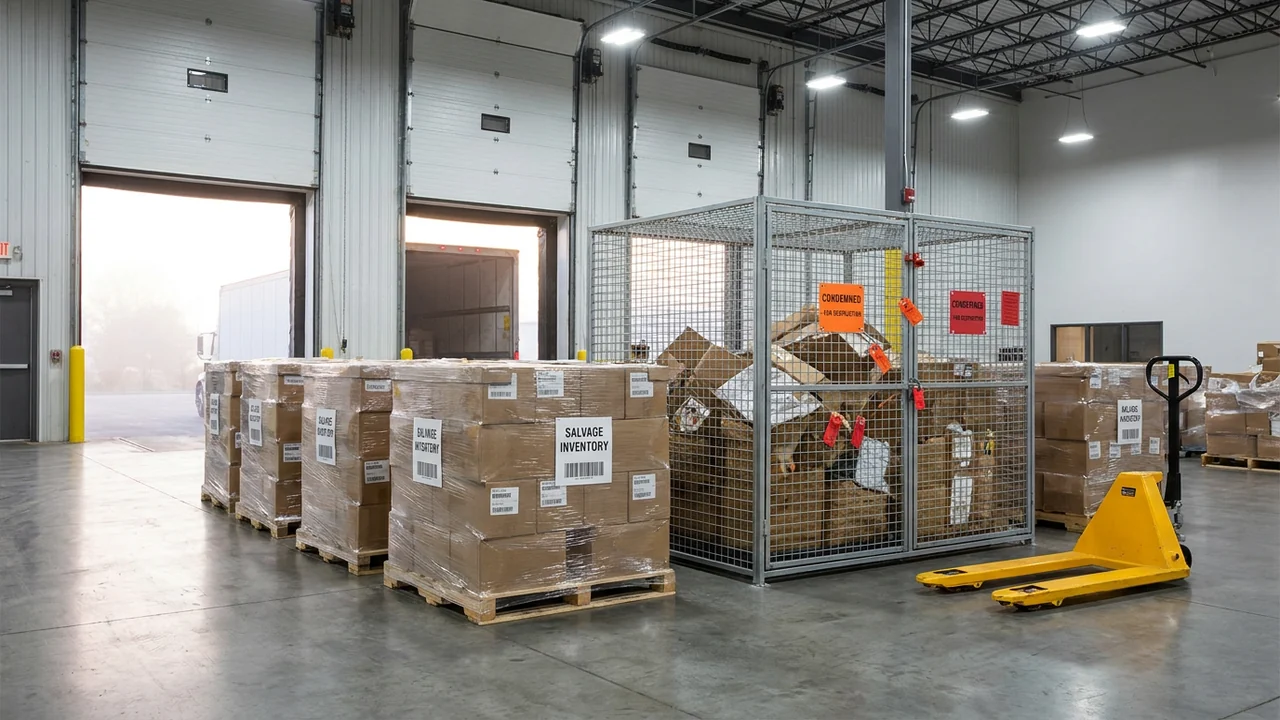
Moving damaged merchandise out of a retail store or distribution center is an industrial logistics operation, not a household box pack-out. When a crew packs 300 mixed SKUs into unmarked brown cartons without pallet-level lot indexing, surviving goods pick up soot from neighboring contaminated boxes in the truck, restorable stock loses its barcode traceability, and condemned merchandise disappears before the brand owner or carrier salvage auditor can witness its destruction.
Under ANSI/IICRC S320 and RIA commercial pack-out standards, every physical movement of commercial stock must preserve both material segregation and audit-grade chain of custody. A store manager or carrier examiner should be able to point to any SKU on the Day-1 capture log and trace which sealed pallet holds it, which climate-controlled vault bay stores it, or which witnessed-destruction manifest retired it.
Just as critical is closing the loop at the end of the job: obtaining documented manufacturer or quality-assurance recertification for restored stock before restocking, executing compliant disposal for hazardous or brand-restricted goods, and verifying planogram-accurate resets. Authorization & compliance disclaimer: Brand-owner destruction sign-offs, hazardous-waste manifests, and product recertification clearances must be issued by the authorized brand representative, licensed waste hauler, or OEM quality team—not self-certified by the pack-out contractor.
Commercial Stock Pack-Out, Custody & Disposition Pipeline
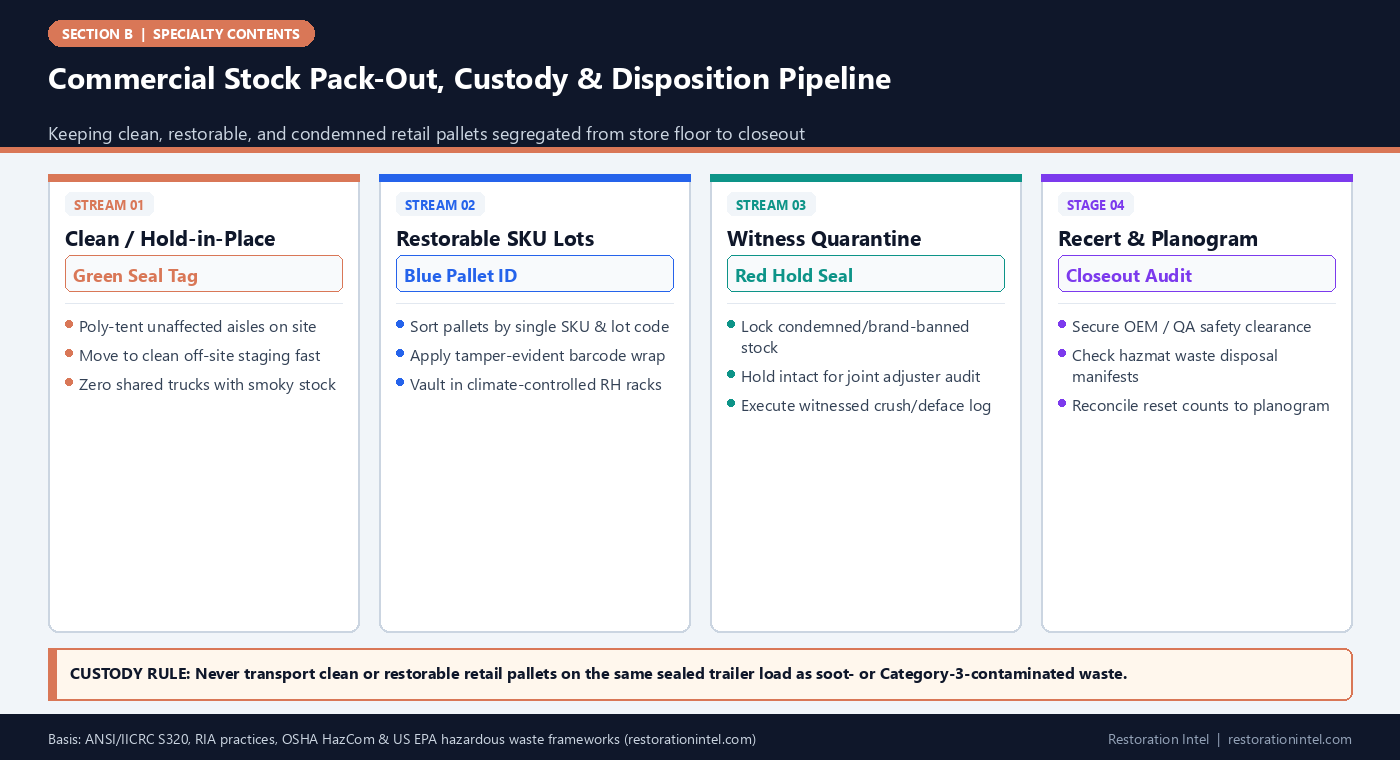
Commercial Stock Three-Stream Pack-Out, Custody & Disposition Matrix
Operational controls across clean stock protection, restorable vault processing, witnessed destruction, and commercial reset.
| Operational Stream | Segregation & Packaging | Custody & Seal Tracking | Disposition / Recertification Gate | Closeout Sign-Off Artifact |
|---|---|---|---|---|
| Stream A: Undamaged / Clean Stock | 6-mil poly containment or clean cleanroom trailer move | Green pallet ID + clean-zone vault bay log | Visual & RH check prior to store reopening | Clean-release count matched to ERP surviving balance |
| Stream B: Restorable Stock & Fixtures | Single-SKU/lot palletizing + corner boards + stretch wrap | Blue barcode pallet ID + numbered seal tag | Batch cleaning pilot + OEM/QA inspection clearance | Written QA/OEM recertification & pack-back tally |
| Stream C1: Non-Hazardous Total-Loss Stock | Dedicated staging zone or locked roll-off bin | Red quarantine ID + SKU/lot witness sheet | Joint adjuster inspection + disposal authorization | Signed J-05 disposal log + landfill weight ticket |
| Stream C2: Brand-Restricted Total-Loss Stock | Tamper-sealed pallets in restricted vault cage | Dual-control seal numbers + serial/lot manifest | Brand-rep inspection + witnessed crushing/defacing | Notarized/signed brand Certificate of Destruction |
| Stream C3: Regulated Hazmat / Aerosols / Li-Ion | UN-rated drums, vented poly, or non-conductive bins | OSHA HazCom SDS binder + EPA generator ID | Licensed hazardous-waste hauler pickup only | EPA Uniform Hazardous Waste Manifest / bill of lading |
| Store Fixtures, Shelving & POS Hardware | Blanket-wrapped gondolas + ESD anti-static bags for POS | Fixture ID + cable-port photo map per checkout lane | IT/POS diagnostic power-on test before re-mount | Planogram & checkout-lane operational sign-off |
Three-Stream Floor Segregation Before Any Pallet Moves
Cross-contamination during pack-out turns partial retail losses into avoidable total losses. When a pack-out crew loads lightly exposed canned goods or clean seasonal apparel into the same box truck carrying charred drywall debris or wet protein-smoke cartons, off-gassing and soot transfer ruin the surviving merchandise before it reaches the warehouse.
Establish three color-coded physical streams and separate staging lanes before rolling a single pallet jack: Green for unaffected stock requiring clean protective poly or immediate clean-truck transfer; Blue for restorable SKU lots routed to restoration processing; and Red for non-salvageable or brand-restricted total-loss stock held for witness verification.
Keep each Blue pallet homogeneous whenever possible—grouping by single SKU and lot code rather than building mixed “grab-bag” pallets—so vault technicians can pull, clean, or test entire batches without tearing down twenty mixed skids.
- Clean-truck separation: Never co-mingle Stream A/B merchandise with Stream C smoke-saturated or Category-3 waste on the same trailer.
- Hazmat pull-out first: Isolate leaking aerosols, pool chemicals, automotive fluids, and damaged lithium-ion retail packs under OSHA HazCom and EPA hazardous waste rules before shrink-wrapping pallets.
- Cross-link triage criteria: Enforce the physical gates defined in B-59 cleanability triage before wrapping Stream B skids.
Lot-Indexed Pallet Manifests and Tamper-Evident Chain of Custody
High-value retail pack-outs require tighter chain of custody than standard household vaults because SKU shrinkage, pilferage, or mis-counts directly affect commercial financial audits. Applying the principles of field chain-of-custody documentation, every pallet or Gaylord container receives a unique serialized barcode placard listing origin aisle/bay, SKU list, lot codes, unit count, stream color, and the initials of the lead technician who sealed it.
For locked-cage electronics, designer goods, liquor, or high-value tools, wrap pallets in opaque black stretch film and secure a numbered tamper-evident security seal across the pallet cap or trailer roll-up door. Record seal numbers on the bill of lading at departure and verify unbroken seal numbers upon vault check-in.
Inside the restoration vault, assign dedicated commercial rack bays with climate monitoring—keeping relative humidity stable so cardboard retail cartons do not slump, canned seams do not flash-rust, and leather or footwear stock does not bloom with mold during multi-month structure rebuilds.
- Master pallet index: Maintain a live vault rack map linking every pallet barcode to its exact rack bay, aisle, and inbound seal number.
- Opaque wrap for high-theft SKUs: Conceal high-value retail electronics and luxury merchandise in opaque black film with dual-signature tamper seals.
- Vault RH telemetry: Log daily temperature and relative humidity inside commercial stock vaults to defend against storage-deterioration claims.
Brand-Owner Witnessed Destruction and De-Branding Protocols
When brand agreements or safety regulations mandate total-loss destruction rather than salvage resale, casual dumping is a contractual violation. Brand owners, franchisors, and specialty insurers often require either an on-site brand compliance representative or a third-party witness to observe physical destruction—crushing, shredding, slicing garments, punching cosmetic jars, or defacing serial plates—so counterfeit or damaged goods never leak into gray markets.
Before scheduling destruction, verify three written approvals in the claim file: (1) the adjuster’s signed non-salvageable disposal authorization, (2) the insured’s property release, and (3) the brand owner’s written destruction protocol specifying witness rules, de-branding requirements, and disposal method.
During execution, record time-stamped video and photos showing pallet seal removal, lot/SKU verification, physical defacing or compactor/crusher destruction, and certified landfill or licensed waste-facility weigh tickets, culminating in a signed Certificate of Destruction.
- Pre-destruction triple sign-off: Never crush or haul brand-restricted stock without written concurrence from insured, adjuster, and brand representative.
- Video-verified de-branding: Capture uninterrupted visual proof when defacing logos, cutting power cords, or crushing serialized housings.
- Licensed waste manifests: Route batteries, solvents, and electronic stock through certified e-waste or hazardous-waste haulers with retained manifests.
Hazmat Isolation, Subrogation Evidence Holds, and Multi-Month Storage Controls
Large retail and warehouse pack-outs routinely uncover regulated materials mixed directly into general shelving: pressurized spray paints, automotive solvents, pool oxidizers, lithium-ion power-tool packs, and refrigerated or frozen food pallets. Loading leaking chemical cases or fire-stressed lithium cells into an enclosed vault trailer creates immediate transport and storage ignition hazards. Following hazmat and lithium-ion stabilization protocols, crews must segregate damaged batteries into non-conductive vermiculite-lined drums and manifest regulated retail chemicals through licensed disposal vendors rather than vaulting them alongside dry goods.
Simultaneously, check whether the loss carries third-party subrogation exposure—such as a failed roof drain, a burst fire sprinkler head, a defective lithium battery charger, or an electrical panel failure. Under evidence preservation and spoliation-hold rules, never discard, pressure-wash, or crush stock or shelving sitting immediately beneath the origin point until subrogation engineers and opposing experts inspect and release the evidence zone in writing.
- Origin-zone hold perimeter: Rope off pallets and racking directly under failed sprinkler heads or origin shelving until written subrogation clearance is logged.
- Hazardous SKU manifest: Separate aerosols, flammables, oxidizers, and lithium-ion retail packs at intake using SDS sheets and UN-rated containment drums.
- Cold-chain separation: Isolate thawed or power-outage perishables immediately from dry-goods vaults so spoilage odors never migrate into clean Stream A/B pallets.
QA Recertification, Warranty Clearance, and Planogram-Ready Pack-Back
Restored commercial stock cannot simply be wheeled back onto a sales floor because it looks clean to a pack-out crew. Before Stream B pallets leave the restoration plant, establish clear recertification gates tailored to the product class: written OEM or authorized service-center sign-off confirming factory warranty remains valid for tested appliances or tools, independent odor/soot-clearance verification for soft goods, or manufacturer QA acceptance for re-cased hardlines.
If the pack-back phase involves store fixtures, gondola runs, and point-of-sale hardware, coordinate re-installation against the retailer’s official floor planogram and IT cabling map rather than dropping pallets randomly in the center aisle. POS terminals, barcode scales, and security pedestals require supervised power-on and network testing alongside the store’s IT vendor before reopening day.
Close the custody chain using structured unpack verification and reconciliation protocols adapted to commercial bin receiving—reconciling every returned SKU and lot count against the original Day-1 Stream B manifest.
- OEM clearance letters: Attach written manufacturer or authorized-technician recertification statements to any restored serialized equipment or stock.
- Planogram staging: Deliver returned pallets sequenced by store department and aisle number so store merchandisers can restock immediately.
- Receiving reconciliation: Require dual sign-off from the store manager and pack-out lead confirming zero unlogged pallet variances at closeout.
Practitioner Verification Checklist (B-61)
- Segregate site stock into three color-coded streams (Clean/Hold, Restorable SKU Lots, Witness Quarantine) before loading trucks.
- Pull aerosols, chemicals, and damaged lithium-ion stock first under OSHA HazCom and EPA waste protocols.
- Apply serialized barcode pallet placards and tamper-evident trailer/pallet seals tracked into climate-controlled vault racks.
- Secure written adjuster, insured, and brand-owner authorization before executing witnessed destruction or de-branding.
- Obtain written QA/OEM recertification on restored Stream B lots and reconcile pack-back counts against the store planogram.
Standards, Authority References & Related Reading
Primary standards, insurance definitions, and sibling Restoration Intel guides referenced in this brief:
- ANSI/IICRC S320 Standard for Professional Contents Restoration
- Restoration Industry Association (RIA)
- OSHA Hazard Communication Standard (HazCom)
- US EPA Hazardous Waste Framework
- IRMI Insurance Glossary: Salvage
- Related Guide: Retail Merchandising & Warehouse Stock: Capture, Serial & Provenance Logging
- Related Guide: Retail Merchandising & Warehouse Stock: Cleanability vs Total-Loss Triage
- Related Guide: Retail Merchandising & Warehouse Stock: Valuation, LKQ Sourcing & Policy Traps
- Related Guide: Field Guide: Chain-of-Custody Form Elements & Pack-Out Sign-Off Template
- Related Guide: Field Guide: Non-Salvageable Disposal Authorization & Witness-Log Template
.md twin for desk QA and team training.Frequently Asked Questions
Why must restorable retail stock be packed as single-SKU or single-lot pallets?
Mixed grab-bag pallets destroy SKU traceability, force crews to unstack entire skids to test one lot, and block store managers from reconciling returned inventory back into their ERP receiving module.
What makes brand-owner witnessed destruction different from normal debris haul-off?
Brand owners often require formal witness presence, photo/video proof of logo defacing or crushing, serial/lot logs, and a signed Certificate of Destruction so damaged branded goods never enter secondary discount markets.
How do we protect surviving stock during multi-month commercial store rebuilds?
Move unaffected stock into clean, climate-controlled vault bays monitored for temperature and humidity, keep it completely isolated from smoky or wet pallets, and seal high-value skids with tamper-evident tags.
Who can issue recertification for restored retail electronics or safety merchandise?
Only the original manufacturer (OEM), an authorized warranty service center, or an appropriately credentialed quality-assurance authority—not the restoration contractor alone.
What documents close out the commercial chain of custody at pack-back?
A complete closeout file pairs the Day-1 frozen ERP reconciliation and pallet manifests with vault RH logs, signed J-05 destruction certificates (for Stream C), QA clearance letters (for Stream B), and store-manager receiving sign-offs.