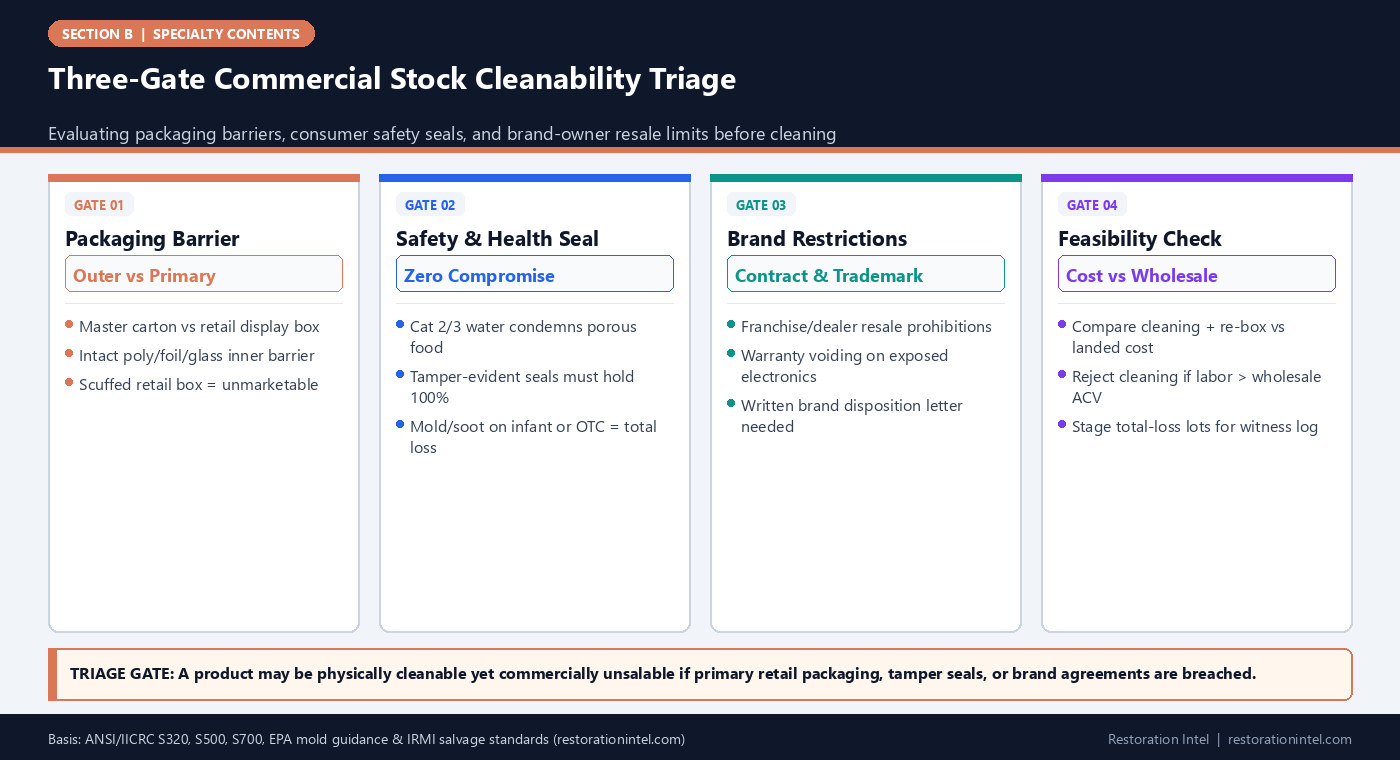
Direct Answer: Commercial stock triage evaluates three sequential gates—outer vs. primary packaging integrity, consumer-safety and regulatory seal status, and brand-owner salvage restrictions—before testing whether cleaning or re-boxing is economically feasible against wholesale landed cost.
.md twin for estimator QA and carrier file documentation.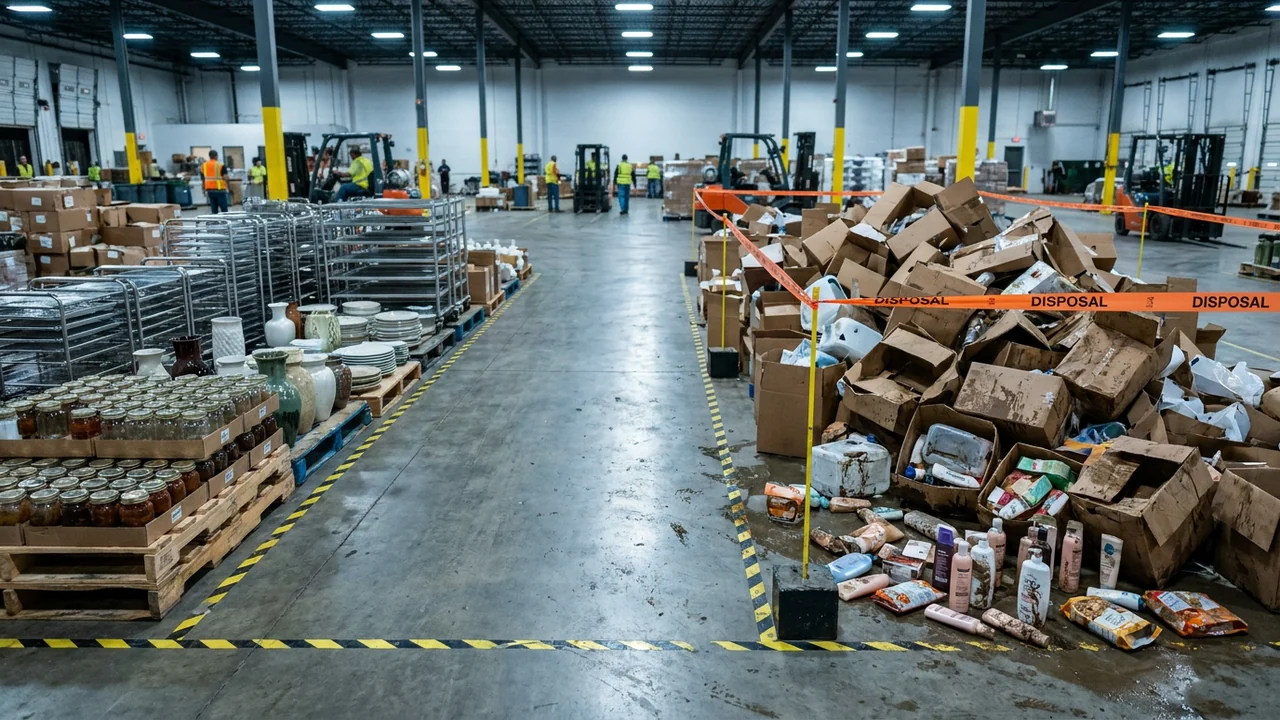
Cleanability triage in a retail store or warehouse follows fundamentally different rules than residential contents restoration. A homeowner may gladly accept a professionally cleaned ceramic lamp or deodorized winter coat back into their closet once it meets ANSI/IICRC S320 cleanliness criteria. A commercial retailer, by contrast, cannot place a soot-scented dress shirt, a water-stained retail gift box, or an unsealed cosmetic jar back onto a sales floor as brand-new merchandise.
At the same time, blanket condemning an entire warehouse simply because smoke entered the building or sprinkler water wetted the bottom pallet tier triggers sharp carrier pushback. When a pallet of sealed glass jars or shrink-wrapped hardware sits inside damp outer corrugated master cartons with zero breach of the inner vapor barrier, the product itself may be completely unaffected once re-packed or sanitized under controlled protocols.
Defensible stock triage runs every SKU lot through physical contamination testing under ANSI/IICRC S700 and S500, consumer safety rules, and brand-owner authorization boundaries. Regulatory & brand-authorization disclaimer: Restoration contractors assess physical contamination and cleanability; authority to condemn regulated food/OTC goods, recertify manufacturer warranties, or waive brand-owner resale restrictions rests solely with public health authorities, the brand owner/manufacturer, and the insurance carrier.
Three-Gate Commercial Stock Cleanability Triage
Retail & Warehouse Stock Cleanability vs Total-Loss Triage Matrix
Decision indicators separating re-conditionable pallet stock from safety-condemned or brand-restricted total losses.
| Merchandise Category | Peril Exposure | Primary Contamination Gate | Brand / Regulatory Constraint | Triage Path & Witness Proof |
|---|---|---|---|---|
| Canned, Bottled & Hermetically Sealed Goods | Cat 1 water or light airborne soot on outer case | Intact metal/glass hermetic seal & unbreached cap | FDA/health rules bar Cat 2/3 flood-submerged food | Cut away wet master carton, clean/re-case if approved; condemn if submerged |
| Dry Packaged Food, Pet Feed & Unsealed Pantry | Any smoke odor, high humidity, or water wick | Porous paperboard, unsealed poly, or heat shift | Zero-tolerance food-safety & adulteration risk | Immediate total loss; photograph lot codes & stage for witness log |
| Retail Apparel, Footwear & Soft Goods | Heavy synthetic soot, protein odor, or Cat 2/3 water | Odor retention in fibers & damaged retail hangtags | Brands often bar selling restored garments as new | Test-clean only for Cat 1/light smoke if brand permits; else total loss |
| Consumer Electronics & Small Appliances | Smoke particulate, corrosive soot, or moisture | Internal PCB corrosion creep & voided UL/OEM warranty | OEM warranty voiding on smoke/water exposure | Teardown/OEM check or immediate condemnation; zero blind wipe-downs |
| Hardlines, Hardware & Sealed Plastics | Light dust/soot on outer packaging | Uncompromised inner blister pack or bare metal/poly | Intact retail clam-shell required for shelf sale | HEPA vac + wet wipe + OEM re-box if cost < wholesale landed cost |
| Cosmetics, OTC & Juvenile / Infant Goods | Elevated heat, smoke plume, or water intrusion | Thermal breakdown, compromised seals, porous pads | Strict product-liability & brand destruction clauses | Non-restorable total loss; document seals & hold for brand witness |
Separating Outer Shipping Cartons From Primary Retail Packaging
In a distribution warehouse, merchandise lives inside concentric packaging layers. The outermost layer—shrink-wrapped pallet film and heavy brown corrugated master cartons—exists specifically to absorb transit scuffs, warehouse dust, and minor environmental contact. Inside sit inner packs or the printed retail boxes, blister clamshells, or sealed glass bottles that customers actually see on a store shelf.
When sprinkler discharge wets the top tier of a pallet or light smoke drifts down a warehouse aisle, field crews must cut open representative outer master cartons and inspect the inner goods before declaring either a total save or a total loss. If water wicked into printed retail gift boxes—warping paperboard, bleeding ink, or lifting adhesive—the product may fail merchantability even if the metal tool inside still works, unless the manufacturer supplies replacement retail cartons.
Conversely, if moisture stopped at the outer corrugated case and the inner hermetically sealed poly bags or metal cans remain dry and odor-free, stripping and disposing of the wet outer cartons quickly prevents secondary mold growth and preserves high-value inventory.
- Three-layer inspection photo: Photograph the pallet exterior, the opened master carton interior, and the exposed primary retail package side by side.
- Rapid wet-carton stripping: With adjuster concurrence, strip damp outer corrugated cartons early to stop wicking and microbial amplification onto dry inner packs.
- Re-boxing feasibility check: Confirm whether the supplier sells replacement branded retail boxes with matching barcodes before budgeting re-packing labor.
Consumer Safety, Regulatory Condemnation, and Seal Integrity
Certain retail categories carry zero-tolerance safety thresholds regardless of how clean an item looks after a wipe-down. Under ANSI/IICRC S500, Category 2 (grey water) and Category 3 (black water/floodwater) intrusion renders porous food packaging, paperboard cartons, pet feed bags, cosmetics, medical supplies, and infant products non-salvageable. Even canned goods submerged in Category 3 floodwater face strict public-health condemnation due to seam contamination and label loss.
Thermal and smoke losses introduce invisible chemical hazards. Firefighting foams, synthetic plastics combustion, and protein-smoke residues deposit acidic soot and volatile compounds onto porous retail packaging, open-weave textiles, and heat-sensitive pharmaceuticals or cosmetics. Elevated attic or warehouse heat during a fire can also destabilize active ingredients, melt adhesives, or compromise sterile barrier seals without visible charring.
Never clean, repackage, or return consumable, medical, juvenile, or personal-care retail stock to service without written clearance from the manufacturer’s quality-assurance team and any applicable local health inspector.
- Temperature-shift evidence: Photograph melted wax, warped blister plastic, or tripped warehouse temperature indicators to prove thermal compromise on uncharred pallets.
- Tamper-seal documentation: Capture unbroken versus lifted induction seals, neck bands, and sterile Tyvek pouches at macro resolution.
- Health-inspector coordination: Log the inspector’s name, agency, and condemnation order number whenever regulatory agencies embargo food or OTC stock.
Brand-Owner Salvage Restrictions and Trademark Protection Clauses
Even when merchandise is physically cleanable—such as high-end branded apparel lightly exposed to smoke odor or boxed electronics sitting near a fire partition—contractual rules often override physical cleanability. Major apparel labels, luxury cosmetics houses, footwear brands, consumer electronics OEMs, and franchised retailers routinely include strict brand-integrity and salvage-restriction clauses in their authorized-dealer and distribution agreements.
Those agreements prohibit a retailer or insurance carrier’s salvage vendor from selling smoke-restored, water-exposed, or re-boxed branded merchandise into secondary discount channels, and frequently void factory warranties on any serialized unit exposed to heat, soot, or sprinkler moisture. Reselling restored branded safety gear (helmets, harnesses, smoke detectors, car seats) also creates severe product-liability exposure.
When brand restrictions bar restoration or third-party salvage resale, obtain the exact dealer-agreement clause or a formal written brand-owner letter on letterhead stating that affected lots cannot be recertified or liquidated—and must undergo witnessed destruction—so the adjuster does not deduct phantom salvage credits under IRMI salvage rules.
- Collect dealer agreements early: Request brand-authorization and salvage-restriction clauses from the insured during the first week of triage.
- Warranty-void letters: For serialized retail electronics, appliances, or safety equipment, secure written OEM statements detailing when smoke/moisture exposure voids factory warranty.
- Zero unauthorized liquidation: Never release branded total-loss stock to a third-party liquidator without written carrier and brand-owner sign-off.
Economic Feasibility: Cleaning Labor vs Wholesale Landed Cost
Commercial stock triage differs sharply from residential keepsake cleaning on economics alone. In a home, a sentimental chair or family photo album justifies skilled hand-cleaning even when labor approaches replacement cost. In a warehouse or retail store, every SKU has a cold, verifiable wholesale landed cost—often far below the shelf retail sticker price.
Applying the logic of cleaning cost versus economic feasibility, an estimator must compare the full cost of pack-out, transport, ultrasonic or HEPA processing, deodorization, re-boxing, quality verification, and return freight against the SKU’s wholesale replacement cost. Spending $18 per unit in restoration labor on retail housewares whose wholesale cost is $9 per unit makes zero economic sense unless the item is an irreplaceable custom fixture or out-of-production pre-sold order.
Run a quick batch feasibility test on representative pallets before mobilizing a large cleaning crew: time-study one pallet of 50 cartons, multiply labor plus re-packaging consumables by SKU count, and compare directly against the ERP unit cost.
- One-pallet pilot test: Clean and re-box one sample pallet under timed supervision before committing an entire warehouse to restoration.
- Include full round-trip cost: Factor de-palletizing, cleaning, new cartons/labels, vault storage, and re-palletizing against wholesale unit cost.
- Reserve restoration for high-margin/scarce lots: Focus salvage cleaning on high-unit-cost hardlines, sealed industrial components, or backordered seasonal goods.
Witness-Quarantine Staging and Non-Salvageable Sign-Off
Once a SKU lot fails packaging, safety, brand, or economic feasibility gates, never toss it straight into an open roll-off dumpster. Wholesale retail claims frequently trigger joint carrier inspections, brand-owner witness audits, or manufacturer subrogation reviews. Disposing of stock prematurely invites spoliation objections and arbitrary claim reductions.
Stage condemned stock cleanly by SKU and lot inside a designated quarantine zone or sealed roll-off container, clearly separated from restorable pallets. Pair every condemned lot with macro damage photos (soot swabs, water lines, compromised seals, thermal deformation) and prepare a formal disposal authorization using non-salvageable witness-log templates before moving into valuation (B-60) and final disposition (B-61).
- Quarantine segregation: Use high-contrast red/orange pallet wrap or taped floor zones labeled “HOLD — NON-SALVAGEABLE WITNESS STOCK.”
- Sample retention: Preserve representative damaged units of contested SKUs in sealed evidence bags until the carrier closes salvage inspection.
- Signed release before haul-off: Obtain written adjuster, insured, and (where required) brand-owner destruction sign-off prior to landfill or crushing.
Practitioner Verification Checklist (B-59)
- Inspect both outer corrugated master cartons and inner primary retail packaging before classifying any pallet as clean or total loss.
- Condemn unsealed food, pet feed, cosmetics, OTC drugs, and Cat 2/3-exposed porous goods per health and IICRC safety boundaries.
- Request the merchant’s brand-authorization and dealer agreements early to document salvage-resale prohibitions and OEM warranty-void rules.
- Run a timed one-pallet cleaning and re-boxing pilot to confirm restoration cost sits safely below wholesale landed cost.
- Quarantine condemned SKU lots intact with photo proof and secure signed witness-disposal authorization before any haul-off.
Standards, Authority References & Related Reading
Primary standards, insurance definitions, and sibling Restoration Intel guides referenced in this brief:
- ANSI/IICRC S320 Standard for Professional Contents Restoration
- ANSI/IICRC S700 Fire & Smoke Restoration Standard
- ANSI/IICRC S500 Water Damage Standard
- US EPA Mold Remediation in Schools and Commercial Buildings / Guide
- IRMI Insurance Glossary: Salvage
- Related Guide: Retail Merchandising & Warehouse Stock: Capture, Serial & Provenance Logging
- Related Guide: Retail Merchandising & Warehouse Stock: Valuation, LKQ Sourcing & Policy Traps
- Related Guide: Retail Merchandising & Warehouse Stock: Pack-Out, Chain of Custody & Recertification
- Related Guide: Cleaning Cost vs Depreciated ACV: Navigating the Economic Feasibility Trap on Restorable Contents
- Related Guide: Field Guide: Non-Salvageable Disposal Authorization & Witness-Log Template
.md twin for desk QA and team training.Frequently Asked Questions
If the outer shipping cardboard is wet or smoky, is the merchandise inside automatically a total loss?
Not automatically. If moisture or soot stopped at the outer master carton and the inner hermetically sealed product or retail package is completely dry, odor-free, and intact, stripping and re-casing may save the stock—subject to brand rules and economic feasibility.
Why can't a clothing store simply ozone-treat smoke-exposed garments and put them back on the rack?
Beyond lingering odor risks, many apparel brands and franchisors contractually prohibit selling smoke-exposed merchandise as new first-quality goods, and consumers reject items showing faint odor or missing crisp factory tags.
What proves to an adjuster that branded goods cannot be sold on the salvage market?
Provide the specific salvage-restriction or brand-protection clause from the dealer/franchise agreement plus a written statement from the brand owner requiring witnessed destruction or de-branding rather than secondary liquidation.
When should we abandon cleaning attempts on retail stock?
Abandon restoration immediately when safety/regulatory seals are breached, brand agreements forbid resale, or a timed pilot shows that cleaning, re-packaging, and transport labor exceeds the SKU’s wholesale landed replacement cost.
Can we dispose of spoiled food or wet retail cartons immediately before the adjuster arrives?
Only after thorough zone/lot photography, witness logging, and documented adjuster (or health-department) authorization; if immediate biohazard removal is required for safety, photograph every lot code and obtain written emergency disposal approval first.