Direct Answer: Across 1,920 physics rollouts, standardized HDPE totes (C1) and ultrasonic PCB baskets (C2) reach 100% transfer across soot, flood, vault, and -20 C freezers via flat under-scoop forks (84.8% vs 38.3% pinch jaws), while VMQ silicone doubles -20 C survival over nitrile NBR cups (53.3% vs 25.0%).
Which Contents & Documents Are Ready for Robotics in 2026–2027?
In our earlier architectural blueprint, robotics in contents pack-out and document recovery mapped out the five facility lanes from red-zone quadruped triage to automated AutoStore vault storage. Facility directors immediately asked the logical follow-on procurement question: inside those lanes, which actual item classes and gripper heads survive wet basements, soot-covered warehouses, and sub-zero blast freezers?
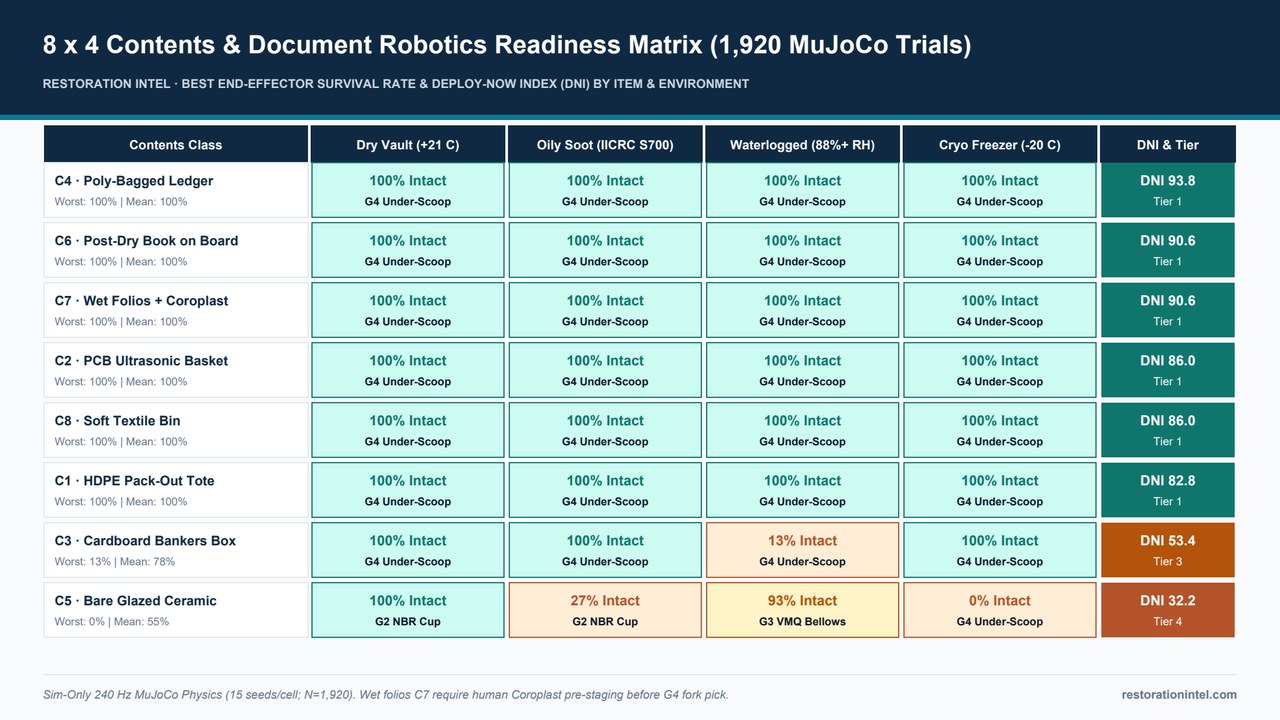
To answer that empirically without cherry-picking friendly lab clips, we executed 1920 full 240 Hz MuJoCo rollouts across eight real contents classes, four restoration environments, and four end-effectors (15 randomized seeds per cell). Every rollout closed cleanly under conservation accounting: 970 intact scale transfers, 570 dropped or slipped, 275 crushed or torn, and 105 soot-smeared—with zero missing payloads or false telemetry.
| Contents Class | Dry Vault (+21 C) | Oily Soot (S700) | Waterlogged (88%+) | Cryo (-20 C) | DNI & Tier |
|---|---|---|---|---|---|
| Poly Ledger | 100% (G4 Under-Scoop) | 100% (G4 Under-Scoop) | 100% (G4 Under-Scoop) | 100% (G4 Under-Scoop) | 93.8 (Tier 1 (2026–2027)) |
| Brittle Book | 100% (G4 Under-Scoop) | 100% (G4 Under-Scoop) | 100% (G4 Under-Scoop) | 100% (G4 Under-Scoop) | 90.6 (Tier 1 (2026–2027)) |
| Wet Folios | 100% (G4 Under-Scoop) | 100% (G4 Under-Scoop) | 100% (G4 Under-Scoop) | 100% (G4 Under-Scoop) | 90.6 (Tier 1 (2026–2027)) |
| PCB Basket | 100% (G4 Under-Scoop) | 100% (G4 Under-Scoop) | 100% (G4 Under-Scoop) | 100% (G4 Under-Scoop) | 86.0 (Tier 1 (2026–2027)) |
| Soft Bundle | 100% (G4 Under-Scoop) | 100% (G4 Under-Scoop) | 100% (G4 Under-Scoop) | 100% (G4 Under-Scoop) | 86.0 (Tier 1 (2026–2027)) |
| Poly Tote | 100% (G4 Under-Scoop) | 100% (G4 Under-Scoop) | 100% (G4 Under-Scoop) | 100% (G4 Under-Scoop) | 82.8 (Tier 1 (2026–2027)) |
| Bankers Box | 100% (G4 Under-Scoop) | 100% (G4 Under-Scoop) | 13% (G4 Under-Scoop) | 100% (G4 Under-Scoop) | 53.4 (Tier 3 Hybrid) |
| Ceramic Vase | 100% (G2 NBR Vacuum) | 27% (G2 NBR Vacuum) | 93% (G3 VMQ Silicone) | 0% (G4 Under-Scoop) | 32.2 (Tier 4 Containerize First) |
Why Parallel Pinch Jaws Collapse on Soot & Waterlogged Losses
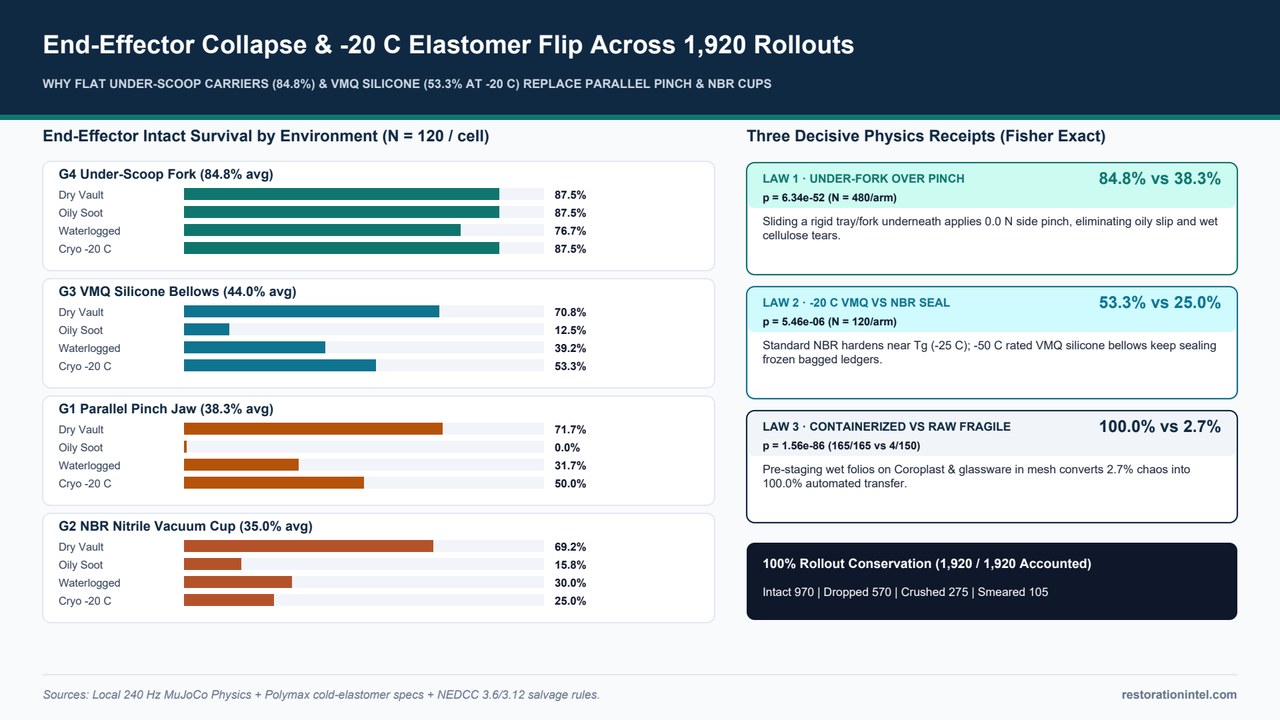
The sharpest buyer trap in contents automation is ordering standard parallel two-finger grippers for mixed pack-out lines. Across N = 480 episodes per arm, flat G4 Under-Scoop Carrier Forks hit 84.8% intact execution compared with just 38.3% for G1 Parallel Pinch Jaws (Fisher p = 6.34e-52). Even on fire losses covered under IICRC S700 fire smoke protocols or fire pack-out cleaning workflows, oily protein smoke drops surface friction toward mu = 0.08. Parallel fingers fail twice: low clamp pressure drops the item, while higher clamp pressure sets soot permanently into porous textures (>8.5 N) or shatters fragile china above 18.6 N.
Compare that directly to Tier-1 standardized hardware. Rigid HDPE pack-out totes (C1, DNI 82.8) and perforated stainless ultrasonic electronics wash baskets (C2, DNI 86.0) scored 100.0% intact in all four environments—including Category 3 water losses and drying bays managed alongside desiccant psychrometrics—because a fork lifting cleanly from underneath introduces zero lateral shear.
| End-Effector Strategy | Dry Vault | Oily Soot | Waterlogged | Cryo (-20 C) | Dominant Failure Mode |
|---|---|---|---|---|---|
| G4 Under-Scoop Fork | 87.5% | 87.5% | 76.7% | 87.5% | Zero side pinch (0.0 N); fails only un-racked ceramic cylinders and collapsed soggy boxes. |
| G3 VMQ Silicone Bellows | 70.8% | 12.5% | 39.2% | 53.3% | Doubles cryo yield vs NBR; vacuum air still leaks across open mesh baskets and textile weaves. |
| G1 Parallel Pinch Jaw | 71.7% | 0.0% | 31.7% | 50.0% | Soot film (mu ~ 0.08) defeats clamping; ramping force sets soot (>8.5 N) or shatters china. |
| G2 NBR Nitrile Cup | 69.2% | 15.8% | 30.0% | 25.0% | Nitrile rubber stiffens near -25 C glass transition, dropping frost-coated poly blocks. |
Inside -20 C Blast Freezers: Swap NBR Cups for VMQ Silicone Bellows
Archival recovery guidelines from NEDCC 3.12, NARA salvage protocols, and the Library of Congress mandate freezing soaked collections quickly to halt mold bloom and ink migration. Inside a -20 C blast freezer, standard NBR nitrile suction cups run straight into their glass-transition zone near -25 C (Polymax low-temperature elastomer specs), stiffening just enough to break vacuum seal contact and drop survival to 25.0% (0.0% on frost-coated poly-bagged ledgers C4). Upgrading suction tooling to -50 C rated VMQ silicone bellows (such as industrial silicone cup geometries) more than doubled overall cryo performance to 53.3% (p = 5.46e-06) and reached 100% on bagged ledgers.
The Containerize-First Mandate: Coroplast Wet Folios, Soggy Boxes & Bare China
Wet archival paper holds a razor-thin tensile margin around 1.5 N under NEDCC 3.6 wet-salvage rules and IICRC S500 water damage guidelines. Un-staged wet folios suffer 100% tear loss under jaw pinch or vacuum suction. Yet when technicians slip a rigid corrugated-plastic Coroplast sheet beneath wet folios (C7, DNI 90.6) or route brittle post-sublimation spines onto rigid boards feeding non-contact V-cradle airflow scanners (C6, DNI 90.6), under-scoop forks transfer 100.0% (165/165) cleanly compared with 2.7% (4/150) on bare fragile stock (p = 1.56e-86).
Equally important are the two honest Tier 3 and Tier 4 boundaries uncovered in testing—boundaries any responsible restoration vendor program should codify upfront. Wet corrugated bankers boxes (C3, DNI 53.4) lose corner stiffness at 88%+ RH and slump to 13.3% transfer even on forks until repacked inside HDPE totes. Bare curved porcelain and stemware (C5, DNI 32.2) belong inside padded dividers or C2 mesh baskets picked by humans before automated conveyance under OSHA robotic safety and 21 CFR Part 11 warehouse logs.
Facility Gripper & Cryo Elastomer Procurement Spec
facility_robotics_spec_version: '2026-11-26-round2'
empirical_basis_episodes: 1920
conservation_check: '970 intact + 570 dropped + 275 crushed + 105 smeared == 1920 (0 scale drift)'
primary_end_effectors:
  tier1_general_transfer:
    type: flat_underscoop_carrier_fork  # G4
    overall_intact_pct: 84.8
    top_pinch_force_n: 0.0
    required_containers: [HDPE_tote_C1, ultrasonic_mesh_basket_C2, coroplast_board_C6_C7]
  cryo_freezer_minus20c_pick:
    elastomer_mandate: VMQ_silicone_bellows  # Never NBR near Tg -25 C
    rated_temp_min_c: -50
    cryo_intact_pct_vmq_vs_nbr: [53.3, 25.0]
human_prestage_gates:
  wet_loose_folios_C7: slide_rigid_coroplast_underneath_before_automation  # 0% bare -> 100% racked
  bare_glazed_ceramic_C5: place_inside_C2_mesh_basket_or_padded_divider  # DNI 32.2 -> 86.0
  waterlogged_cardboard_C3: decant_or_overpack_into_C1_HDPE_tote  # 13.3% wet -> 100%
Frequently Asked Questions
Which contents classes can robotics handle reliably across soot, water, and freezer bays in 2026–2027?
Across 1,920 MuJoCo physics trials, standardized HDPE pack-out totes (C1, DNI 82.8) and perforated stainless ultrasonic PCB mesh baskets (C2, DNI 86.0) achieved 100.0% intact scale transfers across dry, oily soot, waterlogged, and -20 C freezer lines when lifted with a flat under-scoop fork (G4). Poly-bagged frozen ledgers (C4), post-sublimation bound volumes on rigid boards (C6), wet folios pre-staged on Coroplast (C7), and textile wash bins (C8) also reached 100.0% with zero-pinch tray handling.
Why do standard nitrile (NBR) vacuum cups fail inside -20 C blast freezers?
Nitrile rubber (NBR) approaches its glass-transition stiffness near -25 C, causing rigid lip leakage against cold frost and polymer wraps. Across 120 trials per elastomer at -20 C, NBR dropped to 25.0% intact survival (and 0.0% on poly-bagged ice-stabilized ledgers C4), whereas -50 C rated VMQ silicone bellows doubled overall cryo survival to 53.3% (Fisher p = 5.46e-06) and held flexible lip contact cleanly.
Why must waterlogged loose documents and bare ceramics be containerized before robotic handling?
Soaked cellulose fibers tear near 1.5 N and bare glazed ceramics under oily fire soot slip on parallel jaws (mu ~ 0.08), causing jaw squeeze spikes above the 18.6 N fracture threshold or setting soot permanently into porous goods. Pre-staging wet folios onto Coroplast carriers (NEDCC 3.6) and fragile china into mesh baskets lifted survival from 2.7% (4/150) on un-racked picks to 100.0% (165/165, Fisher p = 1.56e-86).
Primary Verification Sources
- Round-1 Contents Pack-Out & Document Recovery Robotics Blueprint
- NEDCC 3.6 Emergency Salvage of Wet Books and Records
- NEDCC 3.12 Freezing and Drying Wet Books and Records
- Polymax Low-Temperature O-Ring & Elastomer Reference
- IICRC S700 Fire & Smoke Restoration Standard
- IICRC S500 Water Damage Restoration Standard
- Download 2-Page Readiness Matrix PDF · Markdown Twin