Updated November 14, 2026 — reformatted to Restoration Intel house standard with Print-First PDF brief and Markdown twin.
Direct Answer: The adjuster didn’t cheat you. They did their job — and your estimate lost every line item you couldn’t prove. A shop called Proof AI put it sharper than most in September 2026: “A mitigation job you can’t document is line items the adjuster wipes out.” They’re building claim-defense automation for trade contractors.
.md twin for Water Mitigation & Structural Drying.
Updated October 6, 2026.
The adjuster didn’t cheat you. They did their job — and your estimate lost every line item you couldn’t prove.
A shop called Proof AI put it sharper than most in September 2026: “A mitigation job you can’t document is line items the adjuster wipes out.” They’re building claim-defense automation for trade contractors, and they’ve named the thing nobody in this trade wants to say out loud. The fight over your invoice isn’t won on the job site. It’s won in the file.
For the emergency phase those line items defend, see What Is Water Mitigation? and Emergency Documentation and the Loss Timeline.
Here’s how the stripping actually works. The adjuster opens your Xactimate estimate next to their file, and every line item gets the same quiet question: where’s the record? Not your word. The record. The line items that die first are always the same ones.
Equipment without a placement log. Twenty air movers and three dehus for five days is a big number on paper. Without a daily log showing equipment type, serial or asset number, placement location, and readings taken at each visit, the adjuster has no reason to believe all of it was there all five days. The equipment line shrinks to what the photos show, and photos show a room, not a week.
Antimicrobial without a contamination determination. You sprayed because the water was Category 2 and degrading. But if your arrival notes don’t document the category determination — source, observed conditions, time in contact with materials — the antimicrobial line reads as optional. Optional gets deleted.
Monitoring visits without psychrometric data. A daily monitoring charge is a charge for professional judgment exercised on site. Judgment with no readings attached is a drive-by. Temperature, relative humidity, and specific humidity readings, taken daily and trending downward, are what turn a monitoring line from “technician stopped by” into “drying was verified in progress.” No trend, no pay.
Demolition without moisture-map evidence. Flood cuts, pad removal, baseboard detachment — every removal line needs the reason it couldn’t be dried in place. The moisture map taken at arrival is that reason: material moisture content above the dry standard, documented per material, per area. Without it, removal looks like a choice. Choices get negotiated down.
Emergency service without FNOL-time documentation. The after-hours premium survives when the file shows the call came in at 9:40 PM and the crew was on site by midnight. It dies when the timeline is reconstructed from memory two weeks later.
None of this is the adjuster being adversarial. Their file has to survive their review — a supervisor, a reinspection, sometimes a courtroom. An adjuster can be deposed. “The contractor told me so” is not testimony. A contemporaneous record is.
This is also where the standard has been heading for years, and the 2026 revision of the IICRC S500 made it explicit: documentation is no longer closing paperwork. The moisture map, atmospheric readings, and material moisture-content readings are supposed to form a continuous, timestamped record from first notice of loss through completion. Not a folder of photos assembled at invoice time. A record that starts when the job starts and doesn’t stop until the dry standard is met.
So what does the defense file actually look like? It’s three layers, in order.
Arrival
Moisture map of every affected area. Photos with timestamps, before anything is moved. Water category and class determination, written down with the reasoning — source identified, contamination assessed, evaporation load classified. Equipment plan: what goes where, and why. This layer answers every question the adjuster will ask later, and it answers them with the date still on them.
Daily
Atmospheric readings and material moisture readings, every visit, same points where possible so the trend is visible. Equipment check — everything still running, placement adjusted as the drying front moves, adjustments noted. Notes on anything unusual. This layer is what protects the equipment and monitoring lines, because it proves the drying was managed, not just billed.
Completion
Final readings showing materials at or below the dry standard. Final photos. The record closes when the job closes, not when the invoice goes out.
The economics are not close. Documentation costs a technician minutes per visit — a meter, a phone, a consistent habit. A stripped estimate costs thousands per job, and it costs them quietly: most contractors never learn which lines died or why. They just learn that “insurance work doesn’t pay.” It pays fine. It pays what the file proves.
There’s a larger current running under this, worth naming. The whole economy around AI agents is converging on verifiable evidence — open standards now exist for proving what an automated system did, because nobody accepts the operator’s word anymore. Restoration got there first by necessity: your drying log was the original tamper-evident record. The contractors who already document like the file is the product are about to find the rest of the world catching up to their habit.
Documentation is the argument. The work is the work. But the record is what gets paid — and the record is the part you control completely, starting on the next job.
Restoration Intel is an operator publication for the restoration trade. Informational only — not legal or coverage advice. When a claim is disputed, the policy language and the documented facts decide it.
Undocumented Water Mitigation Gets Stripped From Estimates — Visual Workflow
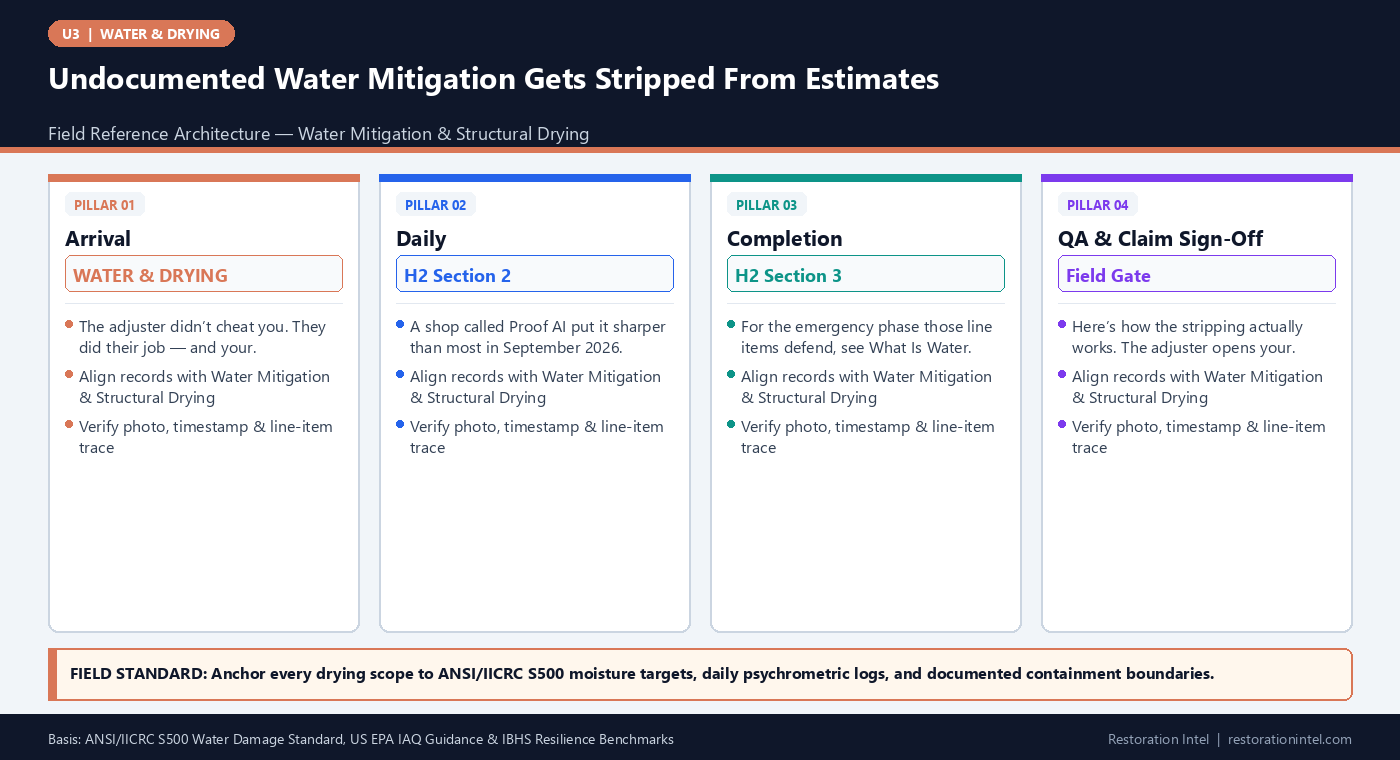
Field Operational Breakdown & Verification Matrix
Structured operational summary of Undocumented Water Mitigation Gets Stripped From Estimates mapped to Restoration Intel documentation gates.
| Operational Stage | Field Focus in This Guide | Documentation Requirement | Verification Gate |
|---|---|---|---|
| 1. Arrival | The adjuster didn’t cheat you. They did their job — and your estimate lost every. | Timestamped photos, measurements & scope notes | Cross-check against primary standard prior to submission |
| 2. Daily | A shop called Proof AI put it sharper than most in September 2026: “A mitigation job. | Timestamped photos, measurements & scope notes | Cross-check against primary standard prior to submission |
| 3. Completion | For the emergency phase those line items defend, see What Is Water Mitigation? and. | Timestamped photos, measurements & scope notes | Cross-check against primary standard prior to submission |
| 4. QA & Claim Sign-Off | Here’s how the stripping actually works. The adjuster opens your Xactimate estimate. | Timestamped photos, measurements & scope notes | Cross-check against primary standard prior to submission |
Field Documentation & Scope Verification Standard
To align Undocumented Water Mitigation Gets Stripped From Estimates with Restoration Intel house standards under Water Mitigation & Structural Drying, field and estimating personnel should maintain an auditable record from first site walk through final carrier sign-off. That record begins by separating verifiable site conditions from assumptions: timestamped wide and close-up photographs, instrument readings paired with calibration or baseline context, and written scope notes tied directly to the line-item or contractual requirement.
When preparing a claim packet, internal SOP, or commercial facility handoff, pair the checklist below with the downloadable Print-First PDF brief and plain-text Markdown twin so estimators, project managers, and desk examiners work from identical scope boundaries without losing provenance between field capture and final review.
Operational consistency across Water Mitigation & Structural Drying assignments also depends on maintaining clean separation between original site observations, insurer policy or municipal code constraints, and subsequent supplemental change orders. Every transition in containment, equipment deployment, clearance testing, or reconstruction sequencing should be logged sequentially with author attribution, date and time metadata, and cross-references to the governing technical manual or carrier guideline so third-party reviewers can audit the decision path without re-inspecting the structure.
Supervisors and quality-assurance leads can use this standardized package format during post-loss file audits, adjuster reinspections, and internal technician training to confirm that intake forms, drying or remediation logs, chain-of-custody records, and closeout certificates remain complete, internally consistent, and ready for immediate human review or automated compliance screening.
Practitioner Verification Checklist
- Confirm scope boundaries and loss classification for: Undocumented Water Mitigation Gets Stripped From Estimates.
- Capture timestamped field photos, measurements, and serial/assembly notes before mobilization or tear-out.
- Tie every line item or operational recommendation to primary references (ANSI/IICRC S500 Water Damage Standard, US EPA Indoor Air Quality (IAQ)).
- Verify internal cross-links and preserve all customer intake/compliance forms intact on the canonical page.
- Export and attach the Print-First PDF field brief and verify the sibling Markdown twin (.md) resolves HTTP 200.
Standards, Authority Citations & Related Guides
- ANSI/IICRC S500 Water Damage Standard
- US EPA Indoor Air Quality (IAQ)
- Insurance Institute for Business & Home Safety (IBHS)
- Related Guide: Salvage Is a Window, Not a Service
- Related Guide: IICRC Cat 3 Contents Pack-Out Protocol
- Related Guide: Field Guide: IICRC S500, S520, and S700 Quick-Reference Thresholds for Contents Triage
.md twin for carrier and field review.Frequently Asked Questions
What is the core operational takeaway of Undocumented Water Mitigation Gets Stripped From Estimates?
The adjuster didn’t cheat you. They did their job — and your estimate lost every line item you couldn’t prove. A shop called Proof AI put it sharper than most in September 2026: “A mitigation job you can’t document is line items the adjuster wipes out.” They’re building claim-defense automation for trade contractors.
Which industry standards govern water mitigation & structural drying documentation?
Practitioners should anchor field logs and claim packets to ANSI/IICRC S500 Water Damage Standard and US EPA Indoor Air Quality (IAQ), ensuring verifiable measurements and photo provenance.
Where can field and estimating teams access the offline or AI-readable edition?
Each upgraded Restoration Intel guide ships with a 2-page Print-First PDF brief and a plain-text Markdown twin (.md) linked directly inside the article download cards and /llms.txt.