Direct Answer: Field crews must classify both the contamination source and the material porosity across ANSI/IICRC S500 (water Category 1–3), S520 (fungal Condition 1–3), and S700 (fire/smoke residue chemistry) before packing or discarding items—using ANSI/IICRC S320 documentation rules to justify every restore-versus-total-loss call.
.md twin for estimator QA and carrier file documentation.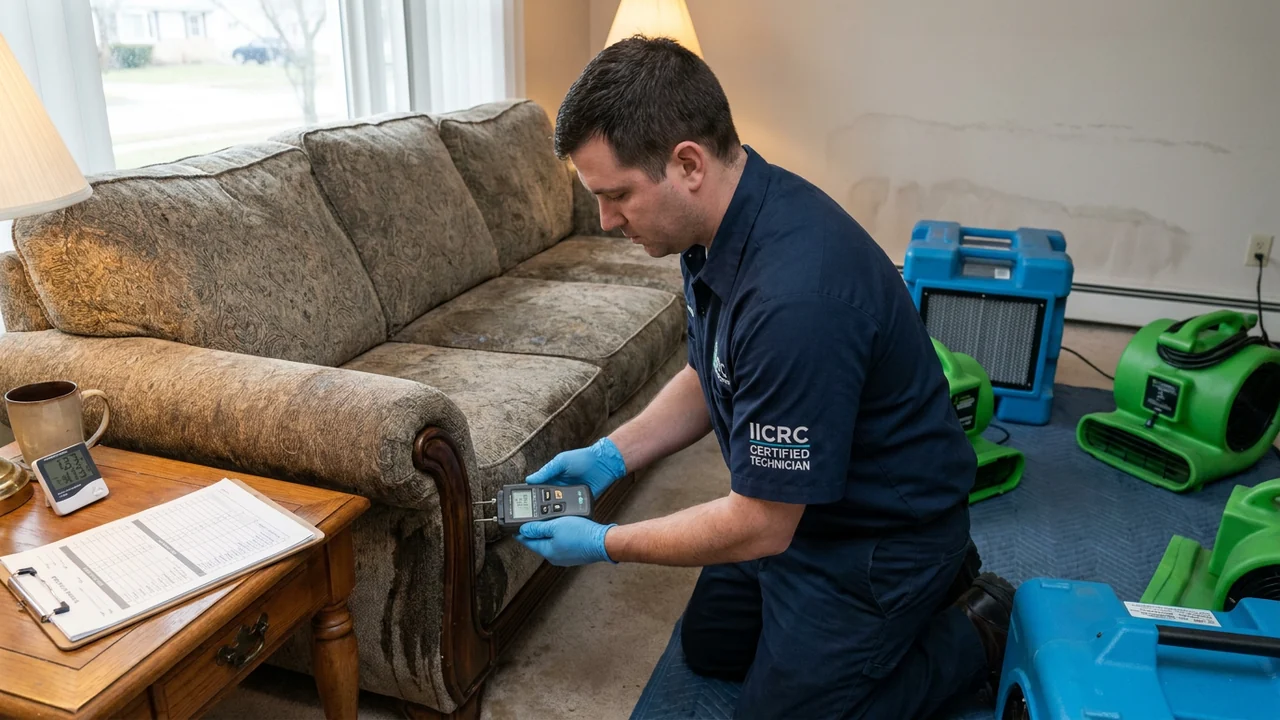
Contents triage breaks down when field technicians treat every wet or smoky item with a single rule of thumb. Category 1 clean-water exposure on solid oak furniture demands rapid stabilization and controlled drying, whereas Category 3 black-water immersion on an upholstered sofa triggers an immediate health-hazard total-loss call. Mixing those categories inside the same pack-out trailer creates cross-contamination liability and uncollectible cleaning invoices.
This quick-reference desk and field sheet aligns contents triage thresholds across ANSI/IICRC S500 (water), ANSI/IICRC S520 (mold), and ANSI/IICRC S700 (fire and smoke) under the process umbrella of ANSI/IICRC S320.
S500 / S520 / S700 Contents Triage Decision Matrix
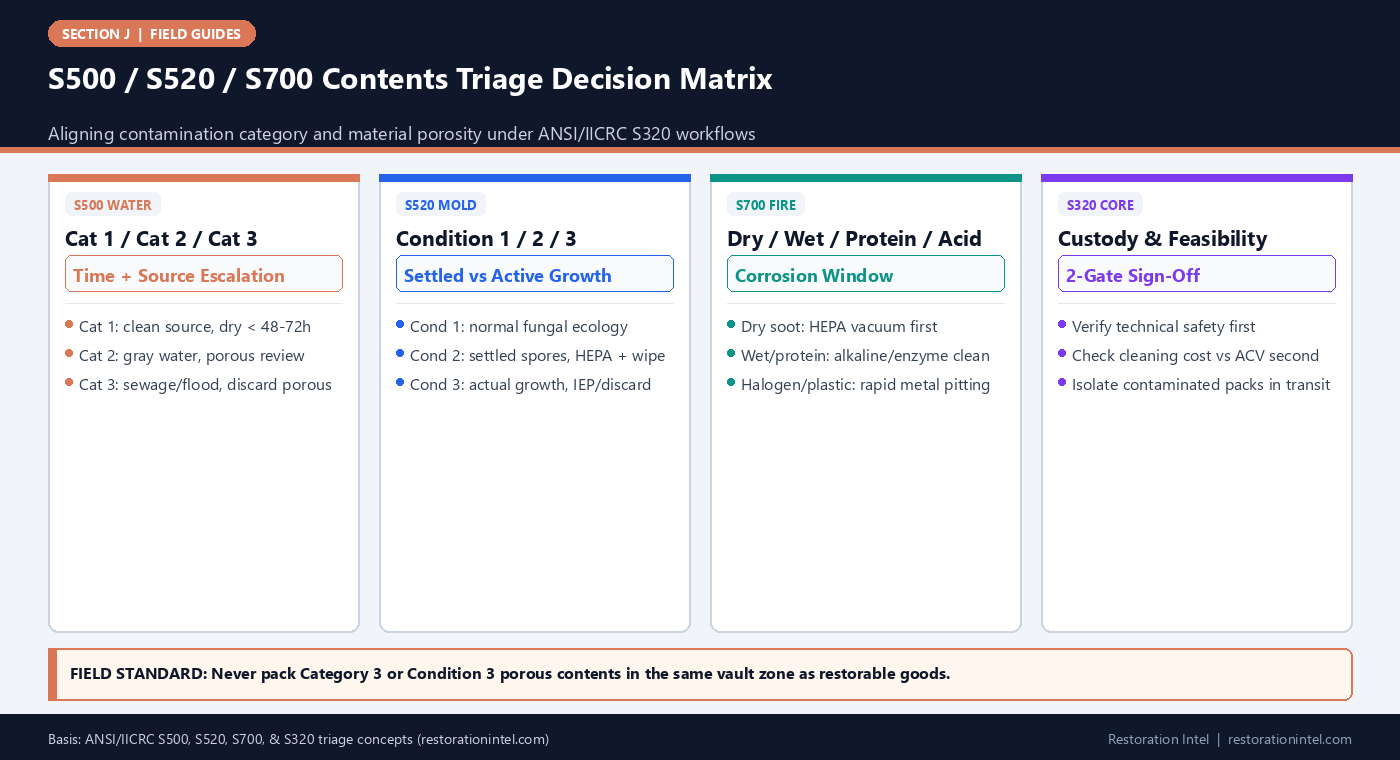
Cross-Standard Contents Triage Thresholds (S500, S520, S700 & S320)
Apply the strictest applicable standard when water, mold, and smoke conditions overlap on a single loss.
| Standard & Level | Trigger Condition on Site | Porous (Apparel, Paper, Bedding) | Semi-Porous (Wood, Upholstery, MDF) | Non-Porous (Glass, Metal, Glazed Ceramic) |
|---|---|---|---|---|
| S500 Category 1 | Clean supply-line water, no sewage/soil contact, rapid response | Dry/launder promptly before time-based degradation occurs | Solid wood: elevate & dry; MDF/particleboard: inspect for swelling | Wipe, dry, inspect electronics separately for internal moisture |
| S500 Category 2 | Gray water (appliance discharge, aquarium, clean overflow >48h) | Specialty antimicrobial laundering or discard if cost/health warrants | Upholstered cushions: evaluate extraction vs replacement; discard swollen MDF | Clean and sanitize per S500/S320 protocol |
| S500 Category 3 | Sewage backup, rising floodwater, toilet overflow with feces, or extended stagnation | Non-salvageable total loss (document, authorize, dispose safely) | Upholstery & foam: non-salvageable; solid unfinished wood: strict IEP/sanitization gate | Clean, disinfect, verify zero trapped hollow cavities before release |
| S520 Condition 1 | Normal background fungal ecology, no abnormal settled spores | Standard handling; protect from cross-contamination | Normal protective wrap if moving out of active work zone | Standard clean/pack |
| S520 Condition 2 | Settled spores/fragments from adjacent Condition 3 area without visible growth | HEPA vacuum / specialty laundering; verify no odor persistence | HEPA vacuum + damp wipe hard surfaces; inspect fabrics carefully | HEPA vacuum + damp wipe + verify containment clearance |
| S520 Condition 3 | Visible actual mold growth or hyphal fragments embedded in material | Discard porous textiles/paper unless rare archival IEP remediation | Discard foam/upholstery; sand/HEPA/treat only dense solid wood if warranted | HEPA + antimicrobial wash + dry; confirm no porous backing/lining |
| S700 Light/Mod Smoke | Wood/paper dry soot or moderate structural fire smoke without heavy melt | Specialty dry-cleaning/ozone/hydroxyl if no char or heat shrink | HEPA dry-sponge + deodorize solid wood; evaluate fabric weave absorption | Rapid neutral/alkaline wash to prevent acid etching on chrome/brass |
| S700 Heavy/Protein/Synthetic | Burnt meat/grease, heavy plastics (PVC/HCl), or direct high-heat exposure | High odor/chemical retention; test sample or flag total loss | MDF/veneer blistering or melted foam = total loss; test solid wood | Inspect plating/circuitry immediately; heavy corrosion = total loss |
Mapping S500 Water Categories and Exposure Time to Material Porosity
Under ANSI/IICRC S500, triage never depends solely on how clean the water looked when the pipe broke. Time, temperature, and contact surfaces quickly escalate Category 1 water into Category 2 or Category 3 if standing water wicks through drywall insulation, dust, or organic debris over multiple days. Field crews must record both the original source and the estimated dwell duration before marking soft goods or upholstered furniture as restorable.
Material porosity determines whether contaminants can be reliably extracted or remain trapped inside cellular voids. As detailed in IICRC Cat 3 Contents Pack-Out Cleaning Protocol, porous items saturated by Category 3 water—including mattresses, box springs, upholstered cushions, books, and particleboard—are presumed non-salvageable unless high sentimental or archival value justifies specialized third-party verification.
- Elevation check: Separate dry upper-shelf goods from wicking lower-drawer items before assigning one room-wide category.
- MDF/particleboard rule: Swollen or delaminated engineered wood loses structural integrity permanently and should be flagged total loss immediately.
- Hollow-cavity warning: Non-porous items with sealed foam cores, hollow metal legs, or unsealed electronics boards must be treated by their trapped internal material.
Applying S520 Fungal Conditions Without Over-Packing Spores
ANSI/IICRC S520 divides indoor environments and contents into Condition 1 (normal fungal ecology), Condition 2 (settled spores transferred from a Condition 3 source), and Condition 3 (actual mold growth). Field crews frequently make the costly mistake of packing Condition 2 or Condition 3 boxes straight into a climate-controlled vault alongside clean Condition 1 customer jobs, cross-contaminating warehouse racks.
Items exhibiting visible Condition 3 growth on porous fibers or foam padding are rarely safe or economical to restore. Condition 2 hard goods and cleanable textiles require HEPA vacuuming and containment staging on site or inside a dedicated negative-air receiving bay before entering general vault inventory. Whenever active fungal growth affects high-value textiles, fine art, or ambiguous assemblies, defer remediation scope to an Indoor Environmental Professional (IEP) assessment.
- Vault quarantine rule: Never load suspected Condition 2/3 items into shared trailers or unsealed racks with clean jobs.
- Musty-odor red flag: Persistent microbial VOC odor inside upholstery or book bindings after surface wiping signals hidden Condition 3 growth.
- HEPA-first sequence: Dry HEPA vacuum loose spores before any wet wiping so moisture does not drive spores deeper into grain or seams.
Using S700 Smoke Chemistry Thresholds for Rapid Fire Triage
ANSI/IICRC S700 emphasizes that fire residues are chemically active, not inert dust. Synthetic materials, PVC wiring, and plastics release acidic chloride vapors that combine with ambient humidity or firefighting water to etch polished chrome, brass, stainless appliances, and optical glass within hours. Protein fires from scorched kitchens leave microscopic, greasy, high-odor films that smear if wiped with dry sponges first.
Field triage on fire losses starts with quick stabilization and chemistry matching. As outlined in Contents Restoration After Fire: Pack-Out Protocols, crews should apply temporary corrosion-inhibiting protectants to high-value bare metals, test-clean representative samples before committing a whole room to pack-out, and reject heat-warped plastics or delaminated veneers on sight.
- Dry-before-wet rule: Use HEPA vacuuming and dry vulcanized chemical sponges on dry wood/paper soot before introducing liquid cleaners.
- Halogen corrosion triage: Inspect plated hardware, faucets, appliance trim, and circuit boards early; pitting already visible on site indicates total loss.
- Heat-line check: Look for melted wax, crazed glass, or warped polymer housings to mark the thermal boundary where internal electronics failed.
Integrating S500, S520, and S700 Decisions Under ANSI/IICRC S320
While S500, S520, and S700 govern peril-specific hazards, ANSI/IICRC S320 binds them together into a repeatable contents workflow: site hazard check, triage categorization, photo/inventory logging, pack-out custody, processing verification, and reset. Tracking the ongoing framework updates covered in S320 Public Review Is Open helps project managers keep field SOPs aligned with current industry consensus.
When a room presents mixed perils—such as fire suppression water sitting for five days beneath charred shelving—the crew must apply the most restrictive hazard threshold to every affected porous item. Clear triage tags attached during walkthrough prevent pack-out technicians from wasting labor wrapping items that will fail health clearance or economic feasibility review back at the shop.
- Strictest-peril override: When water Category 3 and smoke coexist, Category 3 biohazard disposal rules govern porous items immediately.
- Test-patch documentation: Photograph small test-cleaning passes on borderline items to justify pack-out versus replacement to desk examiners.
- Economic sanity check: Flag low-value items whose specialty decontamination exceeds replacement ACV before crating.
Practitioner Verification Checklist (J-03)
- Identify and document the specific water Category (S500), fungal Condition (S520), or smoke chemistry (S700) for every affected zone before packing.
- Separate porous, semi-porous, and non-porous contents into distinct triage lanes and never co-mingle Category 3 or Condition 3 goods with clean packs.
- Flag swollen particleboard, heat-warped plastics, pitted electronics, and Category 3 upholstery as non-salvageable with photo proof prior to disposal authorization.
- Perform rapid metal-corrosion checks on appliances, hardware, and tools exposed to synthetic smoke or suppression moisture.
- Attach signed triage rationale tags linking S320 inventory line numbers to the peril condition observed at initial walkthrough.
Standards, Authority References & Related Reading
Primary standards, insurance definitions, and sibling Restoration Intel guides referenced in this brief:
- ANSI/IICRC S500 Water Damage Standard
- ANSI/IICRC S520 Mold Remediation Standard
- ANSI/IICRC S700 Fire & Smoke Restoration Standard
- ANSI/IICRC S320 Standard for Professional Contents Restoration
- Related Guide: S320 Public Review Is Open
- Related Guide: IICRC Cat 3 Contents Pack-Out Cleaning Protocol
- Related Guide: Contents Restoration After Fire: Pack-Out Protocols
- Related Guide: Field Guide: Quick-Triage Decision Tree for Soft Goods, Upholstery, Casegoods, and Electronics
- Related Guide: Field Guide: Photographic Proof Angles Required to Substantiate Odor, Corrosion, and Hidden Moisture
.md twin for desk QA and team training.Frequently Asked Questions
Can Category 1 clean water escalate to Category 2 or Category 3 before pack-out arrives?
Yes. Under ANSI/IICRC S500, clean water that sits unmitigated over time, dissolves soil/contaminants from subfloors or insulation, or stagnates in warm interiors degrades to Category 2 or Category 3.
What is the difference between S520 Condition 2 and Condition 3 on contents?
Condition 2 means settled spores or fragments migrated onto an item without visible active growth, making HEPA cleaning viable on many hard and washable surfaces. Condition 3 means active fungal growth is present on the item.
Why do synthetic and PVC fires ruin metal and electronics so quickly under S700?
Burning plastics release acidic gases such as hydrogen chloride that react with moisture to rapidly pit bare metals, plated fixtures, and micro-circuit solder joints even in rooms untouched by direct flame.
How does ANSI/IICRC S320 interact with S500, S520, and S700?
S320 provides the overarching contents restoration management standard—inventory, chain of custody, packing, cleaning validation, and return—while S500, S520, and S700 supply the technical peril thresholds for water, mold, and fire.