Updated November 24, 2026 — refreshed with verified 2-page PDF field brief, bespoke workflow diagram, and primary standards references.
Direct Answer: Restoration contractors routinely invest in IICRC certifications, Xactimate workshops, and onboarding SOPs—yet still watch trained technicians freeze during emotional homeowner calls or complex adjuster reviews. Training transfers what a technician needs to know; coaching builds the live judgment to apply it reliably, closing the performance gap through structured observation and weekly feedback.
.md twin for Restoration Operations & Margin.
Updated October 6, 2026.
Restoration companies invest heavily in training. IICRC certifications, onboarding checklists, safety briefings, Xactimate courses. The investment is real and the knowledge is necessary. But if you’ve ever watched a well-trained technician completely fall apart on an actual job, you’ve seen the gap that training alone cannot close.
Episode 170 of the Head, Heart & Boots podcast — produced by Chris Nordyke and the Floodlight Consulting Group — addresses this gap directly. The distinction between training and coaching is one of the most actionable leadership insights available to restoration operators, and almost no one applies it consistently.
What Training Actually Does
Training is information delivery. It downloads knowledge, explains principles, and establishes the “what” and “why” of how work should be done. A training program can tell a technician exactly how to perform a Category 3 water extraction. It can explain IICRC S500 standards, describe the science of psychrometrics, and walk through every step of the documentation protocol.
Training is time-fixed and curriculum-based. You deliver it, people absorb it (or don’t), and then they go back to the job. The feedback loop is weak. You rarely know whether the information actually changed behavior until something goes wrong.
What Coaching Actually Does
Coaching is skill development. It takes the knowledge from training and builds the judgment required to apply it under real conditions — when the job is messier than the manual, when the adjuster is pushing back, when the customer is panicking, when the equipment isn’t performing as expected.
Coaching works by asking questions rather than giving answers. A field coach doesn’t tell the technician what to do — they ask: “What do you see here? How would you approach this? What would you do differently?” This forces the technician to engage with their own knowledge and build the mental pathways that produce reliable, independent judgment.
The Failure Mode: Training Without Coaching
When restoration companies over-index on training and under-invest in coaching, a predictable failure mode emerges. Employees have heads full of information but no competence or confidence to apply it independently. They become passive — waiting to be told what to do rather than solving problems on their own. They perform adequately when supervised and inconsistently when not.
This is the root cause of the “I have to do everything myself” complaint that restoration owners make constantly. It’s not that employees don’t care — it’s that the organization has trained them to depend on supervision rather than coaching them toward independent judgment.
Building a Coaching Cadence
A coaching cadence doesn’t require a formal program. It requires consistency. After any training event, build in a follow-up conversation: “What from that training are you going to apply this week, and how?” After field observations, ask: “What went well? What would you do differently?” When a mistake happens, ask: “What happened, what was your thinking, and what would change that outcome next time?”
These conversations are short. They can happen in the truck, at the job site, or during a 15-minute one-on-one. The goal is not to evaluate performance — it’s to develop judgment. Over time, employees who experience consistent coaching become self-correcting. They internalize the questions and start asking them of themselves.
Frequently Asked Questions
How much time does coaching require compared to training?
Training happens in scheduled blocks and is relatively time-efficient per person. Coaching is ongoing and distributed — it happens during and after work, not in a classroom. Most effective coaching conversations take 5-15 minutes. The investment is not large; the consistency is what matters.
Can anyone be a coach, or does it require special skills?
Effective coaching requires one core skill: asking better questions than giving answers. Most people default to telling — it’s faster in the moment. Shifting to asking feels slower initially but builds much greater capability over time. Any supervisor can develop this habit with practice.
How do you know if your coaching is working?
The clearest signal is what employees do when no one is watching. If your team makes good decisions independently, applies standards consistently without supervision, and brings solutions rather than just problems — your coaching is working. If they freeze without direction or revert to bad habits the moment oversight relaxes, it’s not.
Should coaching replace training in restoration companies?
No — both are necessary. Training establishes the knowledge base. Coaching builds the skill to apply it. The optimal sequence: train first, then coach the application. Most restoration companies do the first and skip the second.
Related: Leadership in restoration · Mentorship and team building · Hiring for restoration.
Coaching vs Training in Restoration: How Top Owners Develop Teams — Visual Workflow
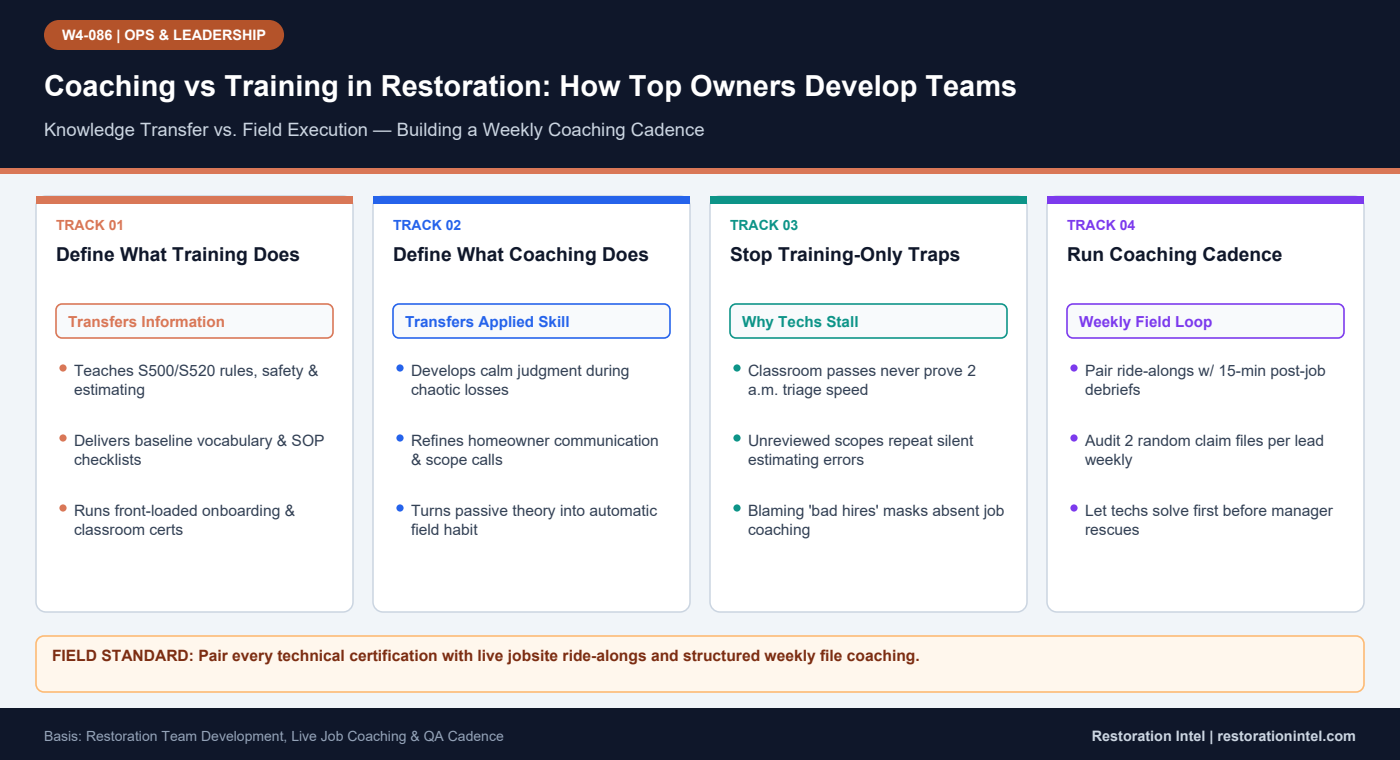
Field Benchmark & Decision Matrix
| Dimension | Training (Classroom / SOP) | Coaching (Live Field Loop) | Shop Failure Without Both |
|---|---|---|---|
| Primary Purpose | Knowledge transfer (the ‘what’ and ‘why’) | Skill application under live loss pressure | Tech recites S500 yet botches homeowner intake |
| Delivery Timing | Onboarding, certification classes & workshops | Continuous weekly job walks & file reviews | Decay of standards within 60 days of hire |
| Owner / PM Role | Instructor or external IICRC trainer | Direct supervisor observing & asking questions | PM takes over hard jobs instead of teaching |
| Measurement Proof | Written exam score or signed SOP checklist | Clean photos, daily GPP logs & calm closeouts | Zero correlation between certs & margin |
| Feedback Style | One-way curriculum explanation | Two-way debrief: ‘What did you see & decide?’ | Passive order-taking crew needing micromanaging |
Practitioner Operational Takeaways
- Never confuse paying for IICRC certifications with operational readiness—training downloads knowledge, while coaching verifies execution on messy job sites.
- Install a lightweight weekly coaching cadence: one field ride-along observation plus one post-job file audit focusing on two specific habits.
- Coach technicians by asking diagnostic questions ('What Category cues did you see before setting dehus?') instead of immediately fixing decisions for them.
- Track coaching impact directly through first-visit Work Authorization capture, photo completeness, and fewer supplement rejections.
Standards & Primary References
- Markdown Twin (.md)
- Leadership in Restoration: The Complete Guide
- Hiring for Restoration: Finding Resilient Teams
- Mentorship in Restoration: Building Loyal Teams
.md twin for carrier and field review.