Updated November 24, 2026 — refreshed with verified 2-page PDF field brief, bespoke workflow diagram, and primary standards references.
Direct Answer: Hiring for restoration requires screening simultaneously for technical aptitude, physical stamina, and calm customer empathy during emergencies. A technician who runs clean psychrometrics yet panics around distressed homeowners creates immediate liability. Hire for attitude, ownership, and composure first—technical workflows can be trained inside 3 to 6 months, whereas character cannot.
.md twin for Restoration Operations & Margin.
Updated October 6, 2026.
Restoration hiring has a specific challenge: the work requires technical skill, physical capability, and customer-facing maturity simultaneously. A technician who can run a perfect drying system but panics when a homeowner is emotional, or who can document meticulously but can’t work under time pressure — creates liability at the job level, not just inconvenience.
The Tim Fitzpatrick Hiring Framework
Tim Fitzpatrick, featured on Episode 139 of Head, Heart & Boots, built a 30-year contracting business on hiring systems that prioritize character alongside skill. His framework applies directly to restoration: hire for attitude and work ethic first, technical competence second. Technical skills can be trained in 3-6 months. Attitude — ownership mindset, customer empathy, willingness to do unglamorous work well — is extraordinarily difficult to change in adults.
Behavioral Interview Techniques
The most predictive hiring interviews for restoration use behavioral questions: “Tell me about a time when a job went sideways. What happened and what did you do?” “Describe a situation where a customer was upset. How did you handle it?” “Give me an example of a mistake you made at work and how you addressed it.” The answers reveal ownership posture, customer orientation, and willingness to be accountable — the traits most predictive of performance in restoration environments.
Building a Talent Pipeline
The restoration companies with the least hiring stress are the ones that have built ongoing talent pipelines rather than reacting to openings. This means: maintaining relationships with vocational programs and trade schools, keeping a candidate pool warm through periodic outreach, and building an employer brand through employee testimonials and reputation that makes the company a preferred employer in its market.
Frequently Asked Questions
Should restoration companies hire experienced technicians or train from scratch?
Both strategies work; the right choice depends on urgency and culture fit. Experienced technicians onboard faster but bring habits — good and bad — from previous employers. Training from scratch takes longer but allows the company to instill its specific protocols and culture without deconstructing prior learning.
How do you assess customer-facing skills in a restoration interview?
Role-play scenarios are the most effective assessment: “I’m a homeowner who just came home to find 6 inches of water in my basement. I’m panicking. How do you respond to me?” The candidate’s response reveals empathy, calm under pressure, and communication skills more accurately than any resume credential.
What compensation package is competitive for restoration technicians in 2026?
Varies significantly by market, but competitive packages typically include: hourly base rate ($18-28 depending on experience and market), overtime opportunity in peak seasons, full health benefits (increasingly a differentiator), clear PTO policy, and a defined path to crew lead with a specific wage increase attached.
How do you reduce time-to-hire without sacrificing candidate quality?
By having a standing recruitment process — always sourcing, not just when you need someone. Companies that post jobs only when they have an opening are perpetually behind. Companies that maintain a warm candidate pipeline can hire in days rather than weeks when an opening occurs.
Related: Employee retention in restoration · Mentorship in restoration · Leadership in restoration.
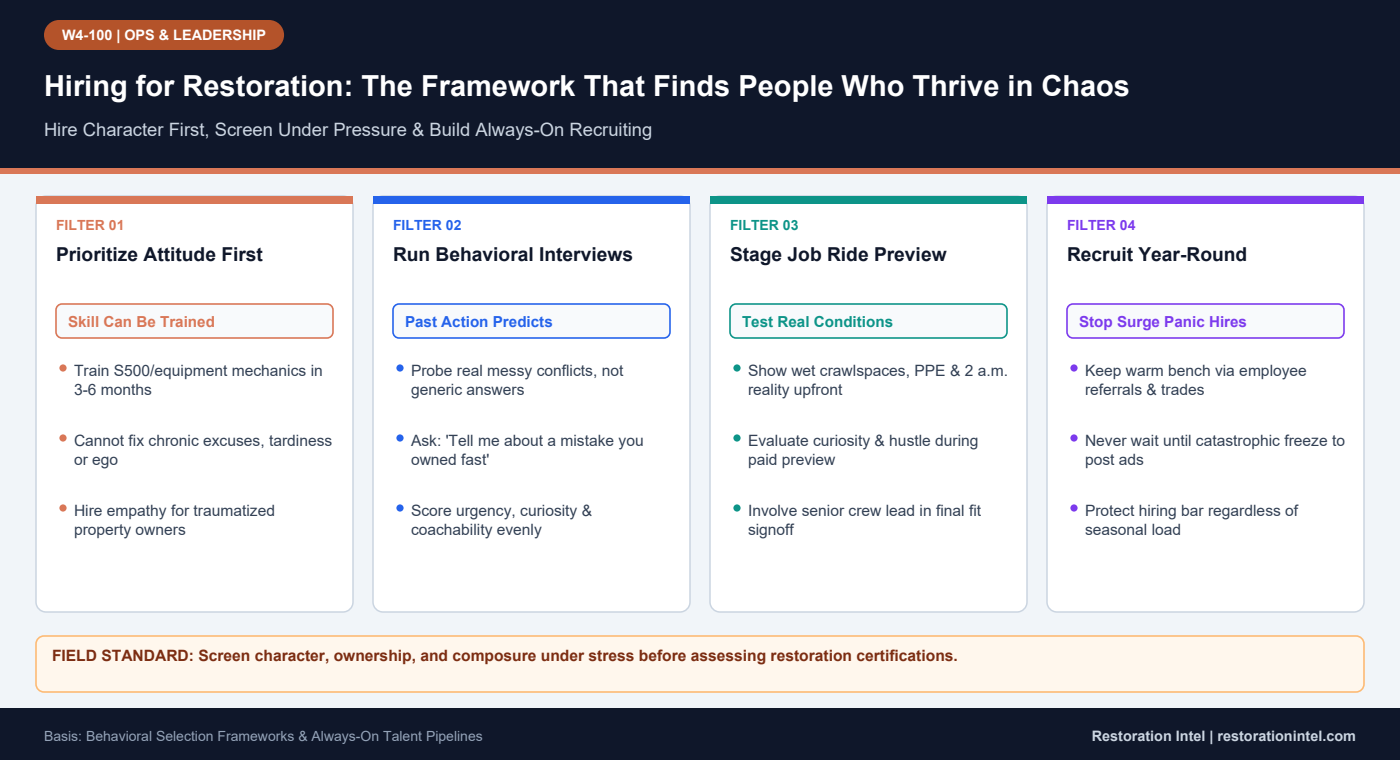
Hiring for Restoration: The Framework That Finds People Who Thrive in Chaos — Visual Workflow
Field Benchmark & Decision Matrix
| Hiring Stage | Broken Panic Approach | Disciplined Selection Standard | Field Quality Outcome |
|---|---|---|---|
| Job Ad & Positioning | Vague ‘hard workers needed’ wage post | Transparent schedule, on-call expectation & growth | Filters out lifestyle mismatches before call 1 |
| Phone Screen | Checking only pulse & clean driver’s license | Check reliability, customer care & shift fit | Protects manager calendar for qualified pool |
| Behavioral Interview | ‘Where do you see yourself in 5 years?’ fluff | Specific past crisis, ownership & feedback stories | Exposes blame shifting before truck keys handed |
| Field Ride Preview | Hiring strictly in air-conditioned office chat | Hands-on van walk, crawlspace view & pace test | Eliminates Day-3 shock resignation churn |
| Pipeline Timing | Hiring only after 2 techs quit mid-storm | Always-open pipeline + $ employee referral bonus | Maintains high hiring bar year-round |
Practitioner Operational Takeaways
- Screen aggressively for attitude, personal ownership, and emotional steadiness first—you can certify drying technicians in 90–180 days, not character.
- Replace hypothetical interview questions with concrete behavioral prompts asking how candidates resolved angry people or owned costly errors.
- Include transparent realistic job previews (crawlspaces, respirators, after-hours emergency rotations) before extending formal job offers.
- Keep an always-on recruiting funnel led by employee referral incentives so storm surges never force panic hires.
Standards & Primary References
- Markdown Twin (.md)
- Leadership Pipeline: Developing Internal Leaders
- Employee Retention in Restoration: Keeping Top Techs
- Coaching vs. Training in Restoration Teams
.md twin for carrier and field review.